Now that ordinary consumers are becoming key stakeholders in IR activities, how should companies engage with individual investors?
With the New NISA gaining traction, investing has become more accessible to the general public. The total number of individual shareholders in Japan has now exceeded 80 million. This number is expected to continue growing.
In 2025, Dentsu Inc. developed and launched “ IR-Branding 360°.” This solution leverages Dentsu Inc.’s expertise in “consumer marketing” for IR targeting individual investors, supporting the formulation of communication strategies.
In this article, we spoke with Yu Maeda, a strategic planner at Dentsu Inc., and Yasuaki Minato, a producer at Dentsu Inc., about the Nisshin Seifun Group’s marketing initiatives for individual investors.
How to Appeal to Retail Investors Who “Don’t Look at Numbers Alone”?
──Please introduce yourselves.
Maeda: I work as a strategic planner, and in addition to my regular client work, I currently provide marketing support for individual investors.
I’m also working to document the insights gained from initiatives implemented at various client companies to further the overall development of the IR-Branding360° solution.
Minato: I have long been involved in launching new business areas within Dentsu Inc. I’m participating in the IR-Branding360° project in a producer-like role.
Thanks to everyone’s support, we’ve received over 200 inquiries and are currently providing our solution to more than 30 client companies.
──I understand that the development of IR-Branding360° was driven by the growing number of individual investors. What percentage of a company’s shareholder base do individual investors typically make up?
Maeda: It varies greatly by company, but on average, it’s said that individual investors account for about 20% of total shareholdings. That percentage used to be much lower, but it has increased due to factors such as the New NISA program.
Minato: In contrast to institutional investors, a defining characteristic of individual investors is that a certain segment of them “doesn’t look at just the numbers.” Specifically, criteria such as their favorable impression of a company and how the company contributes to society’s future have become increasingly important. For this reason, traditional IR measures alone are no longer sufficient.
──An average of 20% is a fairly significant figure. Are companies changing the way they engage with retail investors?
Minato: Yes. These days, “stock price fluctuations driven by retail investors” are being viewed as a factor that cannot be ignored and are being given greater importance. In other words, we’re entering an era where “marketing activities for corporate branding”—which were sometimes questioned in the past—now have a direct impact on stock prices.
As this 20% figure is certain to grow in the future, the importance of marketing targeted at individual investors will only increase.
──Could you please tell us again about the “IR-Branding360°” solution?
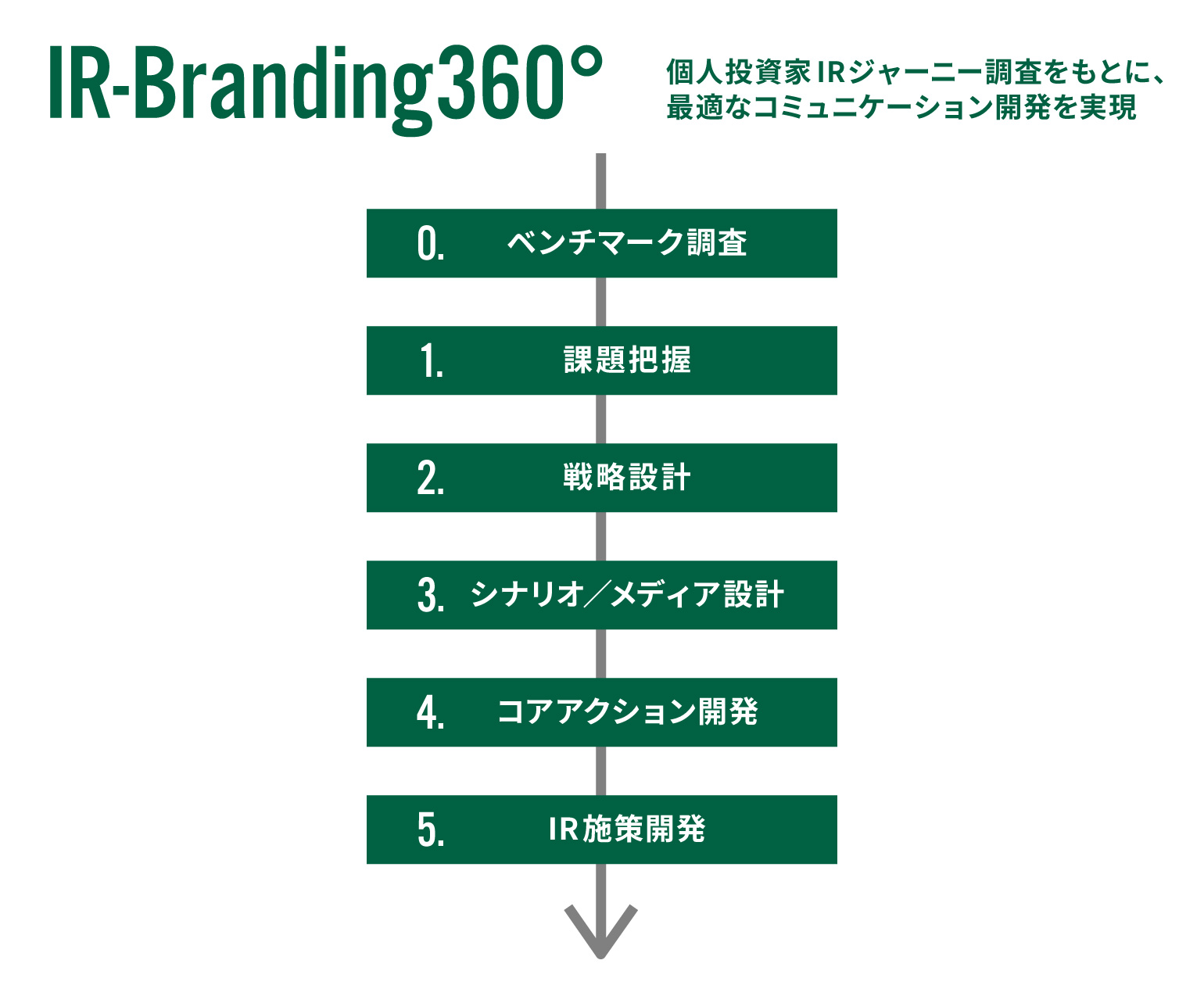
The big picture of IR-Branding360°. We provide support for the necessary phases based on our clients’ needs.
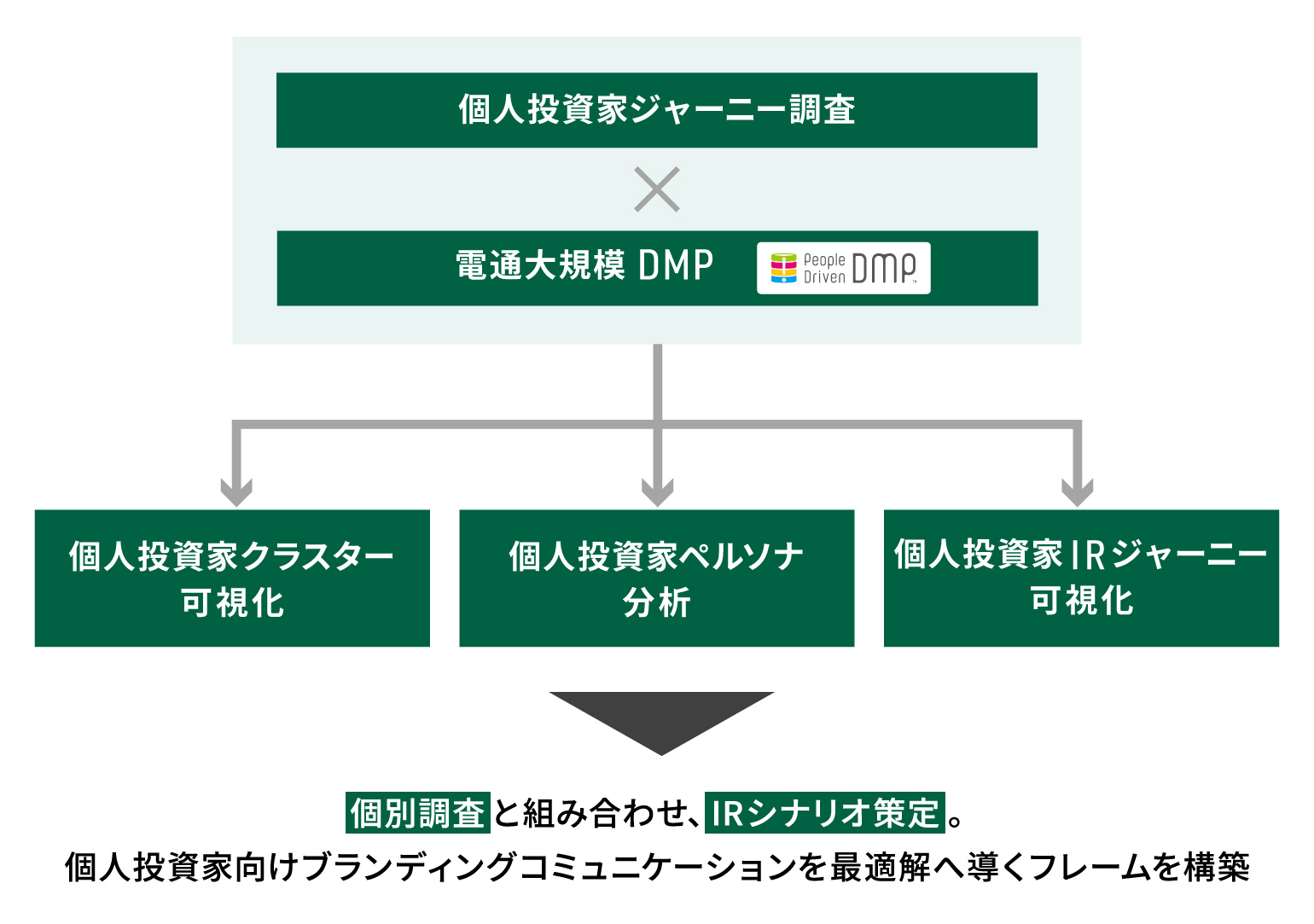
Minato: With this solution, we can analyze and visualize the personas and investment journeys for each cluster of retail investors, based on their investment tendencies.
In other words, for each company,
“what kind of people the retail investors we want to target are, what media they consume, and what messages will lead to investment,”
and design communication strategies accordingly.
While the core of the solution consists of the aforementioned analysis and the advertising strategies based on it, it is also a one-stop solution capable of planning and producing other IR initiatives, such as creating IR websites, preparing integrated reports, and organizing shareholder meetings.
──So it covers everything from visualizing the retail investors you want to target to the so-called standard IR domain, doesn’t it?
Minato: To summarize, there are three main types of outputs from this solution.
・“Strategy and Scenario Design” based on research into the retail investor IR journey ・“Corporate Branding Design,” which involves defining target audiences and developing core actions in line with the strategy and scenario design • “Planning and Production of IR Initiatives” implemented based on the above
While it’s certainly possible to provide these services on a modular basis depending on the client, we implemented all of them for the Nisshin Seifun Group initiative we’re introducing today.
By tailoring our approach to each investor type, we significantly increased time spent on the site!
──Please tell us about the background behind your support for the Nisshin Seifun Group’s retail investor marketing and the specifics of that support.
Maeda: It all began when the Public Relations Department at Nisshin Seifun Group Headquarters approached us, expressing concerns about their strategies for retail investors. From there, we collaborated with the company’s IR and SR departments to develop and implement support measures.
Minato: Around the same time, several projects centered on “retail investor engagement” had begun in my department, driven by the widely discussed challenge of “how to convert non-financial value into corporate value.” That was the catalyst for developing “IR-Branding 360°” as a comprehensive solution.
Maeda: As for the overall flow of our support measures, we first conducted an analysis of investor types and investor journeys based on the results of the “Retail Investor IR Journey Survey.”
In the investor-type analysis, we classified retail investors into eight “investor types.”
The eight “investor types” identified through the analysis
・New NISA Entrants: A new, large segment of retail investors who began investing as a result of the New NISA program.
・Growth-Oriented Early Investors: A group aiming for capital gains from rising stock prices over a period of several months to several years.
・Large-Scale Risk Diversification Type: A group that invests primarily with assets of 10 million or more, leveraging portfolio diversification.
・Value Stock Focused: A group that prioritizes asset protection and steady returns over the medium to long term and tends to invest in undervalued stocks.
・Income-Focused Type: Investors who focus on high dividends and shareholder benefits from a medium- to long-term perspective and seek income gains (stable returns derived from holding assets).
・Short-Term Traders: Investors who trade in response to stock price fluctuations over a timeframe ranging from a few hours to a few days.
・Supporters: Investors who hold shares to support a company for personal reasons, such as a fondness for the company’s products or the company itself, or admiration for the CEO’s character.
・ESG Contribution Supporters: Investors who evaluate companies’ ESG activities to select investment targets and, through their investments, encourage ongoing consideration of ESG issues.
Maeda: From these eight types, we predict which type is most compatible with each client. This determination is based on factors such as “investment potential”—calculated by multiplying the volume of each cluster by the average asset value held—and the client’s specific requirements, such as the investor segment they wish to target.
Furthermore, by cross-referencing this data with Dentsu Inc.’s extensive consumer data, we create “profiles” of the individual investors we should target.
The profiles are extremely detailed, covering everything from “stock holding periods and specific stocks” and “investment media they typically consult” to “values” and “interests and preferences.”
Minato: For example, while “Growth-Oriented Early Investors” tend to thoroughly read integrated reports and medium-term management plans, “New NISA Entry-Level Investors” tend not to consult such materials very often. “Large-Scale Risk-Diversification Investors” follow major economic media outlets such as WBS (World Business Satellite) and the Nikkei Group—each cluster exhibits distinct behavioral patterns.
Maeda: Based on our analysis, we found that many individual investors with a high affinity for the Nisshin Flour Mills Group “tend to view the owned media of companies they are considering investing in.” We also discovered that when viewing this owned media, they place importance on factors such as “global growth potential” and “whether they can relate to the vision communicated by top management.”
In this way, we analyzed the information touchpoints of various types of individual investors as a “journey” and designed our approach accordingly. Focusing on owned media, we rolled out content designed to increase investment interest through the most appropriate media channels.
──So, through this journey analysis, you identified “common traits” among retail investors who are highly aligned with the Nisshin Flour Mills Group. How did you translate those findings into concrete outcomes?
During the redesign, we emphasized the Nisshin Flour Mills Group’s potential for overseas business expansion—a factor that individual investors value highly. Additionally, on the IR site for individual investors, we re-adjusted the placement and presentation of the president’s comments to clearly convey “what kind of leader is at the helm and what philosophy guides their management.”
As a result, the average time spent on each site increased significantly, and navigation within the sites improved. Based on the analysis of our target retail investors, I believe we were able to provide creative content that delivered messages resonating with a wide audience.
Regarding advertising, we are also experimenting with strategies such as tailoring creative content to different types of individual investors.
Supporting clients from project inception through implementation as a data provider in new fields
──What other support measures does IR-Branding360° offer?
Minato: In terms of planning and producing IR initiatives, we sometimes handle everything from the creation of integrated reports to the planning and production of shareholder events. Additionally, the scope of our work varies depending on the client company’s specific challenges and requests—for example, there are cases where we focus solely on strategy and scenario design, or corporate branding design.
Maeda: I believe our structure allows us to handle a wide range of scenarios. For example, we often use investor typology analysis to highlight “what distinguishes our company’s individual shareholders from those of other companies,” and we also receive requests from clients who want to “gain insight into their company’s current status based on that analysis.” In other words, we can provide data that enables companies to benchmark their IR efforts against those of their peers.
In addition to targeting existing high-volume clusters, we also handle media planning and content creation aimed at “segments we want to expand into in the future.”
“We don’t stop at analysis—we offer a one-stop service that extends all the way to content production”—and our deep expertise in this field. These are the unique strengths that Dentsu Inc. brings to the IR marketing sector.
──I’ve heard that you’ve received many inquiries from financial institutions, particularly securities firms. What are the reasons behind these inquiries?
Minato: We realized this after launching the project: not only our client companies but also securities firms were struggling with how to communicate with individual investors.
This time, thanks to the “Retail Investor IR Journey Survey,” which provided data visualizing personas by type of retail investor, we received inquiries from many securities firms.
The inquiries fell into two main categories. One was from securities firms with investment platforms for individual investors, requesting to “utilize this for their own marketing.”
The other came from securities firm representatives who deal with the IR departments of client companies, asking for advice because they “couldn’t provide answers when companies consulted them about strategies for retail investors.” In other words, there is a challenge in the retail investor IR space due to a lack of data.
We have also begun discussions with our partner company, FUNDS. For example, we are developing research packages that include in-depth interviews with individual investors, as well as packages that use virtual investment products to analyze “what kind of people are investing.”
──It feels like this has the potential to evolve in even more diverse ways going forward. Finally, could you tell us what kind of clients you’d like to see utilizing this solution?
Maeda: We especially want to hear from those who say, “We want to focus on retail investors, but we don’t know where to start.”
I believe one of Dentsu Inc.’s core strengths is our ability to drive project creation. As companies move forward with marketing to individual investors, there are key decisions to make: whether to have the public relations or investor relations department take the lead, whether to make it a company-wide cross-functional project, and to what extent Dentsu Inc. should commit to it… We’ll work alongside you from the very beginning—starting with defining “what kind of project this should be.”
Minato: Additionally, we’d like to serve those who say, “We’ve done everything we can for retail investors but can’t seem to achieve a breakthrough,” or “We’ve exhausted existing solutions and are at a loss as to what to do next.” Dentsu Inc. can provide a one-stop service—from brainstorming ideas from scratch to executing initiatives—tailored to each client’s needs, and I believe we can be of assistance.
The information published at this time is as follows.
Since joining the company, I have been involved in media planning, big data analysis, and business development/internal activation consulting. Leveraging my own student entrepreneurship experience, I also belong to the "Dentsu Youth Research Department" (https://dentsu-wakamon.com). My specialty lies in proposing projects utilizing my broad knowledge base, contributing to clients' business transformation. Awards include the D&AD Award Yellow Pencil in the Branding category. Also engaged in external activities such as serving as an Industrial Advisor for Shiga University's Faculty of Data Science.
While working on client projects as a strategic planner, he participated in a project led by the Marketing Division 7 to develop marketing solutions for individual investors. He currently works on projects across a wide range of fields, including home appliances, food, infrastructure, and IT. His awards include the JPM Planning Award.

 IR × Branding in the Age of Individual Investors [2/2]