Note: This website was automatically translated, so some terms or nuances may not be completely accurate.
 Insights from Overseas Residents in Their 15th Year: Japan Brand Survey 2025 [4/4]
Beyond the Japan Inbound Boom: Exploring Today’s “Japan Fans”
In the 2019 issue of Dentsu-ho, we published an article that explored the characteristics of “Japan fans (*)” while presenting the results of the Japan Brand Survey.
*People who answered “I like Japan” in the 2019 Japan Brand Survey
Seven years have passed since then. Following the COVID-19 pandemic, the number of foreign visitors to Japan has increased even more than before, and more people are experiencing the real Japan and Japanese culture firsthand. Furthermore, various information has been disseminated through the media and word of mouth, deepening awareness and understanding of Japan. So, who exactly are today’s “Japan fans”?
In this article, we define “Japan fans” as “heavy repeaters who have visited Japan five or more times.” We examine what aspects of Japan interest them and what kind of relationship they are likely to have with Japan in the future. Furthermore, we explore how to maintain and strengthen their love for Japan—based on the results of the Japan Brand Survey 2025 ( Survey Overview ).
<Table of Contents>
▼Just like seven years ago, Japan fans are predominantly men in their 20s and 30s. What are their characteristics?
▼“Japanese food” and “Japanese products” are the starting points. For Japan fans, “things” are also part of their “experience” consumption!
▼Japan fans who travel through Japan with the same sensibilities as Japanese people
▼The Key to the Future Lies in Exporting “Trends from Japan” and All-Japan Initiatives
Just like seven years ago, most Japan fans are men in their 20s and 30s. What are their characteristics?
According to the results of the Japan Brand Survey 2025, Japan fans account for just under 50% of the market in Taiwan, South Korea, and Hong Kong, with a high proportion of men in their 20s and 30s and women in their 30s. In the 2019 survey as well, “Taiwan” and other Asian countries ranked high among markets that like Japan. Furthermore, respondents were predominantly “men” and “in their 20s and 30s,” with no significant changes in trends across countries, regions, or demographics.
Furthermore, 70% of respondents were married, and 70% reported having children. It was surprising to find that more than half of the respondents visited Japan with their children, indicating a high prevalence of family travel. Additionally, these travelers are frequent international travelers—taking overseas trips five or more times a year—and it was revealed that the group of heavy repeat visitors to Japan is also a group of “heavy repeat international travelers.”
In terms of attitudes and values, while they show a high level of interest not only in overseas travel but also in domestic travel and gourmet cuisine, they are notably interested in the economy, investment, and asset management.Furthermore, they tend to score high overall on questions regarding social and business trends they typically follow. In particular, their focus on environmental and technology-related topics—such as “SDGs (Sustainable Development Goals) (overall +10.4 points),” “health tech (overall +10.3 points),” and “the use of generative AI (overall +9.3 points)”—reveals a high level of awareness.
What is it about Japan that attracts these fans, and how do they enjoy the country?
The starting point is “Japanese food” and “Japanese products.” For Japan fans, “things” are also part of their “experience” consumption!
It seems that for many people, the reason for visiting Japan stems not so much from its appeal as a travel destination, but rather from a deepening interest in “Japanese food” and “Japanese products.” There is also a significant number of people whose interest was sparked by Japanese content; surprisingly, just as many people cite the “influence of anime and manga” as they do the “influence of movies and TV dramas.” This suggests that the appeal of Japanese content is expanding beyond just food.
Given that “Japanese cuisine” is a primary reason for visiting Japan, it’s no surprise that sweets top the list of desired souvenirs, with other food-related items like alcohol, dashi stock, and seasonings (such as miso) also proving popular. A 2024 survey found that 40% of respondents cook Japanese food at least once a week, but it’s reasonable to assume that fans of Japan enjoy it even more regularly. Many likely buy souvenirs in Japan for their own enjoyment, continuing to savor them even after returning home.
While there is a current trend toward “experience-based consumption” over “product-based consumption,” for fans, the “products” they purchase in Japan also become “experiences” (time and activities) that allow them to enjoy the things they love about Japan after returning home. Consequently, shopping is likely becoming an even more significant motivation for visiting Japan.
Japan Fans Who Travel Japan with the Same Sensibility as Japanese People
Given that they have visited Japan five or more times, you might think these Japan fans know the country inside and out! But when we look at what they want to do in Japan going forward,
"Eating Japanese cuisine"
"Experiencing the four seasons"
"Visiting scenic natural sites"
"Shopping at drugstores"
"Visiting hot springs"
In addition to these classic experiences, “shopping at convenience stores”—which has been growing in popularity in recent years—ranks high on the list.
While “eating Japanese cuisine” ranks first, it is worth noting that the score for “eating food other than Japanese cuisine” is higher than the overall average. Furthermore, regarding Japanese cuisine people want to try in Japan, there is growing interest in down-to-earth options such as “izakaya” and “set meals.” This suggests that when it comes to food, people may be seeking dining experiences that closely resemble the Japanese way of life.
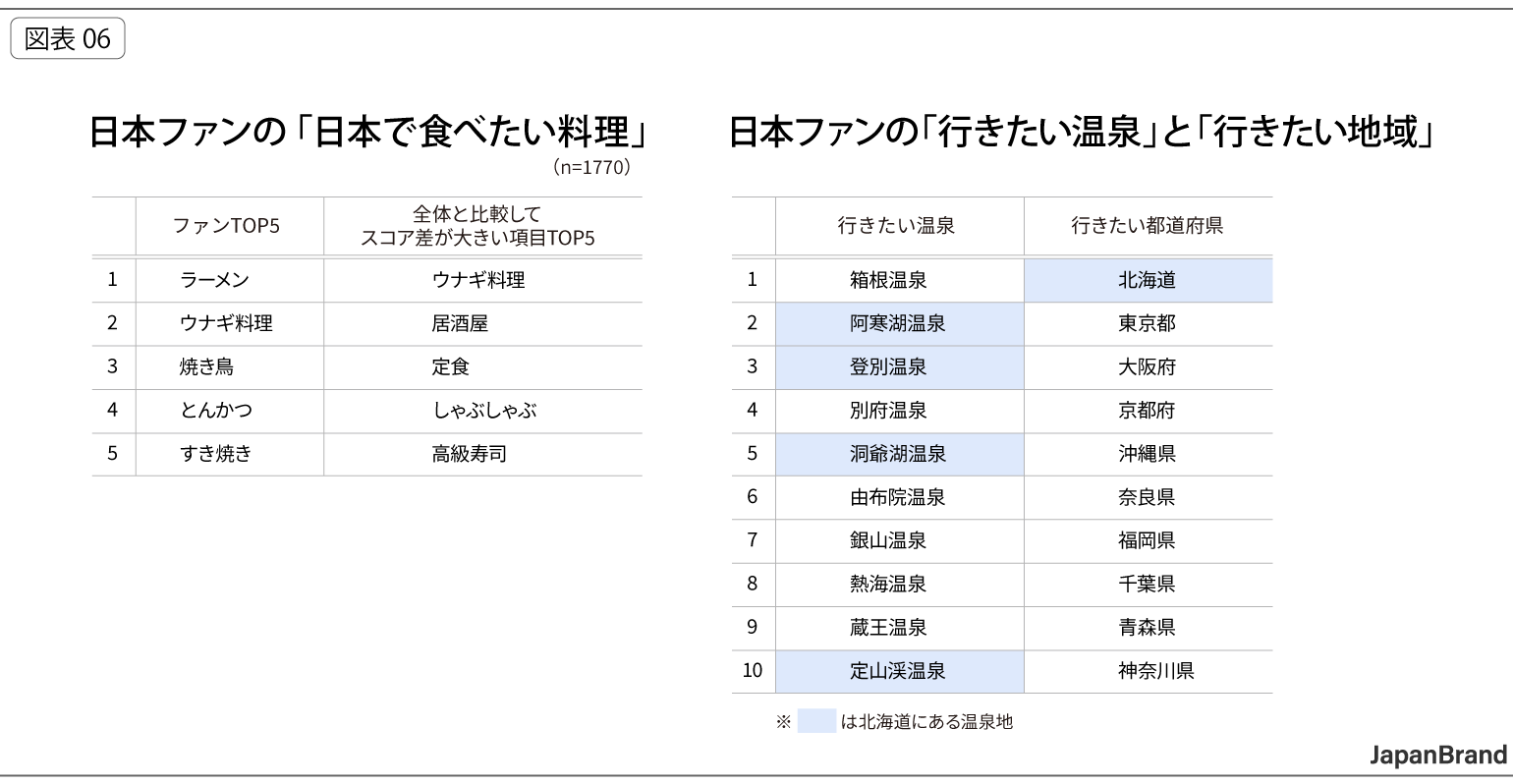
Regarding prefectures they’d like to visit, interest is generally high across the board from Hokkaido to Okinawa. However, when looking at preferred hot springs, four hot springs in Hokkaido—the top-ranked prefecture—feature among the top choices.What is particularly interesting is that hot spring destinations selected include “Lake Akan Hot Springs,” “Lake Toya Hot Springs,” and “Jozankei Hot Springs”—places that are not considered standard choices among Japanese people. This suggests a tendency to want to enjoy the unique characteristics and local flavor of each region when it comes to hot springs, which are a quintessential Japanese experience.
Shopping at convenience stores, savoring down-to-earth flavors and cuisines beyond traditional Japanese food, and enjoying the unique local differences at hot springs. It’s clear that they are enjoying their trip to Japan just like the locals do.
The Key to the Future: Exporting “Japanese Trends” and a Nationwide Approach
First, regarding inbound tourism. While Japan ranks first among countries in terms of intent to revisit, it faces many rivals. The areas where Japan exceeds expectations compared to its rivals (i.e., items with a large score difference) are “ease of shopping,” “diversity of cuisine,” and “fusion of modernity and tradition.”
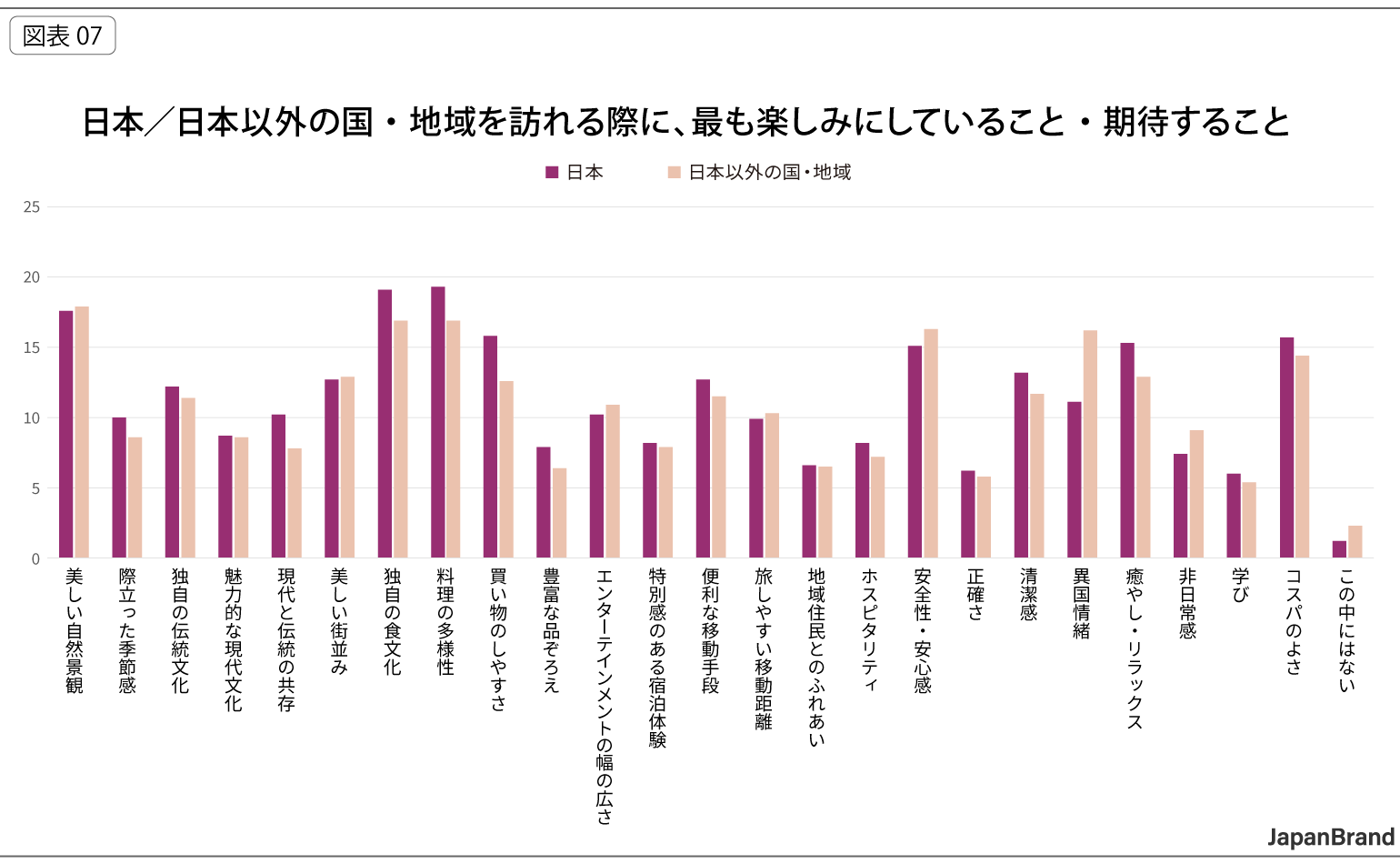
To further strengthen these strengths, we need to share new information and experiences. However, based on our analysis so far, it is highly likely that trends and activities currently popular in Japan will also appeal to Japanese fans overseas. Conversely, things that gain traction overseas can also become topics of conversation and trends in Japan. It seems effective to plan with the understanding that attracting visitors in Japan and overseas can have a mutually beneficial impact.
Next, regarding Japanese “products.” I believe that the concept of enjoying local differences is an approach that can be applied not only to travel but also to food, beverages, and alcohol. Since “regional local cuisine” is often cited as an example of “Japanese-ness,” it seems that fans of Japan are highly interested in the unique culinary characteristics of each region.Following the globally renowned “Kobe Beef,” I feel we have reached a point where adding a deeper layer of information—such as specifying “produced in XX” or “made in △△”—rather than simply labeling something as “Japanese-produced” or “Japanese-made,” can significantly increase its value.
As more people seek authentic experiences in Japan, information about the country has increased, and the number of deep-rooted Japan fans has grown. To capitalize on this opportunity and connect it to further products and experiences, we expect inbound tourism stakeholders and Japanese manufacturers to collaborate to expand their businesses.When experiences in Japan are integrated into the journey leading up to a purchase, and strategies for attracting visitors are based on products and content, this will become the norm. If this becomes standard practice, it will foster a more diverse group of Japan fans with deeper connections. This trend will not be limited to fleeting, individual experiences but will have a significant impact on future generations as well.
Related article: Are More Countries Falling in Love with Japan? ~Exploring “Japan Fans”~
[Contact Information for Inquiries Regarding This Matter]
Dentsu Inc. Japan Brand Project Team
japanbrand@dentsu.co.jp
Japan Brand Survey Hub Page
https://www.dentsu.co.jp/knowledge/japan_brand/
[Purpose of the Dentsu Inc. Brand Survey]
Launched in 2011 following the Great East Japan Earthquake, when Japanese agricultural and marine products as well as inbound tourism suffered reputational damage, this is Dentsu Inc.’s proprietary commercial marketing research initiative designed to understand how products and services originating in Japan are perceived globally.The Japan Brand Survey regularly assesses overseas consumers’ perceptions and actual behaviors regarding the Japan brand as a whole, covering areas such as overseas travel, inbound tourism, culture, regional revitalization, Japanese food, Japanese products, and lifestyle. By visualizing shifting consumer sentiments and the challenges and potential of the Japan brand, the survey contributes to increasingly complex corporate activities while also promoting cross-cultural understanding within Japanese society.
[Dentsu Inc. Brand Survey 2025: Survey Overview]
・Target Areas: 20 countries and regions (United States, Canada, Australia, United Kingdom, Germany, France, Italy, Spain, Saudi Arabia, India, Indonesia, Singapore, Malaysia, Philippines, Thailand, Vietnam, Mainland China, Hong Kong, Taiwan, South Korea) *1
・Eligibility Criteria: Men and women aged 20–59 (middle-income bracket and above) *2
・Sample Size: 12,400 (Breakdown: 1,600 each from the U.S. and Mainland China; 1,200 from India; 800 each from South Korea, Taiwan, and the U.K.; 400 each from other countries and regions) *3
・Survey Method: Online survey
・Survey Period: May 20–June 22, 2025
・Research Organizations: Dentsu Inc. (Principal Investigator), Video Research Ltd. (Implementation Partner)
[Notes and Disclaimers]
*1: The target areas in Mainland China are primarily Tier 1 cities; in India, they are Delhi, Mumbai, and Bengaluru; in Australia, the Sydney metropolitan area; and in Southeast Asia, they are primarily limited to metropolitan areas.
*2: Definition of the middle-income class: Criteria were established for each country based on average national income figures from sources such as OECD statistics and socio-economic classification (SEC).
*3: Samples were collected using an equal allocation method by gender and age group in each country and region, and the data was weighted to reflect the population distribution.
*4: Since the composition ratios in this survey are rounded to the second decimal place (or to the first decimal place where displayed as whole numbers), the total may not add up to 100%.
*5: In creating the charts and tables for this survey, the names of the countries and regions analyzed use the international standard ISO country codes (ISO 3166-1 alpha-2), with a few exceptions.
United States/US, Canada/CA, Australia/AU, United Kingdom/UK, Germany/DE, France/FR, Italy/IT, Spain/ES, Saudi Arabia/SA, India/IN, Indonesia/ID, Singapore/SG, Malaysia/MY, Philippines/PH, Thailand/TH, Vietnam/VN, Mainland China/CN, Hong Kong/HK, Taiwan/TW, South Korea/KR
*6: The names of countries and regions used in this survey report and on our website are based on the long-standing views of the Japanese government, as well as Japanese social norms and business practices.
*7: The names of countries and regions used in this survey are for statistical or analytical convenience only and do not imply any political stance or opinion.
*8: The maps used in this survey (world map and map of Japan) have been partially modified and cropped to fit the analysis content and page layout, and therefore may not accurately reflect national borders or territorial boundaries.
*9: As a commercial marketing research study aimed at understanding the lifestyle habits and brand preferences of general consumers, this survey has been conducted since its inception through commissioned fieldwork partners, strictly adhering to local laws, regulations, and public order and morals.Regarding surveys in China, we conduct them through fieldwork contractors who have obtained the necessary foreign-related survey permits as required by Chinese authorities; our company does not conduct market research activities within China itself. Furthermore, we monitor and review our operational practices as necessary in light of developments such as changes in laws and regulations.
*10: The response data collected in this survey is obtained, managed, and processed lawfully in accordance with the relevant laws and regulations of each target market. The data we receive consists solely of aggregated data that has been anonymized in a manner that does not identify specific individuals and cannot be reversed; it does not contain any personal information.
Was this article helpful?
Share this article


Newsletter registration is here
We select and publish important news every day
For inquiries about this article
Back Numbers

2026/03/09
How does the world's perception of Japan's value change across generations? ─ The enduring appeal of Japan's ever-evolving identity ─

2025/10/28
Exploring both cities and rural areas is becoming a new highlight of travel to Japan. Three Perspectives for Promoting Inbound Travel to Regional Areas
Author

Katsura Nakazato
Dentsu Inc.
Fourth Marketing Bureau
Communications Director
Since joining the company, I have been part of the Marketing Section. I have been responsible for communication planning for companies and government agencies across diverse fields including food, beverages, cosmetics, and apparel. I have also worked on numerous overseas public relations projects for government agencies and local governments. Since 2013, I have been in charge of conducting the 'Dentsu Japan Brand Survey.' I am a member of the Dentsu Inc. Team Cool Japan.
Japan Brand Survey 2015Reflecting on Japan's Present and Future Through the 2019 Japan Brand SurveyExploring Japan's Potential Through Dentsu Inc. Japan Brand ResearchGlobal Sentiments and Japanese Identity: Japan Brand Survey 2023Global Sentiment and Japanese Identity: Japan Brand Survey 2024Insights from Overseas Residents in Their 15th Year: Japan Brand Survey 2025