Thanks to advances in generative AI, we can now arrive at answers quickly.
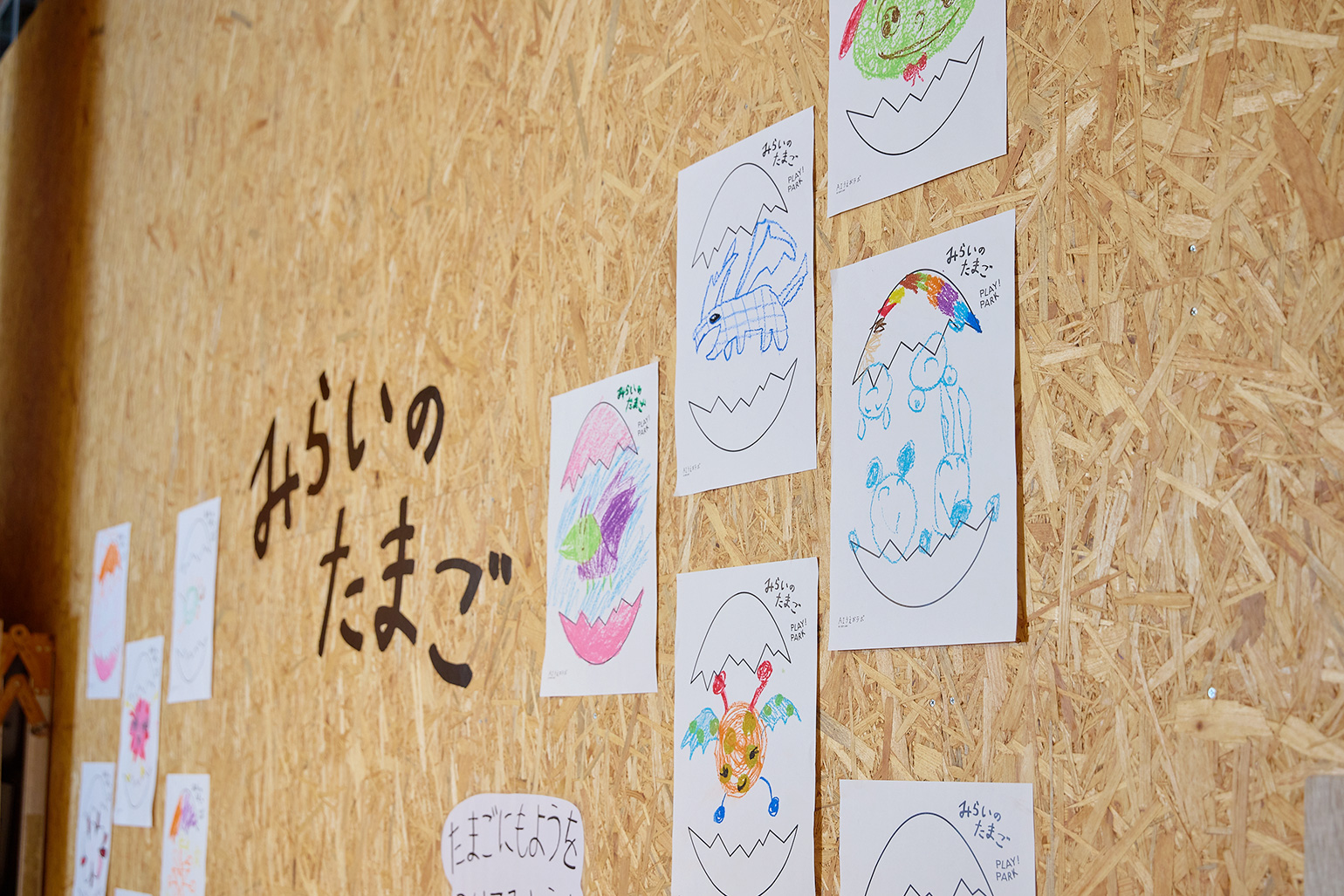
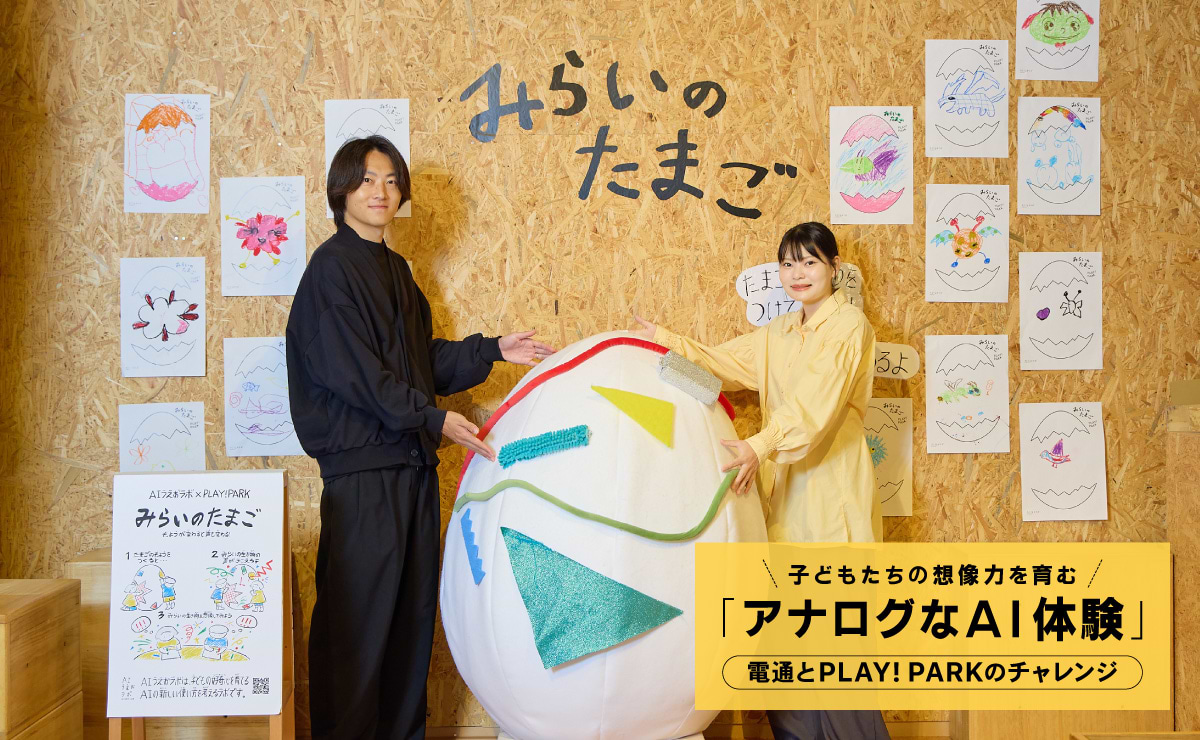
Dentsu Inc.’s “AI Ueo Lab (Aiueo Lab),” which conducts research and practical applications of AI for children, and “PLAY! PARK (Tachikawa City, Tokyo)—which has long valued experiences where children create their own games—held a special hands-on event called “Eggs of the Future” for children and their parents from Wednesday, September 9, to Wednesday, September 23, attracting approximately 6,500 visitors.
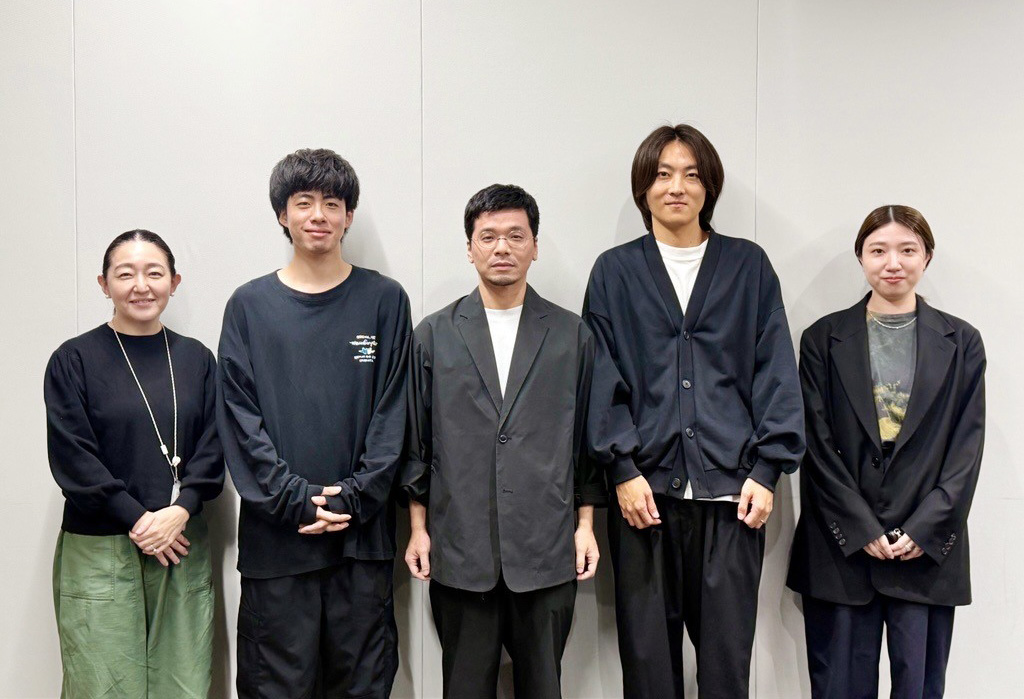
Through an “analog AI experience”—featuring an egg that emits mysterious sounds when materials are attached to it—the organizers aimed to captivate children’s imaginations. Why did they choose to create an “AI experience that doesn’t feel like AI” at this particular time? We spoke with Yō Iida of the AI Ueo Lab and Misaki Hara of PLAY! PARK.
Why We’re Focusing on Using AI to Nurture Children’s Imagination Rather Than AI That Simply Provides Answers
—Please tell us about the background behind the launch of the AI Ueo Lab.
Iida: The AI Ueo Lab is a research lab dedicated to exploring new ways to use AI in children’s education. While we want children to have as many analog experiences as possible, we also live in an era where it’s difficult to get by without engaging with AI and digital technology. That’s precisely why we launched the lab—to explore what the ideal relationship between children and AI should look like.
—Why did the two companies decide to collaborate on AI applications for children this time? Please tell us how this partnership came about.
Iida: At AI Ueo Lab, we were interested in the question: “How can AI expand children’s curiosity and imagination, rather than simply providing answers?” I had visited PLAY! PARK with my 3-year-old son, and I’d been hoping to work with them someday. I initially proposed the idea via email, but they turned me down. However, I wanted them to at least hear me out one more time, so I came up with several proposals centered on the theme of “analog AI experiences” and sent them over.
──I hear they accepted the proposal after that. What was the reason PLAY! PARK decided to introduce AI this time?
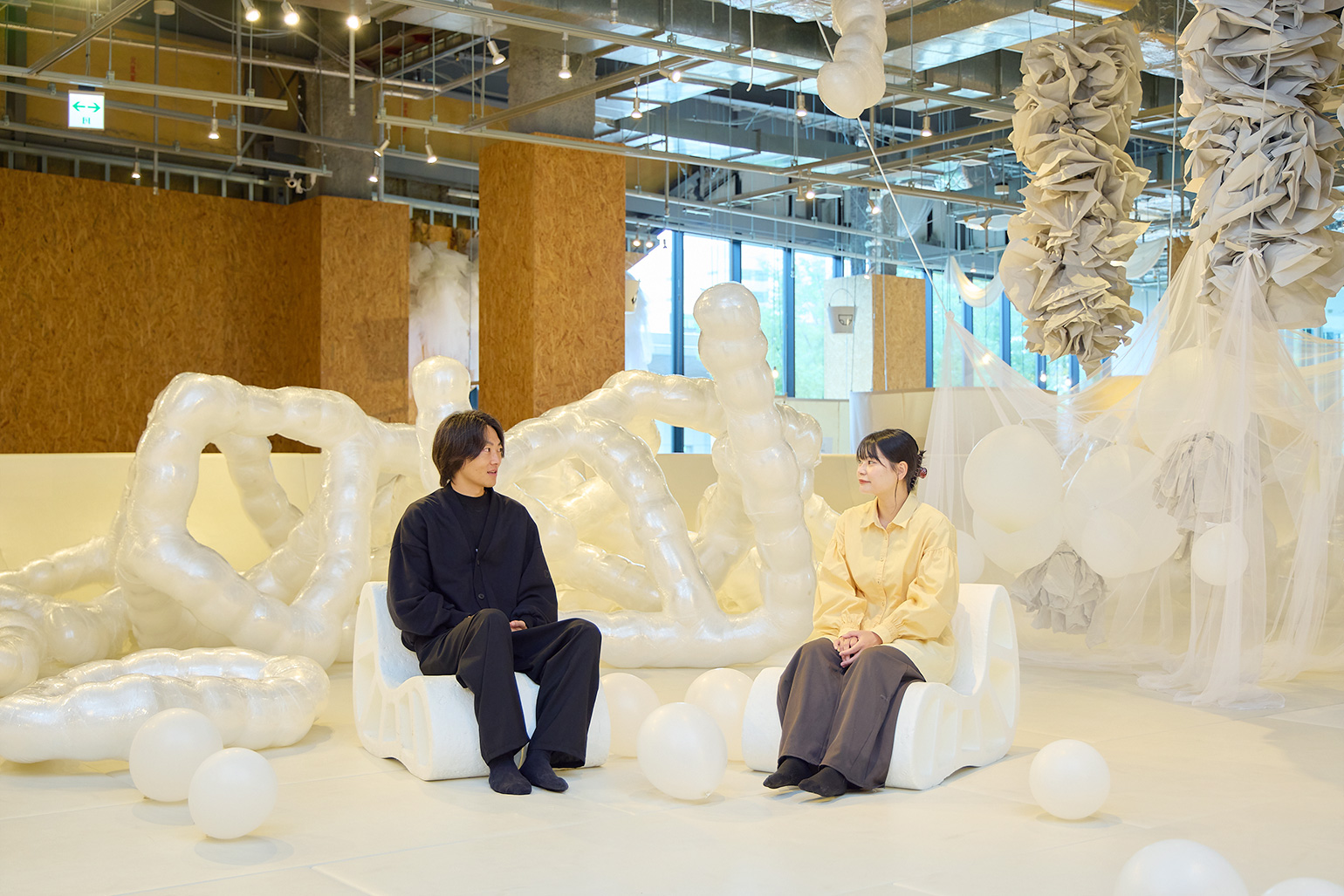
Hara: PLAY! PARK is based on the concept of “encounters with the unknown” and places great importance on children playing with free-flowing imagination. Even the play structure behind me right now—made by wrapping balloons in plastic wrap and connecting them—allows children to climb on it or lift it up, leading to new discoveries as they play. (*This structure has since been replaced. Please visit the PLAY! PARK website for details.)
At the time, our perception of AI was that it “provides the correct answer,” and we were concerned that this was at odds with the vision we were striving for, so we initially declined the offer. However, when I later reviewed the proposal they sent, I realized it aligned with our own philosophy: “We want to value children deciding the answers for themselves” and “We want children to determine the correct answers on their own and play freely.”
I had previously studied UI/UX design and even taught programming to children. I’ve always been interested in the digital field, so I wanted to collaborate on this project.
“Mirai no Tamago”: Born from Children’s Ideas
—How did this “Egg of the Future” come about?
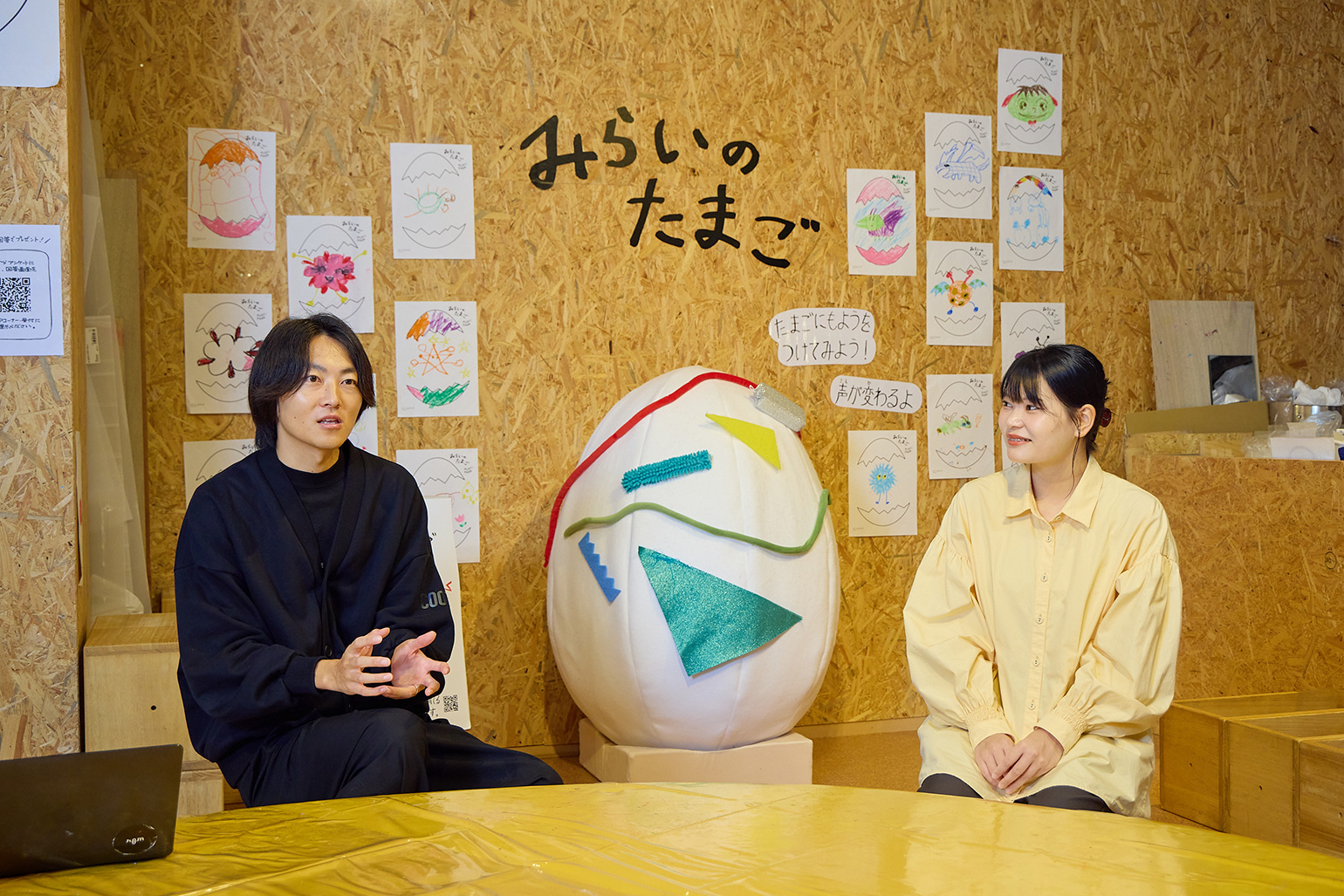
Hara: Previously, when we built a giant egg-shaped play structure at PLAY! PARK, the children asked a barrage of questions like, “What’s inside this?” and “What kind of egg is it?” Conversely, when I asked them, “What do you think is inside?” I was struck by how diverse their answers were—from dinosaurs and chicks to treasure. I imagined it would be fun to use digital technology to make voices come from inside or create reactions like vibrations.
When we received this proposal, I thought we might be able to use the idea from that giant egg project, so we decided to incorporate it.
──What was the most important aspect of the project for you?
Iida: Rather than using AI to create the specific sounds themselves, we prioritized using the sounds generated by AI analysis as a trigger for children to let their imaginations run wild and find their own answers. We were committed to creating “vague sounds” that wouldn’t evoke specific creatures too strongly, but would instead spark children’s imaginations. If they could tell right away—like “That’s a dog” or “That’s a dinosaur”—there would be no room left for imagination.
Hara: At first, there were sounds—like a bear’s roar—that were so intense they might have frightened the children. We thought it would be more interesting if the sounds were softer, allowing different children to imagine different creatures even when hearing the same sound. So, we discussed whether we could make the sounds more abstract and had them adjusted repeatedly.
3 Million Variations of Roars and Handcrafted Design
—How are the sounds created?
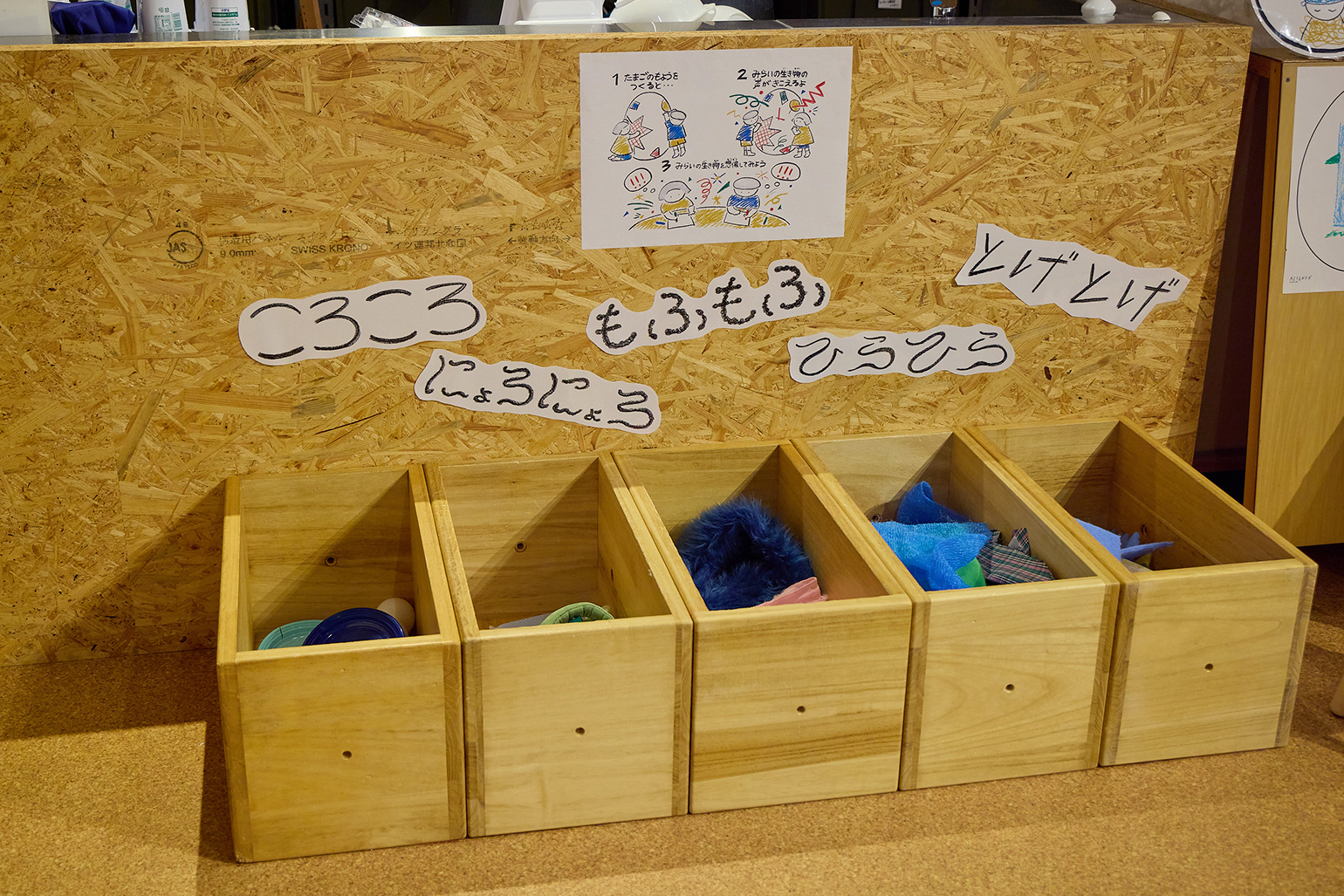
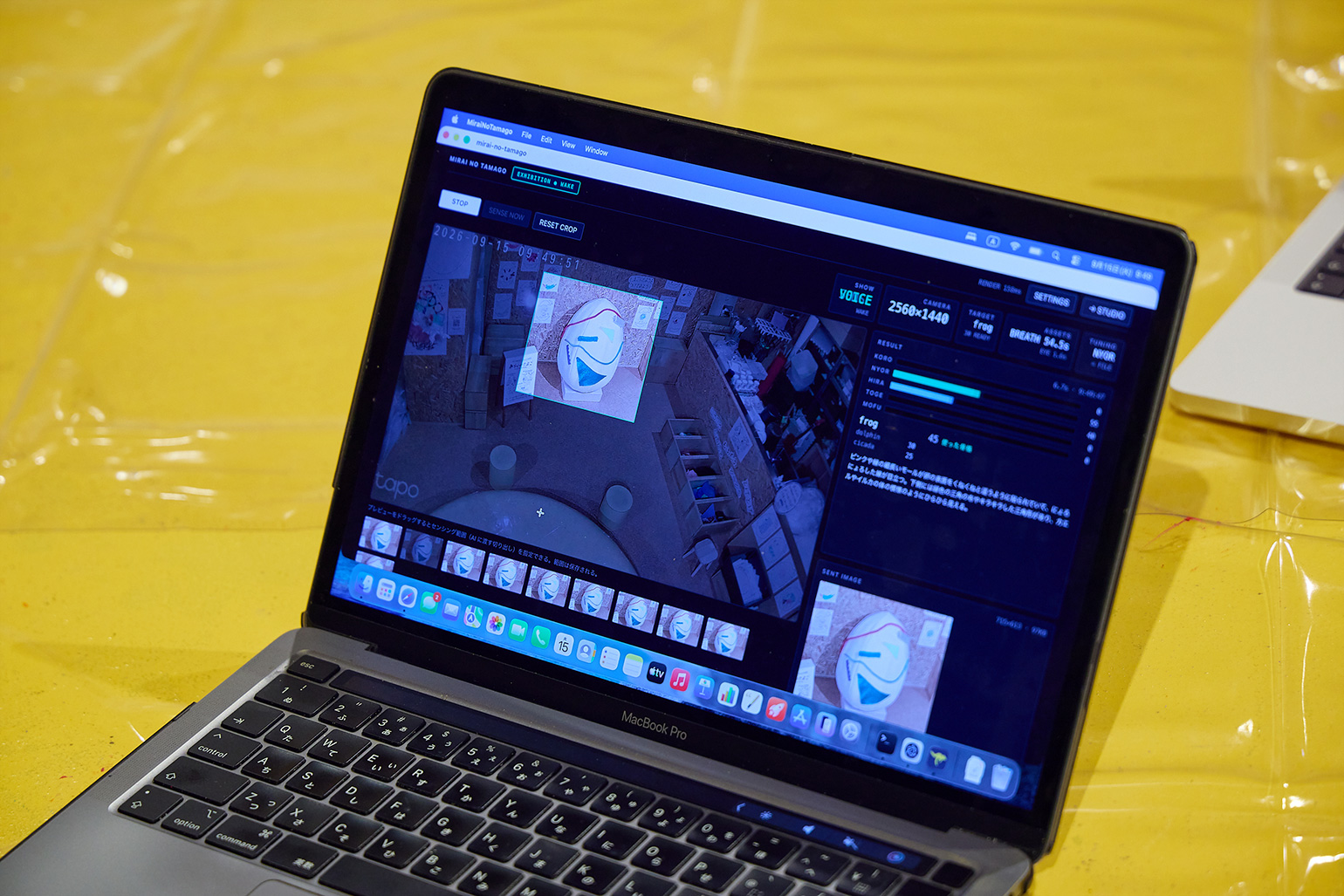
Iida: The sounds are based on the calls of 30 types of creatures familiar to children. A camera mounted on the ceiling recognizes the elements—such as “round and round,” “slithering,” “fluffy,” “fluttering,” and “prickly”—that children stick onto the egg. The AI analyzes the proportions of each element in real time and resynthesizes the base sound accordingly.For example, if a frog’s croak serves as the base, we first strip the frog’s sound down to its skeletal structure, then build new sounds around that framework based on the child’s decorations. The idea is that even with the same skeletal structure, the child’s creations result in a new, unique sound.
While there are approximately 3 million possible combinations of croaks, the AI doesn’t handle everything on its own. For this project, we also enlisted the help of a musician and engineer, who was responsible for adjusting how the croaks sound and their intensity, as well as for system development. Rather than relying solely on AI, a great deal of manual work goes into sound design and fine-tuning.
──I hear there was some ingenuity involved in the speaker placement as well.
Hara: During the preparatory phase, when we were playing the sounds from a separate location, a child pointed out, “It’s not coming from the egg.” Children are very perceptive, so I felt we needed to refine even these details carefully.
Iida: At first, we placed the speakers near the edges of the egg, but we repositioned them so they were embedded deep inside. Those small details were crucial to making it feel as though there really was something inside.
──How did the children react when they actually experienced it?
Hara: When they heard the sound coming from the egg, the children were drawn to it, asking, “What’s that sound?” Even without an explanation, they seemed to intuitively understand that they could stick things on the egg, so they kept sticking them on until the white surface was completely covered. The act of sticking things on became a simple game in itself, and when they heard the sound, they each interpreted it differently, saying things like, “I hear something!” or “It’s a stomach rumbling!” It was really interesting to see so many ideas emerge that we hadn’t even imagined.
Iida: We informed parents about the use of AI upon entry and obtained their consent. The children actually drew many pictures of creatures they imagined based on the sounds they heard, and I felt they were genuinely enjoying themselves. It made me happy to see those drawings. The parents also joined in the fun, asking, “I wonder what’s inside?”
The Ideal Relationship Between Children and AI
—What exactly is the “analog AI experience” you aimed to create with this exhibition?
Iida: We made sure computers and monitors weren’t visible, and we adjusted the camera’s angle so it would only capture the egg decorations—all to ensure it didn’t interfere with their play. The children aren’t aware of the AI, but the fact that they’re actually interacting with it—that sense of wonder—is a crucial element of this experience.
—Through this project, have you gained any insights into how adults should interact with AI?
Iida: While AI is often used to improve work efficiency, this project was a challenge to have AI not provide the answers. AI can present a vast array of possibilities, but only humans can choose which ones to select and how to interpret their meaning. I believe that each option AI adds serves as a building block for expanding children’s potential. It’s convenient to get an immediate answer when you ask a question, but whether that constitutes a fun experience is another matter entirely.The process of grappling with problems on one’s own, getting hands-on, and creating something becomes a rich, memorable experience. I believe “Mirai no Tamago” is one way to foster that depth of experience.
Hara: I felt that AI isn’t just a tool for providing correct answers—it can also be used to broaden one’s thinking. Rather than simply receiving an answer and stopping there, asking questions like, “Is that really true?” or “Could there be another way of thinking about this?” opens up new possibilities. I hope children will interact with AI as a tool that fosters this kind of thinking.
Precisely because we’re living in an era where AI is becoming more accessible, it’s becoming increasingly important to consider not just “how convenient it is,” but also “what kind of experiences it creates.”The initiatives of AI Ueo Lab and PLAY! PARK have demonstrated the possibility that AI doesn’t necessarily have to provide an answer. Rather, by stimulating human imagination and creating space for reflection, it can generate new value. The true identity of the creature inside the egg remains a mystery until the very end. However, the time spent thinking about the answer for themselves may be the most enriching experience for the children.
Graduated from Joshibi University of Art and Design, Faculty of Design and Crafts, Major in Product Design
Responsible for the planning and production of PLAY! PARK. Handles planning and production related to play, including workshops, permanent play equipment, corporate collaborations, and traveling events.