The theme of the fourth installment of the "Future Survey: How People Envision 2028," conducted by Dentsu Inc.'s cross-functional Future Forecasting Support Lab, is "You in 10 Years."
Discourses about the future can be "positive and bright" or "negative and dark." However, regardless of how these discourses unfold, what truly matters is that we ourselves can "feel the future is bright."
Previously introduced content focused on questions about future external environments, such as future technologies and active societies. This time, we asked about "your own future in 10 years."
Will you be happy 10 years from now?
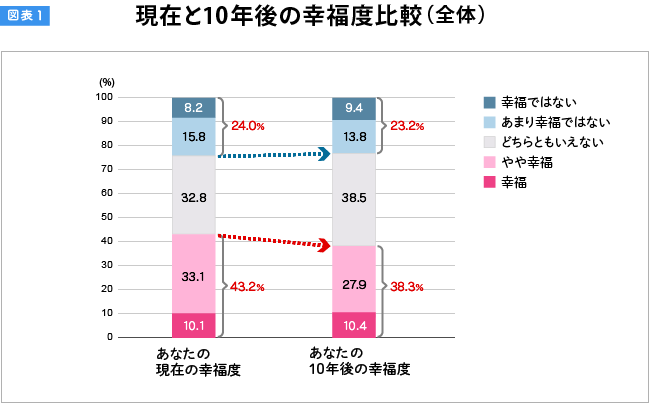
First, we asked about "happiness." We inquired about your current happiness level and your happiness level 10 years from now (Figure 1). Currently, 43.2% of respondents answered they are happy ("Happy" + "Somewhat Happy"), while 24.0% answered they are not happy ("Not Happy" + "Not Very Happy"). Nearly twice as many people answered they are happy.
So, what about happiness levels in 10 years? Compared to the current 43.2%, the projected figure for 10 years is 38.3%, a drop of 4.9 percentage points. Across the entire generation, happiness levels are expected to decline somewhat in 10 years. On the other hand, the proportion of those who answered they are not happy remains largely unchanged.
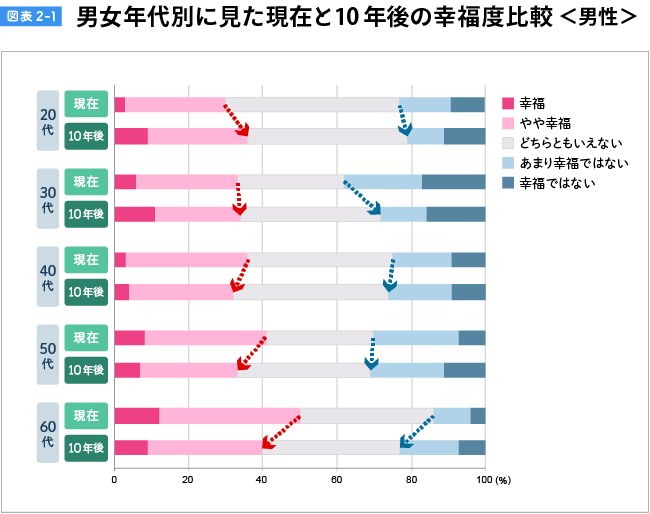
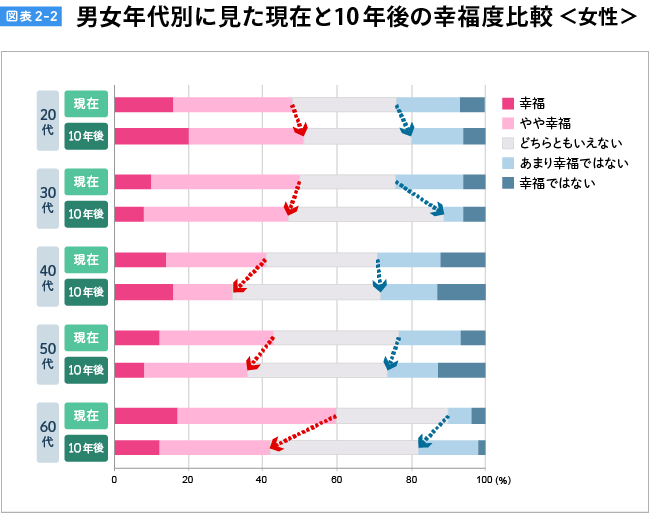
Now, let's examine the results by gender and age group (Figures 2-1 and 2). Here, significant differences emerge.
For men, happiness tends to increase with age. Comparing present and future, those in their 20s and 30s expect an increase, while those in their 40s and older consistently expect a decrease.
A similar trend appears in the "degree of unhappiness," revealing a difference between men in their 20s and 30s, who hold hope for the next decade, and those aged 40 and above, who see few bright prospects.
What about women? Women are more pessimistic. Only those in their 20s reported an increase in happiness, while all those in their 30s and older reported a decrease. The decline among those in their 60s is particularly sharp, dropping by 18.0 percentage points from 60.0% now to 42.0% in ten years.
Japan, where little hope or happiness can be expected for the future. This result strongly reflects the current state of society, doesn't it?
Can technological progress make you happier?
Next, we asked about the relationship between technological progress and happiness. We inquired whether advancements in artificial intelligence, robotics, or information technologies like the internet and social media could lead to greater happiness.
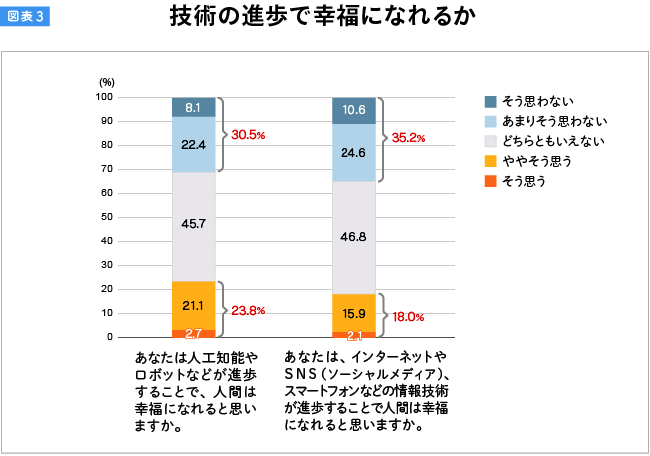
The results are shown in Figure 3. While 23.8% believe "advances in artificial intelligence and robotics can make us happier," 30.5% disagree. Similarly, 18.0% think "advances in information technology like the internet and social media can make us happier," while 35.2% disagree. In both cases, the number of people who disagree outweighed those who agree.
Breaking this down by gender and age group, men generally leaned slightly more toward the affirmative side, and the younger the age group, the higher the level of agreement.
While differing opinions on technological progress are natural, isn't Japan becoming more timid and conservative about new things compared to other countries? The prolonged economic downturn and aging population undoubtedly contribute to this negativity toward new technologies. However, to break through this situation, fostering a public opinion environment that embraces new technologies positively may be crucial.
How would you describe your life in 10 years in one word?
Finally, we present the question: "What single word comes to mind when you think about your life in 10 years?"
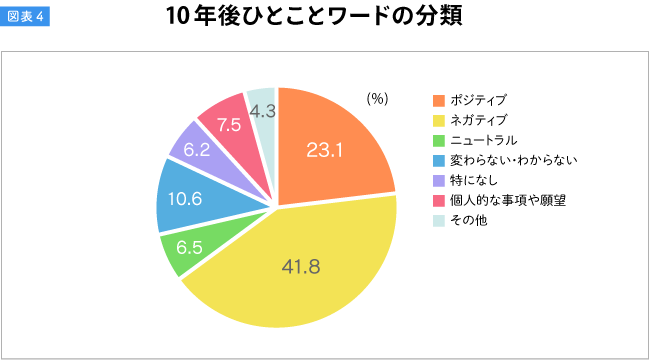
Figure 4 shows the responses categorized as either positive or negative. Overall, negative words outnumbered positive ones.


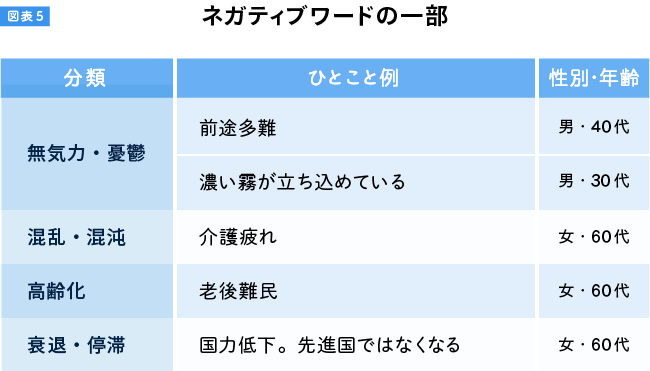
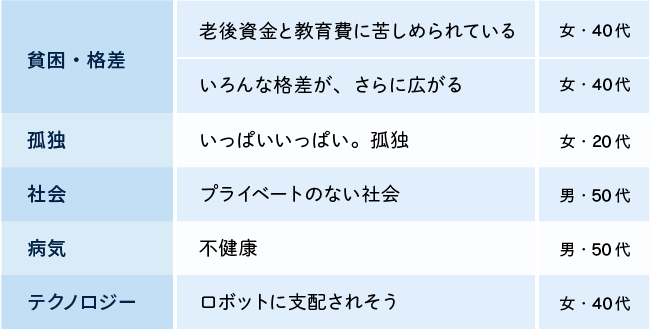
Negative words included diverse keywords like gloom, chaos, aging, decline, poverty, loneliness, and illness. The targets of negativity varied widely too, ranging from oneself to Japanese society.
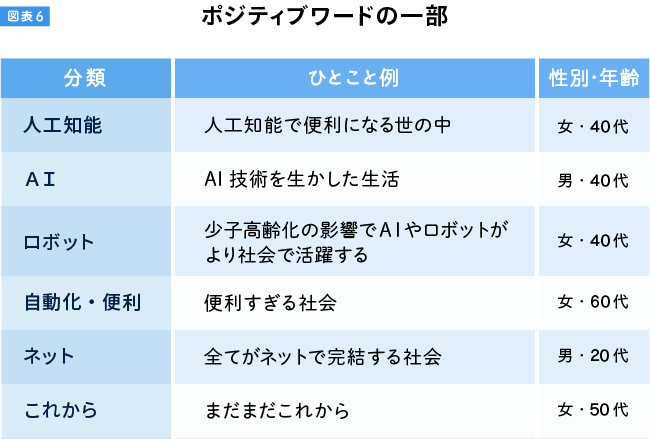
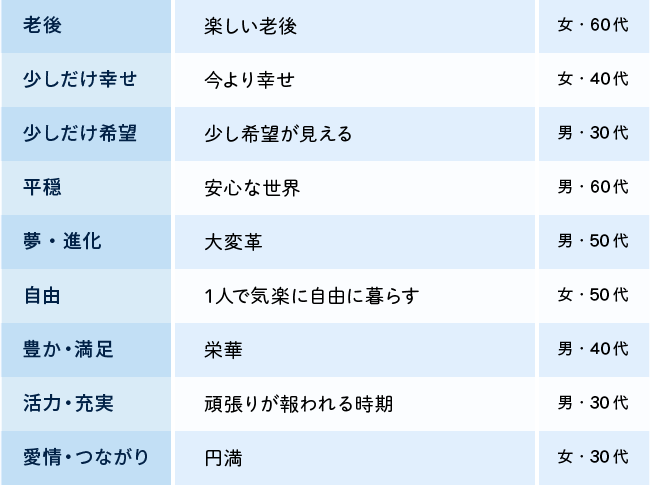
Next, let's look at some positive words (Figure 6). One theme is a more convenient world through technological advances, such as "A world made convenient by artificial intelligence" (female, 40s) and "A society where everything is done online" (male, 20s).
Another group includes opinions like "A little hope is visible" (Male, 30s), reflecting a slight sense of happiness, which was more common among those in their 30s. Meanwhile, sentiments like "A secure world" (Male, 60s), conveying a happy retirement feeling, were more prevalent among those in their 50s and older.


Positive words generally center around technology-related themes, a little happiness, and perseverance.
Japan, having endured a prolonged economic slump, seems somewhat weary, perhaps becoming a society where people struggle to find hope for the future. However, looking at the positive words, faint glimmers of brightness can be sensed. Building a society where each individual can feel even a little hope for the future will be required of both the nation and its companies going forward.
This concludes our four-part introduction to the "Survey on the Future of 2028 as Envisioned by Consumers." For further details, please contact us at the email address below.
Thank you.
Contact:future@dentsu.co.jp
[Survey Overview]
Survey Title: "Survey on How Consumers Envision the Future in 2028"
Conducted:June 2018
Survey Method: Online Survey
Survey Participants:Men and womenaged 20to69living nationwide(1,000 samples)
Research Company: Dentsu Macromill Insight, Inc.