Note: This website was automatically translated, so some terms or nuances may not be completely accurate.
 From the E-commerce Kingdom! New Marketing Discoveries! [4/7]
Discovery! The "Fail-Proof" Way to Sell!
Welcome to the Mail-Order Kingdom, Kyushu!
The "Selling" Ads We Focus On.
This time, we examine the core "method of communication."
■ What do people who want to buy always say?
What kind of feedback do you want customers who see your ads to give? "It left an impression," "It was interesting," "I thought it was a good product"—there are many possible answers, but the one we value most is "It was easy to understand." Why? Because "It was easy to understand" is the feedback people who want to buy will always say.
Comments like "It left an impression" or "I thought it was a good product" are ultimately evaluations of the advertising expression itself. In a way, the advertisement in front of them is the star, and the customer is in a "spectator" state, watching from the sidelines and offering their thoughts. In contrast, the comment "It was easy to understand" is a bit different. This phrase only emerges when customers absorb the ad's information and align it with their own understanding. In other words, "It was easy to understand" is proof that the message was properly internalized and genuinely resonated with them. That's precisely why we aim for "It was easy to understand" when selling.
■ Two Rules for Generating "It was easy to understand"
The fundamental framework for eliciting that heartfelt voice of conviction—"It was easy to understand"—is the model discussed earlier. Crucial within this model are the unique "D" and "B" elements.
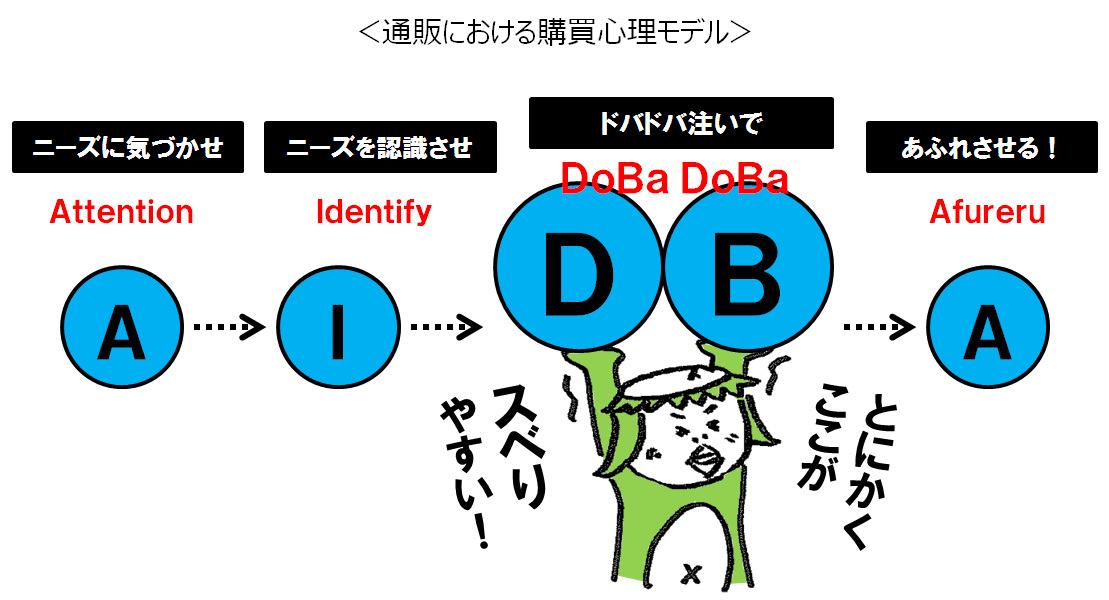
To continuously pour information into the customer's mental cup, they need to be in a position that makes it easy to pour—much like tilting a glass when pouring beer. This "easy-pouring position" corresponds to the previously mentioned "personalization."
How can we get the audience watching an ad to perceive it as "personal"? Fundamentally, the appeal content and the ad's story are crucial. However, we've discovered two absolutely essential rules that must be followed when communicating these elements. Let's introduce them now.
Rule 1: Speak using "familiar stories."
Most advertised products are unfamiliar to customers. This often leads advertisers to over-explain product features or new information. But this is a classic mistake that hinders personalization!
Consumers don't actively seek out ads and aren't focused on them. Presenting "unknown information" or "complex concepts requiring thought" to such distracted individuals is unlikely to spark their interest. Moreover, customers hold the trump card: "If I don't understand, I'll stop watching."
So how can you communicate "unknown" product details to customers and make them feel "I want to buy this"? An effective method is "building your pitch around familiar information." In other words, use information customers already know to convey what they don't know. Here's a simple example.
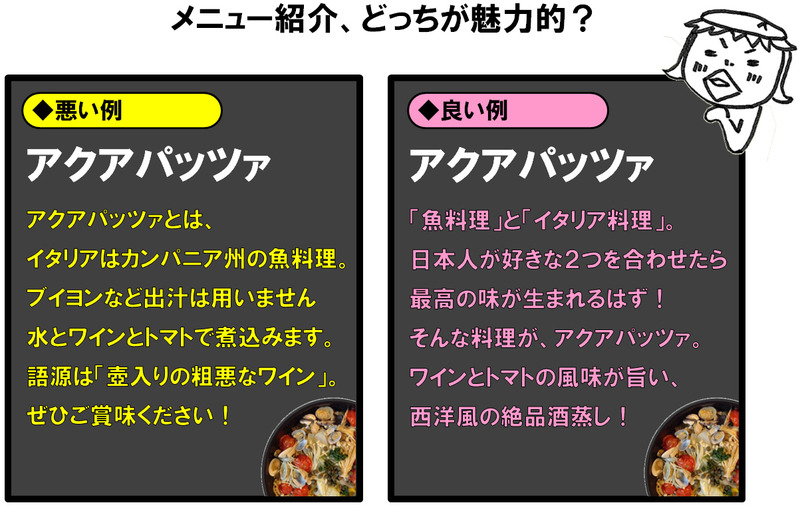
My poor expression might make even the bad example sound somewhat appetizing... But you can probably see how the "good example" uses familiar flavors to help them imagine unfamiliar ones. Starting today, I'm calling this the "Acqua Pazza Theory."
When I first started creating mail-order ads, I was often instructed to "write at a level a second-year middle school student can understand." I believe this is essentially the same principle. The key is combining "easy-to-understand, familiar concepts" to create engaging topics. Doing so dramatically increases the likelihood that information will be perceived as personally relevant.
Rule 2: Make it a story that can be answered with "YES" throughout.
Psychology calls this the "YES effect": when people accumulate "YES" responses, they develop a tendency to act accordingly.
Think about when you're being served. If you think something "suits you" and the salesperson also says "it suits you," you'll want to buy it. Conversely, if you think something "doesn't suit you" but they say "it suits you," you'll start to doubt it and lose the desire to buy.

In other words, to spark the desire to buy, it's essential to constantly align with the customer's mindset. It's also necessary to proceed with the conversation while confirming this alignment. That's precisely why, in advertising, it's crucial to build the story around affirmative information – that is, around points the customer can answer with a "YES."
Look at mail-order catalog ads: they're packed with techniques designed to elicit "YES" responses and build rapport, like prompts such as "Don't you think?" or "How about this?" and checklists. These are clear evidence of the importance of the "YES effect."
■The Sense of "Building" in the Audience's Mind, Not Just Expressing
These are the two key points to keep in mind to ensure viewers find your ad "easy to understand." Fundamentally, it's about putting yourself in the viewer's shoes and creating expressions from their perspective and sensibilities. In other words, it's less about expressing what you want to convey and more about assembling that message within the viewer's mind. If you can achieve this, I believe "I want to buy it!" will overflow from the customer's mental cup!
Finally, I have a question for you all, though I'm a bit nervous about it. What did you think of this column? I'd be thrilled if you found it easy to understand.
Was this article helpful?
Share this article


Newsletter registration is here
We select and publish important news every day
For inquiries about this article
Back Numbers


Author

Katsuyuki Kazuki
Dentsu Kyushu Inc.
Communication Design Bureau Direct Marketing Department