Note: This website was automatically translated, so some terms or nuances may not be completely accurate.
 From the E-commerce Kingdom! New Marketing Discoveries! [5/7]
Will TV Surrender to the Internet?
Welcome to the Mail-Order Kingdom, Kyushu!
Here, all advertising activities are quantified.
For media, it's a harsh environment where superiority and inferiority are immediately apparent.
■Common Conversations About Online vs. TV Advertising
"Lately, TV's acquisition efficiency has been tough, so starting next month, we're shifting the entire budget to online." Haven't you heard talk like this around you recently? Even if not, there's a general feeling that TV advertising, where direct purchase effects are hard to measure, will eventually be overtaken by online advertising, where effects can be accurately measured.
But should online advertising and TV (and other mass media) advertising even be viewed as competing on this axis? Should they be discussed as entities fighting for share on the same playing field?
■The Relationship Between Online, TV, and Needs
If you're involved in direct sales, you'll understand that online and TV (mass media) advertising have entirely different areas of expertise. While there are certainly hardware-related differences often cited—such as suitability for data collection or the potential for technology-driven optimization—there's a more fundamental and crucial distinction. Roughly speaking, online advertising excels at acquiring visible, explicit needs at low cost, while TV advertising excels at uncovering latent needs and creating new customers.
As explained in a previous column, needs are usually dormant beneath the subconscious. In other words, beneath the visible tip of the iceberg—the apparent needs—lies a vast sea of latent potential needs. Applying this to the strengths of online and TV advertising yields the following framework:

In other words, they exist in a complementary relationship, targeting different audiences. Television (mass advertising), needing to reach a broad audience and tap into the subconscious, tends to be at a disadvantage in direct acquisition costs compared to online advertising. However, unless this "underwater zone" is conquered, visible customers will eventually dry up... Therefore, it's crucial to aim for planning that expands customers by complementing each other, based on the roles and target differences of both, rather than judging solely by cost.
■ Two Barriers Hindering the "Honeymoon Period" Between Internet and TV
But why do TV and online, like in the case mentioned at the beginning, tend to end up in a confrontational relationship where they compete for budget rather than collaborating? I believe there are two major reasons for this.
The first is the simple issue of different people managing them. Business owners, advertising agencies, production companies... Across many organizations involved in advertising, online and TV are typically operated in silos. This makes collaboration difficult. That said, this problem can be solved with awareness and organizational adjustments. The second reason, however, is a much bigger barrier.
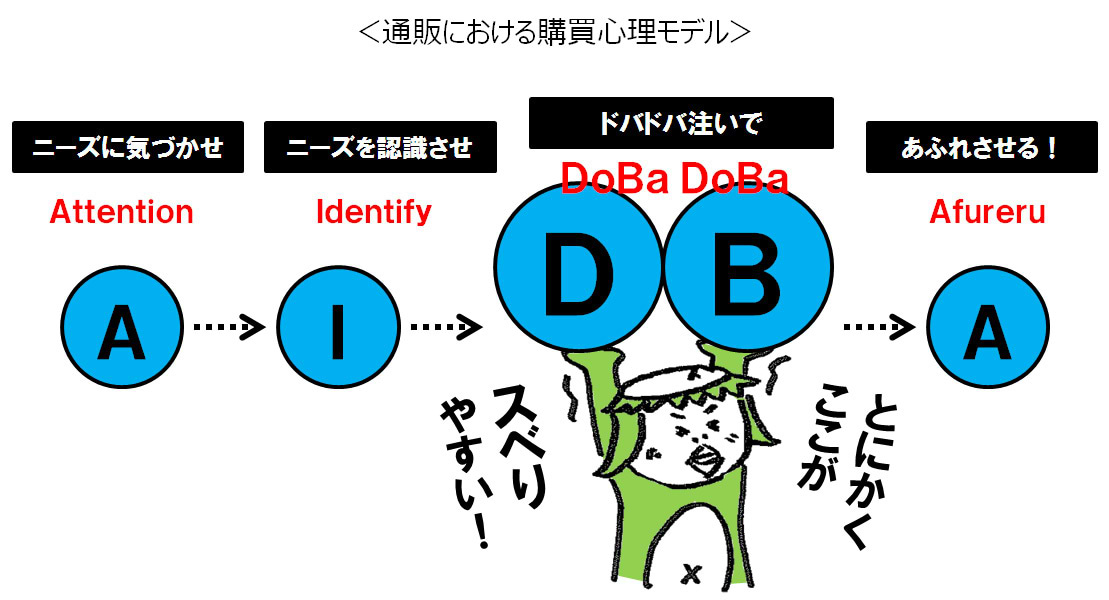
The second reason is closely tied to the "AIDBA" consumer psychology model we've been discussing throughout this column.

This purchasing psychology model is a process for transforming a single customer's mindset. Therefore, it's impossible to achieve unless you push through without distraction, all at once. Consequently, it's an extremely difficult model to realize across different media.
The proof is that both TV and the internet, when used for selling, often end up looking remarkably similar. Think of the relentless, fast-paced flow of a TV shopping channel versus a vertically scrolling e-commerce site you can read through in one go. While their structures differ somewhat, you can see how both end up resembling each other – both designed to run uninterrupted, without distractions, across a single medium.
■The Concept of "Small Advertising"
Television can broadly uncover latent needs, while the internet can acquire explicit needs at low cost. Complementing each other's strengths enables the most efficient media formation.
Efforts to continuously pour media across platforms... such explorations are actually already underway in many places. A prime example is the "Please see tomorrow's flyer" promotion, aimed at uncovering online needs through viral video campaigns.
Each medium possesses distinct strengths: television's reach, video's ability to capture attention, the internet's diffusion power and optimization capabilities, and newspapers' readability at a glance. Prioritizing the goal of transforming a single customer's mindset, we assign roles to each medium and plan the optimal expression. In other words, precisely because the modern media environment makes hitting a home run difficult, we focus on getting that one sale and connecting the batting lineup. This approach—not small baseball, but "small advertising" planning—may well be the effective strategy for making water overflow from the cup across media channels. I intend to strive daily to create such a new model.
What did you think? This concludes my contributions to this series. Thank you so much for reading this far. I sincerely hope the methodology we developed here in Kyushu through much trial and error proves useful to you in some way. Moving forward, the next installment will be written by my senior colleague at Dentsu Kyushu Inc., Shono. I would be delighted if you continued reading his series as well.
Incidentally, during this series, I often received the question, "Why is the illustration a kappa?" The reason is simple: I'm often told I resemble a kappa. When I reveal this, everyone agrees, "You're right!" But here's the thing—no one has ever actually seen a real kappa. Yet, a common image of a kappa exists in people's minds, and many find it convincing when they see me. It really makes you think how mysterious and profound the human mind truly is.

Was this article helpful?
Share this article


Newsletter registration is here
We select and publish important news every day
For inquiries about this article
Back Numbers

Author

Katsuyuki Kazuki
Dentsu Kyushu Inc.
Communication Design Bureau Direct Marketing Department