Note: This website was automatically translated, so some terms or nuances may not be completely accurate.
 From the E-commerce Kingdom! New Marketing Discoveries! [3/7]
Discovery! The biggest enemy of sales was "distraction."
Welcome to the Mail-Order Kingdom of Kyushu!
Here, advertising is a simple world where "how much it sells" is everything.
That's precisely why hints that get to the heart of "selling" are scattered everywhere.
■Pouring Information into a Cup is Tricky
This morning, when I tried to pour milk into the cup my daughter (age 3) was holding, she got distracted and moved the cup on her own, nearly spilling the milk all over the floor. It might sound odd coming from me, but the point here is that pouring into a cup requires focus and constant caution. Why? Because just like that free-spirited little girl, consumers buying your products don't care about the seller either. They're always free and fickle.

When something more intriguing than the object in front of them appears, people instantly shift their interest to that. This "flighty nature," or more simply, "getting distracted," is a major hurdle when "selling"—that is, pouring information into the cup of needs. Even if someone takes the cup of needs in their hands, if they get distracted and toss it aside midway, everything ends right there.
That's why we must pay meticulous attention to "preventing distraction" when selling. Unfortunately, the reality is that this "distraction" happens surprisingly often.
■ To Avoid Being Thrown Off Course by "Fickleness"
To keep consumers focused and ensure they watch your ad all the way through without interruption, you obviously need to create ads with this in mind. The key lies in two points: the "context" and the "content" of the information. This is a crucial aspect for getting people to buy your product, so I'll explain it in detail over two parts.
■ Building Context: Two Success Points
First, this column will delve into "context."
Here, context refers to "how information is delivered in a flow." In other words, it's about creating the optimal flow to deliver information consistently without causing boredom until the end. Creating this optimal flow hinges on two major points. Let me introduce the points we discovered below.
<Point 1> The "Gulliver Tunnel" Structure
The Gulliver Tunnel is a secret gadget from Doraemon. It's a tunnel with a large entrance that gradually narrows as you proceed. This shape is ideal for guiding people toward a product without breaking their interest.
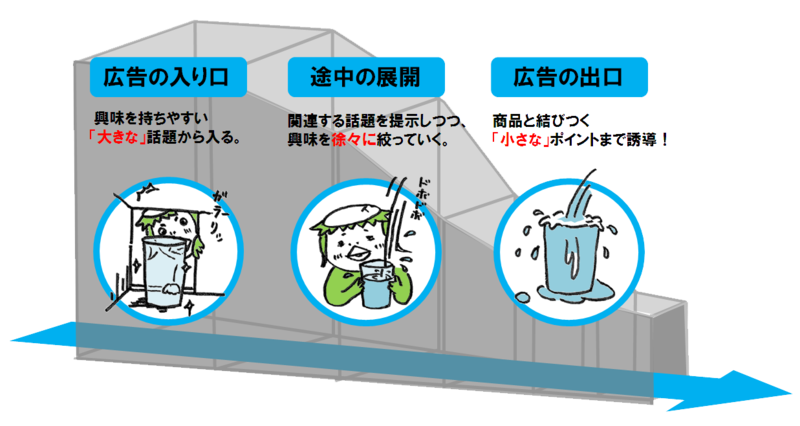
When people first encounter an ad, they usually have little interest in it. To get them to enter the tunnel, you should present a broad topic that appeals to many at the entrance. That's why a large entrance is better.
Once people are inside the tunnel, you must then stimulate various concerns and needs while guiding them toward the "encounter" with the product at the exit. In other words, it's crucial to present related topics while gradually narrowing their focus.
Then, once their concerns or needs are clearly defined, present the product that solves them. Only then will people properly purchase what they need.
When visualized, this flow resembles Gulliver's Tunnel itself. Most successful direct sales examples, like TV shopping programs, follow this structure. This fact alone should highlight the importance of this context.
<Point 2> The "Side Change" Structure
In the first installment, we discussed how the right brain makes purchasing decisions while the left brain supports it. This "Side Change" structure delivers information to both the right and left brain, unfolding like a soccer side change. To achieve this, it's essential to understand the specific types of information each brain processes.
First, the "right brain." As the main player in purchasing decisions, the right brain excels at intuitively recognizing images but struggles with text and numbers. Therefore, "delivering information to the right brain" means conveying the intended message not through text, but by visualizing it in an intuitively understandable way. However, even numbers and text can be understood if they are simple, symbolized forms. The often-cited "13 characters or fewer" is precisely the kind of information that reaches the right brain.
The "left brain" is the exact opposite. It properly understands information logically structured with numbers and text. Crucially, it also acts as a "strategist," supporting the right brain's decisions with the information it has understood.
Considering the characteristics of both these brains, what context emerges when information is conveyed to both? Using dieting as an example...
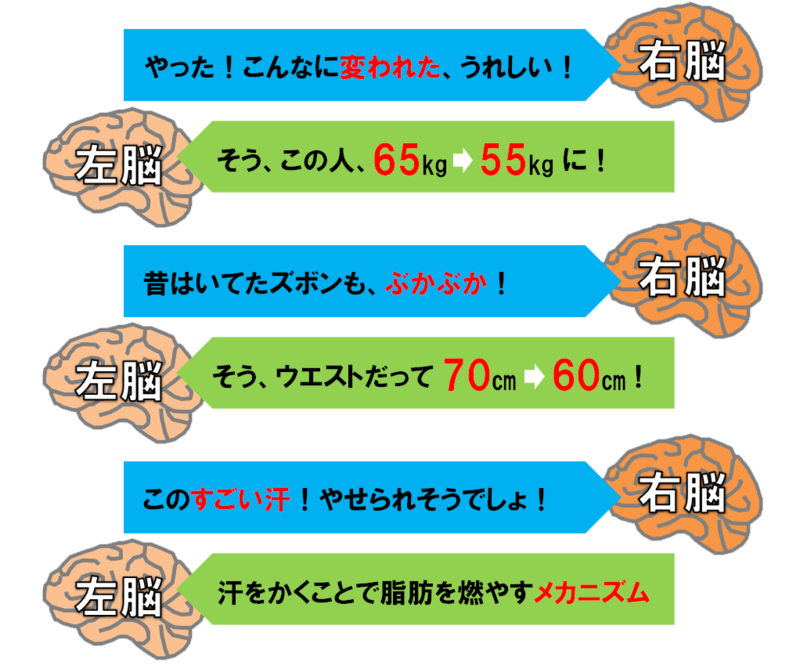
As you can see, this creates a true side-change structure. Logically, repeating the same thing twice might seem odd, but what matters isn't logic—it's effective communication. For that reason, I highly recommend trying this format at least once.
■ Creating "Conviction" Rather Than "Persuasion"
What did you think of the context discussed above? I believe the essence of these points lies not in unilaterally throwing information at someone to "persuade" them, but in naturally guiding them to a state of "conviction." And once conviction is firmly established within the consumer's mind, an unbalanced state emerges: they feel convinced, yet there's nothing to satisfy that conviction. I believe the true nature of that "buying mode"—where desire overflows like water spilling from a cup—is the manifestation of this urge to correct that imbalance.
In any case, consumers are fickle and couldn't care less about sellers. In fact, they often see ads as nothing but a nuisance. The method we introduced this time, "context," is how to get them to notice and understand your product amidst this. And another crucial element is the "content" of the information you deliver. We'll dive deeper into that next time!
Was this article helpful?
Share this article


Newsletter registration is here
We select and publish important news every day
For inquiries about this article
Back Numbers

Author

Katsuyuki Kazuki
Dentsu Kyushu Inc.
Communication Design Bureau Direct Marketing Department