Note: This website was automatically translated, so some terms or nuances may not be completely accurate.
 From the E-commerce Kingdom! New Marketing Discoveries! [6/7]
Theory of Mail-Order Communication Design ①
Welcome to Kyushu, the Kingdom of Mail Order!
From our experience in sales, we've come to realize that consumer purchasing psychology actually varies by product category.
In this column, I'd like to explore the essence of direct communication that originates from the relationship between products and consumers.
■Direct Marketing is an Endless Experimental Psychology
Grasping consumer purchasing behavior directly, in real time, and accurately. Through this characteristic of direct marketing, we have unknowingly acquired a planning methodology that reverse-engineers hypotheses about actual purchasing psychology from results. By agonizing over response results (i.e., each individual behavioral psychology), gaining insights, and reflecting them in promotional strategies—essentially going through this "cycle of repetition"—we have mastered the "tricks that work," crystallized through blood, sweat, and tears. Starting this time, with a new author, we will focus on the overall communication design that leads to effective direct advertising. I would like to share some of the hints and patterns we have discovered regarding the nature of communication design that emerges from the relationship between consumers and products.
■Understanding Mail-Order Purchase Motivation Through Maslow
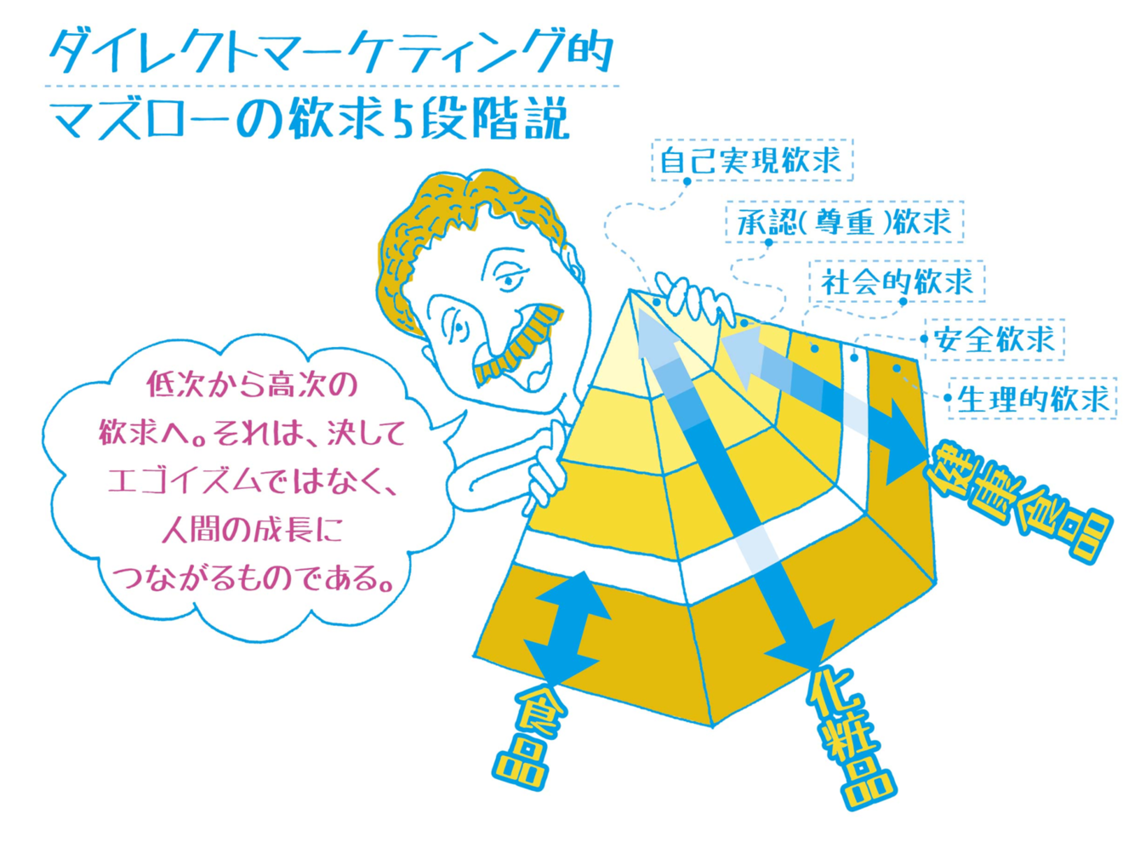
The renowned American psychologist Abraham Maslow theorized human basic needs into five distinct levels. Let's consider his "Hierarchy of Needs" theory in a direct marketing context. We'll examine product categories frequently found in single-item mail-order sales: "Food & Regional Specialties (hereafter Food)", "Cosmetics", and "Health Foods".
 What are the key motivations when considering purchasing food?
It may seem obvious, but the fundamental motivation is the instinctive desire to eat. This reveals a purchasing motivation rooted in appetite, the physiological need described in Maslow's hierarchy. In everyday mail-order advertising, the importance of copy seeking relatability is relatively low. Instead, the key focus should be on how to increase the "salivation rate" – essentially, making a sensory appeal the central point.
On the other hand, what is the fundamental motivation for cosmetics?
While a "physiological need" like "Wanting to be beautiful → Wanting to be popular" likely exists subconsciously, appealing solely to this risks the message feeling trivial and failing to resonate with consumers. To solve this, we focus our messaging not only on the physiological desire of "becoming beautiful = wanting to be popular," but also on the desire for recognition ("wanting to be loved" or "wanting to be seen as vibrant") and the desire for self-actualization ("wanting to feel confident"). This is nothing less than " expanding the purchasing desire" by targeting social desires like the desire for recognition and self-actualization. For example, we cultivate messages like "Resolve your skin concerns and return to your ideal self, to that wonderful version of yourself from back then," or "Becoming beautiful builds confidence, allowing you to enjoy everything in your work and family life."
Regarding health foods, the fundamental motivation, like regular foods, is largely tied to physiological needs. Since health foods are still foods, their claimed benefits face regulatory restrictions. However, the core appeal centers on the desire to resolve physiological discomforts like "pain," "lethargy," or "fatigue." We specifically view this as "the act of transforming negatives into positives." Furthermore, similar to cosmetics, "expanding purchase motivations" is also considered. For example, by depicting expanded desires like "Wanting to play with grandchildren at the park, free from foot pain" or "Wanting to energetically pursue hobbies and enjoy time with friends," we aim to cultivate consumer empathy.

■Media plans vary by product category
So how should we plan media strategies to address the differing purchase motivations across these product categories?
Food, health foods, and cosmetics. The target buyers for these products are often within similar age groups, and the target audience for media plans also aligns based on fundamental attributes like gender and age. We sometimes get asked, "If the volume of media exposure and the contact points themselves don't change, shouldn't the media plan remain the same?"
The answer is "NO. "
Let's look at the data. We calculated the standard deviation for contact rates across media for "Food, Beverages & Alcohol," "Health Foods & Diet Foods," and "Cosmetics," using this as comparative data.

As you can see, there are variations in the media used for food, health foods, and cosmetics.
Why do we see these results?
This seems related to the aforementioned purchase motivations.
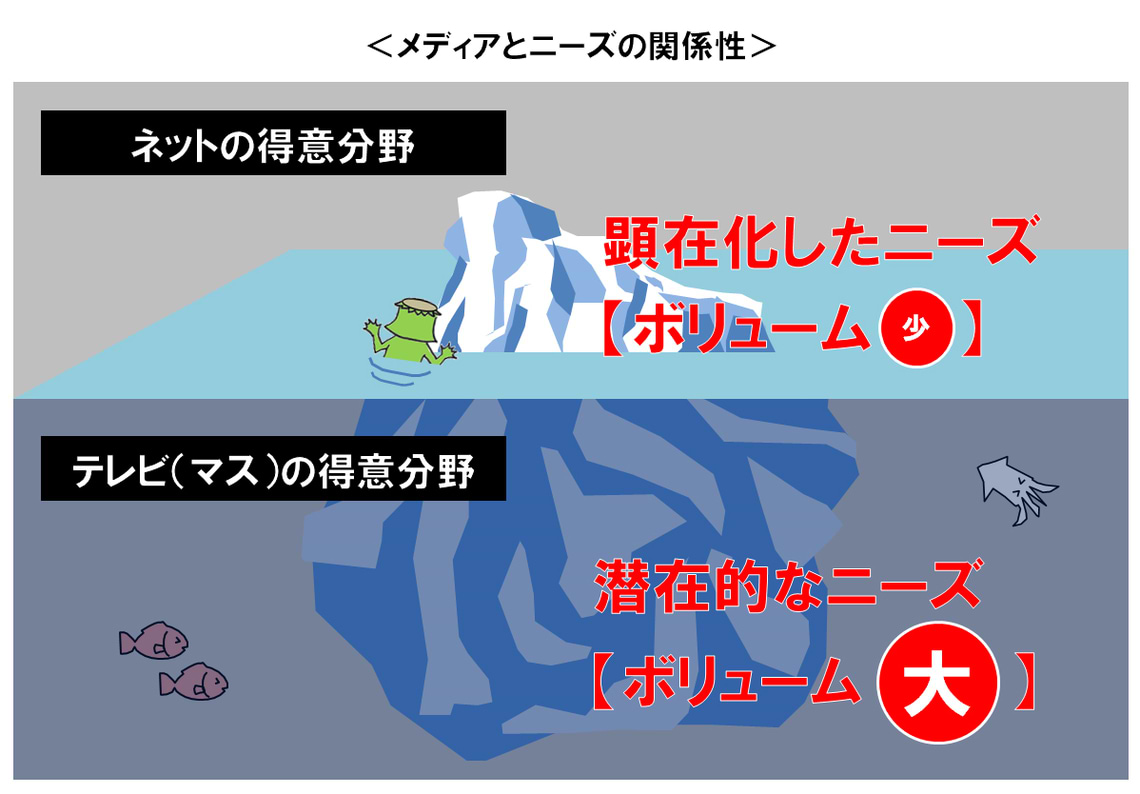
Food products should fundamentally appeal to physiological needs; consequently, they naturally do not need to satisfy higher-level desires. It is also known that nonverbal communication is effective for physiological needs, including appetite. Therefore, in actual media selection, it is not uncommon to see results where paper media or the internet—and even on the internet, static image content rather than video content—achieve a certain level of response.
However, for health foods and cosmetics, it is essential to evoke not only physiological needs but also various levels of extended needs. The construction of such messages is complex and intertwined, requiring careful attention to the sequence of appeal to effectively engage consumer psychology. In such complex, multi-layered communication, nonverbal means alone often prove insufficient. In these cases, we respond through scenario-telling using media like television, which can deliver information that touches on human subtleties.
This column covered two key points: ① How the approach to consumer psychology differs by medium, and ② How the level of purchasing desire varies by product category.
But "easier said than done." I can almost hear our valued clients scolding me: "You talk big, but how's our ad response?" (laughs). It's all about the PDCA cycle. If you discover anything new, I'd love to hear about it. Next time, I'll continue focusing on the relationship between consumers and products, exploring how product selection can solve consumer problems.
Was this article helpful?
Share this article


Newsletter registration is here
We select and publish important news every day
For inquiries about this article
Back Numbers
Author

Hidekazu Shono
Dentsu Kyushu Inc.
Corporate Planning Office
Department Manager