
Note: This website was automatically translated, so some terms or nuances may not be completely accurate.
 From the E-commerce Kingdom! New Marketing Discoveries! [7/7]
Direct Marketing Communication Design Theory ②
Welcome to Kyushu, the Kingdom of Mail Order!
Continuing from last time, this final installment also covers communication design in mail order.
Now, this time's theme is "Gain an Overview of the Psychology Behind Direct Marketing Purchases!"
■The "Linear and Short" Purchase Psychology Process in Mail-Order
While contact point management has grown increasingly important due to the penetration of digital and cross-media channels, the mail-order industry—which targets middle-aged and older consumers—still predominantly relies on short purchasing processes where the response device is directly linked to the medium, as in "How many calls came in?" The golden rule for success in mail-order marketing is to identify the critical psychological transition points within this short, linear process. So, let's re-examine this purchasing psychology as a continuous cycle, from before purchase to after use.
In this relay column, our company's Kazuki introduced the "AIDBA" model as a parody of the "AIDMA" purchasing model, aiming to flood consumers with information. While born from wordplay, this model logically captures the psychological shift of flooding with information, perfectly represented by its acronym "AIDBA."

First, ensure solid exposure to advertising to stimulate purchasing desire, ultimately leading customers to pick up the product. Further, by having them use it, they experience the product's value firsthand, leading to repeat purchases. This is the purchasing psychology transformation model. In essence, it's the "AID-BAR" model, adding "R" (Reality) to the "AIDBA" model. While it breaks down into six points, the key events are consolidated into three major phases. Let's summarize the key points for each phase.
■Point 1: Are you effectively achieving awareness and understanding?
Awareness + Understanding Phase
~Keyword: "Reach + Attention Power"~
First and foremost within this is "effectively delivering the advertising message." ...I apologize for stating the obvious. However, many campaigns stumble in this phase, regardless of whether they are offline or online. As planning professionals,- . It's not just about reach or contact; it's about (efficiently) increasing visibility
- .Focus on delivering compelling/persuasive messages that resonate with the target audience
. The key lies in combining these two elements : "Reach + Attention Power." Planning must leverage the unique characteristics of each medium. Specifically, regarding point a, offline media like television lack detailed information and interactivity but possess powerful attention-grabbing capabilities. Long-form commercials called infomercials cover TV's weakness in detailed information. This enables a seamless flow from awareness to purchase prompting → purchase action. Conversely, internet/digital media, centered on search-linked ads, offer excellent acquisition efficiency. However, the flow from attention to purchase pathways still seems unclear. Improvements in how advertising content is placed are also progressing, so we can expect continued evolution toward media that effectively balances "awareness" and "interest generation." Regarding this content placement, let's examine two cases with different delivery methods.
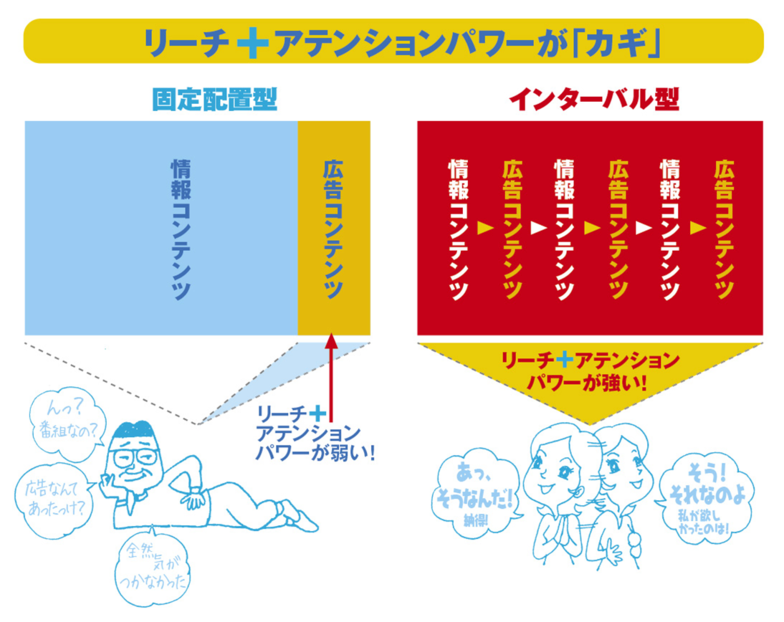
In the diagram above, for media like newspapers or web ads, advertising content is placed alongside informational content, reducing ad attention rates (fixed placement type). Consequently, reach costs increase. Television, however, alternates between informational and advertising content (interval type). Viewers accept this as normal when consuming information, leading to efficiently high ad attention rates. This is the root of television's media power. For any medium, consumers must first be willing to accept the content. Communication design is necessary not only to achieve reach but also to ensure solid understanding by enhancing visibility.
■Point 2: Maximizing the Desire to Buy.
Desire-Inhibition (Barrier) Phase
~Increase purchase desire while reducing the feeling that buying isn't necessary~
Next comes the phase where product understanding has progressed sufficiently, and consumers move toward purchase consideration. The key point here is that even if you try to fill the cup to overflowing by satisfying needs, if there's a barrier higher than the cup itself, it's difficult to convert that into sales. To increase the amount that overflows, lowering this barrier (threshold) is one effective strategy. Formally stated,
"Amount that overflows" = "Needs poured in" - "Barrier of not needing to buy"
Let's look at an example. For the purchasing psychology when considering buying a 100,000-yen personal computer, for example...
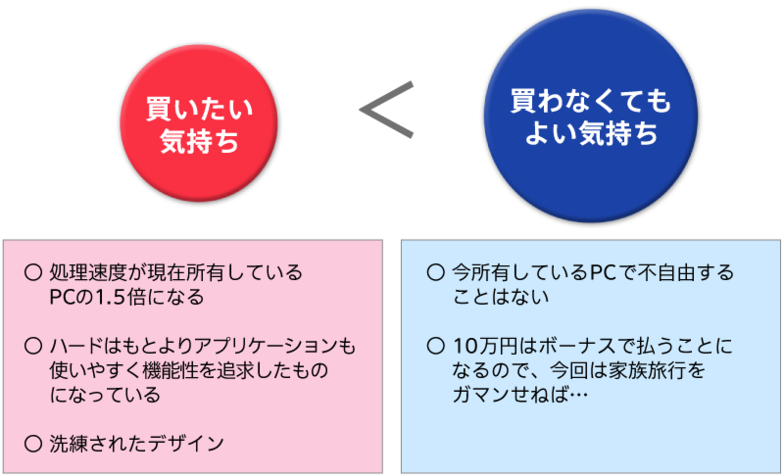
As shown above, while the desire to buy is being stimulated, since the customer isn't entirely dissatisfied with their current situation, they overwhelmingly end up holding off on the purchase. In this case, the desire to buy hasn't overcome the feeling that it's okay not to buy. Naturally, to create that "overflow," you need to: ① amplify the desire to buy, and ② suppress the feeling that it's okay not to buy. Doing this can significantly boost sales promotion effectiveness.
For instance, we employ techniques like this to create overflow.
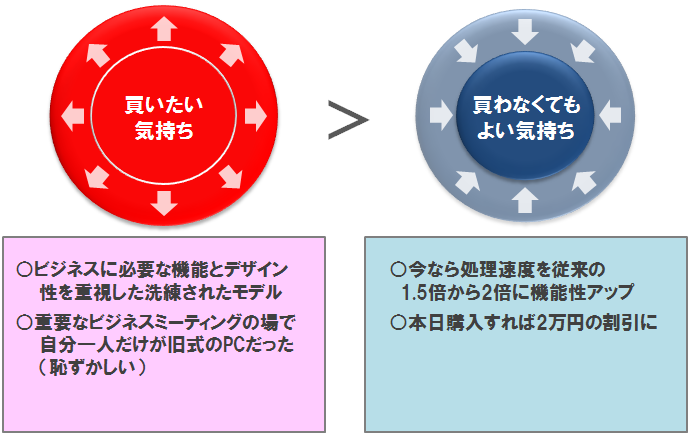
Regarding amplifying the desire to buy, emotional benefits are often more effective than functional benefits. Paying attention to trends or social standing is called the "bandwagon effect" in psychology; it's important to understand that this is fundamentally based on behavioral psychology.
To lower the threshold for feeling it's okay not to buy, we leverage the psychological response to pressure like "You have to buy now!" This aligns with "prospect theory," which states that small calculations of gain or loss influence purchasing decisions. Thus, a slight "discount" or a limited-time "deal" can spectacularly break down the barrier of feeling it's okay not to buy.
■Point 3: The Essence of Mail-Order Business. How to Make Customers Love Your Product?
Purchase + Realization Phase
~When empathy for the product/advertisement transforms into tangible experience, a bond with the customer is formed~
The third point is the moment when what was merely empathy during ad exposure transforms into tangible experience upon purchasing and using the product. I believe this is the KPI (Key Performance Indicator) that strengthens customer relationships. While trust in the company brand often drives purchases, the most effective way to make customers love the product itself is through positive experiences gained from actual use. Sometimes, the very "offers" designed to lower the barrier of "feeling good about not buying" become a double-edged sword that hinders subscription purchases. Therefore, it's crucial to enhance satisfaction by delivering a usage experience that truly meets the desire to buy—by fully realizing the product's value. Top executives at mail-order companies often say , "Making customers happy is the most important thing. " "Sales are the result." This isn't just lip service; it's a profound truth.
How can we make customers happy?
This is the most fundamental principle when considering various promotional strategies for customers. By gathering simple, essential ideas and implementing the PDCA cycle, you can build better relationships with customers. As an example, a company in the fisheries industry sells health foods made from fish. They reportedly send fresh fish caught by their own fleet regularly to their subscription customers. This initiative has been very well received by customers. It's an excellent example of successfully building customer relationships by introducing a meaningful or satisfying surprise gift system.
■Finally
Well, we've now covered "An Overview of the Psychology of Direct Marketing Purchasing" in two parts.
However, concepts and theories alone won't move things forward. Iterative trial and error is paramount. The more you engage and reflect, the more discoveries you'll make. Indeed, within each of your PDCA cycles lies a wealth of essential and meaningful insights.
Finally. There's a reason Kyushu is called the "Kingdom of Mail Order."
What is it?
... Sharing knowledge.
Various mail-order companies and related industry professionals share learning opportunities for sales promotion strategies. I feel this relationship of mutual growth and competition is precisely why it's called a kingdom.
That said, it's also worth noting that many companies here avoid conformity and actively express their individuality.
That concludes my seven-part column series, including this final installment. Thank you to everyone who read along.
Was this article helpful?
Share this article


Newsletter registration is here
We select and publish important news every day
For inquiries about this article
Back Numbers
Author

Hidekazu Shono
Dentsu Kyushu Inc.
Corporate Planning Office
Department Manager
