Note: This website was automatically translated, so some terms or nuances may not be completely accurate.
 Omni-Viewing of Accelerating Videos [1/5]
The Internet Environment That Transformed Video Viewing
The information media industry faces a turbulent era. DENTSU SOKEN INC. continues to track current industry and usage trends regarding diversifying information media, compiling an annual white paper. The latest edition, the 22nd volume, "Information Media White Paper 2015," has just been published by Diamond Inc. To commemorate this, we present the opening feature of this book, "The Accelerating Trend of 'Omni-Viewing' for Video," in this series.
Internet video is expanding rapidly, driven by the evolution of internet environments based on faster speeds and larger data capacities, as well as the widespread adoption of smartphones. Younger generations are said to be the heaviest consumers of this content. They were born into a well-established internet environment and are essentially the driving force behind the "smartphone native generation."
Focusing on this demographic, which will form the core of society in 10 years, we will unravel audience insights for the younger generation (defined here as teens and twenties) over five installments. This is based on original survey findings regarding internet video, titled "The Accelerating Trend of 'Omni-Video Viewing'".
(*) Omni originates from Latin and means "everywhere."
Part 1 analyzes "The Internet Environment That Transformed Video Viewing."
◆ Changes in the Macro Environment
~ Key Points Shaping the Future of the Media Environment
Figure 1 summarizes key points to grasp the future direction of the information media industry and audience trends.

There are four key points: macro factors like population decline, low birth rates, and changes in the media environment; and micro factors such as faster/larger-capacity communications and women's increased participation in the workforce. These are phenomena affecting all Japanese people to varying degrees and are essential points for discussing this theme.
1.Population Decline
In the future Japanese society, a decrease in the total population and an increase in the number of households, primarily single-person households, are anticipated. According to estimates by the National Institute of Population and Social Security Research, Japan's total population is projected to decrease to 116.62 million by 2030. Meanwhile, the total number of households is expected to continue increasing, peaking at 53.07 million households in 2019 before declining to 49.56 million households by 2035. The phenomena of population decline and household growth are certain to significantly impact the markets for information media across all domains and the associated information devices.
2.Women's Participation in the Workforce
Supporting Women's Participation in the Workforce is one of the key policies in the New Growth Strategy proposed by the Second Abe Cabinet. It is a measure to compensate for the shortage of the productive labor force caused by the decline in the working-age population due to population decline. Going forward, as women's participation in the workforce progresses, assuming a trade-off between time spent at home and time spent working, it is expected that time spent outside the home will relatively increase, while time spent at home will decrease. Macro-economically, significant changes in the media consumption environment, centered on women, are anticipated.
3.Changes in the Media Environment
Video Research Ltd.'s MCR (Media Contact Report) shows that the time spent outside the home by male and female teenagers increased from 530 minutes in 2000 to 575 minutes in 2014, a 45-minute increase over these 15 years. The fact that 2014 reached the peak for this 15-year period indicates that younger people are spending more time outside the home and relatively less time inside (Figure 2). This medium-term macro trend undoubtedly influences media consumption both inside and outside the home. Notably, 2011 saw a temporary dip to 558 minutes, likely due to reduced outings following the earthquake disaster. However, time spent outside the home subsequently increased significantly again, confirming the long-term upward trend in time spent away from home.
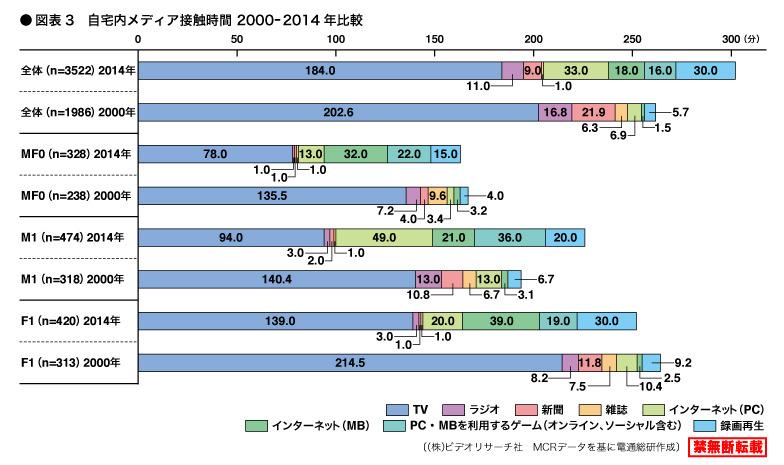
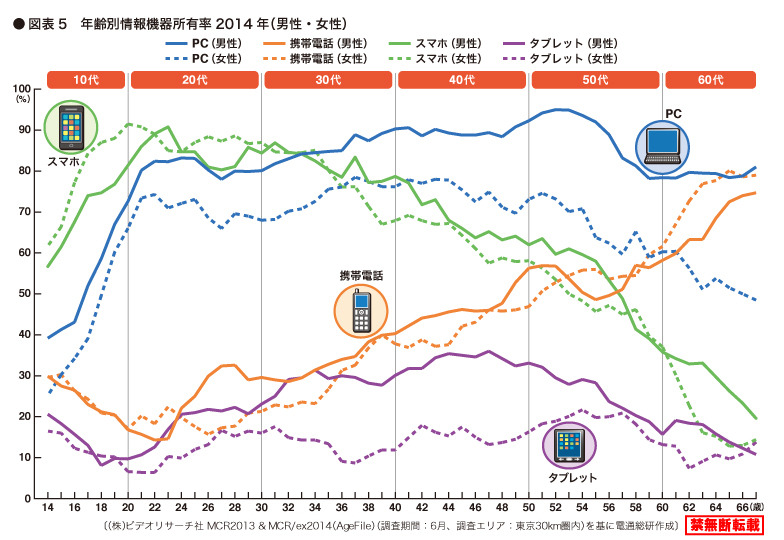
Furthermore, comparing 2000 and 2014 reveals particularly large changes in media contact time among younger age groups. Internet use at home stands out, with teenagers' total internet contact time (combining PCs and mobile devices) increasing from 6.6 minutes to 45.0 minutes (Figure 3). Outside the home, a similar phenomenon is observed, with mobile internet contact time among relatively younger age groups rising from 1.0 minute to 9.0 minutes (Figure 4). Regarding information device ownership, another key point is the high smartphone ownership rate among younger age groups for both genders. Notably, smartphone ownership rates among females in their teens and early twenties are higher than those of males (Figure 5).


4.Faster/Higher-Capacity Communications
According to highly reliable projections, wireless communication speeds are expected to reach levels comparable to or exceeding fixed-line fiber optics. By 2015 and beyond, environments enabling the transmission and reception of 4K-quality content via mobile will be established. Specifically, telecommunications companies have begun testing fifth-generation (5G) communication standards, with market introduction targeted around 2018. An era is fast approaching where wireless communications, devices, and internet media will form massive video distribution channels capable of handling high-capacity video. This will create an environment where it becomes increasingly difficult to distinguish whether the transmission path for content reaching audiences is "broadcast" or "communication."
◆ Will Internet Video Become the Main Viewing Platform for Younger Generations?
As seen above, the media environment surrounding young people features high-speed communication enabling large-capacity transmission, rising smartphone ownership rates, and increased internet usage time. Considering these factors, starting next time, we will focus specifically on "internet video viewing" among the highly multifunctional capabilities of smartphones. Will a world emerge where young people consuming this content become the mainstream audience? If so, what kind of information media environment awaits us? To address these questions, we will use Dentsu Inc.'s original survey results to explore young people's internet video viewing behavior, incorporating future projections.
Was this article helpful?
Share this article


Newsletter registration is here
We select and publish important news every day
For inquiries about this article
Author

Manabu Tachiki
Dentsu Inc.
Future Business Research Institute
Insight MemoOmni-Viewing of Accelerating VideosShiodome Media Researcher CommentaryDigest of the Opening Feature: 'Information Media White Paper 2016'Women's Audience Insights Special FeatureExploring Pathways from the "Quality of Society Survey" to a "Society" Where People Find Meaning in LifeCurrent State of Public Awareness and Values as Seen in the "Quality of Society Annual Survey 2021"DENTSU DESIRE DESIGN's Approach to Marketing Reconstruction Based on "Theory of Desire"Building the future begins with visualizing the will of the future.