
Note: This website was automatically translated, so some terms or nuances may not be completely accurate.
 Japan's advertising expenditure [3/13]
Analysis of "2015 Japan Advertising Expenditures"―Internet advertising spending leads the way, achieving positive growth for the fourth consecutive year.
On February 23rd, "2015 Japan Advertising Expenditures" were announced. Over twenty years have passed since the internet began its dramatic transformation of advertising spending. Toshiyuki Kitahara of DENTSU SOKEN INC. explains the present and future of "advertising expenditures."

Total advertising expenditure in Japan for 2015 (January-December) reached 6.171 trillion yen, a 100.3% increase from the previous year. This marks the fourth
Japan's total advertising expenditure for 2015 (January to December) reached ¥6.171 trillion, a 100.3% increase year-on-year. This marks the fourth consecutive year of positive growth since 2012 and the second consecutive year exceeding ¥6 trillion, following 2014. Japan's advertising expenditure is broadly divided into advertising costs for the four major media outlets, internet advertising costs, and advertising costs for promotional media. Internet advertising, which achieved double-digit growth at 110.2%, is driving the overall market.
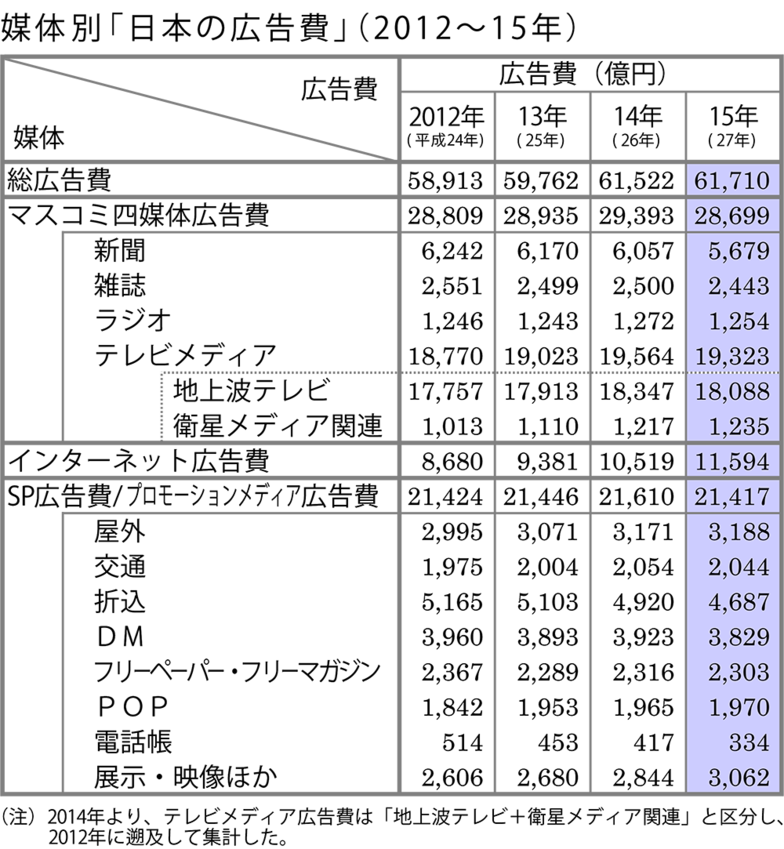
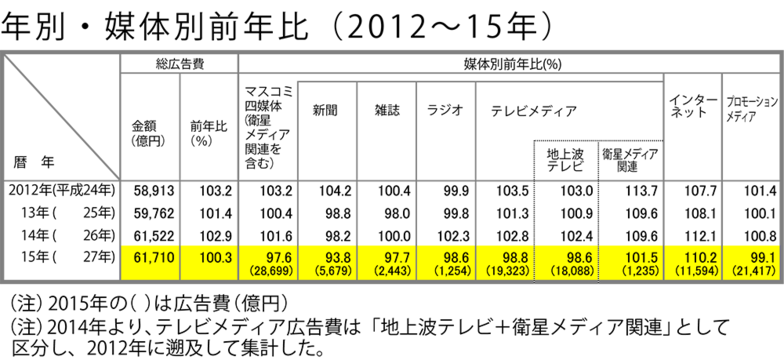
Regarding internet advertising, media costs totaled ¥919.4 billion (111.5% year-on-year), while production costs reached ¥240.0 billion (105.5% year-on-year). Within media costs, programmatic advertising expenses grew significantly to ¥622.6 billion (121.9% year-on-year).

Performance-based advertising refers to an advertising method that automatically or instantly supports ad optimization through platforms processing vast amounts of data. This approach, which involves accurately grasping or predicting consumer behavior patterns to deliver ads, is expected to continue expanding.
Additionally, advertising expenditures for the four mass media outlets (newspapers, magazines, television, and radio) totaled ¥2.8699 trillion, a 97.6% year-on-year decrease. Promotion media advertising expenditures were ¥2.1417 trillion, a 99.1% year-on-year decrease.
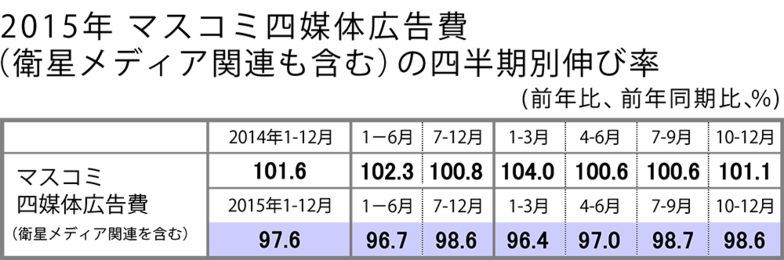
Looking at the four major media advertising expenditures quarterly, the January-March 2015 period saw a 96.4% figure, reflecting a reactionary decline following the significant pre-consumption tax hike demand the previous year. The April-June period also remained stagnant at 97.0%, but signs of a slight recovery began appearing from the July-September period onwards, with television advertising showing renewed brightness around December.
Consumer and Corporate Sentiment Remains Unoptimistic
It's a classic chicken-and-egg situation. We are no longer in an era where hit products emerge frequently. There is a dilemma: without revitalized consumption, advertising budgets won't increase; and precisely because advertising budgets aren't increasing, consumption remains stagnant.
Since the consumption tax hike in April 2014, consumers have continued to hold back on spending. With another consumption tax increase scheduled for 2017, consumption itself is in a holding pattern. This is likely one reason for the weak outlook.
Another factor: While corporate performance was generally strong in 2015, with improvements in ordinary profits, earnings were not being channeled into capital investment. Corporate hesitancy to become more proactive, stemming from uncertainty about the future, is likely another major cause of the weak trend.
Structural Changes in Advertising Expenditures
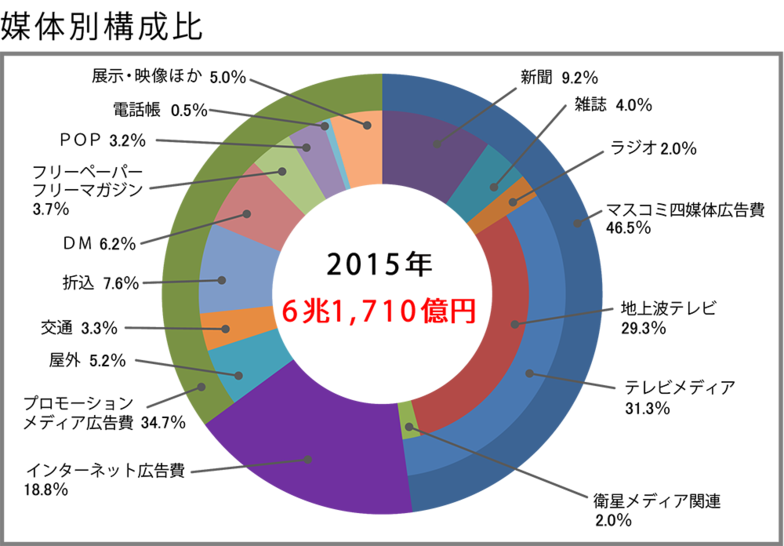
Mass media once accounted for over half of all advertising spending, but now it's below 50%, at 46.5%. Changes continue, as seen in information consumption habits, with more consumers using the internet.
However, it's not just that the internet has been added as a source of information; a significant factor is likely the shift in corporate strategy itself.
For example, some companies now prioritize overseas markets over Japan, directing advertising budgets abroad. Or, when companies merge, if each had an advertising budget of 1, will the combined entity use a total of 2? In reality, this isn't always the case; budgets often end up being around 1.2 or 1.3.
In the electronics industry, companies once all claimed to be comprehensive manufacturers. Now, however, if a company focuses primarily on heavy electrical equipment and only produces home appliances as OEM (original equipment manufacturer: manufacturing products for other companies' brands), opportunities for consumer-facing advertising decrease. If such shifts in corporate strategy are influencing the environment, it suggests a structural change is occurring in the advertising budget landscape.
Advertising serves two primary functions. One is sales promotion, driving product sales. The other is building brand awareness and shaping the brand itself.
Internet advertising tends to be more sales-promotional in nature, operating in a real-time PDCA cycle to maximize results. While highly effective for selling products, it still has limitations when it comes to building brands over the medium to long term.
Recently, we're increasingly hearing companies express a desire to strengthen their brand-building efforts and, to do so, they want to leverage mass media again. While initiatives like launching owned media to broaden awareness are noteworthy, especially for corporate advertising, ads leveraging the credibility of newspapers still carry significant impact.
This isn't a swing back, but rather a reassessment alongside prioritizing efficiency in internet use. I believe we'll see a shift toward combining various media for communication activities, focusing on areas where mass media excels.
Building an Advertising Budget Model Adapted to the Internet Age
Over the past few years, while working on estimating "Japan's Advertising Expenditures," I feel we are confronting the fundamental question of "What is advertising, or advertising expenditure?"
Fundamentally, "Japan's Advertising Expenditures" derives its figures by surveying media companies about the amount of advertising spending directed toward them. On the other hand, the Nikkei Advertising Research Institute's "Advertising and Promotion Expenditures of Major Companies" aggregates advertising-related expenditures from corporate financial statements. Since it primarily targets listed companies, the figures are not large.
Furthermore, the Ministry of Economy, Trade and Industry's "Survey of Selected Service Industries" calculates advertising industry sales based on questionnaires, arriving at a figure of around 6 trillion yen.
Today, advertising agencies engage in various businesses beyond placing ads with media outlets, but traditional advertising statistics do not specifically reflect these activities. While the METI survey shows significant growth in the "Other" category, what exactly constitutes this "Other" segment?
Driven by this question, we organized the current business domains advertising agencies are involved in (see diagram below). The size of each sphere indicates market scale, with "Japanese Advertising Expenditures" centered around media in the middle. The lower left quadrant covers sales promotion and promotional activities; the upper left quadrant covers entertainment-related domains; the lower right quadrant covers e-commerce and domains directly linked to purchasing; and the upper right quadrant covers various digital domains.
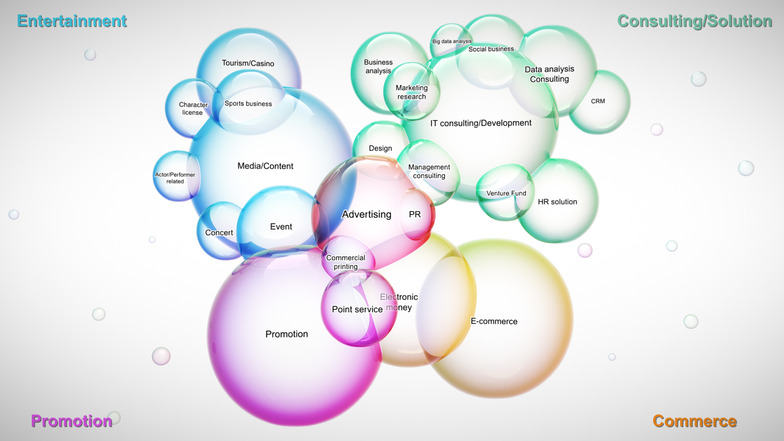
Advertising Agency Business Domains © DENTSU SOKEN INC. Media Innovation Research Department
As you can see from this diagram, "Japan's Advertising Expenditures" actually represent only a very small portion of the extremely diverse business activities of advertising agencies. The current state of advertising agencies cannot be fully captured by the traditional concept of advertising expenditures alone. We must consider it from new perspectives aligned with the changing times.
When a company launches a new product and runs a campaign, they might use TV for the initial announcement, but subsequent initiatives often utilize online channels or physical stores. Consequently, a significant portion of these activities cannot be captured by the traditional "Japanese advertising expenditure" metric, making new indicators essential.
While this diagram centers on "Japan's advertising expenditure," reimagining the whole picture from a digital perspective reveals a completely different view (see video below). This might suggest the emergence of unexpected new competitors, or it could signal that the time has come for mutual collaboration. We believe that understanding advertising expenditure in a broader sense is a major challenge for us.
[Video (No Audio)] Advertising Agencies' Business Domain—Moving the Diagram Reveals a Different Big Picture
© DENTSU SOKEN INC. Media Innovation Research Department
Is the internet even a medium? Isn't it more a means of communication than a medium?
Over 20 years have passed since the Internet became widespread. While we once used browsers to gather information, today the means of gathering information—even on the same infrastructure—continue to evolve rapidly through apps, messengers, and other platforms.
Since things are happening completely differently than 20 years ago, isn't it time we reconsidered the question, "What exactly is the internet?"
Details on "2015 Japan Advertising Expenditures" can be found here (Dentsu Inc. News Release).

Was this article helpful?
Share this article


Newsletter registration is here
We select and publish important news every day
For inquiries about this article
Back Numbers


Author

Toshiyuki Kitahara
Dentsu Inc.
Dentsu Inc. Media Innovation Lab
Principal Researcher
Articles by this person

What's the true intent behind the "Declaration to Quit Mass Media"? The current state of local media. Special Discussion: "Japan's Advertising Expenditures in 2024"
