Note: This website was automatically translated, so some terms or nuances may not be completely accurate.
 DMC Lab Selection: A Book for Thinking Ahead [61/88]
Seven Communication Strategies
"Communication Design," "Communication Planning," "Marketing Communication"...
In recent years, it feels like "communication" has become a very common addition to job titles and organizational names.
Personally, while I primarily handle digital-focused media planning, my business card title reads "Communication Planner."
This is because, in today's world overflowing with products and information, where countless touchpoints with consumers exist, marketing, creative work, and media planning are all now required to solve client challenges by moving consumers within a "communication strategy" focused on how to communicate with them.
While "communication" might sound like a vague term, it's fundamentally the same as connecting with friends, colleagues, or business partners: it's about knowing, understanding, and building relationships where you are accepted. "Communication strategy" is crucial for establishing these relationships between companies and consumers.
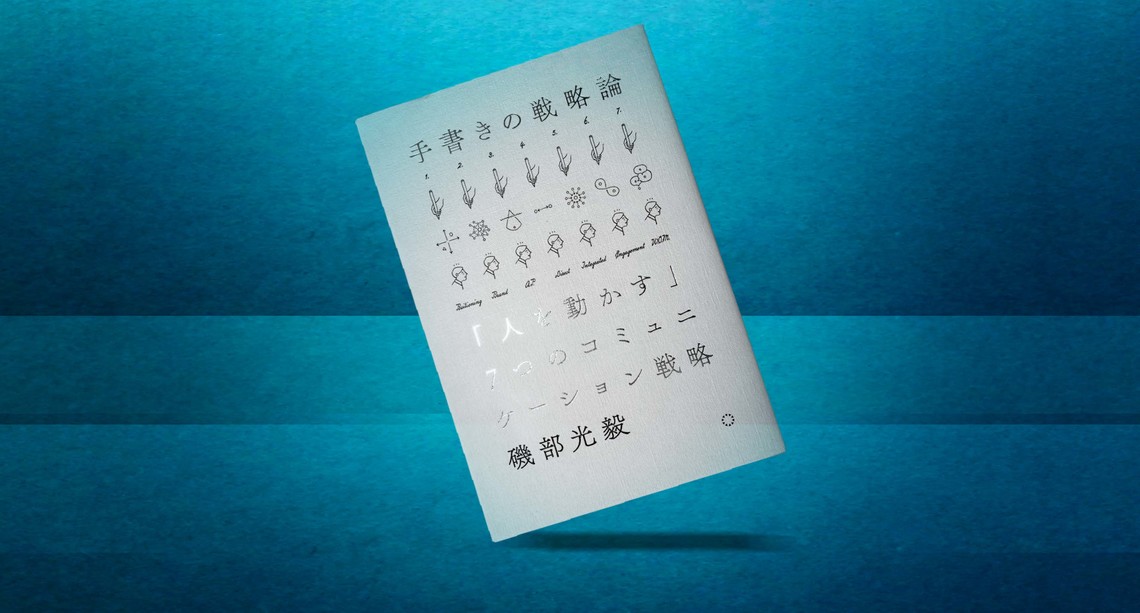
In this book, "Handwritten Strategy: 7 Communication Strategies to Move People" by Mitsutake Isobe (published by Senken Kaigi), "communication strategy" is framed as a "strategy to move people." Seven strategies and techniques for achieving this are organized, systematized, and introduced alongside handwritten diagrams.
1. Positioning Theory: "Differences" move people.
A strategy to secure a distinct positioning in customers' minds compared to competitors.
2. Brand Theory: "Authenticity" in memory moves people.
A strategy to build an associative structure of brand authenticity in customers' minds and leave it in their memory.
3. Account Planning Theory: "Deep Psychology" Moves People.
A strategy to uncover customers' hidden true feelings and motivate them.
4. Direct Theory: Evoking "response" moves people.
A strategy that builds long-term relationships while capturing customers' direct reactions.
5. IMC Theory: Integrating touchpoints moves people.
A strategy that connects multiple customer touchpoints to deliver optimal messages and initiatives.
6. Engagement Theory: "Involvement" moves people.
A strategy that builds mutually empathetic relationships through initiatives that make customers want to engage voluntarily.
7. Word-of-Mouth Theory: Information spread "person-to-person" moves people.
A strategy aiming for information to spread on social media accompanied by trust and empathy.
Communication Strategy is a Seven-Layer Mille-Feuille
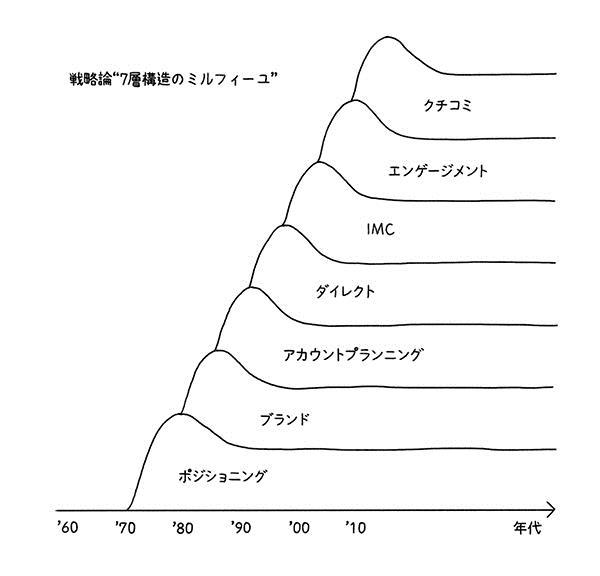
This book states that "communication strategy" is a layered structure where strategies that have changed or emerged over time accumulate, forming a "seven-layer mille-feuille" composed of the seven strategic theories mentioned above (p. 31). It introduces the historical flow and background behind each strategic theory's emergence, alongside past case studies.
Competing for Position in the Customer's Mind
For example, the "Positioning Theory" forms the base layer of this seven-layer mille-feuille structure.
This theory emerged in the late 1960s. It involves occupying a distinct position in customers' minds compared to competitors' products or brands, using this "difference" to influence people.
In the past, it was sufficient to create something new or differentiate through product features and benefits. However, today every market is mature, making differentiation based on specifications difficult. Within this environment, it is necessary to discern customer needs, identify competitive axes that work to the advantage of one's own brand, and build a solid position in the customer's mind.
Which tea do you choose at the convenience store?
For example, when you go to a convenience store to buy tea, dozens of varieties line the shelves, creating a crowded marketplace. While taste preferences vary, most teas are generally quite good.
To make customers choose "this tea!" among them, this "positioning theory" is crucial. The book clearly states this "positioning theory" can be divided into two approaches:
A: "Overtake Type": Creating superior differentiation within existing value axes (
)
B: "Category Make Type": Establishing entirely new value axes to create differentiation (P.58)
Let's apply this to the teas lining convenience store shelves. For the "Overtake Type," it means highlighting points where you excel over competitors within customers' existing, articulated needs for tea—like taste, ingredients, or health effects. For the "Category Creation Type," it means creating a new value axis previously absent from the market—like the recently popular "functional health teas" or "premium bottled teas"—and presenting a "new choice."
This book presents each of the seven strategic approaches in a highly accessible, organized, and systematic manner. By applying these strategic theories to the current market or to the challenges you face, you can gain a comprehensive, bird's-eye view of communication strategy.
By keeping these seven strategies in mind and then selecting or combining them based on the specific challenge, brand/product characteristics, and target audience, you can significantly broaden the scope of your planning.
For anyone involved in "influencing people," this is a book well worth reading.
[Dentsu Inc. Modern Communication Lab]
Was this article helpful?
Share this article


Newsletter registration is here
We select and publish important news every day
For inquiries about this article
Back Numbers
Author

Kawabata Mai
Dentsu Inc.
Marketing Division 3