Note: This website was automatically translated, so some terms or nuances may not be completely accurate.
 From MIT Media Lab! The Future of Humans and Technology [3/3]
The new relationship between digital and reality, created by the magic of technology.

MIT Media Lab
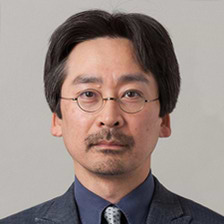
Yuzo Ono
Dentsu Inc.
As the third installment in our series on the MIT Media Lab, this time we feature the voices of young researchers. Belonging to research groups in different fields—such as AI, wearables, IoT, and electric vehicles—they pursue cutting-edge frontiers. What drives their work? What do they feel and think about the future of humans and technology? We asked them to share their visions of the future, as seen from the Media Lab, each from their own perspective.
AI and Wearables as Extensions of the Human Nervous System
~ Nan Zhao (Research Assistant, MIT Media Lab)
[Project Introduction]
Her project "Halo" transforms lighting from fixed fixtures into "wearable lighting." The lighting units become wearable devices that follow each individual. By altering brightness and color, it can change the user's own appearance. Conversely, it can also alter the visual world the user perceives, responding to their emotions or the surrounding environment.
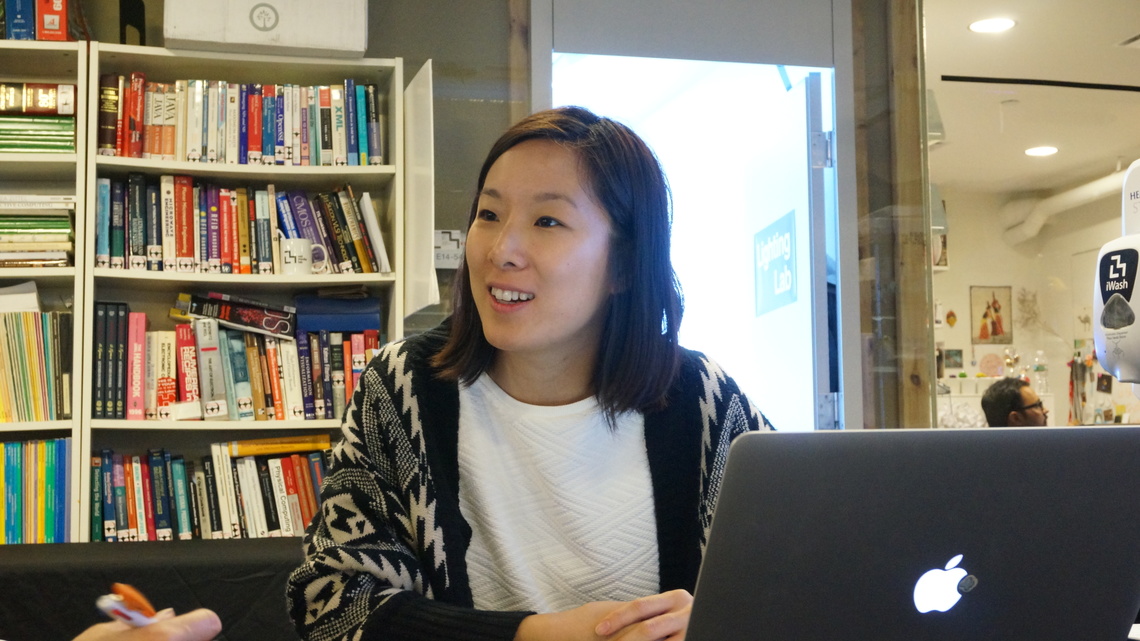
Current terminals are operated via keyboards, with all information condensed onto displays. But this is actually a very limited form and won't be used in the future. Our research group is developing sensors and actuators as extensions of the human nervous system. This requires a more natural interface between humans and terminals, which should also be a system utilizing a certain kind of artificial intelligence (AI).
AI has already permeated our lives, recommending products to buy or travel destinations. I believe AI can further become infrastructure that extends the human nervous system. Some voice concerns that AI might threaten humans, but humans retain the will. Therefore, humans decide what kind of future world we want to live in and what kind of AI to design. What I am developing is AI to understand humans more deeply.
If AI becomes wearable, its close proximity to the body will enable it to understand humans even more profoundly. It also increases the potential to collect valuable data that could suggest new business models for industry. While it's known that light affects human hormones and circadian rhythms, our project focuses on developing wearable devices that understand a person's physical state and create lighting tailored specifically for them, independent of external environments.
The physical form of wearables fundamentally changes the relationship between the device and the human. For example, there are robots that depend on humans. BOXIE, a robot created at the MIT Media Lab, is made of cardboard and incredibly cute, but it struggles to walk, so it needs humans to carry it around.
Wearables are like windows connecting us to the outside world. I hope future wearables become more fashionable and seamlessly integrated into the clothes we wear. While wearable devices currently have limitations in shape and size, new forms and materials are constantly being developed.
Creating stories that resonate with human experience through AI-human collaboration
~ Russell Stevens (Deployment Lead, MIT Media Lab)
~ Eugene Yee (Deployment Strategist, MIT Media Lab)
[Project Introduction]
Their research group, "Social Machines," analyzes and utilizes a wide range of data from mass media to online media, aiming to contribute to solving social issues. In a recent project, they created a database of vast amounts of tweets and news related to the U.S. presidential election. Using AI, they segmented this data by topic and created relationship maps usable by journalists.
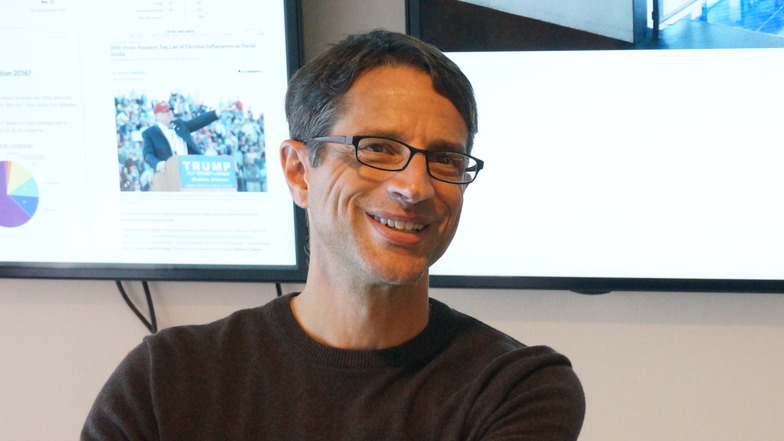
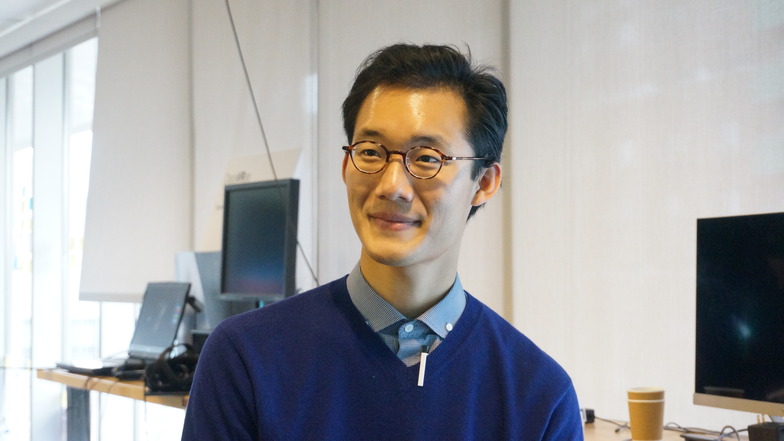
Currently, AI and machine learning are advancing automation, and human involvement is being excluded from the process. However, in our project "Social Machines," we believe humans should be integrated into that process.
One example of our work is in journalism. Rather than having AI write articles, we are developing AI as a tool to help humans write better articles. For instance, during the 2016 presidential election, we analyzed 50 million Twitter posts and 30 news media outlets. We then provided journalists with AI-generated breakdowns of the data, segmented by topic.
This kind of data journalism enables journalists to report with a depth of insight they couldn't achieve alone. Simple sports or economic articles could probably be written by AI alone. But telling more complex stories requires humans. Good stories possess a truth at their core that resonates with human experience. By collaborating, humans and AI could potentially create something as beautiful as art in the future.
I also strongly question the biases inherent in AI algorithms, whether stemming from the coders or from the data itself. What people perceive as "beautiful" varies, but for example, the sensibilities of a "country grandmother" are likely absent from that data. Therefore, we aim to broadly reflect the voices of people who have never been the subject of algorithms as data. Furthermore, we believe it's crucial for algorithms to be "open" so anyone can use them, regardless of specialized knowledge.
In the future, humans and machines will be more closely connected and work together in synergy. By integrating humans into the system, we envision a world where humans come first, not one where machines look down on humans.
The magic of technology unleashed in the real world
~ Edwina Portocarrero (Research Assistant, MIT Media Lab)
[Project Introduction]
She is working on projects that transform children's playgrounds using digital and network technologies. One such project, "Listen Tree," involves transforming actual living trees found in parks into speakers using bone conduction technology. These trees are then connected via a digital network. When someone places their ear against the tree, they can hear music or human voices transmitted through this network.
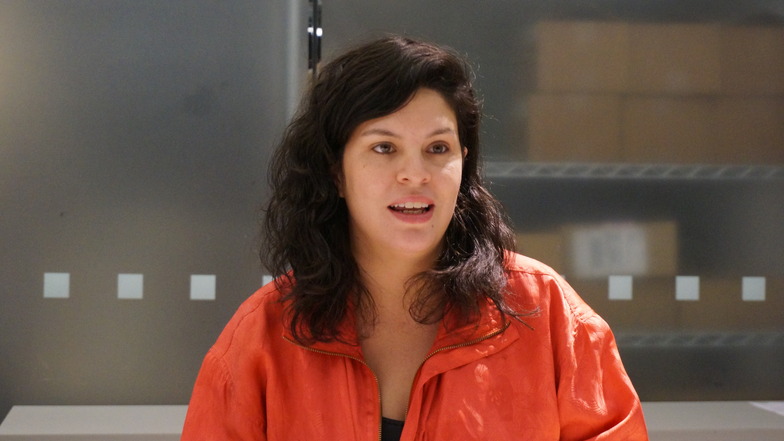
I've always been drawn to tangible, physical matter. It's not just about touch; I'm interested in the materiality of objects and the human thoughts their very existence evokes. I believe using technology in the right places allows us to explore the relationship between such physical matter and the digital world more deeply.
Japan has many wonderful parks. Playgrounds are the ultimate prototyping ground for technology. You can experience it purely, without being conscious of the technology itself. In our project, we attached devices to trees in the park and connected them via Wi-Fi to a forest outside the city. People in the park could place their ear against a tree and hear "stories" carried over from beyond the city.
Placing such playgrounds at the heart of the city creates a force that unites the community. Technology should be a means of connecting people. Due to generational or sociocultural differences, technology risks dividing those who benefit from it and those who don't. But by combining technology with park trees, everyone—children and the elderly alike—can easily enjoy it. We want to embed technology into things that are familiar in people's lives.
While the evolution of digital technology has shrunk the world and made all information and knowledge accessible, maintaining a connection to the physical world we inhabit remains crucial for humanity. I want to gaze upon the mythical, primal stories and potential inherent in materials and objects, and bestow magical power upon them through technology. In this way, I wish to unleash technology from screens and pixels into the real world.
What self-driving cars need is dialogue with design and localization
~ Michael Lin (Research Assistant, MIT Media Lab)
[Project Introduction]
His project, the Persuasive Electric Vehicle (PEV), is a three-wheeled vehicle that can switch between pedal-powered and electric modes. To encourage users to pedal as much as possible, it incorporates features like changing the vehicle's exterior color when in pedal mode, or displaying the real-time number of other users currently pedaling on the driver's panel.
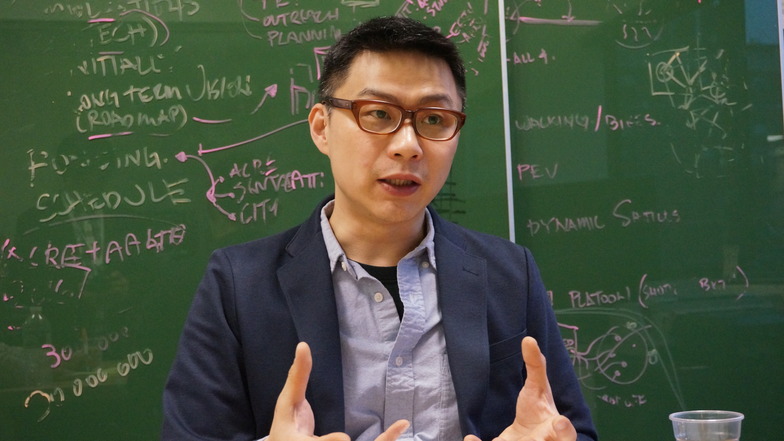
For the past 70 years, cities have been designed for car-centric societies. This design was based on the premise that human drivers make mistakes. The self-driving cars created by Google challenge us to ask whether we need to redesign roads, traffic signals, and infrastructure.
In urban planning, policy, design, and technology must be considered as a trinity. It's a major problem that technology and design are being developed separately without dialogue. The localization of technology is also crucial. The application of self-driving cars will naturally differ between Tokyo and the US. In the US, they'll be used for commuting on highways, while in Tokyo, with its extensive subway network, they might be better suited for more public services, like garbage collection trucks or mobile vending machines.
Computers were used for simple calculations in the 1980s and primarily for video games in the 1990s. The decade from 2000 focused on interfaces enhancing human-computer affinity. I believe the next evolutionary protagonist will be technology that positively impacts people.
For example, our project "PEV" focuses on "persuasive technology" that guides people toward healthier lifestyles. PEV is an electric vehicle that can also be pedaled, allowing users to switch from a high-energy consumption mode for normal driving to a low-energy mode comparable to cycling. Tailored to each city's characteristics, it can start by alleviating traffic congestion and has various applications that improve daily life, such as public services and logistics.
Technology should be designed for people. Our individual data is collected, and artificial intelligence (AI) analyzes our thoughts and lifestyle patterns. If not handled correctly, AI can become dangerous. The formulation of visionary policies is urgently needed.
Was this article helpful?
Share this article


Newsletter registration is here
We select and publish important news every day
For inquiries about this article
Back Numbers
Author
MIT Media Lab
Yuzo Ono
Dentsu Inc.
Business Process Management Bureau