Note: This website was automatically translated, so some terms or nuances may not be completely accurate.
 Target dual-income dads! [4/5]
How different are they from moms? What are the characteristics of "dual-income dads"?
Many people likely experience this daily: even though both parents work in the same household, "Dad and Mom have completely different ways of thinking and acting."
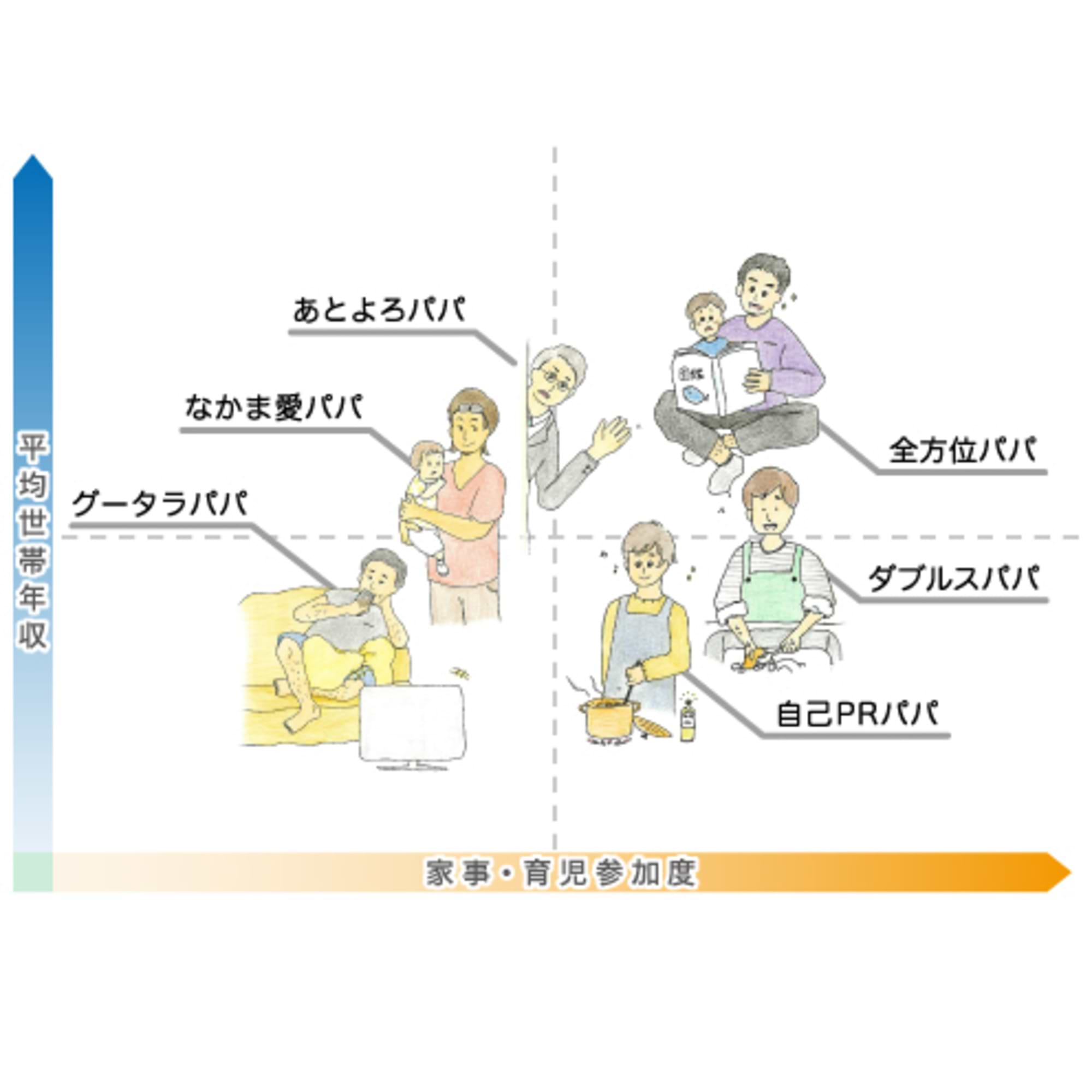
Dentsu Inc.'s "Papa Lab," which researches fathers in dual-income households raising children, has previously reported that working dads are an attractive target for companies (Part 1) and that working dads can be classified into six distinct clusters (Part 2).
This time, we compared the characteristics of dual-income dads—often less discussed—with those of dual-income moms. Based on survey results, we identified distinct traits prominent among dual-income dads across three perspectives: "values," "participation in housework/childcare," and "consumption/purchasing."
*The terms "dad" and "mom" in this article refer to dual-income parents.

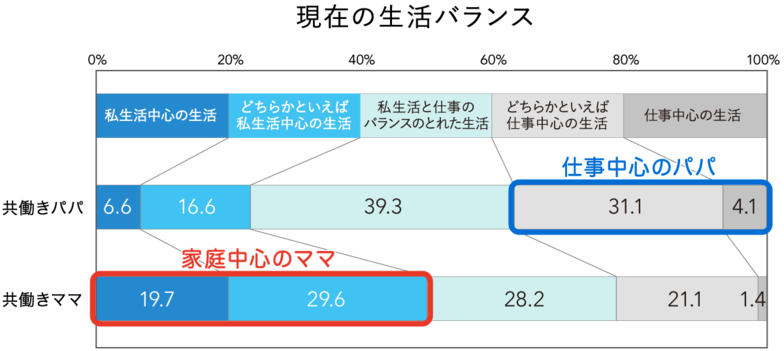
Even in dual-income households, dads lean "work-focused" while moms lean "personal life-focused"
Regarding current life balance, we found that compared to moms—where nearly half lead "personal life-centered" lives even among dual-income couples—dads tend to lead more "work-centered" lives.
Furthermore, examining survey results on "ideal self-image," dads were characterized by traits more applicable to work, such as "competent," "honest," "reliable," "serious," "intelligent," and "broad-minded."
As an aside, while moms show higher awareness of fashion, dads' appearance consciousness seems driven more by the "workplace" and "the gaze of the opposite sex" – for example, "only buying high-end suits and watches for work" or "choosing outfits overly mindful of the opposite sex's attention at work."
Cleaning Dads vs. Laundry Dads
On weekdays, dads spend an average of 1 hour and 1 minute on housework and childcare, which is less than a quarter of the time moms spend.

Looking at the specific tasks, it's clear that even in dual-income households, moms bear the primary responsibility. Nearly all moms cook, while less than 40% of dads do. The only household chore dads do more than moms is taking out the trash.
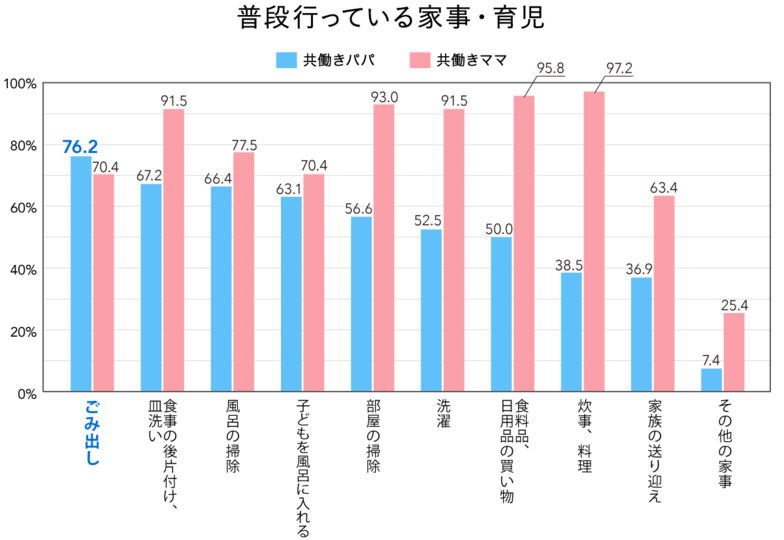
On the other hand, over 60% of dads handle "cleaning up after meals/washing dishes," "cleaning the bath," and "bathing the children." This suggests dads are more likely to be "cleaning-focused" than cooking or laundry, and more inclined to handle "cleanup" tasks rather than preparation.
Dads loosen the purse strings for "children's education" and "personal enjoyment"
Compared to moms, dads showed a stronger tendency to "spend money on higher-quality items, even if more expensive," specifically for "children's education" or "personal enjoyment." In product selection, dads also tend to prioritize "performance/functionality" and often "remain loyal to a brand they like for a long time." They were also found to be more receptive to opinions from "experts" or "savvy consumers/heavy users."
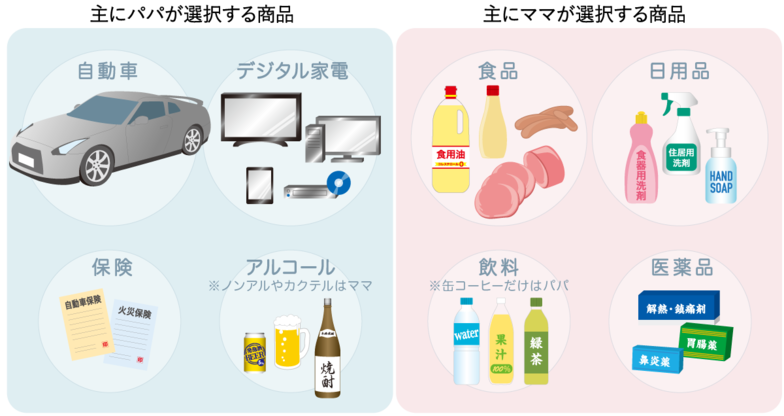
Specific items where dads take the lead in selection include "cars," "digital appliances," "insurance," "alcohol," "watches," and "games."
Finally, the top 5 female celebrities preferred by dads were: 1st - Haruka Ayase, 2nd - Kyoko Fukada, 3rd - Yui Aragaki, 4th - Satomi Ishihara, 5th - Keiko Kitagawa. Kyoko Fukada and Yui Aragaki were particularly popular with dads compared to moms, which could be useful when promoting products targeted at dads.
Considering the characteristics of dual-income dads outlined above, hypotheses like the following might be considered:
・While housework and childcare are still largely mom's role, "cleaning" is an activity other dads are already doing, making it easier for dads to take on (or easier to get them to take on).
・Since dads tend to have a strong work mindset, "being praised by female colleagues at work" can motivate them to engage in household chores and childcare at home.
・When dads are involved in household purchasing decisions, they are more likely to buy higher-priced items or make repeat purchases, not just moms.
At Papalab, we will continue to focus our activities on dual-income fathers, a promising target demographic.
■Analysis Overview
Survey Source: Dentsu Inc. Original Survey d-campX
Target Area: Tokyo 50km radius: 4800s
Survey Method: Persuasion of respondents through in-person visits, electronic survey forms via tablet devices
Analysis Subject Criteria: Married individuals aged 20-59 working full-time with children in junior high school or younger living at home
Dual-income fathers (spouse works full-time) = 122 respondents
Dual-income mothers (spouse works full-time) = 71 respondents
Survey Period: March–June 2016
Was this article helpful?
Share this article


Newsletter registration is here
We select and publish important news every day
For inquiries about this article
Back Numbers
Author

Hattori Rei
Dentsu Inc.
First Integrated Solutions Bureau / Dentsu Inc. Papalab
Senior Solutions Planner