Note: This website was automatically translated, so some terms or nuances may not be completely accurate.
 Inbound Strategy from a PR Perspective [3/5]
China's Latest Media Landscape, the Fragmentation of Social Media
In my previous article, "Chinese Consumer Insights," I discussed the need to thoroughly understand China's ever-changing consumers and establish messages that truly resonate, not just those that are communicated. This time, I'll explore the landscape of Chinese media for delivering those messages.
No need for a wallet?
Modern urban life in China runs on just one smartphone
The internet has deeply penetrated Chinese daily life, at a speed surpassing Japan's. According to the China Internet Network Information Center (CNNIC)'s 38th "Statistical Report on China Internet Development" (released August 3, 2016), China now has 710 million internet users. China's internet penetration rate stands at 51.7%, exceeding the global average by 3.1 percentage points and the Asian average by 8.1 percentage points.
Furthermore, mobile internet users number 656 million, with 92.5% of all internet users accessing the internet via mobile devices. These statistics clearly show how deeply mobile communication development and smartphone proliferation have permeated the lives of the Chinese people.
For example, "WeChat" (a communication app often called the Chinese version of LINE) offers not only messaging functions but also media features for viewing articles across various genres and payment functions enabling direct transactions at restaurants, supermarkets, and other locations.
Furthermore, movie ticket reservations and splitting bills can also be done through WeChat. Consequently, it's not uncommon for Chinese people to go out with just their smartphone in their bag, carrying no cash.

On Beijing's subway, it's no exaggeration to say nearly everyone is fiddling with their smartphones. Without internet access via smartphone, life becomes difficult—one risks becoming an information refugee. In a sense, it's no overstatement to say modern Chinese people are entangled and manipulated by the internet.
The explosive proliferation of smartphones before landline infrastructure was fully established means China's information and communications development has taken a different path from Japan's.
Social Media Fragmentation Driven by Mobile Advancement
While China and Japan differ in many aspects of information flow, one particularly distinctive feature is the fragmentation of social media.
According to the "2016 China Social Media Landscape" report published by Kantar Media CIC, a Chinese social business consulting firm, China's social media landscape revolves around companies like Baidu (China's Google equivalent), Alibaba (which operates China's largest e-commerce site Tmall and payment services), Tencent (provider of China's largest online communication service WeChat),2.and Sina, which operates Weibo, China's Twitter-like platform with 820 million users (as per Q2 2016 financial reports). All manner of social media platforms spread out around these core players.
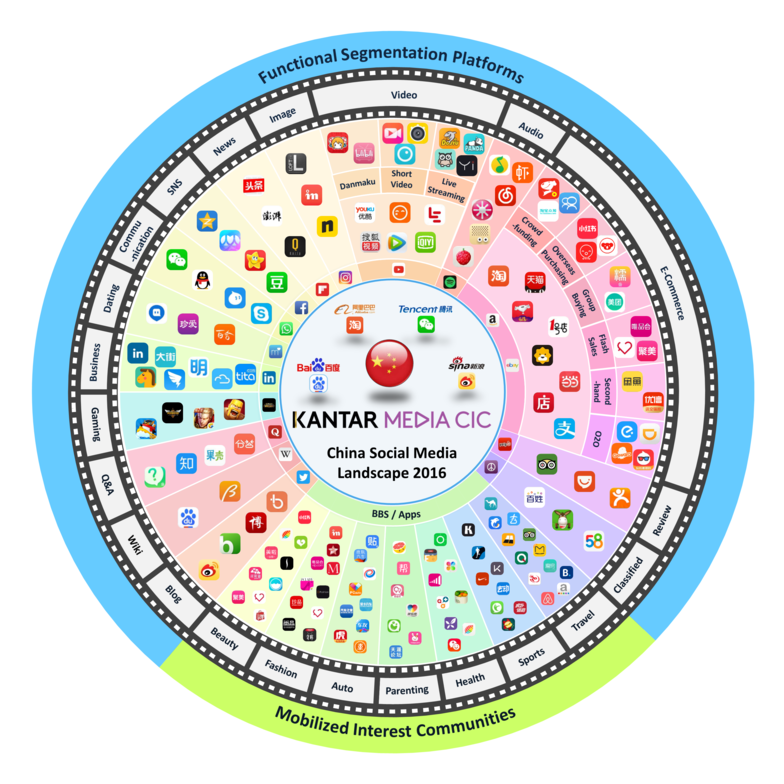
In China, with its massive amount of information and vast internet user base, there is a tendency to use more niche social media platforms in addition to the major players mentioned above.
For example, consider a young mom born in the 1980s. She uses "WeChat" to connect with friends and arrange meals. She books restaurants with good reviews on the food app "Dianping" and downloads coupons while she's at it.
After dining with friends, she subscribes to new mom columns on WeChat during her train ride home. With some free time, she checks out trending drama updates or content posted by popular idols on Weibo.
Back home, she checks baby products recommended by editors and other moms on the parenting platform "BabyTree." If a baby brand catches her interest, she searches for it on "Baidu," then looks it up and buys it on "Tmall." For overseas products, she either asks friends abroad to buy them or purchases them herself when traveling.

This way, they handle nearly all information gathering through their smartphones. As you might notice from this example, Chinese people don't just use one social media platform; they switch between them based on their needs.
The same applies to gathering information. Consequently, alongside major platforms offering broad and rapid access to information, China has seen the development of specialized social media platforms focused on specific domains, tailored to users' age, status, and needs.
The Sense of Unity and New Information Dissemination Brought by Live Streaming
Amid this fragmented social media landscape, live video streaming experienced explosive growth in 2016. In China, it's known as "live streaming" (直播, zhībō).
Today, numerous online media platforms incorporate "live streaming," and dedicated apps exist solely for this purpose. Users with live streaming accounts broadcast various content while responding to followers' comments in real time.
Live streaming allows followers to see influencers and celebrities in real time and interact with them, making it a highly engaging media format.
While such live streaming is popular with some core users on platforms like Japan's Niconico, the situation in China differs significantly. According to the 38th "China Internet Development Statistics Report" (released August 3, 2016), by June 2016, China had 325 million live streaming users, accounting for approximately 45.8% of internet users.
In China, influencers are often asked to livestream new product launches, and company executives themselves livestream to introduce products. Livestreaming is utilized for all kinds of events, heightening user engagement and attention.
Many Chinese influencers and celebrities use livestreaming daily to communicate with fans and foster loyalty. Livestreaming satisfies user demands: feeling closer to favorite influencers, getting the latest updates first, and enjoying events they cannot attend.
To execute effective promotions within China's vast online user base and its constantly evolving, diverse media landscape, it is essential to thoroughly understand your target audience, select appropriate media channels aligned with their needs and habits, and establish a message that resonates clearly.
For insights on effective messaging, we highly recommend reading Part 2 of "Chinese Consumer Insights." Next time, we'll cover "Regional Branding." Stay tuned!
Was this article helpful?
Share this article


Newsletter registration is here
We select and publish important news every day
For inquiries about this article
Back Numbers
Author

Ryū Aki
Dentsu Inc. Public Relations Advisors (Beijing) Co., Ltd.
Communication Design Center