
Note: This website was automatically translated, so some terms or nuances may not be completely accurate.
 Urban Neighborhoods and Incubation Development [3/3]
What is an "incubation project" in urban development?

Toshiaki Hasamura
Dentsu Inc.
Innovation = Creation of New Industries = Birth of Cities
If you live in the Kanto region, you've surely seen the "Let's Go to Kyoto" campaign. Did you know the advertiser wasn't Kyoto City, but JR Central? The reason a railway company runs such a campaign is simple: increasing transportation demand is their business.
Before working on the financial incubation office " FINOLAB Inc. " project, I was involved in conceptualizing and planning projects related to the privatization of public transportation hubs like airports and roads. Airports, roads, and railways all operate on a business structure that can be roughly summarized as "toll × traffic volume" (though they also have various ancillary revenues like retail and food services). Since transportation facilities are often just "transit points," the growth of the business depends on how many "reasons to visit the land accessible via that road or airport" can be created.

Creating "reasons to visit that land" generally follows two main approaches.
① Developing tourism and commerce
② Creating new industries
The earlier 'Yes, let's go to Kyoto.' campaign exemplifies ① tourism development. What I am currently tackling and challenging myself with is ② creating industry. Creating industry is a theme Dentsu Inc. has pursued for many years, and it is an area where considerable know-how and knowledge have been accumulated.
When industries emerge, employment is created. This fosters a community of workers and their families, which in turn creates a market. As the town prospers, both passenger and freight traffic volumes increase at transportation hubs. Conversely, building roads or railways in a place with no industry means no one will use them. Similarly, constructing office buildings or high-rise apartments in an area lacking industry means no one will occupy them.
It is not the presence of a town that sparks industry; rather, people gather where industry exists, and towns emerge. This is why "incubation projects" receive attention in town development.
Industrial clusters are born from "serendipity" and "chance"
So how can we achieve industrial creation? Industrial creation is determined by the coincidence of conditions like geography and local history. Fertile land fosters agriculture, and rich seas nurture fishing.
My mother was born in the mining town of Konomai, Monbetsu City, Hokkaido. At its peak, it was a "city" with over 10,000 residents, boasting state-of-the-art movie theaters and hospital facilities. Sadly, it became a ruin decades ago after the mines closed. I once visited my mother's hometown myself. There was no trace of a city, or even signs of human life—it was like "summer grasses, soldiers' dreams, traces of dreams." While this is an extreme example, it was an "industry" born simply because "a mine happened to be there," and a "city" that grew up around it.
A 2014 report stating that 896 municipalities face extinction by 2040 as "cities at risk of disappearing" became a hot topic and was nominated for the U-CAN Buzzword of the Year award (Source: Japan Revitalization Council ). However, throughout Japanese history, numerous cities have already vanished. And preceding a city's disappearance is the loss of its industry.
Industry is indispensable for maintaining a city. When redeveloping a town, it is necessary to revive and reconstruct the very industries that sustain it.
Incubation projects in urban development are essentially "new industry creation initiatives."
When envisioning an incubation office project like " Finolab " in Otemachi, it goes without saying that we must clearly define the perspective of "what to incubate." People often ask, "Since it's an incubation office, it must support entrepreneurs and startups in founding and growing their businesses, right?" However, fundamentally, "supporting entrepreneurs and startups in founding and growing their businesses" is a means, not an end. What Finolab incubates is the FinTech business ecosystem—the financial technology sector—meaning the industry itself. Startup entrepreneurs are both the bearers and the protagonists of this new FinTech industry.
The "incubation business" here is an endeavor that should be rephrased as "new industry creation." Consequently, Finolab's members include not only the startups as the main players, but also major financial institutions, IT vendors, and non-financial large corporations. It also brings together experts from various fields—lawyers, investors, accountants, consultants, analysts, engineers—as well as officials from relevant government agencies like the Financial Services Agency, the Ministry of Economy, Trade and Industry, and the Tokyo Metropolitan Government, all working together to drive actions toward creating new industries.
The New Industry Creation Initiative recognizes that supporting startup creation and growth may not always be the optimal approach, depending on the specific industry theme or field being targeted.
As one example, I previously collaborated with regional newspapers and local broadcasters on a project aiming to create renewable energy industries like geothermal and solar power. We planned joint ventures with media companies—key players in the regional economy—to establish energy industries tailored to each area's characteristics, generating wealth and employment through electricity sales revenue. In this context, tech startups did not feature (though solar power ventures did emerge).
Furthermore, when creating new industries, marketing is necessary just as it is for product development (which is where Dentsu Inc. comes in). A well-known marketing framework is the "SWOT analysis" method, which involves extracting and analyzing the internal environment (your own management resources) and the external environment (external conditions and rivals).
For Finolab, the internal and external environments presented the following positive factors:
■ Strengths
・Location in Otemachi, the financial district (Mitsubishi Estate)
・FinTech network ( ISID・FIBC )
■Opportunities
・The eve of Japan's FinTech boom
Thus, FinLab emerged as an industrial hub where the FinTech sector's greatest strengths and opportunities converge and synergize.
Why did London become the world's largest FinTech cluster in less than two years?
Let's broaden the discussion globally.
Industrial hubs around the world emerged gradually as related companies clustered together, shaped by geography and historical accumulation. Even Silicon Valley wasn't born from someone's blueprint to create an IT innovation hub; it evolved through historical accumulation, even before the term "IT" existed. It's a well-known story that Hollywood's rise as a major US film industry hub was largely due to its climate. Film stock at the time required strong sunlight for shooting, so film-related companies gradually clustered in sunny Hollywood, where clouds were rare.
However, a recent example exists of an industry being created in a short period: the "East London Tech City" redevelopment project for the 2012 London Olympics. Located east of the City of London (similar to Tokyo's Marunouchi), East London was originally an area with poor security and low rents. Around 2008, a neighborhood emerged there, home to over a dozen IT and design companies, as well as artist studios.
In 2010, while the area was close to the city center yet not particularly attractive, its low rents (perhaps akin to the backstreets of Shibuya's mixed-use buildings) were drawing young people. It was then that Prime Minister Cameron launched the UK's Silicon Valley initiative. This was a clear national declaration to promote industrial creation through innovation.
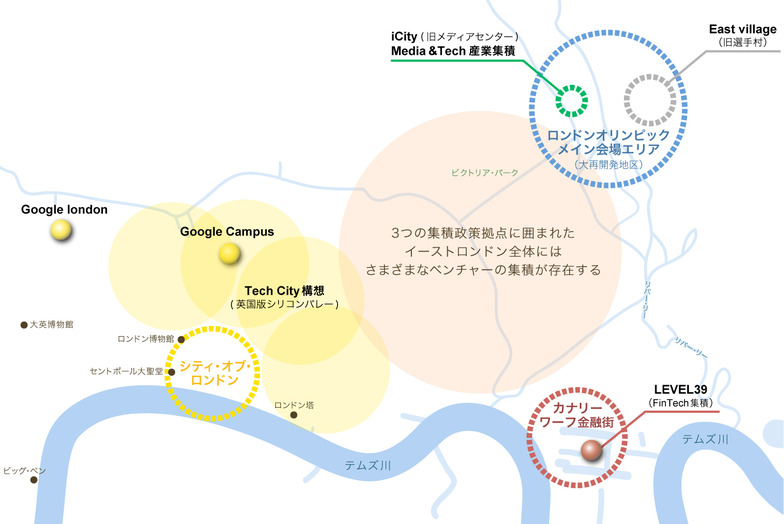
Through a series of highly effective, rapid-fire policies, the number of IT companies grew from a dozen in 2008 to 200 in 2010 and 1,300 by 2015. Successfully attracting the European headquarters of Google and Facebook, the momentum continued unabated even after the London Olympics. Leveraging London's inherent status as a global financial hub, the city embarked on creating a "FinTech startup cluster." In March 2013, Level39, one of the world's largest FinTech startup hubs, launched in London's financial district.
In less than two years, London surpassed Silicon Valley in the FinTech sector, becoming known as the world's largest FinTech cluster.
While the UK may not match Germany in manufacturing sectors like automobiles, or France in food and culture, or even trail Nordic countries and Italy in design and art, its financial sector is a global pride. London's success can be attributed to the massive concentration of global financial institutions and major consulting firms, combined with the Tech City initiative's deliberate focus on differentiating itself from rival cities and fostering tech venture clusters.
Japan's Challenge for 2020
I believe there is much to learn from the example of London, UK. When establishing Finolab, we even traveled to Level39 to learn various things.
Japan has learned much from the UK in its own formation as a modern nation. Japan's recent circumstances, its geopolitical position (an island nation), and its economic situation (with many historically large corporations) also feel closer to those of the UK than to other countries.
Japan must soon achieve a renaissance; otherwise, its future looks bleak due to population decline, aging, and industrial hollowing out. Through redevelopment for the London Olympics and its legacy, the UK gained one of the world's largest FinTech clusters and Europe's top startup ecosystem (though Brexit makes its future uncertain).
Tokyo, aiming to become Asia's top international financial city, is also reaching a critical phase in its redevelopment toward 2020. However, I believe we must never forget that what truly needs redevelopment is not the "city" as hardware, but the "revival of the industries themselves" – the software. We must avoid creating a "statue without a soul."
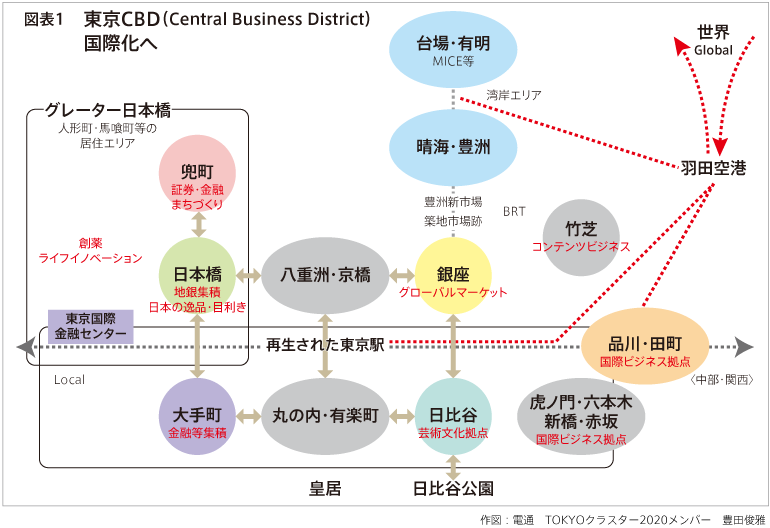
For Tokyo's redevelopment, please refer to the diagram below from the Dentsu Inc. News article " Strategic Special Zone Development and Legacy Toward Tokyo's Internationalization."
Industry is shifting from "big capital" to "individual to individual"
At the end of the 20th century, Eric Raymond published his essay "The Cathedral and the Bazaar." It proposed two software development models: the Bazaar model, premised on open source and open innovation, where participants' autonomy is respected and software is built collaboratively through a flat, neutral relationship; and the Cathedral model, its opposite, where development is led by a specific command center or headquarters through a top-down command structure.
While the essay itself purely analyzed software development methodologies, Japanese author Rei Tachibana drew inspiration from it to propose "Abandon the Cathedral, Head for the Bazaar" in his book The Only Way to Survive in a Cruel World (Gentosha). Rei Tachibana describes the cathedral as the closed space of corporations and the bazaar as the open space of the global market, asserting that the era of corporations is over and the era of the individual has arrived.
While I'm not as radical as Tachibana, I firmly believe this shift is imminent. Various industrial sectors—IT, ICT, FinTech, digital fabrication—are being swept by the wave of digitalization. Industrial activities and value creation that previously required massive capital accumulation can now be achieved with individual-level funding or investment, relatively diminishing the competitiveness of large-scale capital accumulation. In the US, which leads the world in technology-driven innovation, some studies predict that 50% of the workforce will be freelancers by 2020. (The current figure is 35%, while Japan stands at around 16%.)
Blockchain, a core FinTech technology, is also expected to provide the technical foundation for this trend. The realization of a true sharing economy is coming into view, where individuals in remote locations can exchange value via the internet without any intermediaries or credit providers (such as governments, municipalities, or large corporations).
In the advertising industry, for example, video production—which once required massive capital investment—can now be largely replaced by camera equipment, computers, and software affordable to individuals, drastically reducing costs. The gap between professionals and amateurs is converging not on equipment lineup (capital accumulation), but purely on ability (sense and skill). Market structures where capital accumulation held meaning are changing. Going forward, I feel "person-to-person" business, where individuals provide each other with their creativity, skills, and qualities, will accelerate.
Furthermore, "equity crowdfunding," expected to fully launch in Japan this year, will also see the relative influence of large capital holders diminish as this mechanism spreads and develops. No matter how much technology advances, certain industries requiring initial investment will persist. Crowdfunding enables this initial investment to be gathered not from a specific few large capitalists, but broadly from ordinary people.
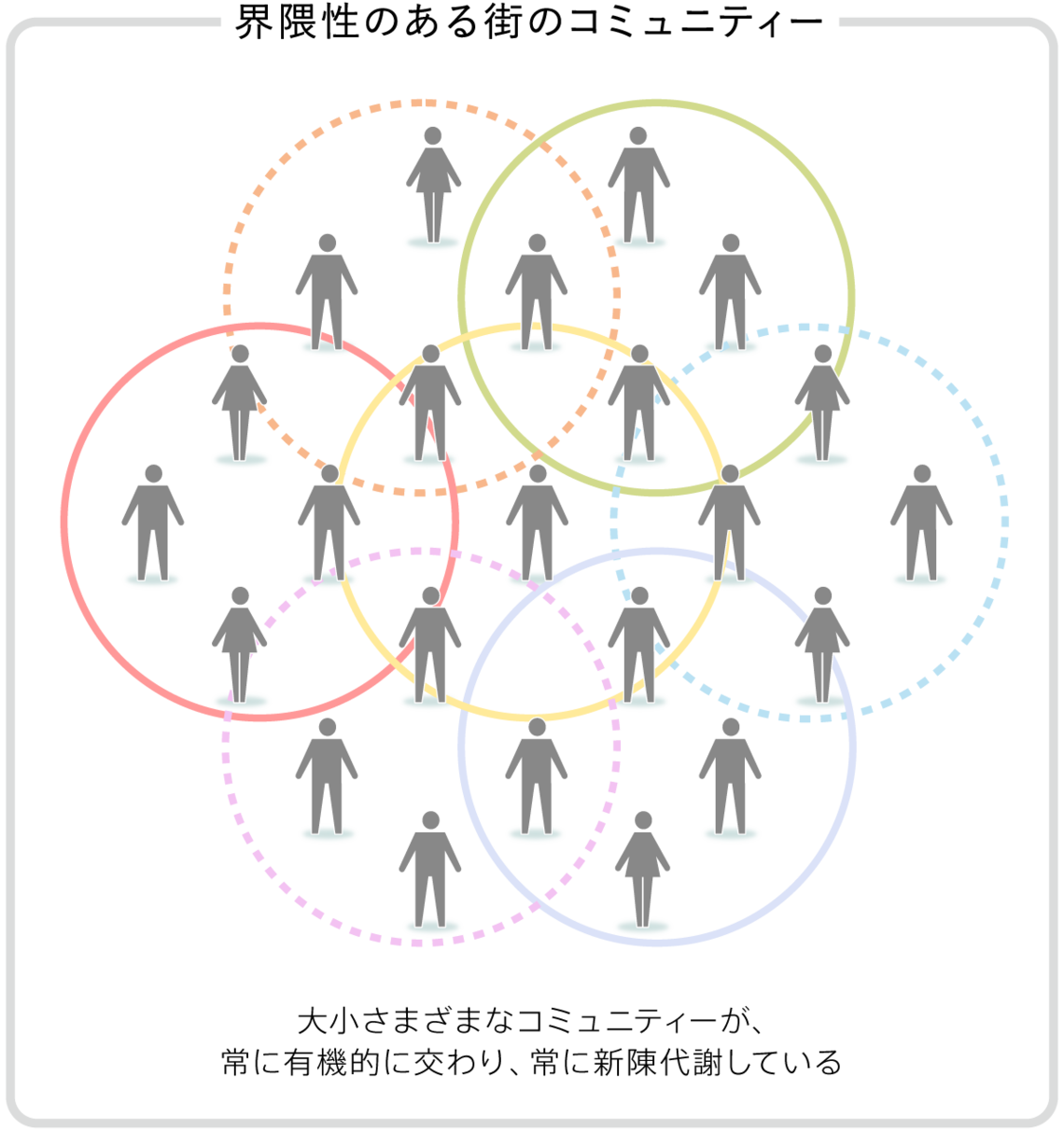
Going forward, labor-intensive industries will likely be replaced by AI and robots. The field known as RPA (Robotic Process Automation) is already gaining momentum, and it's said that even intellectual work involving many routine tasks will be displaced. The "valuable labor" left for humans, I feel, ultimately boils down to the so-called creative class—that is, the "incubation" of new value and industries, and "sparking innovation." If that is the case, then the importance and significance of the soil necessary to cultivate this—the "community-based nature"—will only grow increasingly vital in the future.
Was this article helpful?
Share this article


Newsletter registration is here
We select and publish important news every day
For inquiries about this article
Back Numbers
Author
Toshiaki Hasamura
Dentsu Inc.
Business Development & Activation Division