
Note: This website was automatically translated, so some terms or nuances may not be completely accurate.
 Urban Neighborhoods and Incubation Development [2/3]
Community is the cradle of innovation.

Toshiaki Hasamura
Dentsu Inc.
During my student days, I traveled around the world, visiting about 40 countries. Among them, Varanasi, a city on the banks of the Ganges River in India, stood out. It had that "leisurely pace of time" and "a lifestyle with room for play and breathing space" you might find in any small town, yet it lacked the exclusivity often found in rural areas, instead radiating an atmosphere full of acceptance.

This city sees many pilgrims wandering in from various parts of India (cows wandered too), so for locals, daily visitors are simply the norm. Even as a foreigner who just happened to show up, I never felt uncomfortable or alienated.
Also, few people seemed to live by concepts like "efficiency" or "productivity." While certainly not materially wealthy, many lived leisurely lives—spending the day idly by the river, meditating, or simply doing things that left you wondering what exactly they were up to all day.
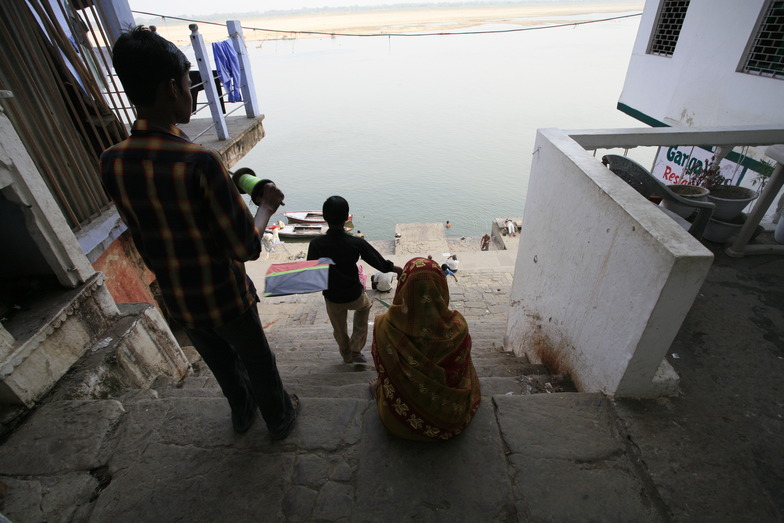
There was an atmosphere of "This is a sacred place, so let's all just get along somehow." You could call it tolerance, or perhaps a bit more harshly, a certain laxness. Combined with the mystique of a Hindu holy site and the element of the mighty Ganges River flowing through it, this created an indescribable charm. It radiated the appeal of "open doors and the natural mingling of diverse people" – an absolute condition for neighborhood character.
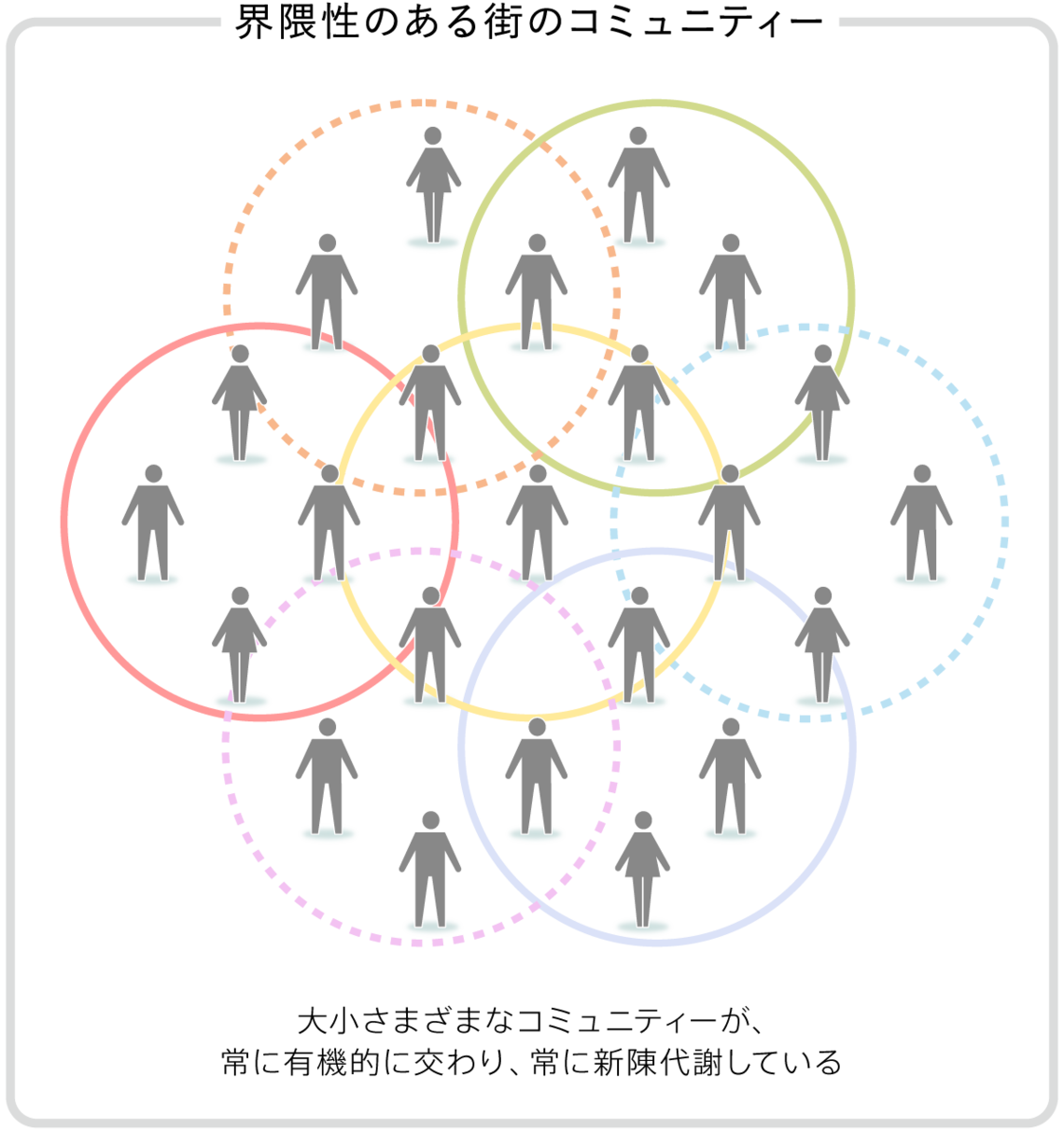
Neighborhood character defines a city's color. It's the state of a city where diverse people—locals and visitors alike—come and go, connect, and form communities.
Conversely, neighborhoods cannot thrive in places that are inherently exclusive, closed off, or have high barriers to entry—where newcomers or visitors feel uncomfortable, and where locals, old-timers, or senior members dominate, making it hard for new people to fit in. Such places, environments, or organizations will gradually decline.
Neighborhood character is the cradle of innovation.
Japan's 20th-century urban planning values were rationalistic and functionalist, eliminating waste. However, today, the most highly valued source of economic value is "innovation."
While there are many debates about what innovation is and how it is created, I believe "innovation is born when different worlds meet." When values cultivated in different cultures, industries, or fields intersect, value emerges that is not simply an extension of what came before.
However, the mere encounter of values does not necessarily guarantee innovation. Such an encounter might result in multiplication, addition, or even subtraction.
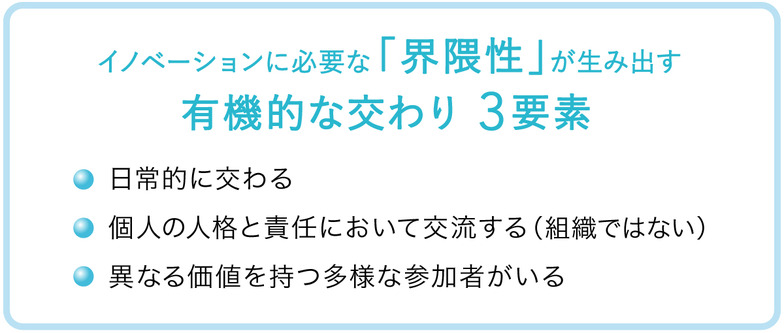
To achieve the multiplicative potential that creates new value, it is crucial for values to intertwine organically. It is this "community-based nature" that fosters organic connections and becomes the cradle of innovation.
So, what is this "organic interaction" that community spirit enables? It differs significantly from the kind of interaction seen in business matchmaking events where many business cards are handed out, or at business seminars where speakers and attendees exchange cards.
Those interactions are based on one-off, non-routine "events," whereas the organic exchange fostered by community-based interaction is grounded in a "community" involving daily contact. Furthermore, for truly organic interaction to occur, each participant must act as an individual, not as a representative of their organization's corporate identity.
The diagram below illustrates the "ease of fostering organic interaction."
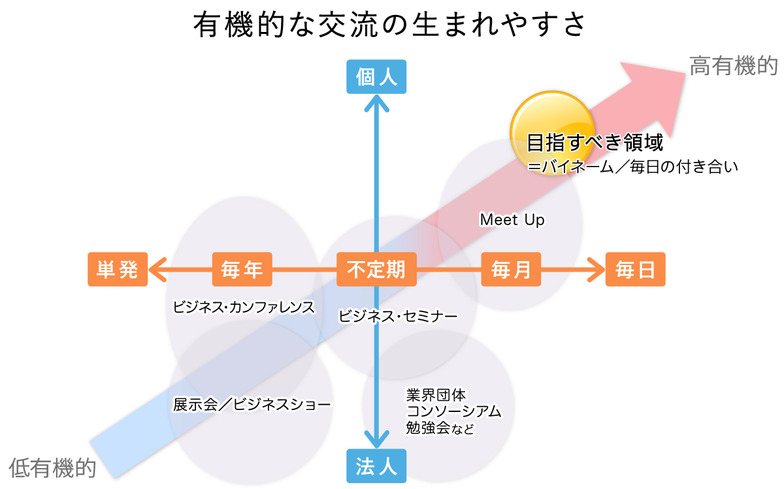
Creating "Daily Interaction Spaces" from "Annual Events"
Born in 2016 precisely as this cradle for innovation is FINOLAB Inc., the incubation office I've been involved with since its conceptualization and launch. Located in the heart of Otemachi, Japan's largest financial district, it fosters a fintech* community enabling daily organic interaction.
*FinTech: A portmanteau of Finance and Technology. It refers to the power to transform society, enabling "anyone," "anywhere," to benefit from convenient financial services through the power of technology.
The catalyst for FINOLAB's establishment was the FinTech Business Conference ( FIBC ), an annual event organized by Dentsu Inc. International Information Services (ISID) since 2012.
As Japan's only fintech event, it attracted high-caliber participants, fostering connections between investors, corporations, and entrepreneurs to nurture business. However, it did not evolve into a community enabling regular, daily interaction.
Amidst this, Chie Ito, leader of the FIBC team, approached us with the request: "We want a place for daily interaction, not just event-based meetings." This led to the establishment of Finolab. When participants meet at a one-off event like FIBC, reconnecting requires scheduling an appointment. This involves contacting each other, coordinating dates and times, and traveling somewhere – a significant effort.
However, creating a "permanent place to connect" (which is exactly what Finolab is) eliminates the need for appointments. It's a world where you can strike up a conversation while having coffee, bump into someone in the hallway, lounge, or elevator, or simply ask "Are you around now?" via phone or messenger. Of course, for complex discussions, you'd schedule time in advance and use a private room. But in the lounge, impromptu business meetings and brainstorming sessions happen routinely. Other people nearby might even join the conversation.
Creating a space where people build relationships as individuals
In "organic interaction," the name of one's organization serves as reference information, but it is not the subject.
Among Finolab members and associates, what matters isn't that I'm a Dentsu Inc. employee; what's valued is information like "What does this person want to do?" and "What can this person do?"
The larger the corporate entity, the more the name and presence of the affiliated company tend to overshadow the individual's name. However, "organic interaction" is, at its core, the very essence of "raw human relationships." In today's SNS-dominated world, it's commonplace to learn about someone's character from mutual friends who discovered them on social media, or to reference their relationships and community affiliations by looking at their friend list. People grow through interactions where they introduce or are introduced to others, help or are helped, and mutually challenge and develop each other. Daily conduct determines whether business opportunities are gained or lost.
While I wouldn't go so far as to say every single gesture matters, it's about understanding and accepting that the accumulation of your actions will all come back to you. Yet, it's also about maintaining a comfortable tension while trusting and being at ease with each other. That, I believe, is "organic interaction" and the very source where innovation springs forth. To put it formally, that is.
Multiplying distinct values: Top-tier financial talent × Top-tier tech talent
From the outset, Finolab has championed creating organic interaction between financial and tech talent. We began by interviewing top financial professionals, their associates, and alumni: "Where are the top financial talents?" "Where do they want to be or go?"
The responses were fascinating. "Top financial professionals are in Marunouchi and Otemachi. They refer to leaving that area as 'falling from grace' and detest it." While opinions may differ, this is a highly suggestive statement. It made us sense that trying to move financial talent elsewhere might not work.
Next, we interviewed "top-tier tech talent." Here, tech talent refers to executives and CTOs at tech startups. While they like the Shibuya area, once called Bit Valley, because many competitors are there, they don't have a strong attachment to it. Their biggest concern is the heavy fixed cost of "rent" (which is why they aren't clustered in Shibuya now, but spread out to places like Yoyogi, Ebisu, and Gotanda).
Furthermore, when we asked "tech talent" specifically interested in fintech, "Why not establish a base in Marunouchi or Otemachi?", the response was, "We'd go if we could, but the rent is too high."
Finolab's original concept was to create a neighborhood where "top-tier financial talent" and "top-tier tech talent" could interact, a place where these two groups intersect. We envisioned a mechanism where these two groups, who typically don't mix, could freely interact and fuse their values, sparking fintech innovation.
Pursuing Innovation Through Portfolio Management
In Japan, the movement to drive innovation still feels very much in a transitional phase. The mindset focused on cutting costs and streamlining to pursue daily sales and profits remains the mainstream, doesn't it? This applies not only to urban development but to various industries and business models, including manufacturers and our advertising agencies. When listed companies pursue shareholder profits, the structural challenge may be the inherent need to generate short-term gains.
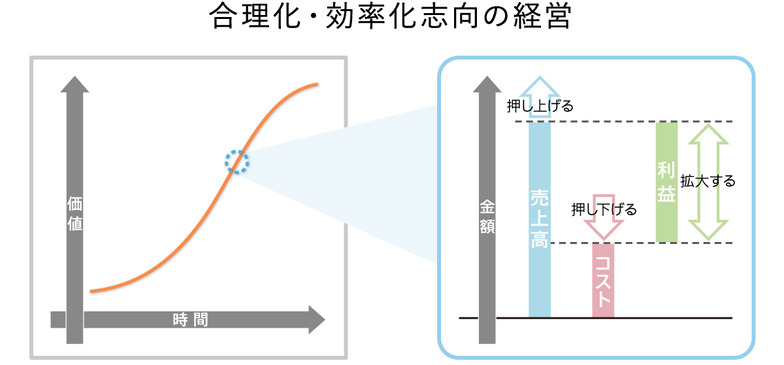
Conversely, the concept of "neighborhood character" often involves elements that seem somewhat "wasteful" from a short-term profit perspective. It advocates for pursuing elusive innovation with a success rate as low as one in a thousand.
While ingenuity and approach can increase the probability of generating innovation, determining its success or outcomes takes considerable time. Even after investing that time, success is never guaranteed. Moreover, judging when to call it a failure is extremely difficult. Something pursued for years, deemed "no good, let's quit," might suddenly spark innovation and achieve a major breakthrough due to a minor trigger.
Perhaps only those with the stamina, resolve, strong will, and clear conviction to persistently invest in something that yields no immediate profit can truly "pursue innovation."
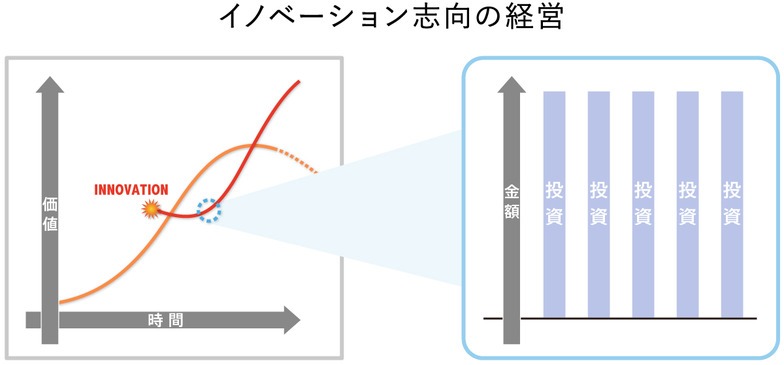
For companies that have pursued short-term profits, the key to balancing profit with innovation is to avoid a "single-point focus" and instead practice "portfolio management" by investing across multiple innovation areas.
Pursuing innovation is almost like gambling. Therefore, if a company concentrates all its investment capacity on a single innovation area, failure in that one area could lead to bankruptcy.
Instead, to pursue innovation for sustainable growth, companies must envision a structure where "investing in 100 innovations, even if 99 fail, allows the success of one to recoup all losses and generate substantial profit." This requires exploring innovation potential across multiple domains.
However, spreading too thin and investing too little in each innovation will cause all of them to fail. Neither spreading too wide nor focusing too narrowly is good. It requires highly sophisticated discernment, yet these must be managed collectively as a portfolio. This is precisely the domain where the quality of management strategy becomes evident.
Take the world of general trading companies, where this portfolio management approach is credited with enabling dramatic turnarounds. It's said that when a major trading company's executive was pressed by shareholders at a general meeting to "withdraw from unprofitable or low-margin development businesses," he responded with a bold statement: "Even if it doesn't generate profit today, this is an area that will shape our company's future, so we will never withdraw. If you oppose this, feel free to sell your shares or fire me." This is a very delicate balance, but it truly exemplifies the art of management.
So far, I've explained innovation from the perspective of relatively large companies. However, I don't believe startups need to engage in portfolio management. They should focus single-mindedly on the business they believe in, charging ahead to scale it up. That's what most of you do anyway.
You might say, "But you just wrote that failure means bankruptcy!" However, startups should inherently be okay with going bankrupt. They should focus all their energy on one thing. If that business doesn't hit the mark, they go bankrupt, start another company, and focus all their energy on that.
This cycle—the difference between a business environment that allows retries and one that doesn't—directly impacts how easily innovation emerges. I feel Japan is in a transitional phase regarding this very point.
Was this article helpful?
Share this article


Newsletter registration is here
We select and publish important news every day
For inquiries about this article
Author
Toshiaki Hasamura
Dentsu Inc.
Business Development & Activation Division