
Note: This website was automatically translated, so some terms or nuances may not be completely accurate.
 Thinking About "Thinking of" ~ Peeking Behind the Scenes of Ideas [2/2]
Create sparks-flying encounters
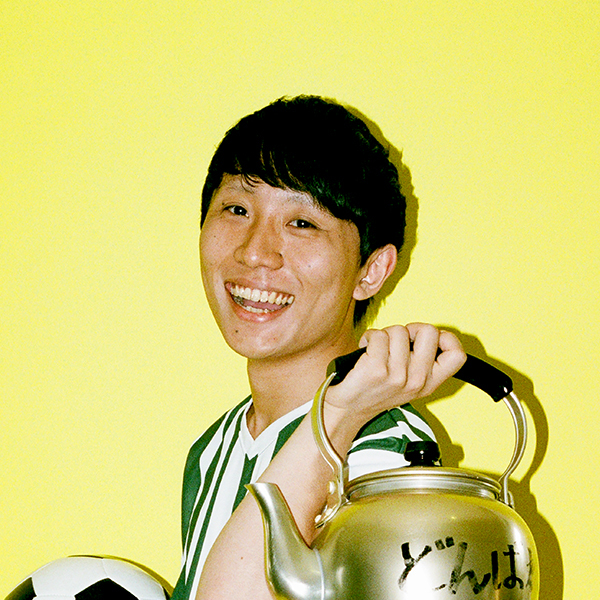
Shinpei Mizumoto
Dentsu Inc.
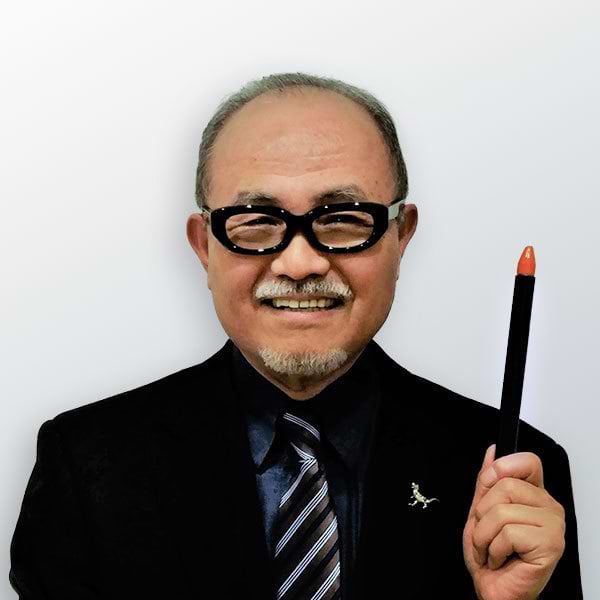
Sakaguchi Yoshiyuki
Ad Museum Tokyo
This series delves into the thought processes leading to great ideas, categorizing them into nine unique themes to uncover the true nature of "coming up with ideas." In this second installment, we examine the theme "Trying to Combine Things."
Golden Week 2017. When I returned to my parents' home in Osaka, my mother was looking at a newspaper ad and said, "This is interesting~. How do they come up with stuff like this?" I peeked over her shoulder. It was an ad for the 'Poop Kanji Drill Inc.'. Seeing my mother, who has neither children nor grandchildren of kanji-learning age, looking at the example sentences in the ad and seeming ready to buy it right then was a bit of a shock.
It teaches kanji using example sentences featuring "poop."
The 'Poop Kanji Drill Inc.' is built on this incredibly strong 'concept'.
But this book's concept isn't something only publishing industry professionals could come up with.
I'm not saying anyone could have thought of it.
The passion of the development team and the immense effort required to bring it to completion, as described later, were extraordinary.
But I believe it was a concept anyone could have conceived of.
I felt it bore a certain resemblance to the "concepts" we usually think up for advertisements.
With the same creative energy used to develop advertising concepts, we might have been able to create a bestseller.
That's the kind of broad creative potential I sensed.
I realized how narrow my own perspective was, just calling it "advertising planning."
This experience led me to decide that the theme of the exhibition I was beginning to plan (the "Thinking About 'Thinking Up'" exhibition currently at Ad Museum Tokyo, running until February 24th) would be the word "think up," and that this book would be one of the key examples featured.
(To put it bluntly, I was jealous of the planning behind 'Unko Kanji Drill Inc.')
Theme 1: "Trying to Stick Them Together"
A method of coming up with ideas by connecting two distant things.
Examples include "Failure Teacher" and "Rice Burgers." By combining disparate elements, countless products and projects have been born. In 2017, a supernova appeared in this "Let's Try Combining Things" realm: the 'Poop Kanji Drill Inc.'.
A completely new kanji drill that combines "poop" and "kanji drill Inc." Released in March 2017, it became a sensation for its 3,018 example sentences—all using "poop"—and has been a massive hit, selling over 2.7 million copies as of December 2017.
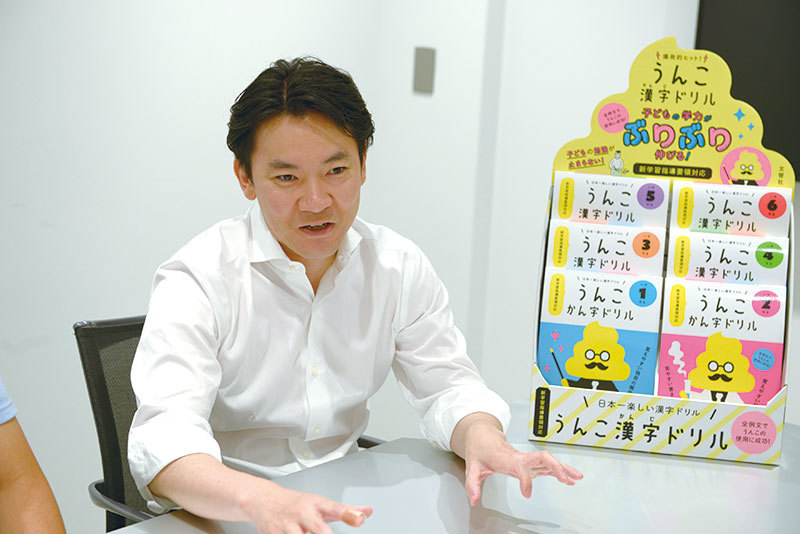
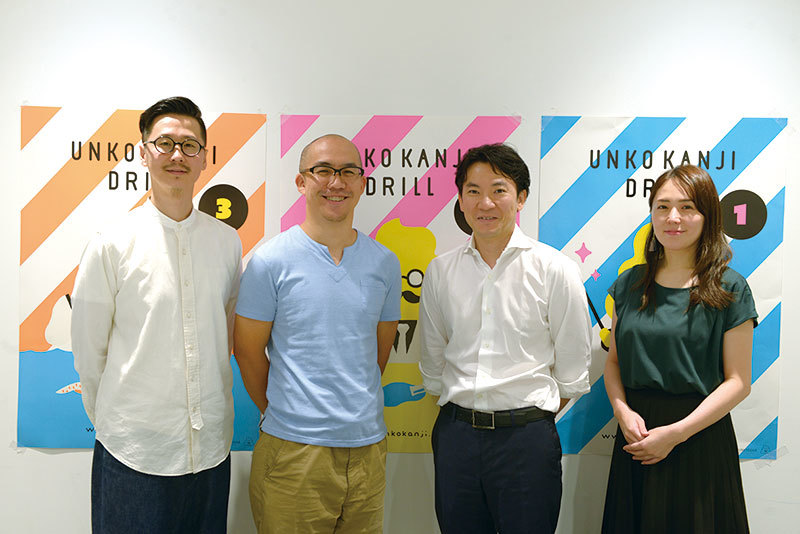
This time, we asked the development team behind this best-selling Drill Inc.—Bunkyosha President Shuji Yamamoto, all-example creator and video director Yusaku Furuya, and Bunkyosha Art Director Ren Kodera, who designed both the cover and all the contents single-handedly—to revisit the path that led to its conception. We'll organize their journey from idea to completion through three "Let's Try Combining..." moments.
An interesting perspective: Let's try combining them
− Poop is bobbing up and down
− Poop clatters along
As adults, unlike when we were elementary school kids, just hearing the word "poop" doesn't make us laugh anymore. Noticing this gap, Mr. Furuya aimed to create "poop" humor that even adults could laugh at. He named his formulaic poems using "poop" + "onomatopoeia" "Poop Senryu" and has published over 400 works since 2003. The response from those around him was excellent, so he pitched the idea to publishers with the goal of publishing a book, but the days of struggling continued.

From a business perspective, I tried combining them
Fascinated by his middle school friend Furuya's idea for "Unko Senryu," President Yamamoto promised Furuya he would publish it under his company. However, as he began to think more realistically about turning it into a book, business concerns started to surface: "If it's just a book introducing senryu, who on earth would buy it, and why?"
Fundamentally, Bunkyosha wasn't an established publisher. It was a venture founded by Mr. Yamamoto ten years prior, driven by the vision of infusing entertainment elements into the self-improvement field. As an extension of that vision, his next challenge was "Education + Entertainment." While contemplating this challenge and reviewing numerous masterful Unko Senryu, he thought, "If we're going to tackle the education genre with these Unko Senryu..." and then "Kanji" came to mind.
"With kanji, the material to memorize is fixed, so even Bunkyosha, which had never made a textbook before, could do it. As a test, I asked Mr. Furuya for example sentences for first and sixth graders. And the example sentences I saw were immediately interesting." Thus, from the concept of "poop senryu + education," the 'Poop Kanji Drill Inc.' project began.
Japan's Most Fun Kanji Drill Inc. That's what's written at the very top of the cover of the 'Unko Kanji Drill Inc.' The concept of creating a textbook that makes you laugh out loud never wavered from development through release; whenever we hesitated, we came back to this.
From a design perspective, we tried combining them
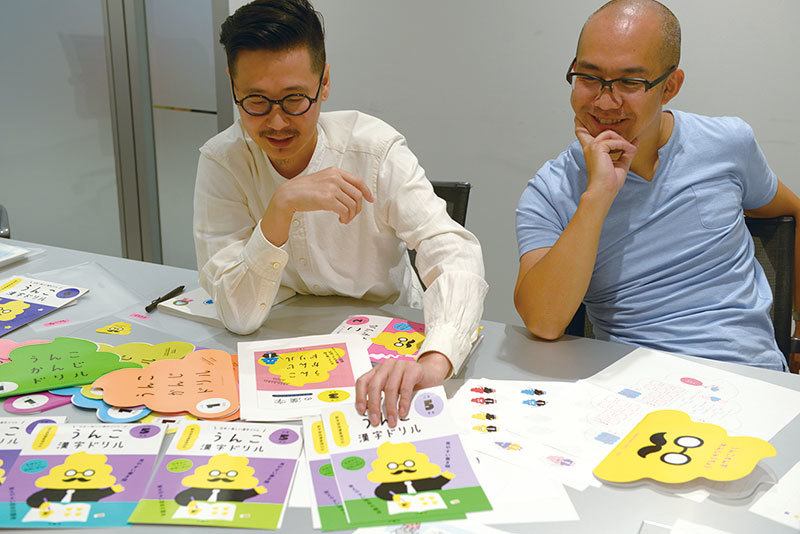
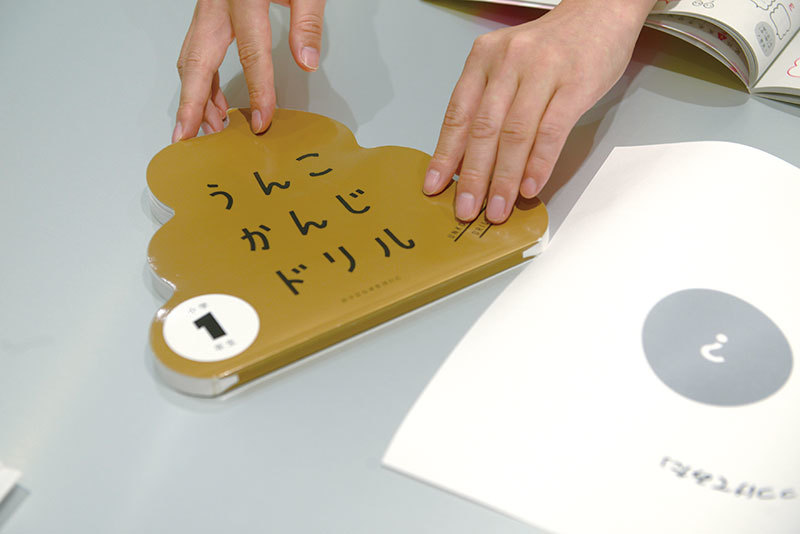
The design aims to create an impact that rivals the humor of the example sentences. Designer Kotera-san meticulously focused on the book's shape and cover color, creating an unprecedented number of prototypes to achieve this.
The obsession wasn't limited to the cover. Researching learning reference books on bookstore shelves revealed that while covers were often well-designed, the crucial interior page design rarely stood out. They tirelessly experimented to create page designs that both highlighted the humor of the example sentences and made learning easy.
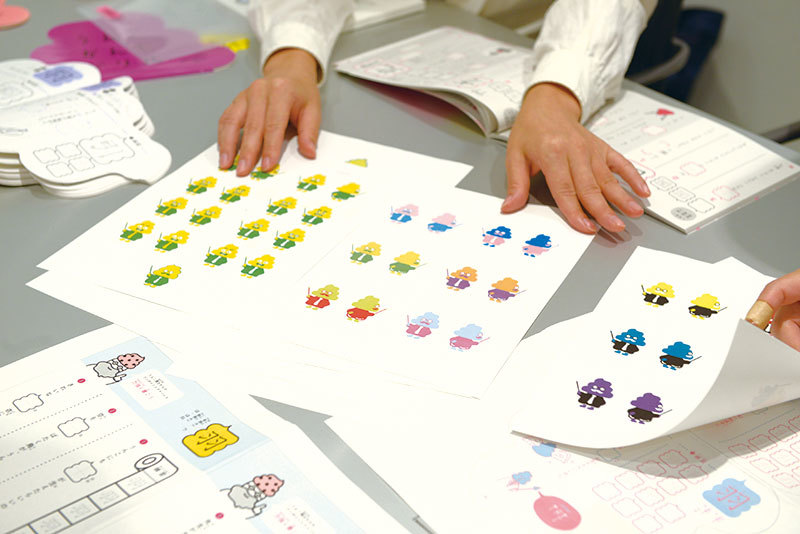
Furthermore, he poured effort into developing "Mr. Poop," the character offering study advice within Drill Inc. After numerous revisions, he settled on a design beloved by everyone.
A Victory of Teamwork and Overwhelming Passion
Preparing for the exhibition, the more we delved into the act of "coming up with ideas," the more we realized that great ideas exist at the intersection of "universal thinking" and "unique passion."
Advertising examples using "just sticking things together" probably pop into the minds of Dentsu Inc. readers by the dozen in an instant.
James W. Young also said, "An idea is a new combination of existing elements," showing how universal the underlying thinking can be. Yet, no one created the 'Poop Kanji Drill Inc.'.
Mr. Furuya's obsession and tenacity, thinking about "poop" for over ten years.
President Yamamoto's business perspective, constantly wondering if entertainment could be integrated into education.
And the design skills of Kotera, who spared no effort in creating Drill Inc. that was both easy to use and exciting.
It was the overwhelming passion and teamwork of these unique developers that gave birth to the 'Poop Kanji Drill Inc.'.
>> Next time (Part 3), we'll introduce Theme #2: "Trying to Draw It."

Based on Edo-period advertising examples featured in the Ad Museum exhibition, we'll present cases of Edo-style "putting things together."
Kabuki as advertising theater?!
Kabuki linked Yoshiwara brothels with products!
"Sukeroku Yūen Edo Sakura" is a kabuki play packed with advertisements, featuring real product names appearing one after another throughout the performance. Set at the Shin-Yoshiwara brothel "Miuraya," it featured tie-ins with Yamakawa Shirozake sake, Fukuyama udon noodles, and the miracle medicine "Sode no Ume" (Plum of the Sleeve). It's what we'd call product placement today.
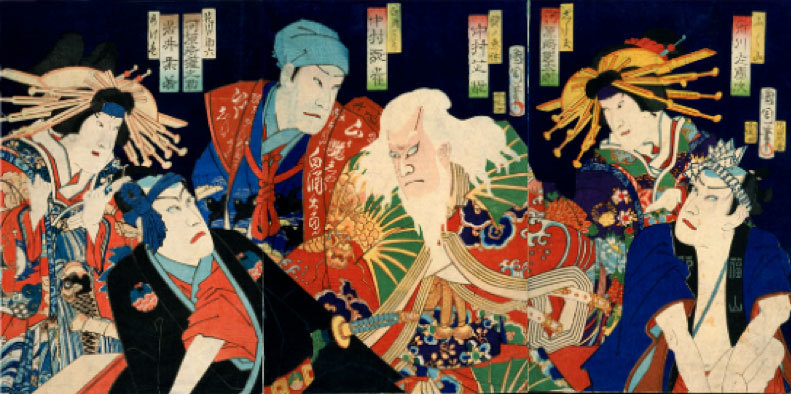
This "Sukeroku play" is a revenge drama centered on the protagonist "Sukeroku" and his lover, the courtesan "Agemaki". The setting is the real-life Shin-Yoshiwara brothel "Miuraya".
The entire play functioned as an advertisement for Yoshiwara. In the heroine Agemaki's entrance scene, she parades down the hanamichi (flower path) while drinking the hangover cure "Sode no Ume." The role of Sukeroku's brother was played by a Yamakawa Shirozake sake seller, the eccentric servant by a morning glory senbei cracker vendor, and the delivery boy by a Fukuyama udon noodle seller. Real product names appeared one after another. Riding the wave of "Sukeroku's" immense popularity, these products also drew large crowds.
Kabuki of this era was considered one of the two great dens of iniquity alongside the Yoshiwara pleasure quarter, yet it was also a trendsetter. As mass entertainment, it enjoyed immense popularity, being Edo's premier pastime. For commoners, kabuki actors were superstars; fashions emerged from their costumes and lines.
Large theaters like Nakamura-za and Ichimura-za lined the Nihonbashi area, where people enjoyed plays from dawn until dusk. Popular plays and actors were depicted in ukiyo-e prints sold at picture book shops, making them a mass art form adored by town girls and even the inner chambers of Edo Castle. These prints also spread nationwide as souvenirs for travelers, samurai, and daimyo, becoming famous Edo souvenirs.
Corporate Tie-Ins in Kabuki as a Media Platform
However, not every kabuki play featured advertisements.
Several plays created and performed by the second-generation Ichikawa Danjuro (1688–1758) stand out as notable examples of advertising plays. According to Saburō Matsumiya's Kabuki and Advertising, Danjuro's first play created for advertising purposes was "Kotobuki no Ji Echigoya" (1715), featuring a kimono merchant.
The second was "Uiro Seller" (1718), a play about a medicine seller peddling "uiro" herbal confectionery from Toraya in Odawara. Danjuro's fluent and eloquent long soliloquy captivated audiences and became a huge hit. In later times, it became one of the Ichikawa family's Kabuki Juhachiban (Eighteen Masterpieces), alongside "Sukeroku".
Having lost his father, the first Danjuro, at an early age, the second Danjuro was passionate about establishing and elevating the Ichikawa family's artistry. One aspect of his brand strategy was leveraging media.
While kabuki itself was an influential medium, he incorporated corporate tie-ins within the plays, published scriptbooks like "Uiro-uri," and even had sponsors invite group audiences, boosting revenue for the theater.
Eventually, during performances of "Sukeroku," Yoshiwara and Uogashi (fish markets) began providing props and gifts, creating a new relationship between actors and their patrons.
In this way, the popularity of the thousand-ryo actor, Danjuro, skillfully mobilized the media, solidifying his unshakable status.
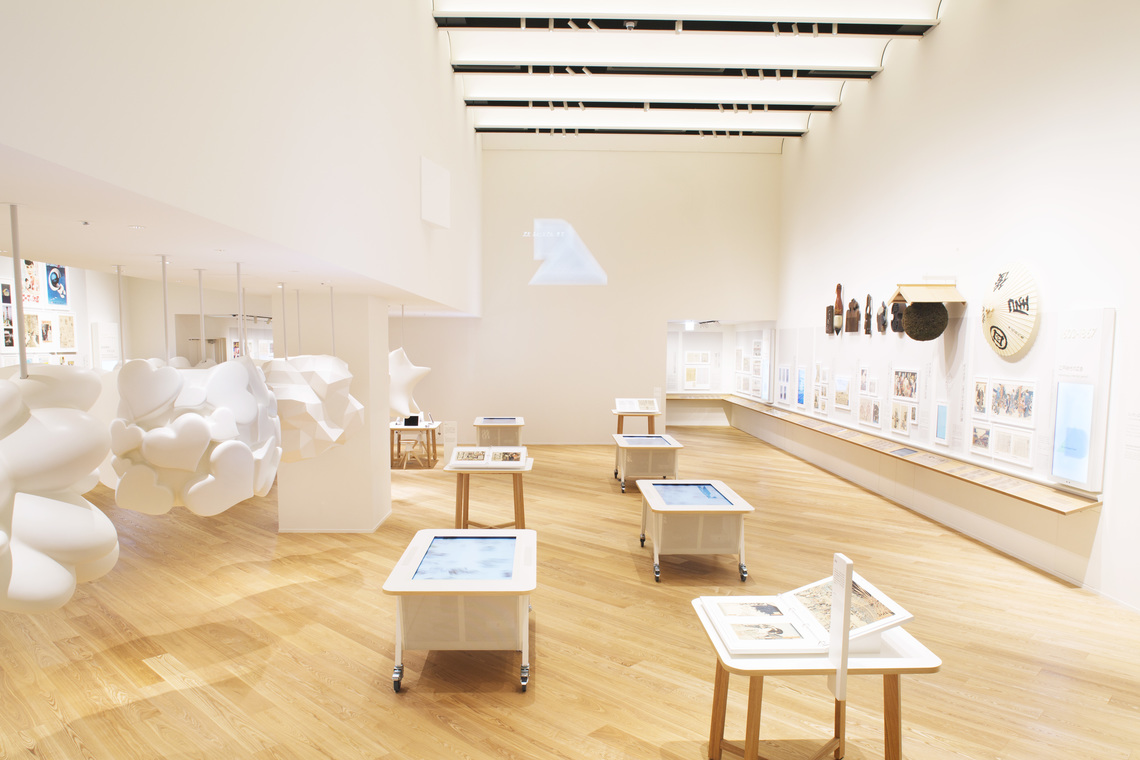
A globally unique museum dedicated to advertising, featuring exhibits on the history of advertising since the Edo period and a specialized library on advertising and marketing.
It houses 300,000 historical advertising materials covering all media and approximately 27,000 specialized books. The library allows searching and viewing digital archives of books and advertising works. This museum is a place to learn about advertising's social impact and cultural value, a treasure trove of ideas that move people. Experience for yourself that "advertising really is fascinating."
Welcome to Ad Museum Tokyo.
Was this article helpful?
Share this article


Newsletter registration is here
We select and publish important news every day
For inquiries about this article
Author
Shinpei Mizumoto
Dentsu Inc.
5th CR Planning Bureau
Copywriter/Planner
Articles by this person
Sakaguchi Yoshiyuki
Ad Museum Tokyo
Curator