
Note: This website was automatically translated, so some terms or nuances may not be completely accurate.
 Place branding—it makes you want to create a place! [2/5]
The Secret to Successful Place Branding: "Direction Capability"
Hiroyasu Wakabayashi
Dentsu Inc.
In the first installment, we discussed what place branding is. This time, we will explain how we should direct our efforts to create good places.
The Five Phases of Place Branding Direction
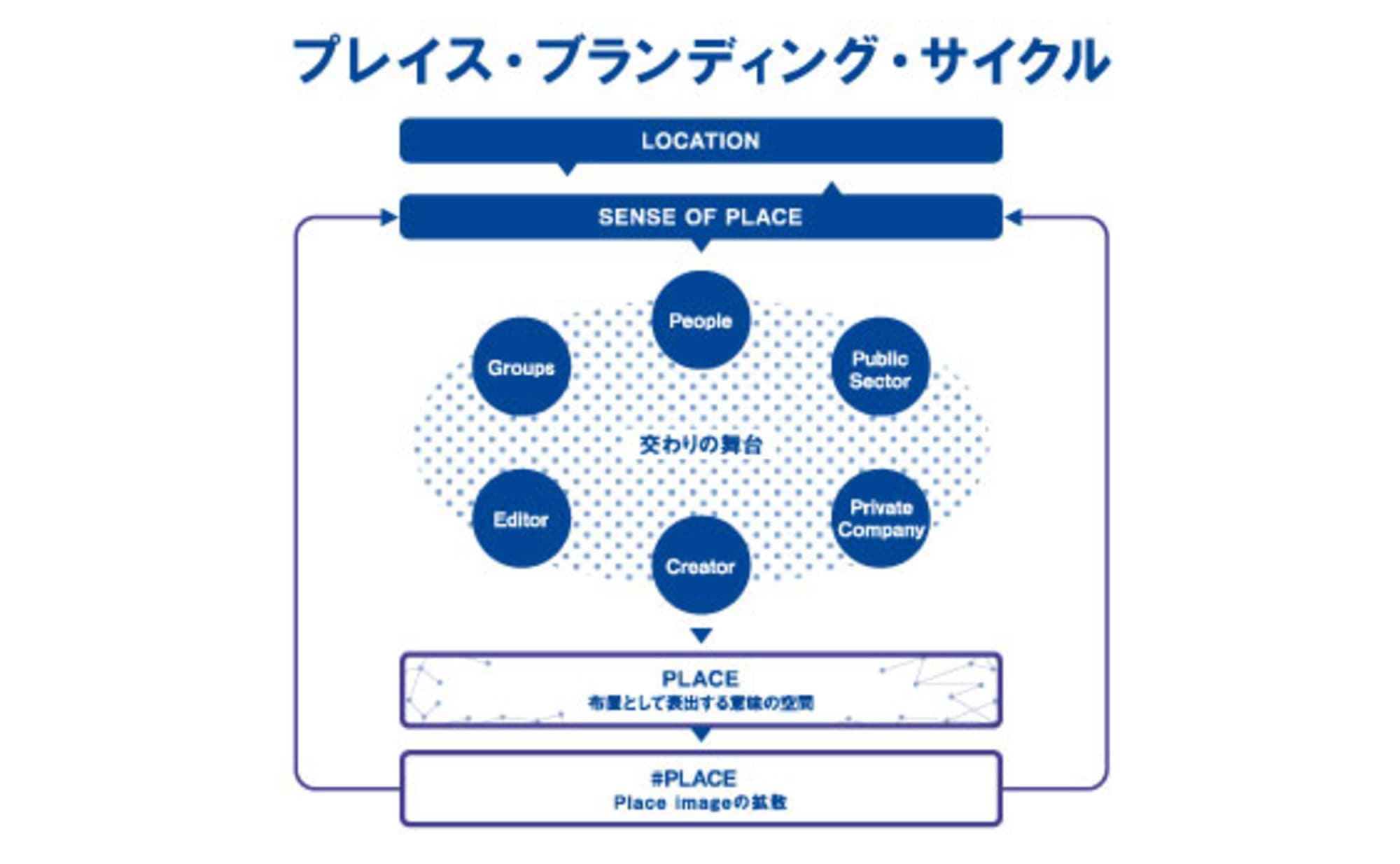
"Place Branding Direction" organizes the key actions required across five critical stages aligned with the Place Branding Cycle. Let's explain them step by step.
[Figure 1] Place Branding Direction
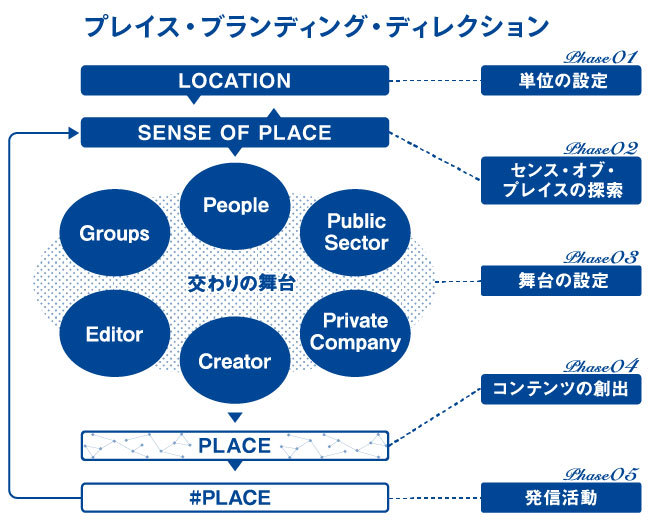

Defining the unit of the place is a critical decision that will determine future success or failure. Therefore, it is necessary to explore the potential of various units. For example, the unit of a city like a "core city" with a population of 200,000 to 500,000 people, or units like "districts," "streets," and "alleys" within a city also hold potential.
Furthermore, "wide-area regions" like "Setouchi," "Shonan," and "Sanriku," "routes" such as the "Shimanami Kaido," and even "along-line areas" like the JR Chuo Line or private railway lines in the city center also hold significant potential as units for place branding.
There is no single correct answer for setting these units. The key to success lies in identifying the optimal unit while sensing the place and its meaning (sense of place).

So, how do we uncover this sense of place? As exploration methods, we interview people who live there, use data mining techniques to quantitatively analyze the meanings associated with the place, and meet with editors engaged in locally rooted publishing activities to explore the place's significance.
Sometimes residents have a vague sense of the place's meaning but struggle to articulate it. Other times, the meaning is already somewhat conscious. We give "words" to these latent meanings of the place.
However, the chances of a place truly coming alive are extremely low if it relies on safe, generic phrases like "a green, culturally vibrant city" that many towns and cities promote. That said, we don't need literary copy either. We believe success comes when we find words that everyone can embrace and weave stories together.

Once the concept of the destination begins to take shape, we create a platform where people who can embody it can connect. For this, understanding the network of people is essential. Leveraging reliable administrative networks and the power of community editors, we aim to connect with key actors.
Understanding their past activities, we explore whether collaboration could spark interesting content. Crucially, participants must perceive tangible benefits. Without perceived value, it becomes forced, and self-sustaining momentum is impossible. Furthermore, the platform must never be closed; fostering serendipitous encounters is vital.
Once potential actors engaged with the place become visible, organizing them is effective for establishing a social presence. That said, coordinating many actors' interests can be challenging, so the key is to start small with an organization built around core members. Launching it as a social project as the first step will gradually attract new actors who share its vision and aspirations.
Furthermore, involving companies as actors enables more powerful activities. While companies have traditionally focused on CSR (Corporate Social Responsibility) centered on community contribution, they are shifting towards CSV (Creating Shared Value), aiming to solve local issues through their core business. To connect with CSV-oriented companies, it is necessary to deeply understand their management philosophy and brand strategy and identify points of connection with the place.
Connecting with influential actors in this way encourages government support for rising public sentiment. With various support programs available today, particularly for regional revitalization, we secure funding tailored to the project after fully understanding these support mechanisms. Through such meticulous activities, the scattered aspirations of actors connect, and the stage for interaction begins to move.

Once the actors become visible, the stage is set to create content. In its narrowest sense, content refers to videos, photos, and text. Here, however, content is a broad term encompassing all outputs—both tangible items conveying the essence of the place and intangible experiences. Specific types of content include those shown in Figure 2.
[Figure 2: Types of Content]
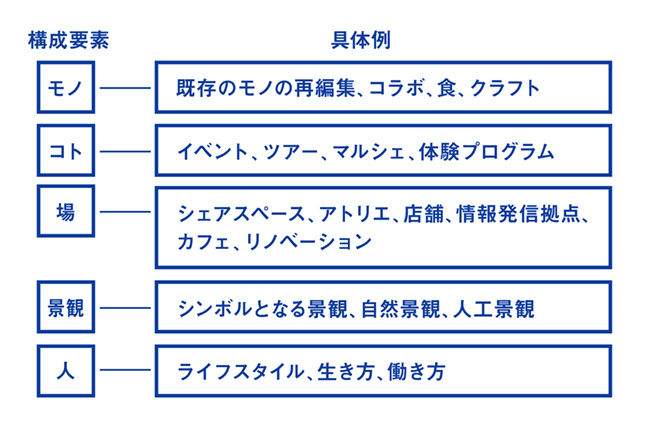
"Things" are the most accessible content conveying the place, while "Experiences" are crucial content providing unique, on-site experiences. "Space" becomes vital stage equipment fostering human connections and generating new content. "Landscape" is key content circulating the place's image in today's SNS-driven world. And "People" also become indispensable content for conveying the place's philosophy and lifestyle.
While diverse content exists, creating just one element alone does not generate a place. "Things," "Experiences," "Places," "Scenery," and "People" must fuse in balanced harmony—not as isolated points—and organically expand as a cohesive whole to evolve into a rich place.

Once content is created, it's time to disseminate it to the world. At this stage, we communicate the place's vision as an organized project involving various actors. Crucially, information should be designed based on PR IMPAKT※ to increase its newsworthiness.
PR IMPAKT is a tool combining keywords to create impactful news. These are, in order: "Inverse (paradox, opposing structure)", "Most (superlative, first, unique)", "Public (social relevance, locality)", "Actor/Actress (human interest, character)", "Keyword (keyword, numbers)", and "Trend (current trends, social climate, seasonality)".
By creating multi-layered news contexts using these perspectives, we aim to secure coverage across various media, from mass media to web and social media.
Design also serves as a crucial means for conveying the worldview of the place. However, for a place, unifying the design of content created in diverse forms is challenging.
Therefore, it is advisable to develop highly versatile designs and create a system where various actors can utilize them. For example, democratic designs that are easy for actors to participate in, such as logos and universal formats, are required.
Communication in place branding differs from advertising campaigns, which can be planned with sufficient budgets. Place branding often faces constant budget constraints, making planning difficult.
Therefore, the key is to initiate communications that aggregate small efforts through "content" people want to share, "stories" people want to write about, and "designs" that encourage widespread participation. As a result, the "place name" spreads in multiple layers, achieving branding.
*PR IMPAKT is a program by the Dentsu Group that maximizes the effectiveness of integrated marketing strategies from a PR perspective.
What is the required directional capability?
Do you understand how to proceed with place branding? What is most required to create a good place is not management skills, but "direction skills."
Management skills are needed when executing plans toward clearly defined goals, but places rarely progress that smoothly. What's required is the skill to navigate unexpected events and integrate disparate activities, steering things toward positive change—that is, "direction skills." If individuals possessing such abilities become Place Directors and actively work throughout Japan, the country will surely become more vibrant.
Now, next time we finally introduce case studies. By learning about specific examples, I hope you'll gain a deeper understanding of place branding.
Was this article helpful?
Share this article


Newsletter registration is here
We select and publish important news every day
For inquiries about this article
Back Numbers
Author
Hiroyasu Wakabayashi
Dentsu Inc.
Solution Creation Center
Creative Director
Promoting the 'Art Circuit' project, which utilizes art in business. Developed the art thinking program "Vision Sketch" and conducts workshops for a wide range of participants, from children to business professionals. Also advancing <a href="http://www.dentsu.co.jp/abic/" target="_blank">the 'Dentsu Inc. abic project'</a> (abic), a branding initiative targeting various regions and locations across Japan. Established Dentsu Inc.'s unique platform consolidating methodologies, practices, and insights related to "place branding."<br> <p></p><br> <主な著書> <br> 2009 "Regional Brand Management" (co-authored, Yuhikaku)<br> 2018 "Place Branding: From Regional to Place Branding" (co-authored, Yuhikaku)<br> 2019: 'Art in Business: The Power of Art That Works for Business' (co-authored, Yuhikaku)<br> 2021: Imagination Becomes a Weapon: An Introduction to "Art Thinking" (PHP Institute)<br>