
Note: This website was automatically translated, so some terms or nuances may not be completely accurate.
 Place branding—it makes you want to create a place! [5/5]
What is essential for a successful DMO (Destination Management Organization)?
Hiroyasu Wakabayashi
Dentsu Inc.
Recently, the theme of "DMO" has been gaining attention as a key strategy for regional revitalization. DMO stands for "Destination Management/Marketing Organization." Simply put, it translates to "tourism management organization." In this final installment, we will clarify the overview and challenges of DMOs while explaining the essential place branding mindset required for establishing them.
What exactly is this "Japanese-style DMO" we keep hearing about?
In the "Comprehensive Strategy for Creating Towns, People, and Jobs" approved by the Cabinet in December 2014, DMOs were identified as one of the pillars of regional revitalization. Experts define a DMO as "a business consortium involving local government and private sector operators in tourism" and "a professional organization with expertise and authority." *While the concept already existed overseas, the "Japanese-style DMO" is one tailored to Japan's current circumstances.
The Japanese DMO model comprises three types based on regional scale: "Wide-Area Collaborative DMOs" (covering prefectural units), "Regional Collaborative DMOs" (covering municipal units), and "Regional DMOs" (covering single municipalities). The national government aims to actively support future DMO candidates that meet the following five criteria.
*Edited based on Kazuo Takahashi (2017), "DMO: Innovation in Tourism Destination Management," p. 198.
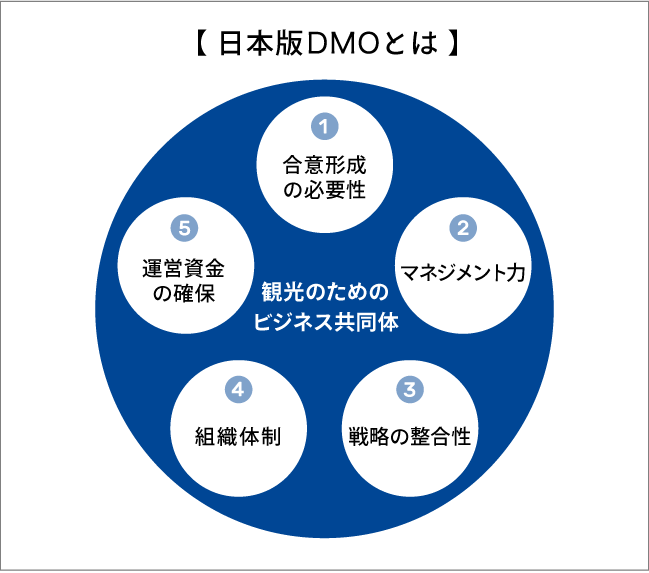
① Mechanisms for consensus-building among diverse stakeholders are established.
② Management utilizes data.
③ Alignment exists between stakeholders' projects and overall strategy.
④ The organization has legal status and clearly defined responsible parties.
⑤ Stable operational funding is secured.
Common Ground Between DMOs and Place Branding
As explained throughout this series, place branding involves assigning meaning to places—whether districts, streets, towns, cities, or regions—using flexible units. It involves engaging diverse actors like private companies, government, and citizens to sustainably create a "place." Let's explore the commonalities between this place branding and DMOs.
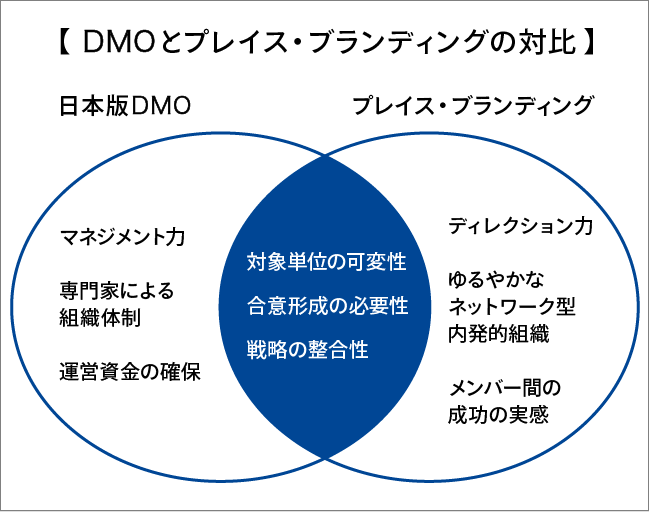
DMOs emphasize strategically defining the target unit, fostering collaboration between government and private sectors, and advancing initiatives through consensus-building among diverse stakeholders. This core essence significantly overlaps with place branding.
While DMOs focus on establishing formal organizations and management structures, place branding demands the ability to create loose networks among diverse actors. Rather than pure management skills, it requires the directional capability to steer efforts toward a shared vision. This may be the key difference.
Case Study of a DMO Initiative: The "Land of Suwa" Project
Let's examine an initiative in Nagano Prefecture's Suwa region that aimed to establish a regional collaborative DMO. The Suwa region comprises six municipalities: Suwa City, Okaya City, Shimosuwa Town, Chino City, Fujimi Town, and Hara Village.
The region faced challenges due to limited inter-municipal collaboration, resulting in fragmented initiatives across different areas. Furthermore, the core assets differed between the area centered around Lake Suwa and the area centered around Mount Yatsugatake, creating a difficult background for integration.
Therefore, taking the opportunity of the Onbashira Festival—a major festival held every seven years that represents the region—efforts began to create a unified brand. To break down barriers between areas, we engaged in repeated dialogue with people from each locality and developed the Suwa region's brand concept.
To us outsiders, this region was brimming with mysterious and wondrous things and events. During the Onbashira Festival, the four shrines of Suwa Taisha, which surround the Suwa region, perform a sacred ritual where the entire town unites to manually bring down 16 pillars from the mountains, transport them to each shrine, and erect four pillars at each.
Meanwhile, in Chino City, you can see the charming yet slightly eerie Jomon Venus, a clay figurine from the Jomon period.
Other attractions include the perilous floating tea house "Takasugi-an," and Okaya City's silk thread production, offering a glimpse into the mystical process between nature and human hands—how thread is spun from silkworms.
Furthermore, Lake Suwa freezes over in winter, occasionally cracking with audible sounds. Locals interpret this natural phenomenon as traces left by the gods crossing the ice, calling it "Omivatari" (Divine Crossing).
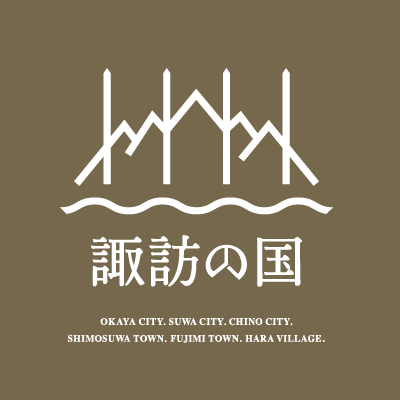
From an outsider's perspective, the Suwa region began to feel like a "unique land brimming with mystical tales." Based on this emerging brand concept, a logo combining the three symbols representing the area – "Lake Suwa," "Onbashira," and "Mount Yatsugatake" – was created by a local designer, launching the "Land of Suwa" project.
Shortly after the project began, a happy coincidence occurred. At that very moment, a group of young entrepreneurs were planning initiatives to revitalize the Suwa region. Recognizing shared concerns, we decided to collaborate.
The first initiative was Yatsugatake's "fresh corn." A young farmer who had returned to Hara Village began selling "corn sweeter than melon." A Suwa native running a restaurant in Tokyo developed sweets using this corn as an ingredient. Shingo Fujimori, also from Suwa, promoted these products.
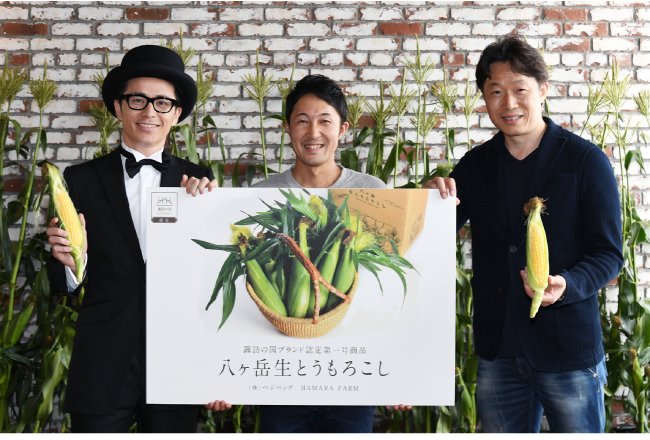
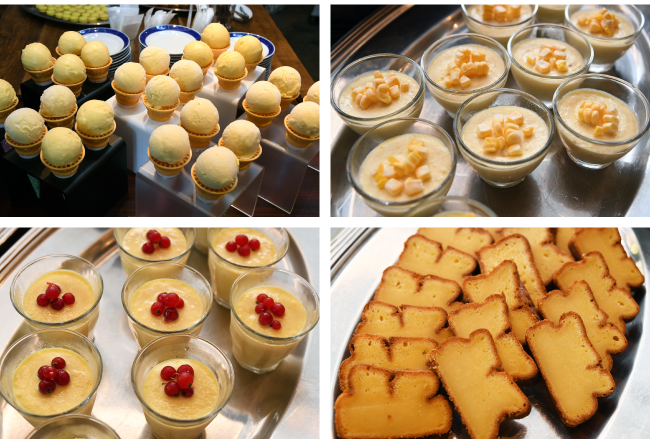
The passionate dedication of Suwa natives resonated with journalists, leading to extensive media coverage. Naturally, sales of "fresh corn" were excellent, and momentum grew for the spontaneous creation of second and third new "Land of Suwa" content. Building on this solid foundation, establishing a DMO in the future is expected to proceed smoothly.
*For details, please see the Dentsu Inc . News.
Avoid "rushing into a DMO" and instead focus on building a solid foundation through "place branding thinking."
While still a work in progress, this is the case study of the "Land of Suwa" project. By deciphering local assets and connecting with young entrepreneurs, compelling content is created and disseminated, yielding successful experiences. Did you sense the essence of this self-sustaining, place-driven branding?
Finally, let's return to the topic of the Japanese-style DMO. Certainly, when various private companies bring their specialized skills together, high-level services may be expected.
However, I feel something is missing if that's all we do. The approach to challenges might become superficial, leaning toward standardized solutions, potentially ending without discovering the place's unique character.
Therefore, what I propose is to incorporate "place branding thinking" as a preliminary step before hastily establishing a DMO.
This approach allows us to identify unique challenges, chart the right direction, and cultivate a truly place-rooted organization through encounters with key players who resonate with this vision. Isn't the ideal model one where the DMO emerges not as an organization assembled by external experts to solve problems, but as a natural outcome of next-generation entrepreneurs discovering local value and connecting with each other?
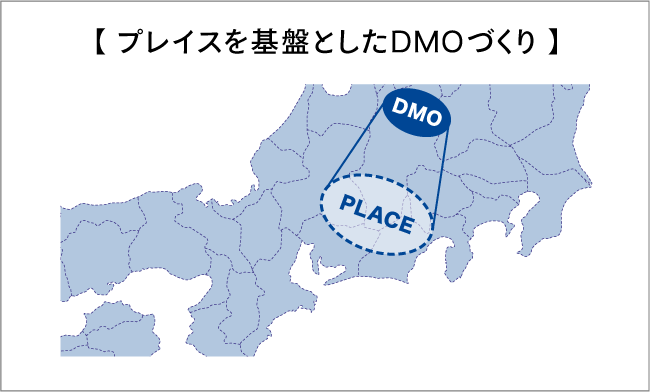
I imagine many are currently grappling with establishing a DMO. Before rushing to launch one, I sincerely hope you'll consider using place branding thinking as a guiding principle.
This concludes our five-part series on place branding. Thank you to everyone who read along. For those eager to start implementing place branding tomorrow, we'd be delighted if you picked up a copy of this book.
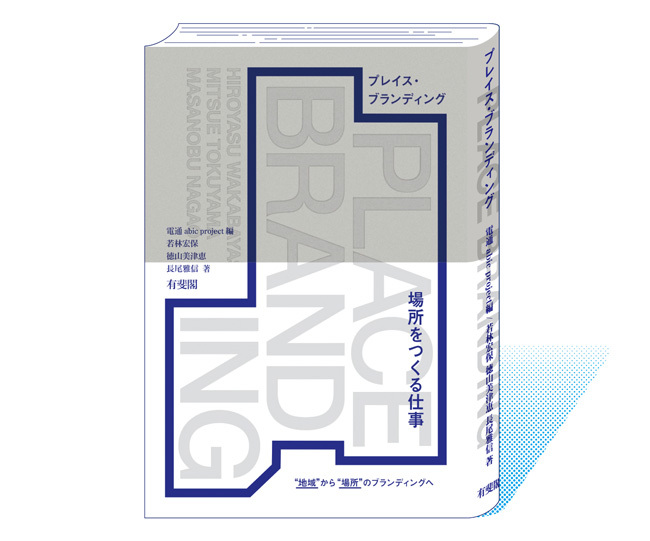
Book now available! Details here.
Was this article helpful?
Share this article


Newsletter registration is here
We select and publish important news every day
For inquiries about this article
Back Numbers


Author
Hiroyasu Wakabayashi
Dentsu Inc.
Solution Creation Center
Creative Director
Promoting the 'Art Circuit' project, which utilizes art in business. Developed the art thinking program "Vision Sketch" and conducts workshops for a wide range of participants, from children to business professionals. Also advancing <a href="http://www.dentsu.co.jp/abic/" target="_blank">the 'Dentsu Inc. abic project'</a> (abic), a branding initiative targeting various regions and locations across Japan. Established Dentsu Inc.'s unique platform consolidating methodologies, practices, and insights related to "place branding."<br> <p></p><br> <主な著書> <br> 2009 "Regional Brand Management" (co-authored, Yuhikaku)<br> 2018 "Place Branding: From Regional to Place Branding" (co-authored, Yuhikaku)<br> 2019: 'Art in Business: The Power of Art That Works for Business' (co-authored, Yuhikaku)<br> 2021: Imagination Becomes a Weapon: An Introduction to "Art Thinking" (PHP Institute)<br>