Note: This website was automatically translated, so some terms or nuances may not be completely accurate.
 Keywords for Predicting the Future [3/13]
"Neo-Liberal Arts" as the Essential Education for the Future Society
Over the next few decades, technology—led by AI, self-driving cars, and robots—is predicted to profoundly transform society and daily life. What must children, and indeed adults, learn now to prepare for the future decades ahead?
Many would likely cite science and technology, but we believe humanities knowledge will also become essential going forward. This time, we discuss humanities knowledge—often overlooked when predicting the future.
Even now, due to factors like declining birthrates and aging populations, widening disparities, and the advancement of globalization and diversity, traditional notions of "happiness," "the ideal form of society and family," and "humanity" seem increasingly obsolete.
Looking ahead, as social structures shift and technological environments advance, societal foundations will likely change at an even faster pace. This suggests that "humanity" itself will continue to evolve beyond what we currently recognize.
Rather than a uniform moral code or set of values applicable to "everyone," we are entering an era where we must continually think for ourselves and revise what constitutes "humanity" and "happiness."
To do this, studying humanities disciplines like literature, philosophy, ethics, and logic will be invaluable. These fields contain accumulated knowledge from millennia of continuous thought and debate about "happiness," "society and family," and "humanity."
In other words, alongside knowledge of the latest technology, we will need a kind of education that integrates traditional humanities knowledge – something we might call a "neo-liberal arts."
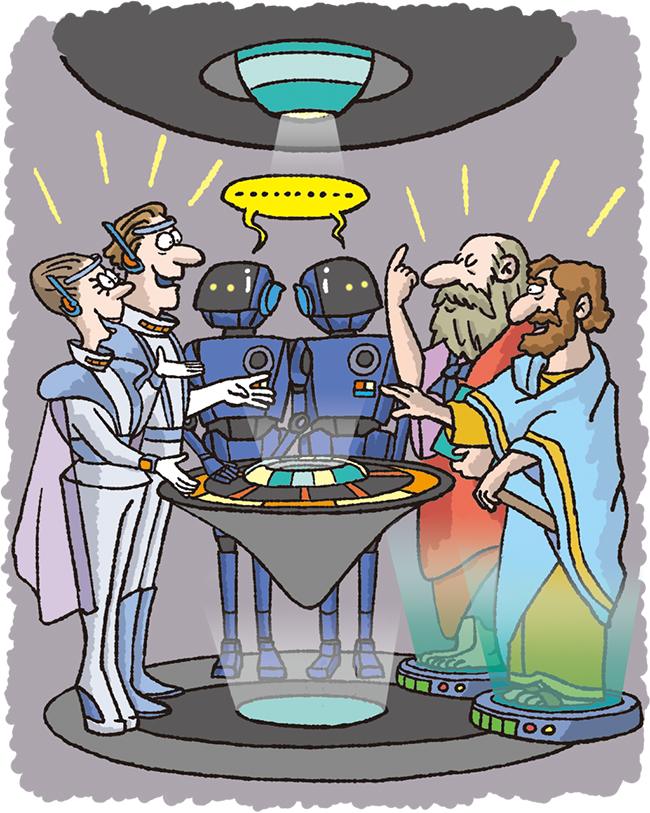
Consider this example: Don't you find that exchanging gifts or morning greetings feels somehow better with a human than with a robot?
Anthropologically speaking, gift-giving and greetings fall within the realm of "gift-giving." Long before the exchange of commodities, humans have continuously given, received, and reciprocated "gifts" and "words" since prehistoric times.
Some scholars even argue that "gift-giving" is the very essence of humanity, the defining characteristic of being human. In modern terms, we could say "gift-giving is a crucial code (CODE) within the OS (basic software) of humanity."
For instance, designing systems that add value like points to these "gift-giving" actions, use technologies like blockchain to circulate points among people, and thereby circulate and activate "gift-giving" behavior to increase the overall "happiness" of everyone involved requires the knowledge of "neo-liberal arts."
As robots and AI take over tasks previously done by humans, and as basic income(※) is introduced, leading to significant societal changes, designing humanity's future necessitates returning to the OS of the human program.
(※) A policy where the government regularly provides all citizens with a cash amount deemed necessary for a minimum standard of living.
You wouldn't want someone who doesn't understand a computer's OS to repair your PC, right? Similarly, don't you think we can't entrust the design of humanity's future to people who don't truly understand the human OS?
Future Prediction Support Lab: http://dentsu-fsl.jp/
Was this article helpful?
Share this article


Newsletter registration is here
We select and publish important news every day
For inquiries about this article
Back Numbers
Author
Riki Murakoshi
Dentsu Inc.
Solution Creation Center