
Note: This website was automatically translated, so some terms or nuances may not be completely accurate.
 Solve problems by starting with play! [2/2]
Start idea generation through play.
The Pitfalls of Idea Generation Methods
There are many so-called "idea generation methods" out there.
Often, these involve filling out checklists, plugging words into charts, or associating words like in a mind map...
Each of these is a valid methodology, and I have no intention of dismissing them. In fact, they can be seen as well-developed "formulas." And of course, many people have likely found these methods effective for generating ideas.
However, if there are so many methodologies, why isn't the world overflowing with idea people?
This is similar to how, despite the abundance of English conversation methodologies, the number of people who can actually speak English doesn't seem to increase. Perhaps the same applies to so-called "health methods" like dieting. Many people have likely tried them once only to give up quickly. So, why do people give up?
This is just a hypothesis, but I think it's because methods that feel like rigid formulas—no matter how correct they are—are simply not enjoyable to practice, leading to quick boredom.
The same principle applies to idea generation. Ideas don't just spring forth easily, no matter how desperately you try to force them out. They aren't those sudden flashes of inspiration depicted in manga, like a lightbulb popping on above someone's head, nor do they suddenly fall from the sky one day.
And when good ideas don't come easily, people start to see it as a "painful act." That's what they mean by "the agony of creation." Once you get to this point, it's only natural that your motivation to think wanes. Coming up with interesting ideas should be fun in the first place...
No matter what you're doing, the key is building up small successes. And the more enjoyable those successes are, the better. This holds true for sports, music, cooking—anything. When it comes to generating ideas, having that "fun experience" of realizing "I can come up with such interesting ideas myself" is what fuels your motivation and confidence going forward.
Turning the "Pain of Creation" into the "Joy of Creation"
I also belong to an internal cross-functional organization called XDS (Experience Design Studio). For several years, our team has been exploring the question: "Is there a way for anyone to easily generate ideas?"
The catalyst was a lecture we gave at a Chinese university as part of our company's CSR activities. Previously, we had conducted what you might call "lecture-style classes" on advertising and design. However, we decided to shift to more practical "workshops" to get students to actually think up innovative ideas themselves.
As mentioned earlier, many excellent methods for generating ideas have been developed by pioneers in the field. We took this further, asking ourselves what could make idea generation a more "enjoyable experience." That's when we arrived at "games."
We reasoned that filtering the process through the lens of "games" might transform idea generation from a "painful task" into something "enjoyable."
This led to the creation of "Ideation Factory," a package containing four games designed for idea generation.

Ideas are created through "decomposition" and "combination."
Through repeated discussion and verification, we concluded that to generate ideas, you must
* Decomposing phenomena into their "elements"
and conversely,
• Combining elements together
We then developed the following four types of games to make experiencing this process enjoyable:
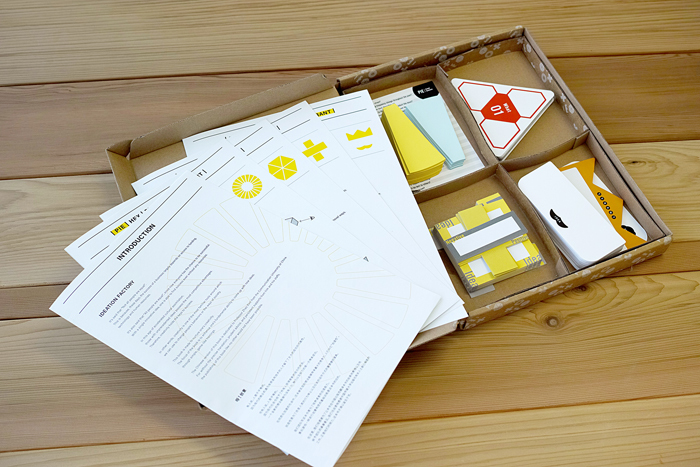
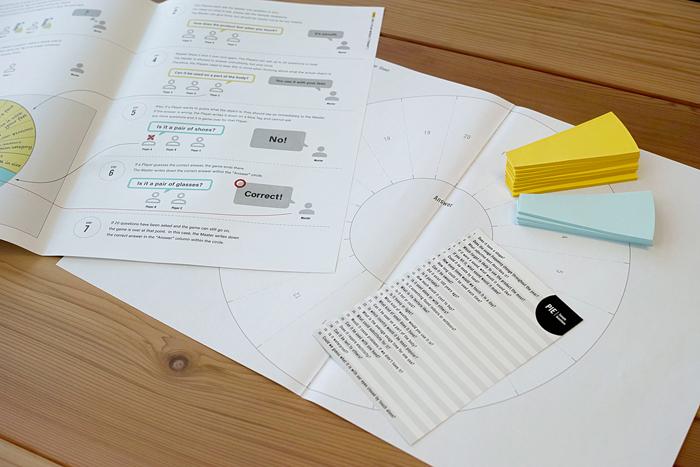
"PIE"
The first is a game called "PIE," based on "element decomposition." It's a simple game where players collectively deduce a "theme" imagined by the parent player by asking questions one by one.
For example, players other than the leader ask questions like "What kind of texture does it have?" If the "theme" is "glasses," the leader might answer "It's smooth," and the process continues. Answers are written on fan-shaped sticky notes and sequentially attached to a circular sheet. As the process repeats, the "PIE" (named for its pie-like shape) is completed.
Questions are limited to 20 total. The goal is to deduce the "secret word" through these questions, thereby revealing its various characteristics (i.e., breaking it down into elements). Secret rules are also included to enhance the game's challenge.
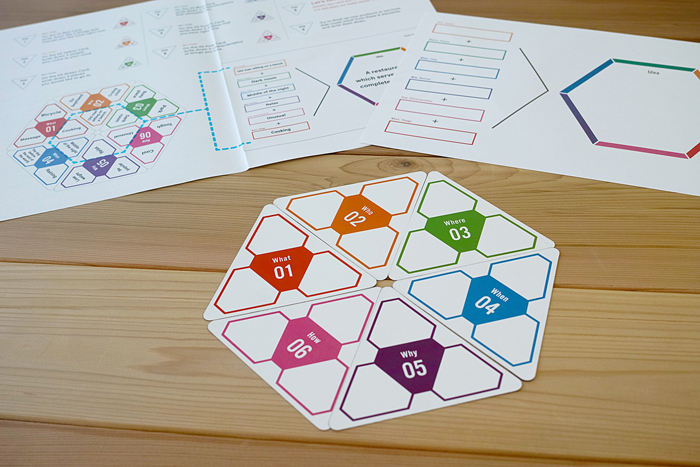
"HEX"
The second is a game called "HEX," where you "combine" six randomly generated elements to create new ideas. "HEX" comes from "Hexagon," meaning a six-sided shape.
The six elements are the so-called 5W1H: "What," "Who," "Where," "When," "Why," and "How." Three of each are written on triangular cards. Then, the completed triangular cards are laid out and combined to generate ideas for new products, services, and more.
By forcibly combining six different elements, you gain the experience of generating ideas you never could have predicted yourself.
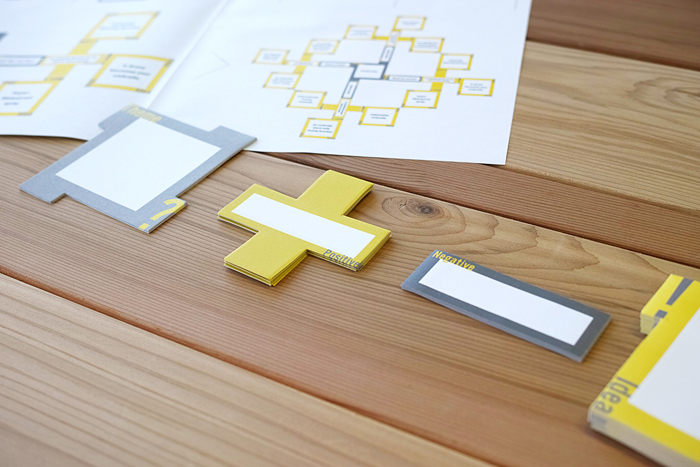
"PLUS-MINUS"
The third is a game called "PLUS-MINUS." As the name suggests, this game generates many ideas by converting the negative (MINUS) aspects of a "theme" into positive (PLUS) ones. We call this "reverse combination."
First, the whole team decides on a "theme" and writes down its "negative points." Next, they write down how converting those points into "positive" ones might look.
For example, if the "theme" is "umbrella," a negative point might be "having to carry it around." Simply converting this to positive could lead to "an umbrella you don't have to carry." Starting from this point, ideas can expand in various directions, such as "a drone umbrella," "umbrella sharing services," or "full-body super water-repellent spray."
The key feature of this game is that by applying this process to several negative points, you can mass-produce ideas.
"TYRANT"
The fourth game, "TYRANT," adds a bit of role-playing fun.
First, choose a king within the team. This king has a selfish personality, always wanting what they don't have, and gives the subjects (other players) unreasonable "challenges" like "I don't have XX, so I need YY." The subjects must brainstorm ideas together and present them to satisfy the king.
For example, if the challenge is "a computer without a keyboard," possible ideas might be "a computer operated by voice" or "a computer operated by brainwaves." However, the ideas cannot be the same as the King's. The subjects must be careful not to duplicate the King's idea and present truly innovative solutions.
This game, which deliberately imposes the constraint of "without ○○" to encourage new thinking, is what we call "elimination combination."
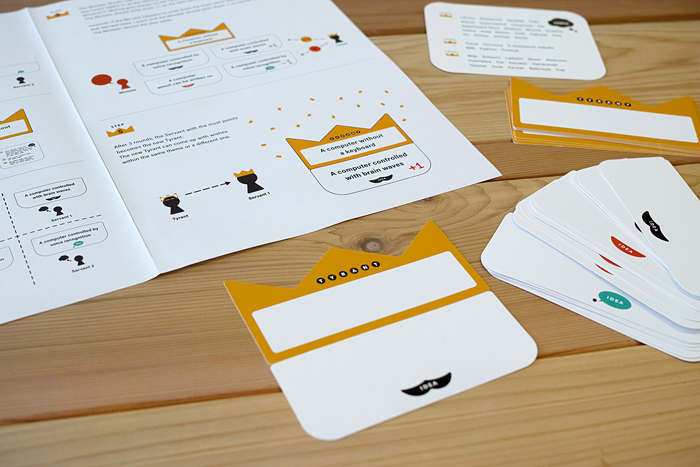
I think the appeal of such games is hard to convey without actually trying them, but we've had many students and working professionals experience it, and thankfully, it has been very well received.
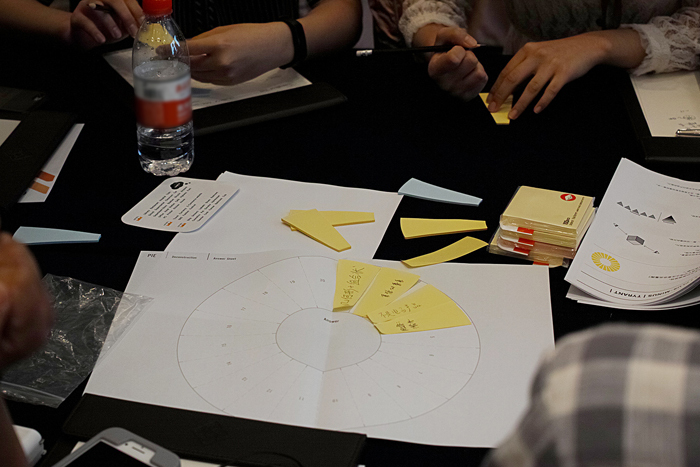
Additionally, it's currently being adopted as part of Mynavi's "MY FUTURE CAMPUS" student career support program, where we conduct workshops for universities across Japan. Sharing a tool we developed ourselves with clients represents a new initiative for Dentsu Inc.
Due to the impact of COVID-19, events sometimes move online, so we also developed an online version that recreates the actual card game on the web.
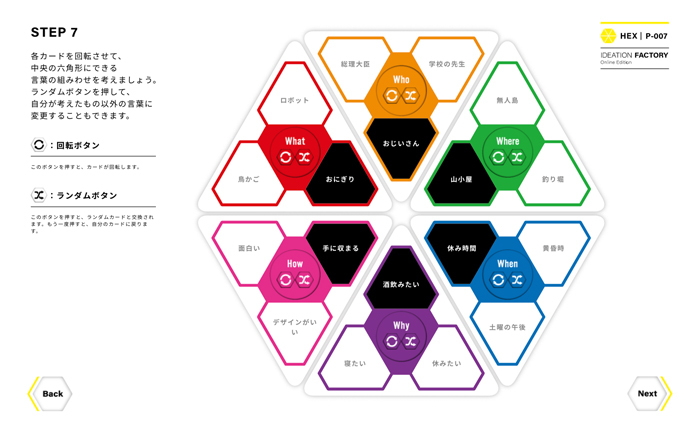
The most important aspect in creating these games was "experience design." While the games themselves could theoretically be substituted with ordinary paper or sticky notes, that approach simply wouldn't deliver an engaging experience. The value lies in the experience itself: engaging with specially designed cards and tools, using both hands and mind to explore ideas.
Furthermore, enjoying the game together in a lively group setting sparks ideas that would never emerge from solitary, aimless thinking. This experience allows participants to truly feel the joy of idea generation, which directly translates into practical training for real-world application.
It's a tool that truly transforms the "agony of creation" in idea generation into the "joy of creation" by starting with play.
If everyone could learn to enjoy idea generation, the world might become a much more interesting place. If you're interested in "Ideation Factory," please feel free to contact PLAY FIRST. Let's create lots of exciting ideas together while having fun.
The contact form is here ( https://play-first.jp/ ).
Was this article helpful?
Share this article


Newsletter registration is here
We select and publish important news every day
For inquiries about this article
Author

Satoshi Iwashita
Dentsu Inc.
Creative Planning Division 1
Art Director and Designer
