
Note: This website was automatically translated, so some terms or nuances may not be completely accurate.
 Solve problems by starting with play! [1/2]
Start business with "play." The PLAY FIRST Approach
Toru Oyama
Lutecia Co., Ltd.
An escape game created by Stanford University!?
Did you know that Stanford University's design school, the Hasso-Plattner Institute of Design, commonly known as the "d.school," owns a very intriguing bus?

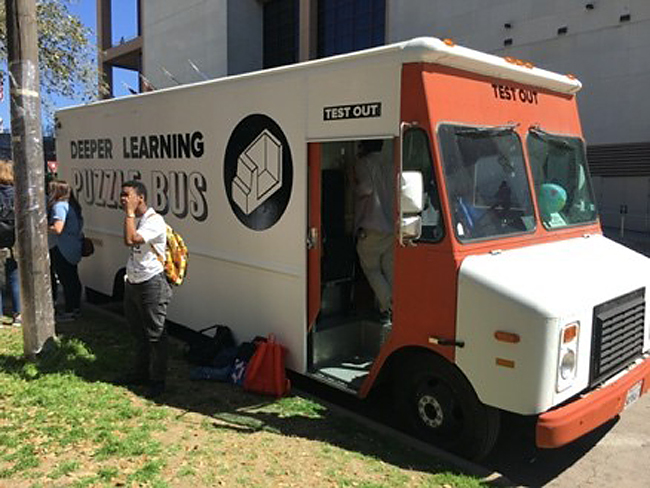
This bus is actually a mobile escape game (escape room).
Escape games are a globally popular activity where people locked in a room or similar space work together to solve puzzles and mechanisms to attempt an escape.
Inside this PUZZLE BUS, it's set up like a room. Participants solve puzzles together, aiming to escape the bus (I actually participated and successfully escaped! The difficulty level felt like beginner to intermediate).
Why would Stanford University's design school have an escape game bus? Actually, the real purpose comes after experiencing the escape game.
While most escape games end automatically once the time limit is up, regardless of success or failure, the real work begins after the PUZZLE BUS game concludes. Participants then reflect on their actions during the game by discussing them with the facilitator who was on the bus.
It was designed as a program to deepen communication skills by discussing how participants communicated with each other, how they cooperated, and why they didn't take the right action at certain moments.
d.school utilizes the escape game format as a playful tool to achieve the academic goal of "learning communication skills."
"Alright, let's start the lecture on communication skills now."
This sounds like a typical lecture, right? But when you want people to learn the same thing, adding the playful element of an escape game—and even creating a bus like this—might make them think, "Hey, maybe I'll give it a try."
Things that seem daunting at first glance, topics that generally spark little interest, or tasks that feel like a hassle. For these common challenges, the "play-first" approach is highly effective.
Not gamification, but play first.
Incorporating "play" elements into problem-solving.
Many might think, "Isn't that gamification?" It's been about ten years since the term "gamification" became popular, hasn't it?
What image comes to mind when you hear "gamification"?
For example, in a manga app, users might get more free manga to read based on how many days they access it. In a running app, there might be a ranking feature where users compete with friends based on distance or number of runs.
Many probably imagine gamification as incorporating elements like those found in social games.
In business, especially to prevent customer churn from your own services, how do you keep customers engaged? Implement a ranking system to pit users against each other. Introduce a system where users receive rewards for continuing to use the service for a certain period. Further, vary the probability of receiving special rewards to appeal to users' gambling instincts, encouraging them to make multiple small payments even if the individual amount is extremely low. Over the past decade, we've seen plenty of examples like this.
While these certainly contain "play" elements, it's questionable whether users are genuinely enjoying them. They might be effective for chasing immediate profits and generating short-term revenue, but in the long run, are they truly fostering a positive brand image?
Instead of adding elements that fuel gambling instincts and creating the illusion of enjoyment, what if we "start with play" itself? Couldn't this make the process itself, the product or service itself, more enjoyable and innovative?
That's why we decided to launch a new project team.
"PLAY FIRST"
This is a new approach to gamification that starts with play, a design unit tackling various challenges.
Moving beyond conventional gamification techniques, we leverage the essence of play and games to solve challenges in corporate communication. Furthermore, consistently applying the "start with play" concept across education and entertainment domains, we will advance planning, service systematization, and R&D rooted in play.
Start with play.
Did professional baseball players start intense training the very moment they encountered baseball? Surely they began by playing—throwing the ball faster! Hitting it farther than before!
Of course, intense practice is essential to becoming a pro. But no one would find a strict training program fun right from the start. If it isn't enjoyable initially, it won't last.
How about injecting playfulness into serious things?
Take "disaster drills," for example. Few people would say disaster drills are incredibly fun. Since it's a drill, you have to take it seriously, so it's hardly enjoyable. But, sadly, even though we know we should participate in disaster drills, if something else fun comes up, we tend to prioritize that over the drill.
So why not start disaster drills with play? Combine evacuation ladders and balcony kick-out doors to create a field athletics course. You'll learn to use them properly in an emergency, and it'll help with your lack of daily exercise. Fun and useful. Don't you think it's killing two birds with one stone?
"Play" holds a powerful value that draws people in.
Through PLAY FIRST, we aim to shine a light on the power of play and games once again, and as a post-gamification concept, we hope it can be of service to you.
If you're interested, please feel free to contact us.
The contact form is here ( https://play-first.jp/ ).
PLAY FIRST's Main Activities
- New business support starting with play / New product development support
- Play-Based Consultation
- Development and Materialization of Educational Programs / Corporate Training
- Ideation workshops
- Play-Based Marketing and Communication
- Research on Play and Service Development
Was this article helpful?
Share this article


Newsletter registration is here
We select and publish important news every day
For inquiries about this article
Author
Toru Oyama
Lutecia Co., Ltd.
CEO & Game Designer / External Researcher at the "How About This?" Active Learning Research Institute