
Note: This website was automatically translated, so some terms or nuances may not be completely accurate.
Are you just filling in the blanks when creating your Mission, Vision, and Values?
Hello, I'm Taiki Ueda, a copywriter. I participate in the activities of TANTEKI , a startup communication support team.
TANTEKI designs statements and other materials to communicate the founder's vision and business ideas in a way that resonates both internally and externally.
Now, suddenly, what exactly is your company's Mission, Vision, and Values (MVV)? Hereafter, we'll abbreviate it as "MVV."
Having encountered MVVs from various companies, I've often felt that "mission and vision are mixed up" or "are they really being communicated properly inside and outside the company?"
MVV is like the backbone of a company. As employee workstyles and the business environment change amid the pandemic, it seems necessary not only for companies setting new MVV but also for those with existing MVV to verify whether their MVV truly functions for future corporate growth.
Therefore, TANTEKI has collected MVVs from various companies. This article examines "effective, functional MVVs."
【Table of Contents】
▼What Exactly Are Mission, Vision, and Values?
▼The "Two-Part Approach" Theory Emerges from Researching Various Companies: Mission and Values
▼For Mission, Vision, and Values That Communicate and Function
What exactly are Mission, Vision, and Values?
Before delving into MVV, let's first clarify their definitions.
MVV was proposed by management scholar Peter F. Drucker. According to him, they are defined as follows (*)
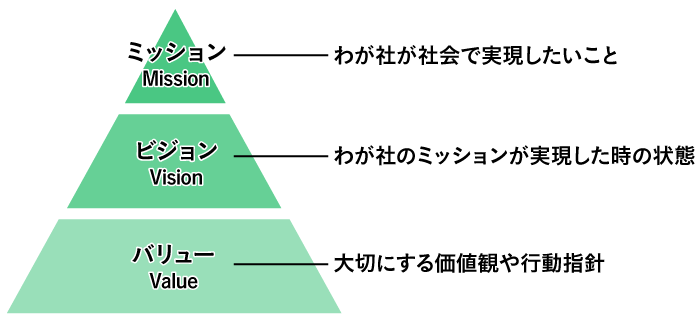
※Definitions of Mission and Vision are quoted from "Drucker's Five Questions" (Author: Junichiro Yamashita).
In practice, MVV is a framework used by many companies, but why is it necessary?
Among TANTEKI's primary clients—startups—it's common to see that as the company grows and the number of employees increases, the president's ideas and passion become harder to convey to each individual employee. This problem is often called the "30-person wall." Setting and revising MVV is an effective way to overcome this wall, enabling everyone to share the same passion and run in the same direction. Beyond this, MVV can serve as a guideline for business decisions and evaluation systems, and it can clarify the type of talent sought in recruitment. It can be expected to be effective in various other ways.
The "Two-Part Theory for Mission and Values" Revealed by Examining Various Companies
To explore "effective, communicable MVV," TANTEKI examined the MVVs of dozens of companies. The results revealed they can be categorized into three main types.
① Kanji-based Type
This type uses different terminology instead of the MVV format. Management philosophies corresponding to mission and vision are framed as "guiding principles," "company creed," or "declaration," while values are summarized as "operating policies" or "behavioral guidelines." These are combined to form the corporate philosophy. Common among national clients with over 100 years of history.
② MVV Type
This type sets all three: "Mission," "Vision," and "Values."
③ MV Type
A type that omits the "Vision" and focuses solely on defining the "Mission" and "Values." Common among startups and growing companies with a relatively short corporate history.
What merits attention here is the existence of the third type: the MV (Mission-Value) model without a Vision. I wondered if the reason companies adopt this unique MV model might be tied to a "pitfall" inherent in the MVV model... specifically, the problem of "restating the Mission in the Vision section" (meaning it becomes Mission-Mission-Value!).
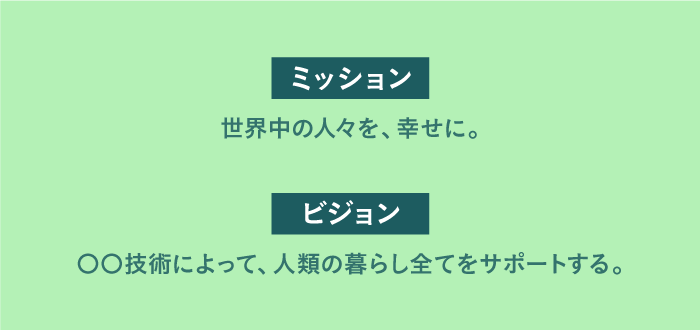
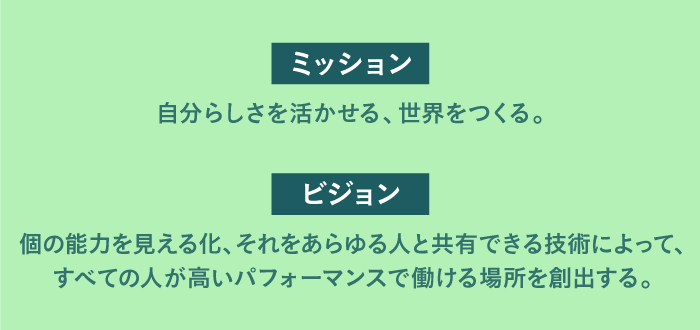
While values clearly serve as "guiding principles," missions and visions tend to get mixed up. So, let's examine the patterns of this "mission-repeating problem" that makes MVV harder to communicate (the mission and vision below are fictional examples created by TANTEKI for illustration purposes).
Pattern A
Because the mission is too abstract, a more concrete mission is restated in the vision section.
Pattern Ⓑ
Because the mission statement is incomplete, supplementary mission details are added in the vision statement.
So, how can we avoid ending up with Mission-Mission-Value?
For example, in Pattern A, it would be good to redefine a more concrete mission and unify the mission and vision.
For Pattern Ⓑ, one approach is to create a "Mission Statement" that supplements the mission, thereby unifying the mission and vision.
In this way, when confusion is likely, organizing them as a unified MV type (Mission-Vision) makes them easier to communicate. This is the "theory that mission and values can be two separate things" that emerged from this analysis.
For a Mission, Vision, and Values that Communicate and Function
While the previous section proposed the simple "MV model," the "MVV model" remains effective when the roles of mission and vision are clearly defined.
The vision is:
"Become the platform for XX"
"The No. 1 [XX] Company"
"Achieve ¥XX billion in sales within X years"
In other words,
・Mission = Subjective
・Vision = Objective
This perspective is crucial. The vision objectively captures how the company wants to be perceived in the medium to long term, clearly defining its outline. This also clarifies its role relative to the mission, making it easier to communicate. Whether using the MVV or MV framework, the key is whether the defined content resonates with society and employees.
If the goal becomes merely filling in the blanks within the MVV framework, it risks confusing the mission and vision, failing to fulfill the true purpose of MVV. Perhaps the best approach is to first establish a mission that resonates, then decide whether to create a vision as needed.
The "communicative MVV" we collected featured clear perspectives articulated through mission and vision, with each statement fulfilling its role.
Reinterpreting MVV in the TANTEKI style yields the following:
・Mission = Specifying the role or purpose the company wants to fulfill in society
・Vision = Specifying how the company will be objectively perceived when the mission is realized
・Values = The core values and behavioral guidelines cherished by the company and its employees
If you're a business leader with passion but struggle to translate it into compelling "words" like a strong mission or vision... please consult TANTEKI!
Was this article helpful?
Share this article


