Note: This website was automatically translated, so some terms or nuances may not be completely accurate.
 "People Driven Marketing® Practical Webinar 2020" Report [9/9]
What companies must focus on to grow: Customer touchpoints, UX, and organizational development
Dentsu Inc.'s "People Driven Marketing(※)" (PDM), a human-centric marketing approach, has now entered its fourth year and has significantly evolved as "PDM 4.0."
This series provides a digest report on the three-day "People Driven Marketing® Practical Webinar 2020," where Dentsu Inc. professionals and corporate guests discussed the future of marketing and data.
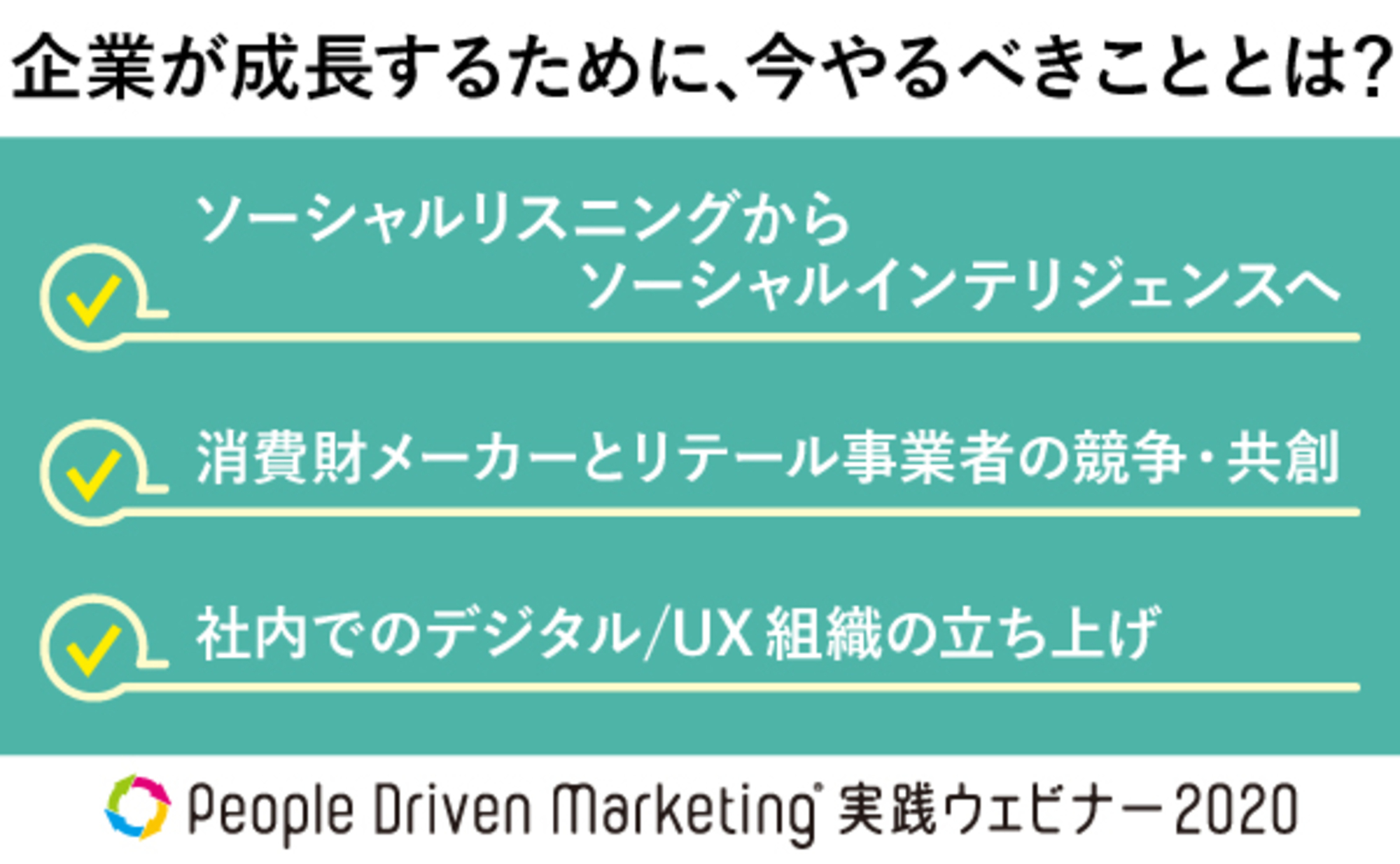
This installment covers three sessions: "Leveraging Social Data," "Competition and Co-creation Between Consumer Goods Manufacturers and Retailers," and "Launching Digital/UX Organizations."
※People Driven Marketing
https://www.dentsu.co.jp/business/pdm/
Dentsu Inc.'s integrated marketing framework centered on "people," designed for the data & digital era. It reframes challenges from a people-centric perspective and integrates the Dentsu Group's cutting-edge marketing methodologies to support customers' sustainable growth.
Three Challenges in Social Data Utilization: User Volume, Time Lags, and Metrics

Leveraging social media, including SNS, and the consumer data (social data) obtained from it is now indispensable for marketing.
In the session titled "From Social Data to Brand Customer Experience: Connecting with Consumers in the New Era of Marketing," Ms. Akiko Gunji from Dentsu Inc. and Mr. Takashi Oeki from DataCurrent, Inc., a Dentsu Group company, took the stage.
They explained solutions for transforming social data into rich and rewarding customer experiences.
According to Ms. Gunji, who has long worked in digital marketing, particularly in the communications field, corporate use of social media, which gained momentum around 2010, has become increasingly sophisticated year by year. Today, social data is referenced for product development, and social media is integrated with e-commerce.
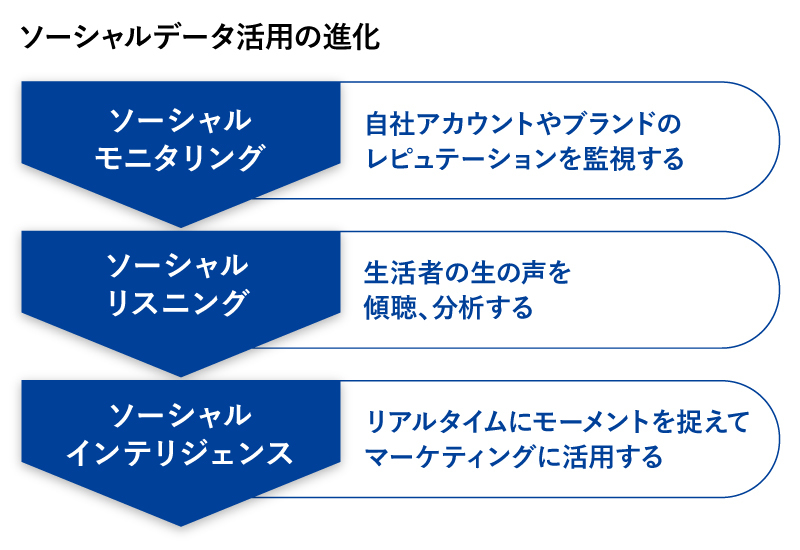
"Regarding social data utilization, it began with 'social monitoring' to track brand reputation. This evolved into 'social listening' to capture authentic consumer voices, then progressed to measuring campaign effectiveness and analyzing consumer insights. Today, it has advanced to 'social intelligence,' capturing real-time customer needs and moments," said Ms. Gunji.
Mr. Gunji emphasized that in the digital age, it is essential to "provide users with the content, information, services, and products they want, at the time and place they want them." He positioned social data as "a crucial means to grasp consumers' true feelings in real time and create positive customer experiences." However, he also highlighted a challenge in the field of advanced data utilization: the tendency for operations to become fragmented.
"For example, suppose you plan to deliver an ad to a user who tweets 'I don't want to get sunburned' at that exact moment. However, problems occur with some frequency, such as too few people tweeting the keyword or missing the optimal delivery timing," said Mr. Gunji.
Therefore, he concluded that to create better customer experiences, team members must collaborate to bridge these fragmented operations.
To address these challenges, the cross-functional project team "Dentsu Engagement 360" was formed by seven digital companies within the Dentsu Group in Japan. This project provides one-stop marketing support, centered on social data utilization, covering everything from acquiring new customers to nurturing existing ones.
Regarding specific solutions, Data Strategist Mr. Ooeki explained by outlining "three problems and their solutions."
Challenge 1: "User Volume Problem"
The problem arises when attempting to deliver ads to users who posted a specific keyword (KW), but the target user volume is too small to fully leverage the ads.
Solution: "We developed a solution called 'Historical KW Targeting'. For example, on Twitter, we can target not only users who tweeted a specific KW, but also users who searched for that KW, or users who commented on or shared related posts. Expanding the timeframe into the past also enables us to secure user volume." (Mr. Ōeki)
Challenge ②: "Time Lag Problem"
Even when ads are delivered based on keywords obtained through social listening, they often reach users too late.
Solution: "Our 'Real-Time Keyword Targeting' solution detects pre-specified keywords in real time, enabling delivery before user interest cools." (Mr. Ooeki)
Challenge 3: "Metrics Problem"
The problem of not being able to adequately measure how "good customer experiences" translate into improved business performance.
Solution: "For example, there's the 'Measurement Pilot' program developed in partnership with Twitter. By combining Twitter ad exposure data with 'purchase data' and 'TV commercial exposure data,' we visualize users' offline actions, enabling more flexible analysis." (Mr. Ooeki)
Mr. Otsuki concluded the session by stating that these are examples of menus within the "ID Integration" domain of the "KIZUNA COMMUNICATION" service, adding, "We also offer a wide range of other services and menus, and through the Dentsu Engagement 360 project, we aim to propose solutions tailored to each client's individual needs."
Read the "Do!Solutions" article here.
Consumer Goods Manufacturers Enter an Era of Competition and Co-creation with Retailers. What DX is Needed to Prevail?

The session titled "Business DX for Consumer Goods Manufacturers Competing & Co-Creating with Distribution" featured Soichi Fujii from Microsoft Japan and Katsumasa Yagi from Dentsu Digital Inc. Drawing from their collaborative experience supporting corporate DX planning and operations, they explained key points for transforming consumer goods manufacturers.
Mr. Yagi, who has developed and promoted numerous digital services, opened by stating, "The rapid DX of retailers is drawing in consumer goods manufacturers," citing the example of Walmart, a major U.S. retailer.
"Walmart's services like Curbside Pickup(※) are currently performing well. Even during the pandemic, they successfully established the 'Buy Online, Pickup In Store' system and steadily acquired new customers," said Yagi.
* Curbside pickup: A service where customers can pick up items ordered online at a physical store, similar to a drive-through.
Mr. Yagi further presented data showing Walmart rapidly expanding its share in the e-commerce space. Its app has gained 58 million users and has already surpassed Amazon in app rankings.
Moreover, Walmart's "retail DX" initiatives, including its app, have deepened customer understanding and enabled effective promotions. As a result, approximately 84% of Walmart customers now purchase its private brand (PB) products.
"Walmart already has about 50% of its products as private brands. Consumer goods manufacturers must also better understand customers and provide the products and experiences they desire, or they will be swallowed up by retailers offering superior customer experiences and strong private brands," said Mr. Yagi.
Mr. Yagi also pointed out that in the traditional value chain, consumer goods manufacturers handled the "interest experience," retailers handled the "purchase experience," and manufacturers again handled the "usage experience." However, "DX is blurring these boundaries." He presented three perspectives for future consumer goods manufacturers.
① Co-creation of the value chain through data
"By enabling two-way information flow—such as using data provided by retailers for demand forecasting—we move beyond simple collaboration to true co-creation," said Yagi.
② "Competition & Co-creation" with Retailers Extending the Value Chain
"Retailers are enhancing their product development capabilities, accelerating 'competition' with consumer goods manufacturers. However, manufacturers can also create higher-priced products, for example, by packaging user support through collaboration between product development and customer service departments. 'Co-creation' where manufacturers provide this to retailers is also possible," (Mr. Yagi)
③ "Competition" arising from consumer goods manufacturers entering the retail side
"Conversely, manufacturers entering the retail side creates opportunities to gain direct customer touchpoints and data. To achieve this, they must establish new functions for 'delivering shopping experiences'," said Mr. Yagi.
He further proposed that "whereas data was previously utilized by individual departments, integrating data across the entire organization will be essential going forward." He noted challenges in acquiring, analyzing, and utilizing data for achieving this transformation, then passed the baton to Mr. Fujii.
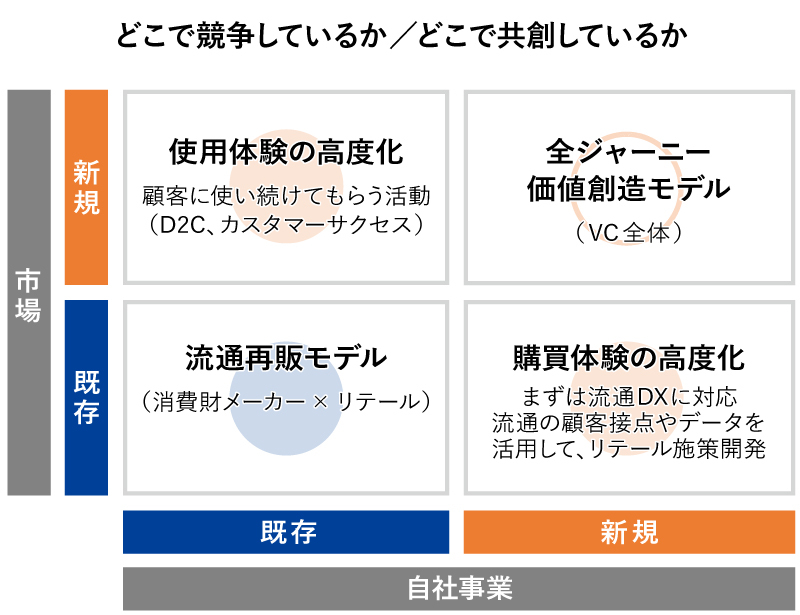
Mr. Fujii, who has been responsible for strategy formulation and market development for the retail sector at Microsoft Japan, agreed, stating, "We vendors providing digital platforms share the same sense of urgency."
He explained that Microsoft partners with many retailers, including Walmart, supporting their DX while simultaneously advancing both parties' businesses.
"For example, global companies faced challenges integrating vast amounts of marketing data dispersed across countries for effective utilization. But today's technology enables rapid and cost-effective integration and use of massive data," said Fujii.
He then introduced examples of global campaigns undertaken with consumer goods manufacturers and co-creation between retailers and consumer goods manufacturers using Microsoft's digital platform.
He then touched on Microsoft's own cloud platform, Azure, explaining, "The cloud is a 'consumption-based' service. It has the characteristic of allowing you to start quickly when you want to begin and stop quickly when you want to stop, making it well-suited for today's rapidly changing markets." He emphasized the necessity of a flexible digital platform.
Mr. Fujii also stated that in an era where change is the norm, a "digital feedback loop" is crucial—where individual initiative results are shared across the organization and linked to subsequent improvements.
Mr. Yagi concluded the session by sharing his perspective: "By leveraging a flexible digital foundation, consumer goods manufacturers can achieve DX that directly contributes to business revenue."
Read the "Do!Solutions" article here.
What are the three stages—launch, implementation, and expansion—for building an internal digital/UX organization?

In the session titled "Vertical Launch of Digital/UX Organizations Achieved Through On-Site Support," Ms. Miki Nanbu of NTT DOCOMO and Mr. Hironobu Konami of Dentsu Digital Inc. took the stage.
Based on NTT DOCOMO's case study, they explained the challenges that arise at each stage of a digital/UX organization's growth flow and the key points for achieving results.
Mr. Konami, who focuses on UX design and supports corporate transformation at Dentsu Digital Inc., stated that the growth flow of a newly established organization can be divided into three steps: "Launch Phase," "Practice Phase," and "Expansion Phase."
Ms. Minami, who oversaw NTT Docomo's digital/UX organization "Digital Marketing Promotion Department" (hereafter referred to as Digi-Promo), agreed, stating, "Digi-Promo also followed these three steps."
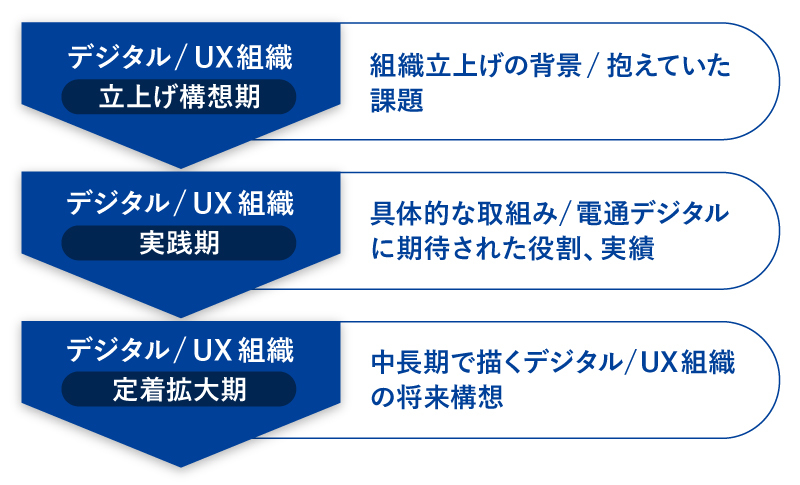
"In 2015, we launched 'd Point,' a common service accessible even to non-Docomo subscribers. Then in 2018, we made a major strategic shift toward a company-wide membership service platform. At this juncture, we integrated parts of the systems department, data analytics department, and the d Point membership management organization to establish Digi-Promotion," said Mr. Nanbu.
Digi-Su's primary missions are driving company-wide DX and building the foundation for business operations targeting d Point members. Dentsu Digital Inc. has been deeply involved with Digi-Su from its inception to the present.
Regarding Dentsu Digital Inc.'s role, Mr. Nanbu stated, "First, they proposed an overall scenario to grow Digi-O into an organization capable of optimally executing company-wide digital marketing."
Mr. Konami observed that launching digital/UX organizations often faces common challenges across four key areas: "strategy," "structure and talent development," "data utilization infrastructure," and "business operations."
Mr. Nanbu explained how the Digital Promotion Office and Dentsu Digital Inc. addressed these challenges within the three-step process.
① Challenges in the Launch Phase
- Strategy... What management challenges should it solve?
- Structure and Talent Development... What kind of structure should be prepared at launch?
- Data Utilization Infrastructure... What data utilization infrastructure is needed at launch?
- Business Operations... Where should we start?
The key to DX is establishing a data foundation and shifting the business to a "customer experience-centric" approach. Therefore, Mr. Nanbu states that during the launch phase, establishing the Marketing Automation (MA) environment was the absolute top priority.
"To instill the benefits of digital marketing within the company, we had no choice but to demonstrate results by showing how MA could actually bridge the gap with customers," said Mr. Nanbu.
However, the initial Digital Promotion team was primarily composed of systems personnel, lacking marketers skilled in designing customer journeys and generating scenarios tailored to each customer's "current state." Mr. Nanbu joined the Digital Promotion team specifically to implement digital marketing that combined customer communication with MA.
② Challenges in the Implementation Phase
- Strategy... How to execute strategy with driving force?
- Organizational Structure & Talent Development... What organizational structure is needed to implement initiatives?
- Data Utilization Infrastructure... How should the data utilization environment be operated?
- Operations... How should initiative implementation be planned?
Digi-Suishi relentlessly repeated the execution of member acquisition and activation initiatives across each business unit, striving to establish best practices. They gathered information by "cross-cutting" all previously independent teams—line pricing plans, various services, points, and payments—to optimize customer approaches.
Mr. Nanbu states that during this period, "we leveraged Dentsu Digital Inc.'s full capabilities to drive initiatives from planning to execution." Mr. Konami added, "Since many Dentsu Digital Inc. employees were already stationed across NTT DOCOMO's business divisions, this likely facilitated smoother horizontal collaboration between Digi-Su and each division."
③ Challenges in the Expansion Phase
- Strategy... How to embed the strategy?
- Structure & Talent Development... How to scale cross-departmental initiatives?
- Data Utilization Infrastructure... What environment is required for company-wide data utilization?
- Business Operations... How to engage each business unit?
Two years after its launch in 2018, the Digital Promotion Office is entering its expansion phase. In July 2020, it merged with part of the Smart Life Business Division to become the Marketing Platform Division.
"We announced internally and externally that we established this headquarters to permeate the digital strategy. Since management regularly communicates support for digital advancement, these efforts will only accelerate further," stated Mr. Nanbu.
Mr. Konami stated, "The final form of a digital/UX organization varies depending on the corporate culture." He explained that for NTT DOCOMO, establishing a UX oversight department called the "Marketing Platform Division" and having it collaborate horizontally with other divisions like the "Sales Division" and "Smart Life Business Division" was the optimal approach.
Mr. Nanbu agreed, concluding the session by expressing his determination to further develop customer-experience-centric digital marketing.
Read the "Do!Solutions" article here.
*For a more detailed report on this webinar, please visit the special feature page on "Do!Solutions"!
Was this article helpful?
Share this article


Newsletter registration is here
We select and publish important news every day
For inquiries about this article
Back Numbers
Author