Note: This website was automatically translated, so some terms or nuances may not be completely accurate.
 "People Driven Marketing® Practical Webinar 2020" Report [7/9]
From DX Success to BX (Business Transformation) Success
Dentsu Inc.'s "People Driven Marketing®" (PDM®), a human-centric marketing approach, has now entered its fourth year and has significantly evolved as "PDM 4.0".
This series provides a digest report on the three-day "People Driven Marketing® Practical Webinar 2020," where Dentsu Inc. professionals and corporate guests discussed the future of marketing and data.
This article introduces Meiji Yasuda Life Insurance's digital-first sales and marketing transformation, along with NEW STANDARD's new DX business model for the D2C Inc. era. It also explains Dentsu Digital Inc.'s approach to DX implementation, which aims to drive business transformation beyond mere digitization.
※People Driven Marketing
https://www.dentsu.co.jp/business/pdm/
Dentsu Inc.'s proposed integrated marketing framework centered on "people" for the data & digital era. It reframes challenges from a people-centric perspective and integrates the Dentsu Group's cutting-edge marketing methodologies to support customers' sustainable growth.

Digital-Driven Sales and Marketing Transformation in Life Insurance

Meiji Yasuda Life Insurance is focusing on sales reform starting with digital marketing. Regarding the reason for this, Norihiro Toda of the Digital Marketing Development Group stated:
"Our company has long engaged in digital marketing and achieved certain results in driving customer traffic from digital advertising. However, subsequent sales activities were left entirely to the sales staff, resulting in separate PDCA cycles for 'digital touchpoints' and 'real-world touchpoints'. To solve this challenge, we initiated a sales and marketing reform centered on digital, integrating online and offline efforts."
Five specific measures were implemented for this reform:
[1] Collaboration with the J.League, including the official league app "Club J.LEAGUE"
[2] Multi-channel digital communication
[3] Sales support leveraging digital data
[4] Promotion of non-face-to-face sales processes, which saw rapidly increasing demand during the COVID-19 pandemic
[5] Integrated online-offline PDCA
Regarding these five initiatives, Mr. Norifumi Watanabe, Marketing Producer at Dentsu Inc., and Mr. Hiroshi Sakamoto, General Manager of the Digital Strategy Division at Dentsu Digital Inc., who participated in the project team, each explained key points. Web Dentsu News introduces three of these initiatives.
Collaboration with the J.League, including the official league app "Club J.LEAGUE"
Meiji Yasuda Life Insurance has served as the J.LEAGUE's title partner since 2015. To create ongoing online engagement with J.LEAGUE fans, they developed the official J.LEAGUE app "Club J.LEAGUE."
Since its 2017 launch, the app has steadily increased its user base and is now used by hundreds of thousands of people every month. "It enables initiatives to increase new spectators for the J.LEAGUE, such as visualizing the behavior of fans who attend matches, providing special experiences for repeat visitors, and implementing an ambassador program where fans take the lead in inviting spectators to the stadium," said Watanabe.
Multi-Channel Digital Communication
We developed nurturing scenarios for potential customers using MA (Marketing Automation) tools and LINE. For LINE design, we established a specialized Dentsu Inc. team proficient in the official account API. They formulated a strategy encompassing sales activity support beyond digital, providing one-stop service from implementation and distribution to operation.
"Once LINE is perceived as uninteresting, users are less likely to engage," explained Sakamoto. "To continuously deliver content tailored to users with diverse interests, we introduced a collaboration with Magazine House."
Through trial and error, the project continues to deliver strong results even three years after launch, maintaining an open rate exceeding 40%.
Integrated Online-Offline PDCA
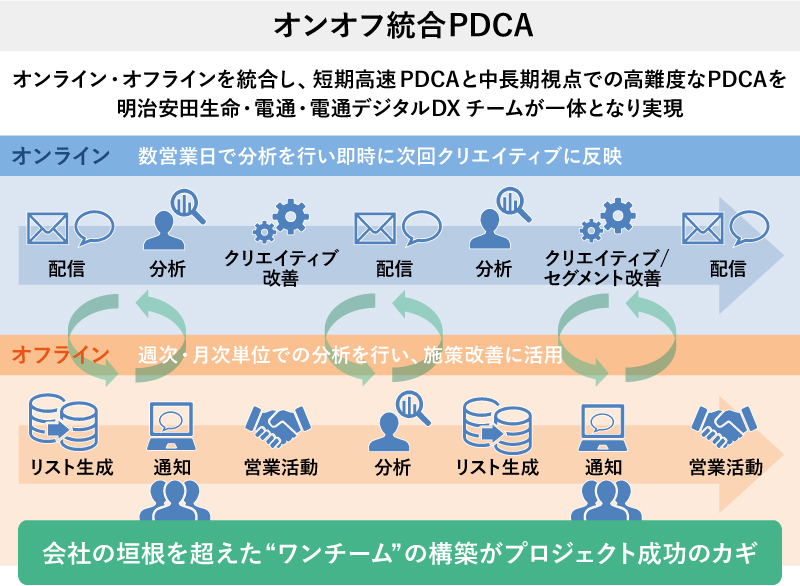
Defining the project's KGI as maximizing conversions, we set KPIs across five stages—acquisition, retention, discovery, material requests, and sales—to drive meticulous PDCA cycles.
The key point is setting integrated KPIs that do not separate online and offline metrics.
"For example, online executes a rapid PDCA cycle: conducting preliminary analysis within days of email delivery and revising creative assets before the next send. Offline analyzes sales activity results weekly or monthly, providing feedback to sales staff. While improving online creative and segmentation, we simultaneously supplement offline sales activity data over several months, driving a mid-to-long-term PDCA cycle," explains Mr. Watanabe.
Mr. Toda states that these measures yielded two major outcomes.
"First, with the cooperation of the J.League, we created a new form of data utilization that benefits all three parties: fans, the J.League, and partners. Second, by leveraging various data, including first-party data, we achieved the sophistication of sales activities through digital initiatives," said Toda.
Read the "Do!Solutions" article here.
What is D2C Inc./DNVB: Growing Brands Together with Consumers?

This session featured Shota Hisashi, CEO of NEW STANDARD (formerly TABILABO), which focuses on business design and development; Koji Asai, Solution Planner at Dentsu Inc.; and Ryohei Mitsuhashi, Head of Digital Commerce at Dentsu Digital Inc. They discussed the potential of DX in response to evolving consumer values.
Mitsuhashi began by noting the shift in consumer values from "product consumption" to "experience consumption." He further stated that since 2010, the emergence of the millennial generation has ushered in an era of "meaning-driven consumption."
Meaning-based consumption refers to a value system where "consumption is driven by the desire to gain experiences, and purchasing decisions for goods and services are made based on whether one can resonate with the brand's philosophy and worldview."
Mr. Hisashi stated, "Interacting with users from the millennial generation and beyond through business, I sense a 'disgust for overly crafted advertising stemming from heightened social awareness.' Additionally, more users are becoming sensitive to purpose and story." He pointed out that this characteristic is crucial when considering brand DX.
Mr. Asai agreed with Mr. Hisashi, adding, "Millennials tend to prefer transparency and authentic narratives. Their choice of products or services is significantly influenced not just by the inherent quality of the product or service itself, but also by their resonance with the creator's stance, vision, and purpose."
Asai further noted that marketing requires not just casting a wide net to reach targets, but also a reverse-engineering approach: "Envisioning a 'specific individual' and figuring out how to get them to buy." He stated, "A prototyping-like approach is needed, where plans are tested in small steps, building successful experiences to pinpoint that 'specific individual'."
Against this backdrop, a business model gaining new attention in the U.S. e-commerce industry is 'D2C Inc./DNVB (Digital Native Vertical Brand).'
This concept builds upon the 'D2C Inc. model—where brands sell products/services directly without intermediaries like retailers or e-commerce platforms—by advancing it further. It focuses on gaining empathy through experiences and increasing fans while driving sales.
Mr. Hisashi explained its characteristics: "D2C Inc./DNVB places significant emphasis on co-creating the brand with consumers. Therefore, building open communities and enhancing transparency to foster trust with consumers are prioritized."
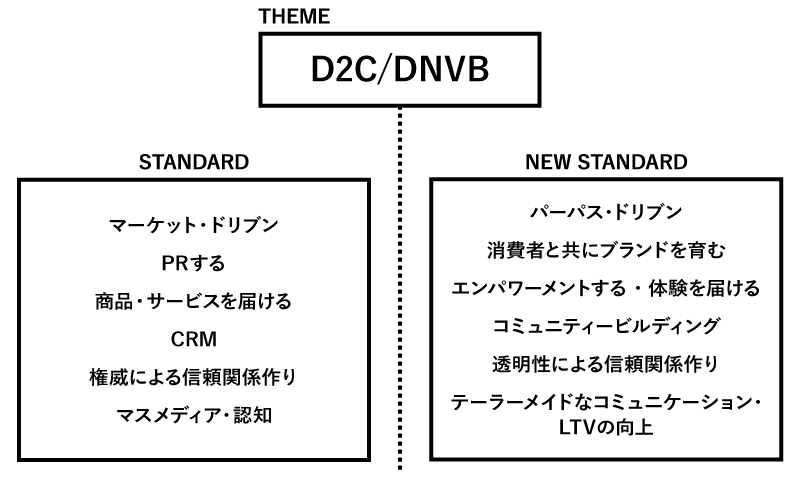
Responding to this, Mr. Mitsuhashi stated, "Adjusting to D2C Inc. brands boils down to 'digitizing how products are made, presented, and sold,'" suggesting the time has come to redefine the very concept of "e-commerce = online shopping."
He proposed a new definition of EC as "a new brand experience and purchasing experience enabled by technology," explaining that it is now necessary to grasp trends with a broader perspective and consider business growth accordingly.
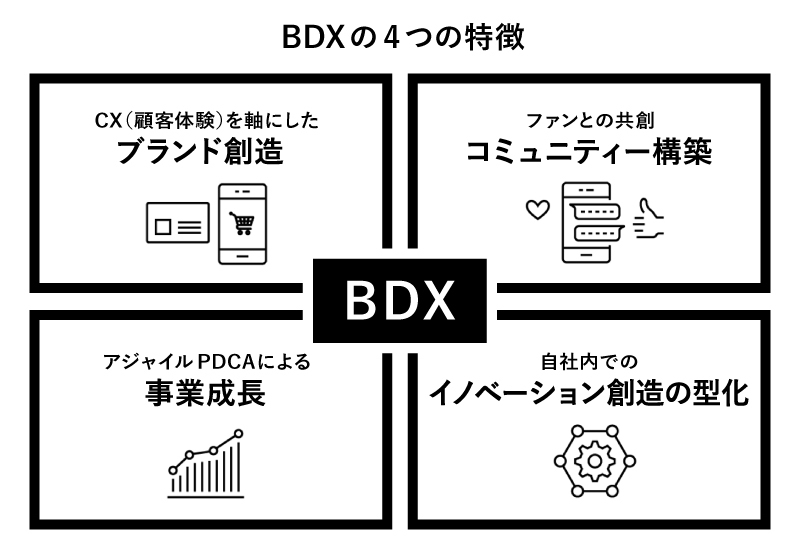
He then mentioned that to support such brand transformation, NEW STANDARD, Dentsu Inc., and Dentsu Digital Inc. have jointly launched the "Brand Digital Transformation" (BDX) project, introducing its four key features.
・Brand Creation
Redefining existing brands or creating new ones
・Community Building
Building relationships with users through content marketing and social media
・Business Growth
Supporting business growth at BDX using Dentsu Digital Inc.'s digital marketing expertise
・Systematizing innovation creation
Preparing formats for creating new ventures internally and supporting their transition to self-sustaining operations
Mr. Hisashi noted the current situation in Japan: "While many brands understand the benefits of D2C Inc./DNVB, I hear they face challenges like 'not knowing how to implement it,' 'difficulty leveraging online and offline channels,' and 'struggling to interactively communicate with users.'"
"However, I believe the D2C Inc./DNVB business model will rapidly gain traction once the structure is understood. Through our projects, we will actively support the adoption of this new business model," he stated regarding future prospects.
Read the "Do!Solutions" article here.
What is "Business Transformation" for DX-Leading Companies?

While the number of companies implementing DX grows annually, many struggle with issues like "vague objectives" or "means becoming the end." What approach is needed to link DX to business outcomes and drive business transformation (BX)?
Yumiko Yasuda, Head of the Business Transformation Division at Dentsu Digital Inc. and a leader who has supported numerous companies' DX efforts, presented current challenges and solutions.
According to Dentsu Digital Inc.'s research, approximately 70% of Japanese companies have initiated DX, but only about 20% of them are seeing clear business results. Regarding the reasons for this, Ms. Yasuda pointed out from survey data collected last year that a characteristic of companies not seeing much effect is that they remain stuck at the stage of operational efficiency improvements and enhancement activities.
Yasuda emphasized that DX requires
1. Digital-driven operational transformation
2. Transformation of customer experience
3. Transformation of products/services and business models
4. Innovation of the company's core business
He noted that while many companies implementing DX have started Step 2, they often stop at digitizing customer touchpoints. He emphasized that unless they continuously pursue Steps 2 and 3, which are customer-centric, they won't achieve new value creation or revenue generation—in other words, BX.
What are the bottlenecks preventing progress in DX for companies? Mr. Yasuda identified
* "Conceptual challenges": DX stalls due to a lack of fundamental goals or vision, or because these are not shared internally.
• "Strategic challenges" where there is no blueprint to connect the DX efforts of individual departments to customer value.
• "Execution challenges" where an overall vision or strategy exists but lacks a command center to coordinate execution teams
As solutions to these three challenges, Mr. Yasuda presented concrete approaches, drawing on practical examples from leading DX
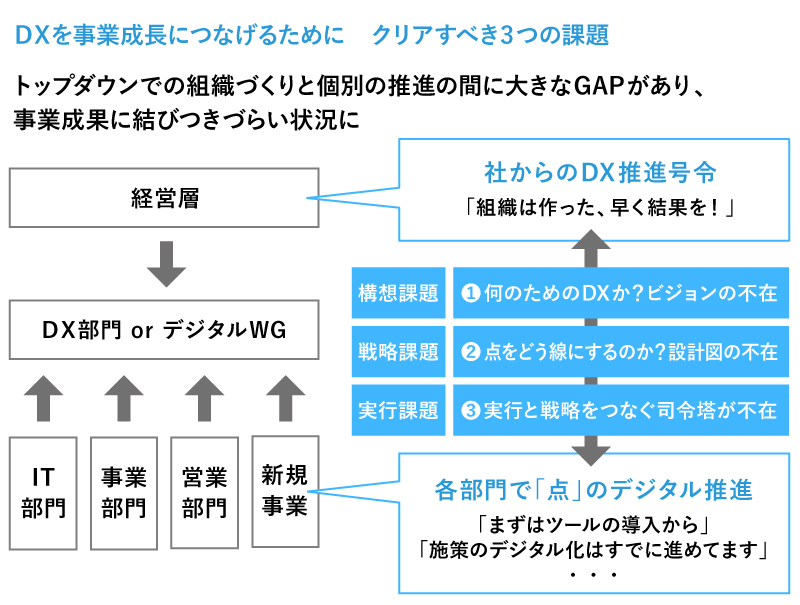
To address these three challenges, Mr. Yasuda presented concrete approaches, drawing on practical examples from leading DX companies.
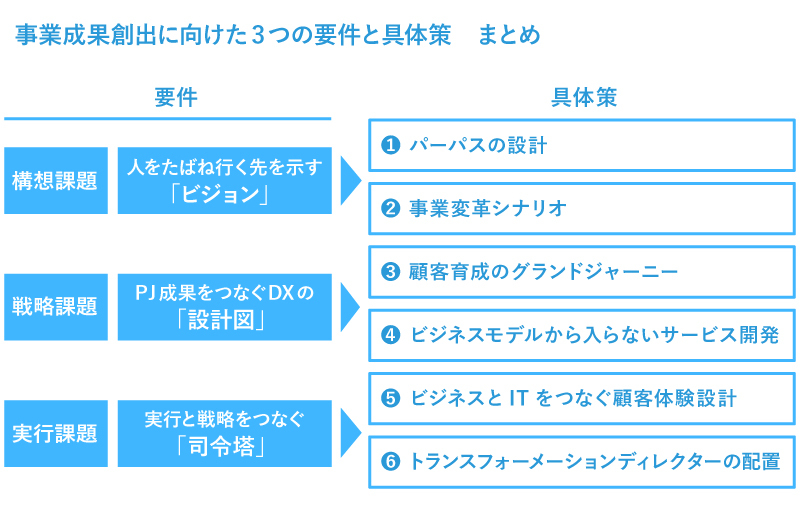
At a major food manufacturer, he proposed a new business development methodology focused not on growth markets but on anticipating future customer changes. By accompanying them through this process, it led to the creation of new personalized services. Furthermore, by delving into "the new value and purpose that companies will provide going forward" – essentially their "purpose" – a shared understanding of DX efforts emerged within the company, leading to sustained results thereafter.
Furthermore, using the example of a major durable goods company launching a subscription business, he explained key points for promoting new business models within Japanese companies where existing businesses still account for the majority of revenue. In the case of an energy company, he emphasized the importance of designing and implementing a customer journey focused on "customer utilization" – digitizing the customer base, a critical asset for existing companies, and running digital services on top of it.
Finally, Mr. Yasuda stated, "While it goes without saying that top management commitment is paramount for DX success, there is another critical factor: middle leaders' personal ownership. To drive business transformation, it's not just about forecast thinking—improving existing operations by addressing current challenges. Backcast thinking, which reevaluates existing operations starting from a future vision, is equally indispensable. Middle-level leaders are the ones who understand both approaches, can embody and realize them, and become the catalysts for business transformation." With this, he concluded the session.
Read the "Do!Solutions" article here.
※For a more detailed report on this webinar, please visit the special feature page on "Do!Solutions"!
Was this article helpful?
Share this article


Newsletter registration is here
We select and publish important news every day
For inquiries about this article
Back Numbers
Author