Note: This website was automatically translated, so some terms or nuances may not be completely accurate.
 "People Driven Marketing® Practical Webinar 2020" Report [5/9]
What are the next moves being made at the forefront of data marketing?
Dentsu Inc.'s people-centric marketing approach, "People Driven Marketing®," has now entered its fourth year and has significantly evolved as "PDM 4.0."
This series provides a digest report on the three-day "People Driven Marketing® Practical Webinar 2020," where Dentsu Inc. professionals and corporate guests discussed the future of marketing and data.
This installment delivers insights on "Data Utilization Methods" essential for companies today, including an introduction to data utilization trends in Japan and the US by DENTSU CROSS BRAIN INC., which supports corporate data talent development and environment building.
※People Driven Marketing
https://www.dentsu.co.jp/business/pdm/
A people-centric integrated marketing framework proposed by Dentsu Inc. for the data & digital era. It reframes challenges from a people (People) perspective and integrates the Dentsu Group's cutting-edge marketing methodologies to support customers' sustainable growth.
Challenges and Solutions for "Always-On Marketing": Cutting-Edge Data Utilization in Japan and the US

Mr. Kawabe and Mr. Sato from DENTSU CROSS BRAIN INC., a team of top data analytics talent, unraveled the current state of data marketing and explained the necessary personnel and competencies for the next strategic move.
With technological evolution, consumers' information-gathering behaviors have drastically changed. Actively seeking out desired information has become commonplace, and each individual now seeks different information at different times.
Furthermore, the methods of information gathering are also changing. Mr. Sato, one of Japan's leading data scientists, pointed out the diversification of information gathering methods: "More people are obtaining information that matches their interests and concerns through social media timelines rather than search engines. Meanwhile, generations less familiar with social media gather information through entirely different methods."
Amidst this landscape, the term "Always-on Marketing" has gained significant attention in recent years. "Always-on" means "constantly connected." It is a marketing concept aimed at improving the relationship between companies and consumers by providing each individual with the optimal information at the optimal time.
Among the technologies surrounding Always-on Marketing, Mr. Kawabe particularly focuses on "alternatives to third-party cookies." Third-party cookies, issued from domains other than the website a user is visiting, were indispensable for targeted advertising that delivers optimal information to each individual.
However, in recent years, due to personal data protection concerns, third-party cookies are becoming increasingly unusable. Mr. Kawabe, who until recently served as Director of a data analyst team in the US, explained the "next steps" being discussed in the US to replace third-party cookies.
One concept is the "walled garden" (*1). This refers to an ecosystem where platform companies like Google and Facebook hold users' personal information while protecting it.
By leveraging this ecosystem, client companies can implement sophisticated and rapid advertising strategies. However, a concern arises that it becomes difficult to see what is happening within the walled garden, potentially hindering client companies from properly managing their own information.
As an alternative, Mr. Kawabe proposed building an in-house ecosystem to utilize consumer data.
"We are seeing movements to actually collect PII (Personally Identifiable Information) in-house and build mechanisms to link proprietary first-party cookies," stated Mr. Kawabe.
Building such a data foundation in-house enables continuous deepening of customer understanding and allows for linking various data available in the market with the company's own infrastructure.
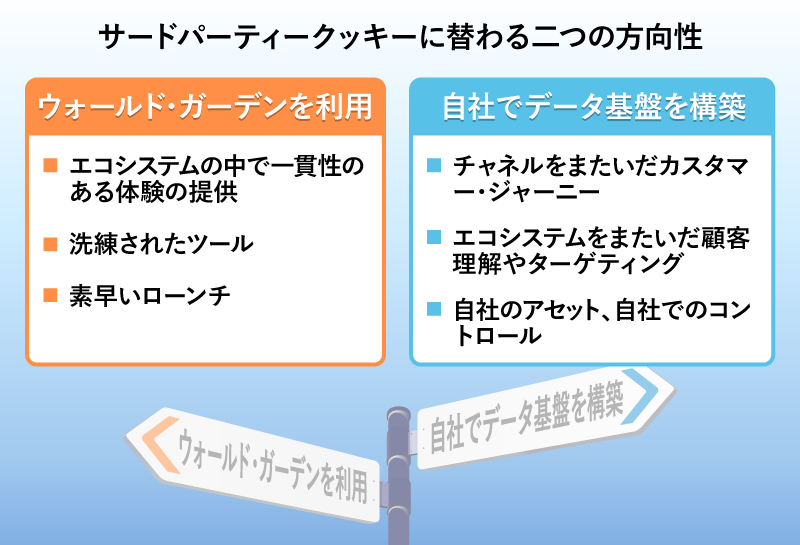
※1 Walled Garden
An advertising ecosystem where platform companies hold users' personal information while protecting it. Within this ecosystem, client companies utilize anonymized and aggregated data to implement highly accurate targeted advertising; this environment is called a "data clean room."
As technology advances and becomes more complex, training marketers capable of data analysis has become an urgent priority.
While the environment for data analysis and utilization, replacing third-party cookies, is taking shape, a new problem has emerged: "talent shortage."
Mr. Sato noted that marketing efforts have become commoditized in recent years, making even AI-related technologies difficult to differentiate. He explained, "More than the technology itself, what's required is the 'planning ability' to determine how to apply it effectively in the marketing field."
He expressed the view that "Even if companies have the environment to utilize data and AI, the current reality is that implementation into business operations is not easy due to a shortage of personnel. Particularly, there are not that many Japanese companies that can centrally analyze all data and move as one toward a consistent customer experience."
The sophistication and complexity of marketing technology are accelerating, with numerous tools emerging across broad fields and each maturing.
"Companies bring in experts as partners to leverage marketing technology, but even with expert assistance, it's difficult to understand everything, and significant oversights and errors are occurring," Sato noted.
What should companies do to solve these challenges? Mr. Kawabe states, "Companies should hire and train 'marketing data analysts' in-house."
A marketing data analyst is someone who not only understands marketing but can also design and build data analysis environments and select the correct data analysis methods.
"If hiring many marketing data analysts quickly is unrealistic, I recommend training your own marketers to become marketing data analysts. They can start by performing their core marketing duties while collaborating with external data specialists to absorb the skills and knowledge needed for data utilization, building a foundation for talent development," says Mr. Kawabe.
Another crucial point Kawabe highlighted is "establishing a system that seamlessly links data analysis and data utilization."
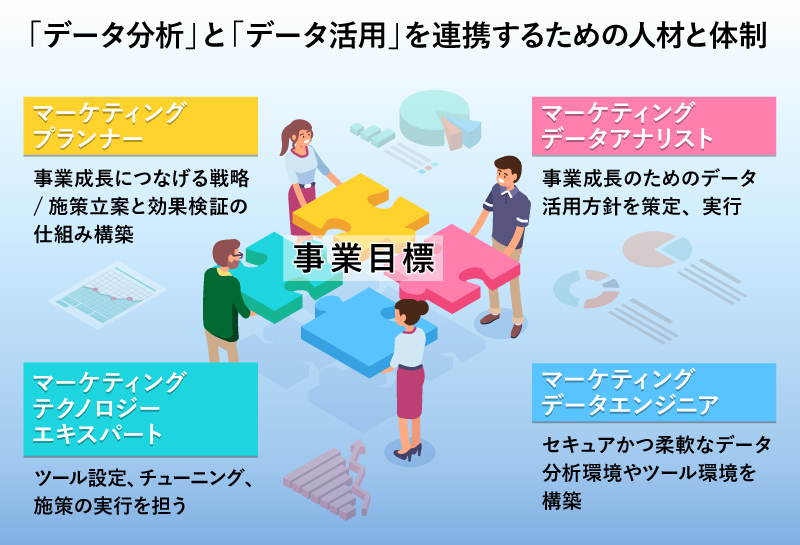
- Data-Driven Marketing Planner
- Marketing Data Analyst
- Marketing Technology Expert
- Marketing Data Engineer
By forming a single team with these four functional roles and sharing business objectives, brand identity, and values, greater results can be achieved, Mr. Kawabe explained, concluding the session.
Read the "Do!Solutions" article here.
For the detailed report, please visit the feature page on "Do!Solutions"!
Was this article helpful?
Share this article


Newsletter registration is here
We select and publish important news every day
For inquiries about this article
Back Numbers
Author