Note: This website was automatically translated, so some terms or nuances may not be completely accurate.
 "People Driven Marketing® Practical Webinar 2020" Report [3/9]
What should the future of branding look like? The four essential perspectives for driving DX.
Dentsu Inc.'s people-centric marketing approach, "People Driven Marketing®," has now entered its fourth year and has significantly evolved as "PDM 4.0."
This series provides a digest report on the three-day "People Driven Marketing® Practical Webinar 2020," where Dentsu Inc. professionals and corporate guests discussed the future of marketing and data.
This installment introduces a session by Takashi Sakuma, Executive Creative Director at Dentsu Digital Inc., who has created numerous "brand experiences," discussing "The Future of Brands Opened by Creativity."
Amid advancing digitalization and DX (Digital Transformation), what should the future of brands look like? He outlines how brands should exist in response to societal changes and presents the perspectives necessary for brand transformation.
※People Driven Marketing
https://www.dentsu.co.jp/business/pdm/
Dentsu Inc.'s integrated marketing framework centered on "people," designed for the data & digital era. It reframes challenges from a people-centric perspective and integrates the Dentsu Group's cutting-edge marketing methodologies to support customers' sustainable growth.

Before Advancing DX, Return to the Essence of Your Brand

In today's rapidly accelerating digital age, people's values are undergoing significant transformation. Consumption trends are shifting from "ownership value to usage value," "things to experiences," and "products to services," making corporate DX increasingly crucial.
Creativity is crucial during this transformative period. Mr. Sakuma, who has worked as a Creative Director planning and executing corporate branding, points out that before companies push forward with DX, they must first return to their essence.
"The purpose of DX is not merely introducing digital tools. That would be putting the cart before the horse. Companies must re-examine the meaning behind transforming their products, business, and brand for the future, understand that essence, and then consider DX."
Promoting Brand DX Through Four Perspectives: "People," "Purpose," "Creativity," and "Data/Tech"
He then outlined the following "four perspectives" for transforming a brand:
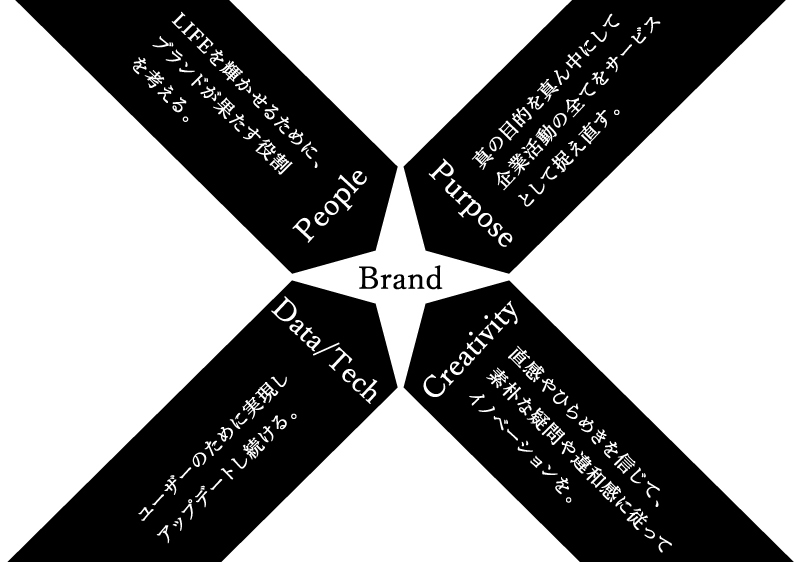
1. People: The perspective of targets and customers
With the digital shift, globalization, and the spread of COVID-19, work styles and lifestyles have diversified, and life choices have increased. Sakuma analyzes that "from now on, it will be an era where people live while seeking their own unique stories and ways of living true to themselves." In other words, it is an era where "people" increasingly become the protagonists.
What role should brands play in this era? Sakuma argues we must shift our thinking to focus on "enriching individuals' lives."
"Brands carry images like 'luxury' and 'aspiration.' Consequently, the relationship between brands and individuals has traditionally been one where 'the individual partakes in the worldview the brand creates. They are granted access to participate in that worldview.' However, the coming era is one where each individual becomes the protagonist. The role of brands will shift to 'making people = LIFE shine.' What matters is setting the stage for people to shine. Embracing this mindset will be a fundamental prerequisite for advancing DX."
2.Purpose: The Perspective of Clarifying Purpose
To transform a brand, it's also crucial to redefine the business purpose—to thoroughly examine "what we do and why we do it."
Traditionally, advertising existed as a means to make people aware of a product's existence. PR followed to promote sales and products, and sales served as the method to deliver the product. In other words, all corporate activities centered around "selling products," with everything else being a means to that end.
However, when purpose is placed at the center, one realizes that all corporate activities are means to achieve that purpose. Consequently, corporate activities inevitably shift from products to services. Mr. Sakuma stated, "The essence of DX is to place the realization of purpose, not products, at the center, and to reinvent and reinterpret the means to achieve it." He urged us to re-examine the purpose of the business, the origins of the product, and the intent behind it.
3. Creativity: The Service and Product Perspective
So, once the purpose is defined, how should services and products be created? Mr. Sakuma emphasized that "unleashing creativity" is crucial.
"Creativity might seem like a complex concept. But what matters is a childlike way of thinking. That innocent sense of 'Isn't this great?' or 'Isn't this interesting?' is creativity itself."
In business, intuition, flashes of insight, and that "just feels right" sensation tend to be suppressed. Sakuma states, "Trusting each person's sense is the creative mindset."
"Liberating your intuition, flashes of insight, and imagery; questioning common sense and putting it into words. Or digging deeper into that feeling of 'something's off' or discomfort. That's what leads to new creativity suited for our increasingly diverse society," says Sakuma.
The key criterion Sakuma values for evaluating creative ideas born this way is whether they "make you go 'Huh?' and tug at your heartstrings."
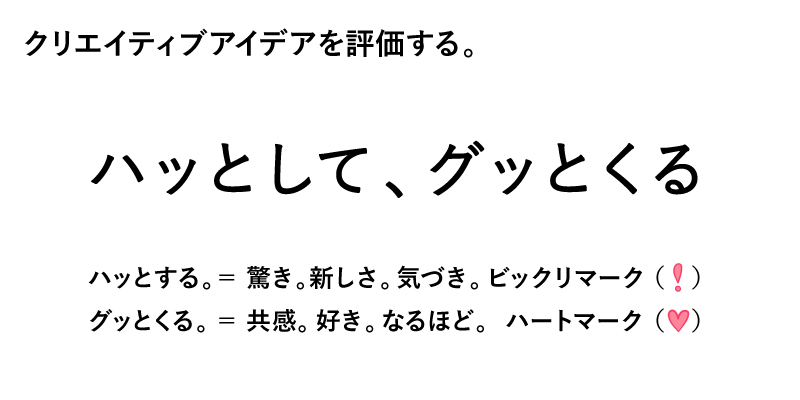
"Wow" refers to surprise, novelty, or a state worthy of an exclamation mark. Furthermore, it must also contain an element that evokes empathy or favor, something that "tugs at your heartstrings." This refers to a state worthy of a heart symbol. In other words, Sakuma stated, "Creative ideas that make you want to add both an exclamation mark and a heart symbol are precisely those that possess both novelty and universality."
4. Data/Tech: The Implementation Perspective
Data and technology are leveraged to bring these creative ideas to life. Sakuma cites the Silicon Valley-born D2C Inc. (Direct to Consumer) shoe brand "allbirds" as a prime example.

The brand's concept is "the world's most comfortable shoes." It excels not only in functionality but also in using sustainable materials like wool and sugarcane that are gentle on both skin and the planet. "What's new is that it provides the value that 'choosing and wearing sustainable shoes is cool,'" Sakuma expressed approval of the brand's direction.
Furthermore, the official website features a video that "visualizes" the CO2 emissions throughout the entire process, from material sourcing to product disposal. The brand also pursues comfort by instantly managing global customer data and adjusting inventory, as well as incorporating user feedback to meticulously refine product renewals.
"Using data to enhance user comfort and sustainability—that's where I see the innovation. I don't mean to dismiss data-driven approaches, but isn't it smoother to first consider what means are available to achieve your goals, and then utilize data accordingly?"
What brands can do to make individual lives shine
As mentioned in Perspective 1, people are now the protagonists. What can brands do to make individual lives shine? To pioneer the future of brands, we must pursue this role.
While we introduced the "four perspectives" essential for brand DX, they don't necessarily need to be implemented in order. Starting with the second perspective—"clarifying purpose"—can be smoother, but Sakuma points out that regardless of the starting point, it's crucial to consider all perspectives.
He concluded, "Great creative ideas can be explained from any perspective and can build upon other ideas. It is through this iterative process that brands shine, become beloved, and are truly needed."
*For a more detailed report on this webinar, please visit the feature page on "Do!Solutions"!
Was this article helpful?
Share this article


Newsletter registration is here
We select and publish important news every day
For inquiries about this article
Back Numbers

Author