Note: This website was automatically translated, so some terms or nuances may not be completely accurate.
 "People Driven Marketing® Practical Webinar 2020" Report [1/9]
Three Essential Keywords for Marketing in the New Normal Era
Dentsu Inc.'s people-centric marketing, "People Driven Marketing®", has also significantly evolved into "PDM 4.0" as it enters its fourth year.
This series provides a digest report on the three-day "People Driven Marketing® Practical Webinar 2020," where Dentsu Inc. professionals and corporate guests discussed the future of marketing and data.
※People Driven Marketing
https://www.dentsu.co.jp/business/pdm/
Dentsu Inc.'s integrated marketing framework centered on "people," designed for the data & digital era. It reframes challenges from a people-centric perspective and integrates the Dentsu Group's cutting-edge marketing methodologies to support customers' sustainable growth.
"PDM": Human-Centered Integrated Marketing for the Digital & Data Era

In the session titled "What Are the 3 Essential Keywords for Marketing in the New Normal Era?", Taiyo Hamakubo, who promotes data-driven marketing at Dentsu Inc., and Manabu Takahashi, who serves as Solution Director, took the stage.
They discussed the three key concepts necessary to realize people-centric marketing, considering recent societal changes and shifts in consumer behavior.
In today's world, where digital evolution keeps customers and companies "Always on" connected, and the visualization of human consciousness and behavior is rapidly advancing.
In response to this era, Dentsu Inc. introduced the "People Driven Marketing" (PDM) framework in 2017.
It aims to achieve corporate marketing goals by delivering the "right information" to the "right audience" at the "right place" and "right time," based on customer awareness and behavioral data.
The content of PDM has evolved year by year. In 2019, as "PDM 3.0," we advanced support activities for the entire spectrum of corporate marketing activities, which are becoming dual-funneled.
The dual funnel combines Dentsu Inc.'s traditional strength in the 'new customer acquisition funnel' with a 'existing customer management funnel'. It integrates the awareness-to-purchase domain with the CRM (Customer Relationship Management) domain, aiming to enhance customer LTV (Lifetime Value)," explained Mr. Hamakubo.
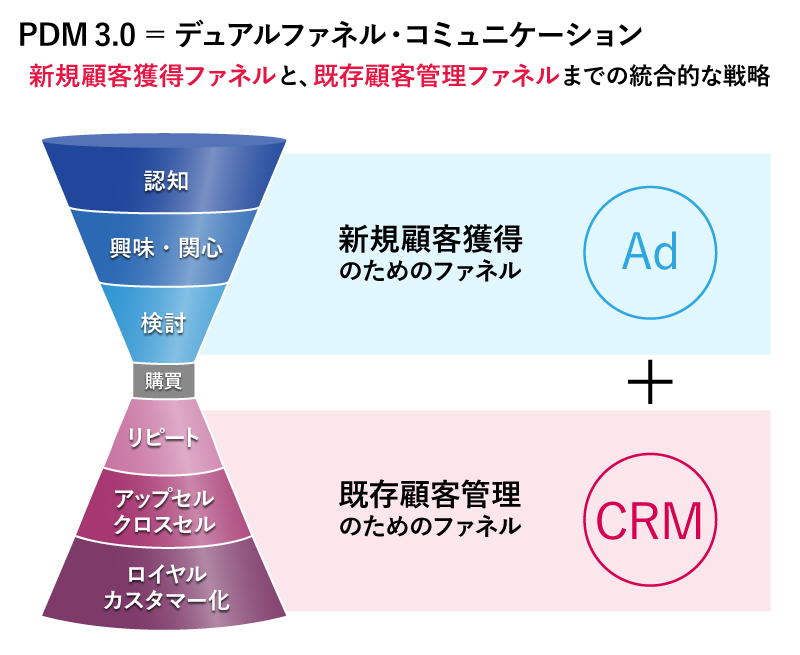
However, 2020 brought drastic societal changes, prompting a transformation in the Dual Funnel initiative. Mr. Hamakubo first explained "how people's lives and mindsets changed in 2020."
2020 saw rapid adoption of cashless payments, D2C Inc., and digital communication
The pandemic led many people to spend more time at home, drastically reducing time spent going out. Mr. Hamakubo highlighted the increasing use of cashless payments. "From the perspective of preventing infection spread, the proportion of cash used in many situations has decreased," he pointed out, noting the growing adoption of cashless payments.
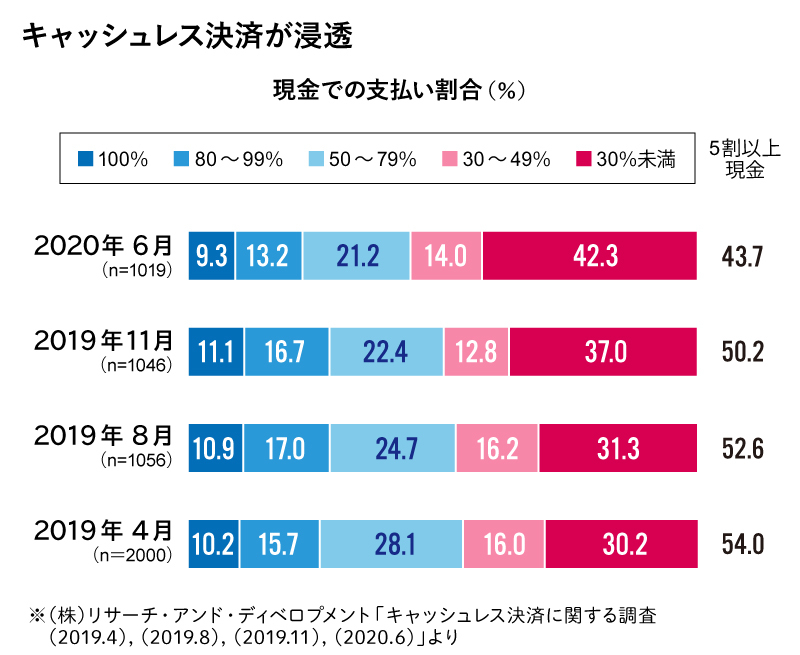
He also noted, "As time spent outside decreased, even industries that were not traditionally well-suited to mail order began focusing on e-commerce," presenting data showing the growth in e-commerce sales.
Regarding D2C Inc. (Direct To Consumer – a business model where companies sell products directly via their own websites, bypassing retailers), he expressed optimism about market potential: "Even in industries like cosmetics, major manufacturers are reported to be entering this space. Looking at Google search trends, searches for 'D2C' are surging."
Alongside the rise of cashless payments and D2C Inc., Mr. Hamakubo highlighted another crucial shift: the digital transformation of information access. As human communication becomes increasingly digital-centric, digital platforms are also gaining greater importance as information sources.
"More people feel that social media, information blogs, and corporate official websites are useful for learning about products and services," said Mr. Hamakubo.
Purchasing a hot sandwich maker after seeing it on Twitter. What insights did this lead to?
How should marketing activities adapt to these shifts in consumer awareness and behavior? One answer Mr. Hamakubo proposed is the concept of "pulse-type consumption" (instantaneous current-like consumption), a consumer behavior model advocated by Google.
While the traditional purchasing process mainly followed the flow of "Awareness → Interest → Comparison → Consideration → Purchase," pulse consumption is an instantaneous act of buying a product one likes without a clear reason.
While impulse buying has long been common for daily necessities, the proliferation of smartphones has enabled purchases anytime, anywhere, leading to pulse consumption even for clothing and electronics.
Mr. Hamakubo referenced data showing "an increasing number of consumers who feel no hesitation about buying products they happen to discover while using their smartphones right then and there." He commented, "I was surprised at first, but upon reflection, I can relate to this myself."
"I myself recently saw a Twitter post and bought a hot sandwich maker. It seems many others did the same, as I later saw an article reporting that product was running low," said Mr. Hamakubo.
This purchasing process is a classic example of impulse buying: "See Twitter post → Buy." However, Hamakubo notes, "Looking back, there was a 'setup'."
During the period of self-restraint due to the state of emergency declaration, he found himself cooking more often and frequently browsing recipe sites. Additionally, he came across the topic "solo camping videos are interesting," which led him to watch YouTube videos and purchase outdoor gear.
There's no obvious direct link between this sequence of events and "seeing information about hot sandwich makers on Twitter." However, Hamakubo suggests that these small elements accumulated as foreshadowing, ultimately leading to the experience of "seeing Twitter and purchasing a hot sandwich maker."
"Looking at this experience from a marketer's perspective, all the actions leading up to the final Twitter view exist as data. These 'clues' could serve as hints or precursors leading to the purchase trigger," he stated.
In other words, capturing various information exposures that occur "before" product awareness as marketing data becomes crucial in marketing strategy.
The concept that "accumulated information touchpoints act as foreshadowing, and something triggers the purchase" significantly impacts not only new customer acquisition but also the management funnel for existing customers. This is because the actions of loyal customers and the product reputation they spread become the "foreshadowing" and "triggers" influencing new customers before awareness.
From this perspective, Mr. Hamakubo stated, "CRM will become important not only for improving the LTV of existing customers but also for acquiring new customers."
Global strengthening of personal information protection. An era where consumers choose what information to disclose
As Mr. Hamakubo noted, the digital accumulation of consumer behavioral data continues to grow rapidly, accelerating its use in marketing.
Concurrently, a global push for "strengthened personal data protection" is underway, creating an environment where caution is required when utilizing consumer behavioral data for marketing.
Mr. Takahashi, who took the stage in place of Mr. Hamakubo, explained the importance of personal information protection and the three key concepts necessary for marketing activities in light of this.
Mr. Takahashi first outlined the movements in Europe and the US surrounding the strengthening of online personal information protection. He mentioned that platform providers like Apple and Google are moving towards significantly restricting the use of cookies, which have traditionally been the mainstay of digital advertising. He further introduced that similar movements are occurring in Japan, led by the Fair Trade Commission.
"More companies are introducing systems where consumers themselves can choose how cookies are used. We are entering an era where consumers can decide where their personal information is disclosed," said Takahashi.
However, modern business already cannot function without consumer data. Mr. Takahashi states that in such times, companies must also rethink their approach to data utilization.
Three Keywords Essential for Realizing PDM for Consumers
The current social situation is one where the "accelerator" for data utilization is being pressed due to the impact of the COVID-19 pandemic, while simultaneously, the "brake" is being applied due to movements in personal information protection.
What will become crucial going forward is an approach that makes consumers positively want to "disclose their data." "We intend to pursue this as PDM 4.0," Takahashi stated, outlining a concrete direction.
Partnering with companies that already hold consumers' information and provide services where consumers feel, "My life wouldn't function without sharing my data here." Collaborating with such companies to build a data infrastructure that maintains continuous connections between the company and consumers. Establishing relationships where consumers feel comfortable with the idea of "connecting my personal data."
Mr. Takahashi emphasized, "It is crucial to utilize data while strictly adhering to personal information protection rules," and introduced three keywords Dentsu Inc. has established to achieve the above:
Keyword ① Data Clean Room
The "Data Clean Room" is a service major platform providers offer to businesses. All data within the clean room is statistically processed and anonymized to prevent personal identification, earning it the name "Clean Room" – a sterile environment where privacy is not compromised.
Takahashi emphasized that integrating platform-held data, companies' first-party data, and Dentsu Group's proprietary marketing data within this Clean Room—without compromising personal information—for marketing purposes will become increasingly vital.
Keyword 2: Supportive DX
The second is "Accompanying DX (Digital Transformation)." This refers to a mindset that prioritizes "customer success" – that is, advancing DX with the success and needs of consumers at the forefront, aiming to enhance LTV through ongoing relationships.
"Hospitality and services that truly support consumers are the foundation. We then provide the necessary digital solutions and security. This is our vision of DX," says Takahashi.
Keyword 3: Data × CR
The final keyword is "Data × CR" (Data × Creative).
If the "experience value gained by providing behavioral data" isn't communicated, no one will want to share their behavioral data with a company. This is where Dentsu Inc.'s long-cultivated creative power becomes crucial.
"If we cannot materialize the 'experiential value' that connects a company's vision with consumers, PDM becomes merely an accumulation of numbers and data. The 'materialization of experiential value through creativity' is the most crucial point of PDM—using data to drive marketing," said Takahashi.
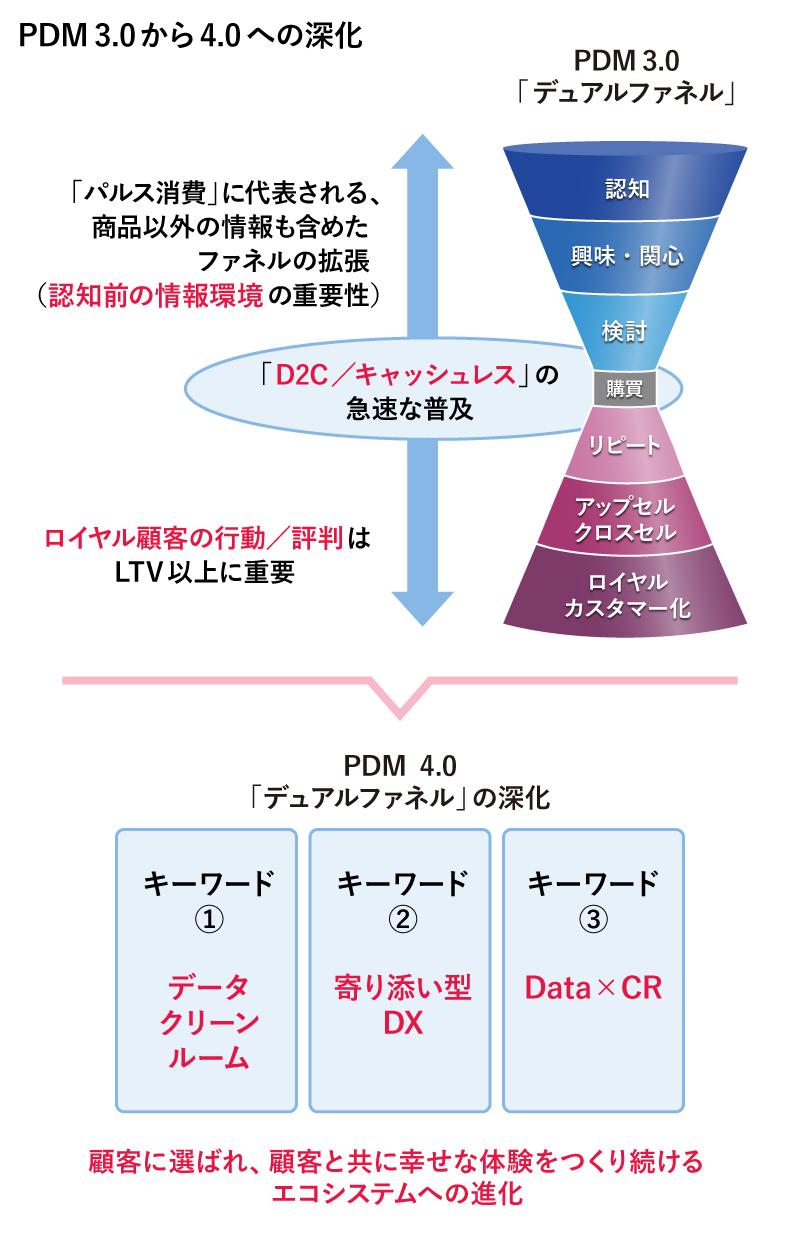
Using the "Data Clean Room" to uncover the context behind consumers, and employing "Accompanying DX" to build digital foundations aligned with the services consumers desire. Then, based on these, delivering optimal experiential value through "Data×CR."
"Within this integrated flow, we leverage the strengths of the Dentsu Group. This represents the deepening of the Dual Funnel and the evolution of an ecosystem that continuously creates happy experiences alongside our customers," stated Takahashi, concluding the session.
*For a more detailed report on this webinar, please visit the feature page on "Do!Solutions"!
Was this article helpful?
Share this article


Newsletter registration is here
We select and publish important news every day
For inquiries about this article
Author