Note: This website was automatically translated, so some terms or nuances may not be completely accurate.
 "People Driven Marketing® Practical Webinar 2020" Report [4/9]
What is marketing utilizing "data integration" required in the new normal era?
Dentsu Inc.'s people-centric marketing approach, "People Driven Marketing®" (PDM), has now entered its fourth year and has significantly evolved as "PDM 4.0".
This series provides a digest report on the three-day "People Driven Marketing® Practical Webinar 2020," where Dentsu Inc. professionals and corporate guests discussed the future of marketing and data.
This installment focuses on the session "Further Evolution of the Dual Funnel: Expanding Data Integration," featuring Koji Kobayashi of CCC Marketing and Ryo Yajima of Dentsu Inc. Data Marketing Center.
※People Driven Marketing
https://www.dentsu.co.jp/business/pdm/
A people-centric integrated marketing framework proposed by Dentsu Inc., designed for the data & digital era. It reframes challenges from a people-centric perspective and integrates the Dentsu Group's cutting-edge marketing methodologies to support customers' sustainable growth.
The "Data Clean Room": An Essential Marketing Foundation for the Cookie-less Era
The "Expanding Data Integration" theme featured three sessions. The first session introduced the reality and practical examples of "Data Clean Rooms."
In today's environment, heightened awareness of personal information protection has made it difficult to utilize IDs like cookies and IDFA (iOS advertising identifiers), which have been the foundation of data marketing. Meanwhile, brands' need to leverage cross-media analysis for marketing remains unchanged.
How can compliance with personal information protection be achieved while simultaneously solving marketing challenges? This is where the "Data Clean Room" concept was born.
The term "clean room" originally refers to a sterile, dust-free environment. A "data clean room" is a cloud environment where only authorized data scientists can access anonymized information—rendered unidentifiable for specific purposes like data integration and analysis. Leveraging this platform enables companies to securely integrate their accumulated "first-party data" (such as internal purchase data and campaign participation information) with the diverse information held by platform providers.
The potential for business development centered more closely on each individual customer was discussed through the use of data clean rooms.
Dual Funnel Marketing for Daily Consumer Goods Based on T-Point's Large-Scale Purchase Data

The final session of the day discussed a solution model jointly developed by Dentsu Inc. and CCC Marketing.
Joining Ryo Yajima, who primarily handles marketing method development and implementation at Dentsu Inc.'s Data Marketing Center, on stage was CCC Marketing's Kosuke Kobayashi. CCC Marketing provides various business solutions by leveraging the unique data(*) of over 70 million T Members. Mr. Kobayashi provides data utilization consulting services to manufacturers and retailers.
※ = Unique Data
This refers to over 70 million single IDs, over 5 billion annual purchase transactions, data on 6 billion types of products handled across a network of 200,000 stores, persona data comprising 300 items of customer DNA, offline and online movement/behavior data and media exposure data, as well as CCCMK Group's original enhanced data.
Mr. Kobayashi began by stating, "As technology and systems mature, things that were previously impossible to do are now becoming achievable." He then introduced dual-funnel marketing for consumer goods, which had been difficult until now, using analysis results and case studies.
"Dual Funnel" combines two funnels: one for acquiring new customers from awareness to purchase, and another for managing existing customers. The new customer acquisition funnel includes "Awareness," "Interest/Consideration," and "Purchase Consideration." The existing customer management funnel includes "Repeat Purchase," "Up-sell/Cross-sell," and "Loyal Customer Conversion."
"For many consumer goods, consumers often 'already use' the product or 'know the product,' making repeat customer acquisition crucial for companies," stated Yajima.

The funnel for acquiring existing customers in daily consumer goods is noteworthy. Ultimately, this means understanding customers' purchasing behavior: "Who is buying and how much?"
However, accurately tracking online purchases of daily consumer goods is challenging in reality. "To gain high-resolution insight into purchasing behavior, large-scale purchase data like T-Points is indispensable," states Yajima.
Specifically, T Point can identify users with a single ID. This allows tracking where users are in the funnel at any given moment—for example, a customer who was a loyal user of Coffee A but switched to Brand B three months later.
Furthermore, it offers the advantage of managing customers from the "customer's own perspective" across brands and categories.

Mr. Yajima states, "By shifting the perspective from 'understanding how things sell' to 'understanding people's situations,' purchase data is transforming into something usable for practical marketing."
Based on this concept, Dentsu Inc. and CCC Marketing jointly developed the "Shoppers Driven Platform" solution model to address dual-funnel marketing challenges.
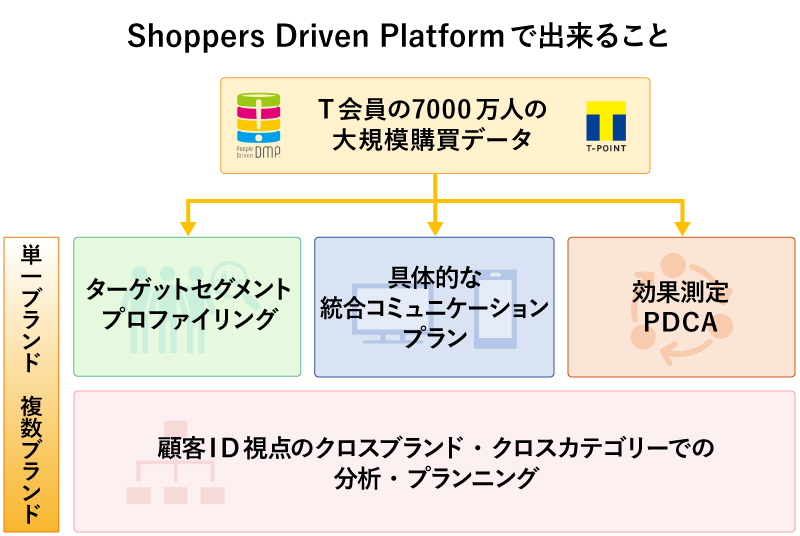
Through digital integration, moving from "understandable" data to "actionable" data
The "Shoppers Driven Platform" is a mechanism for continuously visualizing customer status and providing feedback.
The latter half of the session explained how the Shoppers Driven Platform is evolving by leveraging T-Point's large-scale purchase data, using cutting-edge case studies.
<Key Evolution Points>
"Target Segment Profiling"
When targeting and analyzing, we can consider the target based not only on demographics and preferences but also on customers' actual purchasing behavior.
"Concrete Integrated Communication Plans"
It is now possible to execute campaigns at a sufficient scale on digital platforms, moving beyond traditional test marketing approaches.
"Effect Measurement PDCA"
By conducting medium-to-long-term verification rather than just evaluating single campaigns, we can cultivate customers over extended periods.
"Cross-Brand/Cross-Category from a Customer ID Perspective"
The concept of LTV (Lifetime Value) has been introduced not just for individual brands, but for the entire manufacturer.
Dual funnel marketing in the FMCG sector, once challenging, is now achievable. Digital integration enables customer-centric PDCA cycles to be deployed at the business level within this domain.
Mr. Kobayashi concluded the session by stating, "We believe combining CCC Marketing's and Dentsu Inc.'s assets will make dual-funnel marketing even more precise. Under the theme 'From "understandable" data to "actionable" data,' we will continue evolving to support your marketing efforts."
Read the "Do!Solutions" article here.
※For a more detailed report on this webinar, please visit the special feature page on "Do!Solutions"!
Was this article helpful?
Share this article


Newsletter registration is here
We select and publish important news every day
For inquiries about this article
Back Numbers

Author