Note: This website was automatically translated, so some terms or nuances may not be completely accurate.
 "People Driven Marketing® Practical Webinar 2020" Report [6/9]
The Cutting Edge of Customer-Centric Marketing
Dentsu Inc.'s people-centric marketing approach, "People Driven Marketing®," has now entered its fourth year and has significantly evolved as "PDM 4.0."
This series provides a digest report on the three-day "People Driven Marketing® Practical Webinar 2020," where Dentsu Inc. professionals and corporate guests discussed the future of marketing and data.
This installment introduces three sessions held under the theme "The Future Beyond Customer Experience." We'll cover each session, which presented a vision for the future of marketing using concrete examples, addressing how to transform business from the customer's perspective while leveraging data and digital technology.
※People Driven Marketing
https://www.dentsu.co.jp/business/pdm/
Dentsu Inc.'s proposed integrated marketing framework centered on "people," designed for the data & digital era. It reframes challenges from a people-centric perspective and integrates the Dentsu Group's cutting-edge marketing methodologies to support customers' sustainable growth.
The Key to Future Marketing: "Accompanying CRM"
 The first session featured Takashi Uozumi from Dentsu Digital Inc., who supports clients' digital marketing. He explained "Accompanying CRM" for the coming era, using examples of "Customer Success."
Customer Success, literally "customer's success," is the philosophy that building trust with customers by helping them better utilize purchased products or services ultimately drives business growth. It has traditionally been discussed mainly in the B2B domain.
Mr. Uozumi began by noting that various service platform companies are now rolling out services emphasizing customer success.
For example, Amazon sends emails to customers who purchase honey and infant products together, warning them: "Please be careful, as giving honey to infants carries the risk of botulism." Netflix also sends emails to inactive customers who haven't watched content for a while, asking if they wish to continue their subscription. If there is no response, they automatically cancel the service without further permission.
"Amazon's email might seem overly meddlesome at first glance, but these preventative warnings aimed at avoiding undesirable situations lead to positive customer evaluations. While Netflix's approach risks lowering its own profitability, it's a prime example of customer success driven by a genuine customer perspective," said Mr. Uozumi.
Service platforms build customer trust and touchpoints through such initiatives. Uozumi points out that if this trend accelerates, customers may increasingly base purchase decisions on the kindness and favorability they feel from the service experience provided by the brand, rather than solely on product performance or brand recognition. This could lead to a relative decline in the brand value companies have cultivated in existing markets.
Given this situation, he urged, "Companies need to apply the customer success mindset, previously used only in B2B, to the B2C domain."
Furthermore, Uozumi presented an overall vision for customer success-oriented marketing to achieve customer-centric CRM in the B2C domain.
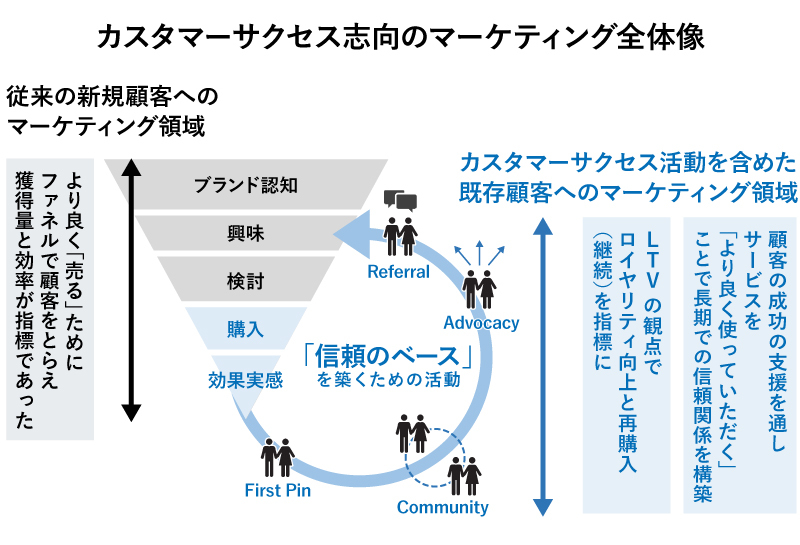
"After a product or service is purchased, we build a foundation of trust within the customer's daily life. This activity is customer success-oriented marketing. The trust foundation cultivated here is precisely what redirects the customer's interest back to the product or service, leading to repeat purchases. In other words, increased loyalty leads to upsells and cross-sells," he stated.
However, building such a model company-wide requires significant effort and time, including organizational reform. Therefore, Dentsu Digital Inc. proposes "Customer Prototyping" to companies facing challenges with customer trust and touchpoints. This approach involves starting small, proving results, and then scaling up.
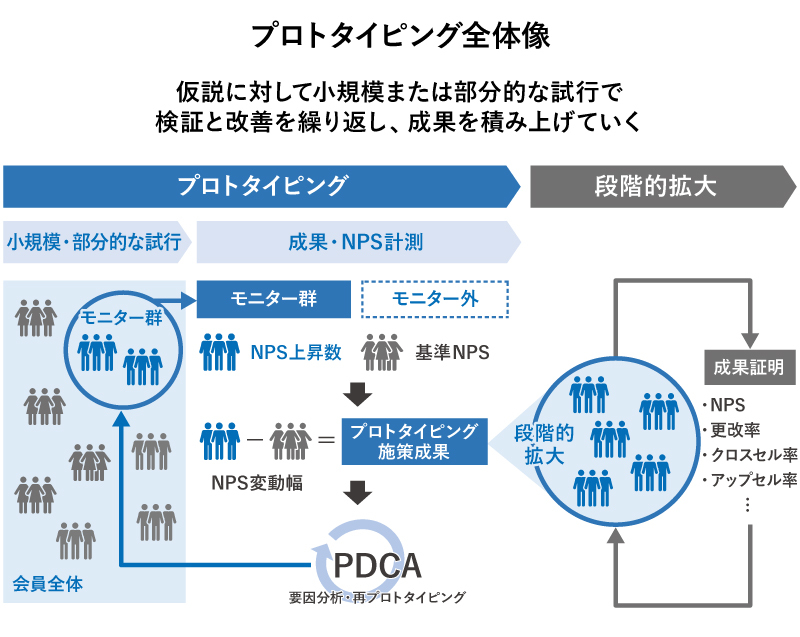
Mr. Uozumi introduced the three steps of "Customer Prototyping":
Step 1: Formulate hypotheses and conduct research on what customer success should look like for the customer.
Step 2: Define long-term KPIs and KGI targets to be driven through customer success initiatives, then plan a prototyping period.
Step 3: After forming the necessary team, launch specific activities.
"Traditional marketing was based on the idea that 'selling products to customers leads to corporate KPIs.' Going forward, we need to return to the true meaning of CRM: prioritizing customer-centric hospitality, focusing on 'attentiveness, awareness, and consideration,'" stated Mr. Uozumi.
He concluded by suggesting a method: "First, let's start with what we can do, in the form of 'customer prototyping.'"
Read the "Do!Solutions" article here.
The Future of the Food Service Industry Transformed by Mobile Ordering

The next session featured Takeshi Nitta, CEO of Showcase Gig, and Takuma Uehara from Dentsu Inc. Data & Technology Center. They discussed the growing adoption of mobile ordering during the pandemic and the resulting changes in the food service industry.
Showcase Gig and Dentsu Inc. began a capital and business alliance in April 2020, offering solutions centered around mobile ordering to restaurants, retailers, and manufacturers.
Their core product is the "O:der" platform, which enables the creation of OMO (*) services including mobile ordering. It features three key elements:
- * "Mobile Order": A smartphone ordering and payment service for takeout
- "Table Order," for in-store smartphone ordering and payment
- "Self-Order Kiosk," hardware that functions like a large smartphone, enabling in-store ordering and payment
* OMO = Online Merges with Offline. A concept signifying the fusion and integration of offline and online. It represents an approach that does not distinguish customer touchpoints or sales channels as "online vs. offline," but rather centers on the experiential value for consumers.
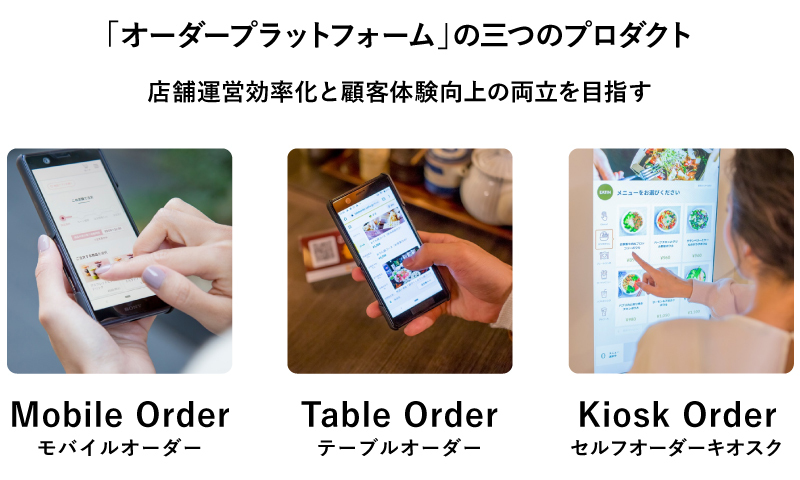
Mobile Order is a convenient tool that allows customers to place orders via apps and pick up their items without waiting in line or calling staff. In countries like the US and China, this has become a very standard service in recent years.
Mr. Uehara states, "While awareness in Japan is still low, the pandemic's demand for contactless solutions has driven rapid growth."
Uehara also cited integration with external platforms as a key factor in mobile ordering's adoption. Creating systems that allow orders via Google, LINE, Instagram, and others broadened accessibility, attracting previously untapped customer segments.
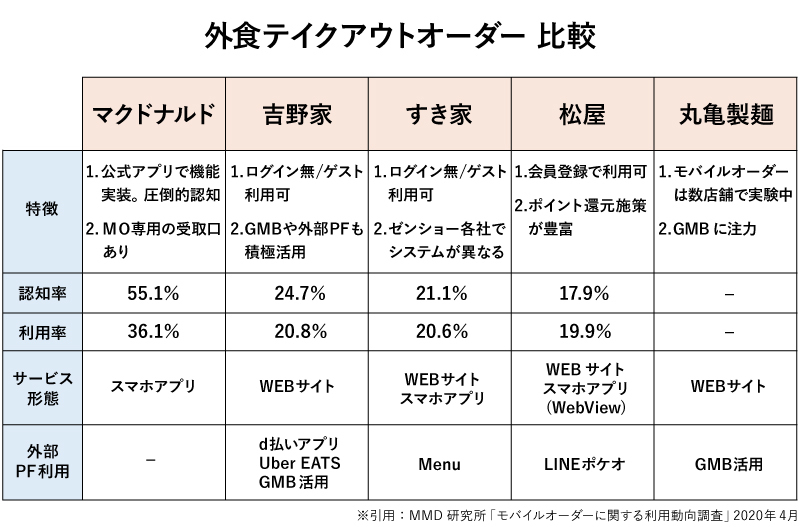
So, why should the restaurant industry adopt mobile ordering? The biggest benefits, according to Mr. Nitta, are reduced staff workload and increased average customer spend.
"Since customers don't need to call staff every time they order, it's easier to boost sales of beer and other alcoholic beverages, leading to fewer missed sales opportunities. Adoption is increasing in so-called pure dining establishments like izakayas and yakiniku restaurants. In some stores, nearly 100% of customers order via smartphone. The average customer spend has increased by 8-10% or more," (Nitta)
Mobile ordering still has room to evolve. Beyond the traditional "eat-in," "takeout," and "delivery" options, future developments are expected to include increased contact points and various applications enabled by data integration.
As an example of external integration, Yoshinoya's advanced ordering system was introduced, allowing mobile orders directly from a Google Maps URL.
"We believed more ordering channels were better. Rather than focusing on a single native app, we built it as a web API that easily integrates with external services. This resulted in a very intuitive customer journey," said Nitta.
Showcase Gig opened a mobile-order-only cafe in Tokyo in 2016 to let people experience the benefits of mobile ordering. An application of this concept is the concept shop "TOUCH-AND-GO COFFEE Produced by BOSS" for Suntory Holdings, developed by Showcase Gig.
This pickup-only store allows customers to customize their BOSS coffee with milk, flavors, and labels. Orders can be placed via LINE or in-store terminals, and coffee is easily retrieved from lockers.
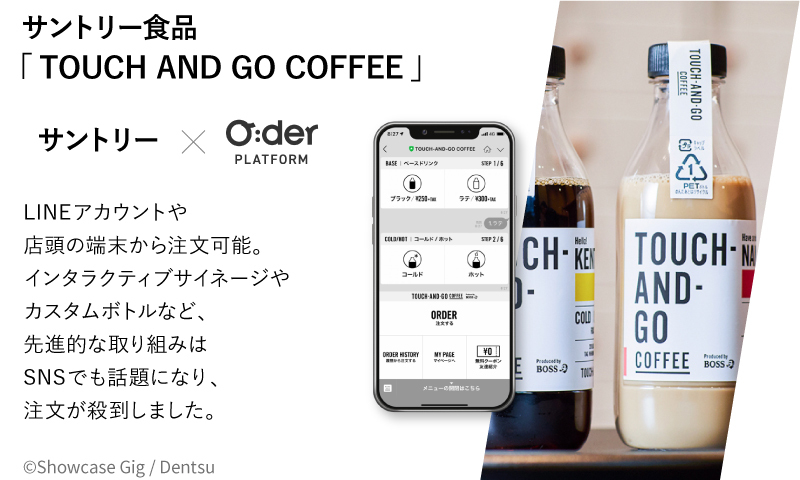
The session concluded with a vision for the future of the foodservice industry. Consumption within the store, such as dine-in, is termed "ON-Premises," while consumption at home or outside the store is called "OFF-Premises." Leveraging data and IDs effectively in this "OFF-Premises" space is said to be crucial for the future of the foodservice industry.
Many businesses report that regular customers who used to visit daily have stayed away due to the pandemic. While they can recall the customers' faces, they feel powerless to reach out. This underscores why establishing a presence in the "OFF-Premises" world is crucial. Both speakers suggested that mobile ordering will continue to evolve significantly.
Read the "Do!Solutions" article here.
What is "Across PDM," Gaining Attention in B2B Marketing?

The final session focused on "Across PDM" (A×PDM), a combination of ABM (Account Based Marketing) and PDM (People Driven Marketing) for B2B PDM utilization. It introduced methodologies and mindsets for success in the B2B space, where sales and marketing are expanding from people-centric approaches into mass-market domains.
Presenters included Hiroaki Kitagawa, Marketing Manager at Sansan, which operates the corporate cloud business card management service "Sansan," and Takashi Kinugawa from Dentsu Inc., who has collaborated with Kitagawa on B2B marketing.
The session began by introducing Sansan's case study, explaining how they overcame "challenges unique to B2B."
Although the two companies had collaborated on B2B marketing before, they initially struggled. Kinugawa analyzed the cause as "a misalignment in understanding the funnel structure unique to B2B."
"We were thinking about what to do to deepen the funnel for a single individual. It was essentially a B2C-like approach. However, in the actual field, deals progress not just with one contact person per company, but also involve decision-makers. The information sought by the contact person gathering information differs from what the decision-maker needs. A strategy focused solely on a single individual's funnel was insufficient for B2B marketing," he reflected.
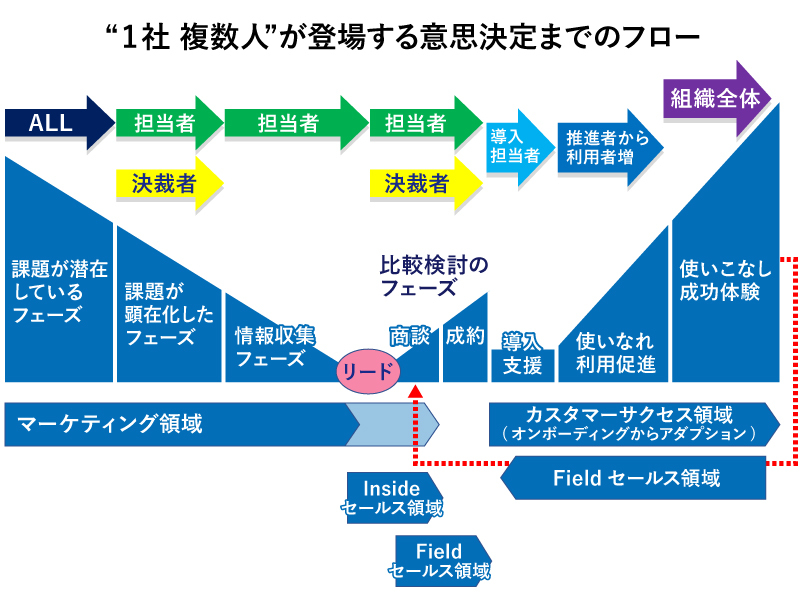
Consequently, the Dentsu Inc. team fundamentally reevaluated their approach and developed Sansan's original P2C methodology.
"P2C" (Pass To Contract) is one of Dentsu Inc.'s marketing methodologies. It defines the attitude change flow from when a user first learns about the service to the point of closing the deal. It clarifies the current challenges needed to deepen this flow and articulates "what is the objective," "what actions to implement," and "how to evaluate success." It serves as a roadmap for communication.
No matter what initiatives emerge, applying them to this P2C framework automatically clarifies:
"What is the purpose of implementation?"
"What challenge does it solve?"
"What effect is expected?"
"What KPIs will we use to evaluate?"
can be organized at a glance.
"When creating this P2C, we primarily leveraged data accumulated within Sansan. We reorganized, from a marketing perspective, insights from each department's past interactions with customers to answer: 'What strengths do we have for the operational challenges decision-makers in each industry face? How can we ensure they remember us?' This P2C then became the foundation for planning and PDCA cycles," (Mr. Kitagawa)
Furthermore, the approach both executives emphasize as crucial for effective B2B marketing is "Across PDM" (A×PDM). As mentioned at the outset, this combines the B2B theories of "Account Based Marketing" (ABM) and "People Driven Marketing" (PDM). It is used to understand and communicate with customers from both a "company-centric" and a "person-centric" perspective.
The "3×3 Double Matrix" (see figure below) illustrates the A×PDM concept. The red axis represents company-based targeting (ABM), while the blue axis represents individual-based targeting (PDM).
The nine empty cells represent customer statuses when the company is the subject. For example, "a person from a company with no existing contract who is also a first-time lead."
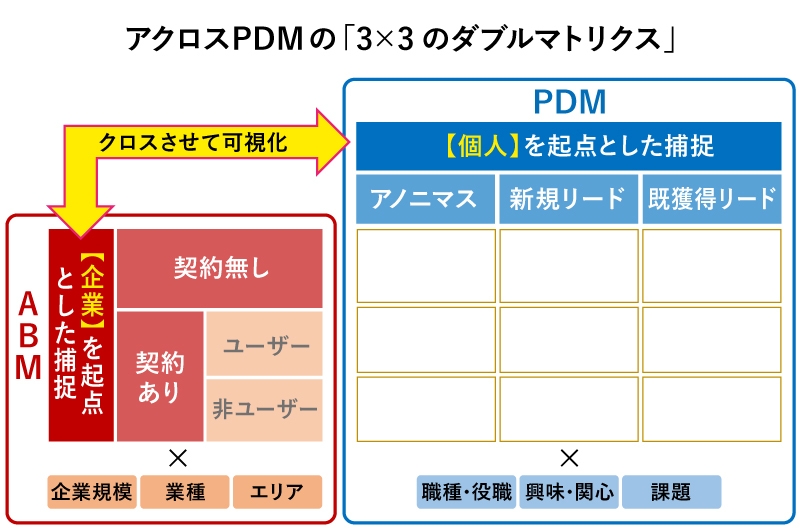
Even within "companies," the information that resonates varies based on company size, industry, and region. Similarly, for "individuals," it changes based on job type, position, interests, concerns, and challenges. Mr. Kinugawa states, "Rather than roughly defining the target profile, success is more likely when you meticulously classify customer types and design strategies while considering what characters are present."
Finally, Mr. Kitagawa declared, "To efficiently run the PDCA cycle, I feel scenario creation based on P2C and Across PDM is crucial. We must continue to focus on and address the funnel structure unique to B2B, distinct from B2C."
Mr. Kinugawa concluded the session by outlining future prospects: "A strategic-level PDCA cycle is vital—continuously refining what you've created by developing it along both 'corporate' and 'individual' axes."
Read the "Do!Solutions" article here.
*For a more detailed report on this webinar, please visit the special feature page on "Do!Solutions"!
Was this article helpful?
Share this article


Newsletter registration is here
We select and publish important news every day
For inquiries about this article
Back Numbers
Author