Note: This website was automatically translated, so some terms or nuances may not be completely accurate.
 The Essence of Growth Hacking as Seen in "Club J.LEAGUE" [2/2]
Revealing the Secrets of Operating the J.League Official App: 80% of Core Fans Are Registered
The J.League official app "Club J.LEAGUE" has surpassed 1 million downloads and grown into a service registered by 80% of the J.League's core fans.
As the operations lead for the Dentsu Inc. team, I have been involved since the planning and development stages of the service.
In the previous article, we mainly introduced the evolution of Club J.LEAGUE over its five years since launch, focusing on the "features the service offers." This time, the theme is "service operations."
In operating this service, we established
- We established fundamental principles and stances,
- optimized operational methods and meeting structures,
- and made small decisions weekly based on data.
This approach has enabled us to continuously implement growth hacking.
We'll share tips on decision-making, system building, and operational methods.
A "Good Experience Ecosystem" Grows Your Service
When growing a digital service, it's rare to have ample funding or be able to invest heavily in user incentives or advertising. Moreover, such circumstances are heavily influenced by internal and external environments.
I believe the most crucial factor for sustaining digital service growth is creating a mechanism— an " ecosystem "—that can continuously provide users with good experiences in a sustainable manner.
Building an ecosystem as a service, and continuously maintaining and strengthening that ecosystem in response to changing circumstances, is the " fundamental philosophy of service operation." The key points are the following two:
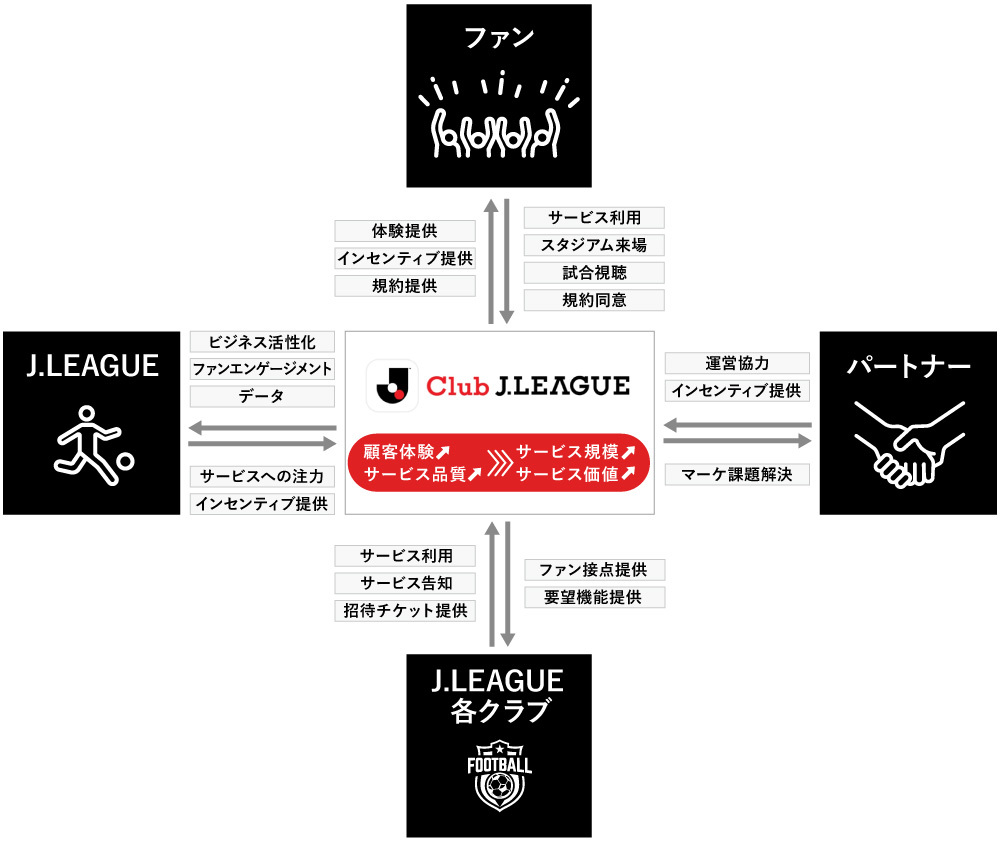
Point 1: Listen to Stakeholders' Opinions
To keep the ecosystem running smoothly, it is absolutely critical to listen to stakeholders and consistently identify clear challenges.
For Club J.LEAGUE, this means not only listening daily to fans and supporters, but also "listening to the voices of the clubs," "listening to the voices of partner companies providing benefits," and sometimes "listening to voices within the J.LEAGUE itself." Doing so dramatically increases both the probability and accuracy of identifying the next steps forward.
Through this listening, Club J.LEAGUE has realized the club-focused features introduced previously (early entry/halftime campaign functions/app push notification management screen, etc.) and co-creation with partner companies, accumulating small daily service improvements.
Point 2: Risk-taking must start with service operations
For a system to function effectively, the question often arises: "Who takes the initial risk?" This risk can be financial or labor-related. Crucially, we believe it is essential that the operational side (in this case, the J.LEAGUE) takes this risk first, rather than the clubs or partner companies.
Nothing new can be achieved without risk. If someone must take the risk, it is vital that we, the operators, demonstrate the resolve to take that risk first.
Examples of risks taken by the J.LEAGUE as the operator include the following:
- Service Launch Phase
⇒ While the service scale was small and clubs were slow to actively adopt it, the J.League took risks, such as investing a significant portion of its limited budget into promotion, to achieve a certain scale.
- Post-Initial Launch to Present
⇒ The J.LEAGUE develops new features and makes them available to clubs free of charge initially.
- Throughout the entire period
⇒Clubs are not charged for using Club J.LEAGUE services. Instead, they are encouraged to actively utilize its features.
This strongly incentivizes clubs to use Club J.LEAGUE, creating a self-sustaining ecosystem cycle.
Based on my experience working on numerous projects, when resources are limited and there's pressure to achieve short-term KPIs and gain immediate reputation, self-interest and self-preservation inevitably tend to take priority. However, "prioritizing the interests and benefits of your co-creation partners first" ultimately returns to the service operator in the form of service development.
Systems and Management Methods Enabling Swift Decision-Making
The key points for building this structure boil down to the following two:
Point 1: Clearly Define Roles and Responsibilities
Even if a robust structure is established during the development phase leading up to service launch, maintaining it during the operational phase is often unfeasible. Therefore, the critical question becomes: "How can we operate efficiently with a streamlined structure?"
In operating Club J.LEAGUE, we create an environment where team members can focus on their individual roles by clearly defining role allocation and responsibility breakdown.
Furthermore, clearly defining roles leads to "making clear decisions" and "quickly communicating those decisions."
Point 2: Implementing Integrated Management
To operate with an efficient, streamlined structure, an "integrated management function" is essential.
By consolidating daily issues and problems in one place and clearly defining "Who will solve it? How? By when?" we achieve swift decision-making with minimal wasted effort.
At Club J.LEAGUE, roles are divided between the J.LEAGUE and Dentsu Inc. The J.LEAGUE primarily handles decision-making management for "J.LEAGUE (overall)" and "Clubs," while Dentsu Inc. manages decision-making for "Service Development/Operation" and "Partner Companies."
By dividing business-oriented decision-making responsibilities between J.LEAGUE and Dentsu Inc., while Dentsu Inc. integrates management of system development, analysis, secretariat operations, and PR, rapid decision-making becomes possible.
This approach clearly defines responsibility for decision-making and operations while enabling smooth and speedy progress on projects involving numerous stakeholders.
Development Philosophy and Operational Methods for Achieving Proactive Growth Hacking
Next, we will outline key points on how to ensure flexibility and accuracy in both development and operational methods for digital service development like Club J.LEAGUE.
Development Sprints
The basic development philosophy is
- Agile, not waterfall
- A member-based development style, not a feature-based one
.
Specifically, we monitor development progress on a weekly basis, identify development issues, consolidate new requirements, and conduct "development sprints" in which each member prioritizes the next development activities. We have continued this for a total of about 250 sprints over the five years since launch.
During development sprints, we prioritize relatively large-scale development projects with tight business schedules to build a foundation, and then adjust the overall schedule while incorporating detailed improvement requests into the gaps. In particular, during the J.League season, we set aside time on a regular basis to incorporate new improvement requests.
Design of Development Meetings / Operations Meetings / Individual Team Meetings
In my experience, this aspect is often underestimated, but meeting design is crucial for efficient and effective operations.
At Club J.LEAGUE, to facilitate discussion and coordination between project teams and determine priorities,
- Development Meetings with Full Team Participation
- and an Operations Meeting with all team leaders
We established these two meeting structures.
Furthermore, considering the possibility of urgent issues arising, including natural disasters, and the potential for important topics to emerge between the two main meetings, meeting times are meticulously scheduled to be staggered by half a week whenever possible. This allows for operation with minimized coordination costs, while also establishing "individual team meetings" for each team to address their specific internal issues.
Maximizing Chat Tool Utilization
As Club J.LEAGUE is a service used by many people daily, we receive numerous inquiries from users and clubs. The volume is too large to handle solely through formal meetings, so we maximize the use of chat tools for issues that can be resolved directly between parties. As a result, email communication between our core team members is minimal.
Standardization & Rule-Setting ⇒ Updates
Precisely because this service has many users and stakeholders and requires rapid PDCA cycles, it is crucial to maintain consistent service standards. Ideally, issues should be resolved without escalation to the integrated management team.
Therefore, Club J.LEAGUE prioritizes establishing rules. We create manuals across various areas and continuously update them when policies change. While this may seem like tedious work in the short term, it ultimately leads to the most cost-effective and low-risk operation.
Club J.LEAGUE's operational structure involves team formation with companies outside of Dentsu Inc. Japan Network. Dentsu Inc. itself serves as the hub, accumulating expertise in service planning, development, and construction while managing operations.
At Dentsu Inc. Japan Network, we are strengthening our team structure and capabilities to provide higher-quality services aimed at solving the DX challenges of our client companies.
For more details, please visit the page below.
( https://www.dentsu.co.jp/capabilities/ )

Was this article helpful?
Share this article


Newsletter registration is here
We select and publish important news every day
For inquiries about this article

Author

Norifumi Watanabe
Dentsu Inc.
First Business Transformation Bureau
Director of Product Management