Note: This website was automatically translated, so some terms or nuances may not be completely accurate.
 Don't Miss Out! How to Leverage Data Clean Rooms [1/9]
Cutting-edge case studies keep coming! What you can do with "Data Clean Rooms"
The essential analytical environment for the era of data marketing is the "Data Clean Room" (DCR) provided by major platform operators.
A clean room is essentially a "sterile environment," characterized by the ability to analyze data without identifying individual consumers' personal information and then leverage the results for initiatives. It enables solving various challenges, from marketing initiatives to business growth. While DCRs are often perceived as "analysis tools," they are actually "marketing foundations" essential for business activities.
Moreover, DCR truly shines when combined with other platforms and data, such as a client company's first-party data or consumer awareness data, rather than operating in isolation.
This series explores DCR's potential by introducing practical implementation and utilization cases across various companies. As a preparatory installment, Sohei Mitani, who leads data marketing at Dentsu Inc.'s Data & Technology Center, summarizes "What DCR Can Achieve Today."
<Table of Contents>
▼In an era where "data-driven marketing" becomes a driver of business growth
▼DCR's strength: It doesn't stop at the analytics platform; it directly connects to actionable strategies
▼What specific challenges can DCR actually solve for companies?
The Era Where "Data-Driven Marketing" Becomes a Driver of Business Growth
DCR is already being adopted by many companies. Web Dentsu Inc. has covered it multiple times.
Reference Articles
Data Clean Rooms Will Transform Marketing in the "Cookie-Free Era"
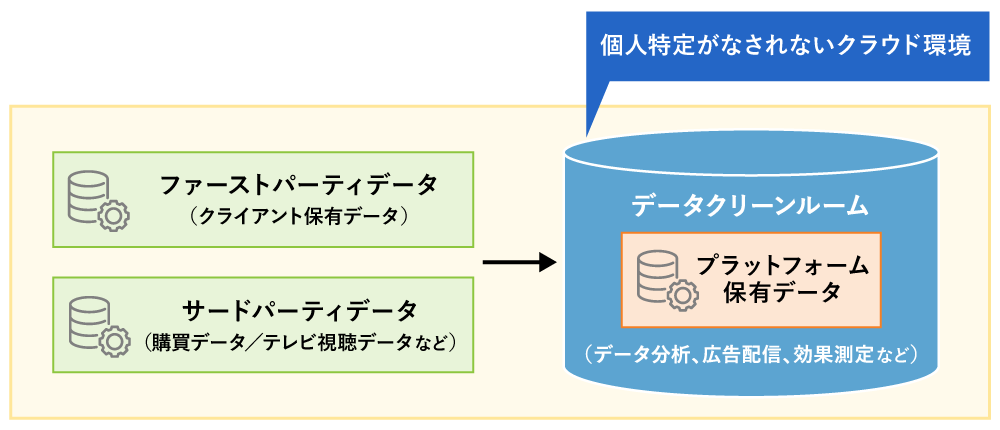
A secure data environment provided by various platform operators that does not identify individuals. It enables advanced ad delivery and effectiveness verification equivalent to or exceeding that achieved with traditional third-party cookies, while protecting consumer privacy.
One reason DCRs are gaining attention is the increasing importance of "data-driven marketing."
From a corporate perspective, personalized communication tailored to each individual enables more effective marketing. This requires "data" such as user behavior and preferences.
Communication designed based on data provides information better suited to each individual consumer, thereby enhancing the customer experience. This also leads to increased customer loyalty and contributes to the company's business growth.
Of course, data utilization has long been a crucial element of efficient marketing strategy, but this trend has accelerated significantly in recent years. The reasons for this can be broadly categorized into the following three points.
■Reason 1: The amount of data available is increasing
The proliferation of smartphones and the penetration of digital technology have increased touchpoints between companies and consumers. This allows for the collection of various types of data from these touchpoints, which helps in understanding consumers.
While this has raised privacy concerns, legal frameworks are advancing, making appropriate "obtaining consent for use" a prerequisite. In some cases, consumers are increasingly proactively providing data themselves, seeking convenience or personalized information.
■Reason 2: Data processing and analysis have become easier
Historically, processing large-scale data required significant costs. However, technological innovation has drastically reduced the expenses associated with data processing.
■Reason 3: Analysis results can be more easily reflected in communication with consumers
Related to Reason 1, the increase in "interactive customer touchpoints" like digital media, corporate websites, and apps has made it easier to incorporate personalized communication based on data.
Marketing based on consumer data has become a crucial driver for business growth.
DCR's strength lies in its direct connection to actionable strategies, not just the analytical foundation
As mentioned earlier, DCR is an "analytical platform" provided by platform operators.
In today's era, there are numerous data analysis environments available. Why, then, is DCR particularly noteworthy?
We explain this with three reasons.
■Reason 1: Access to data unique to DCR
Platform operators each possess diverse consumer data. Beyond clients' ad delivery results, some platforms hold data useful for understanding consumers—such as "interest data" and "behavioral data"—which may be accessible through DCR.
DCR was developed as an environment that balances user privacy protection with marketing analysis. Strict rules for privacy protection are firmly established.
Because these strict protection rules are clearly defined, DCR enables access to consumer data that was previously inaccessible from outside sources, albeit with certain restrictions.
■Reason 2: Easier Data Matching and Processing Enable Advanced Analysis
Naturally, a single company's data alone is insufficient for effective marketing. In this regard, DCR handles more than just data held by platform operators.
In addition to "first-party data" such as CRM data held by client companies, "third-party data" like TV viewing histories and purchase histories—collected by third-party data vendors with user consent—can be uploaded as external data into the clean room.
Using all this data, DCR enables aggregation and analysis from any desired perspective. Depending on the platform, it also supports advanced analytics like "predictive modeling" and "clustering analysis."
■Reason 3: Easy Connection of Analysis Results to Action
DCR is a foundation provided by platform operators that inherently possess abundant "customer touchpoints." This means analysis results obtained there can be easily and smoothly connected to initiatives like ad delivery within that platform.
Furthermore, depending on the platform, it may possess customer touchpoints enabling 1-to-1 messaging. Through these touchpoints, interactive communication—including obtaining consent for data utilization—is sometimes possible.
As evident from these three characteristics, DCR offers more than just a data analysis environment. It combines "access to data useful for understanding consumers" with the ability to "directly connect analysis results to marketing initiatives." This is precisely why it holds significant potential as a marketing foundation.
Some may perceive DCR as similar to a Customer Data Platform (CDP) from the perspective of being a "marketing foundation that enables data utilization and collection." Indeed, their expected roles and functions are quite close.
The difference lies in their focus: while CDPs are often used to "strengthen relationships" primarily with existing customers, DCRs are positioned at customer touchpoints separate from the company itself. This makes DCRs better suited for "acquiring" new customers. Since they are not mutually exclusive, it is advisable to use both CDPs and DCRs together, depending on the objective.
What specific challenges can DCR actually solve for companies?
As we've seen, DCR is an attractive marketing foundation for "understanding consumers" and "connecting initiatives."
So, what specific corporate challenges can it solve?
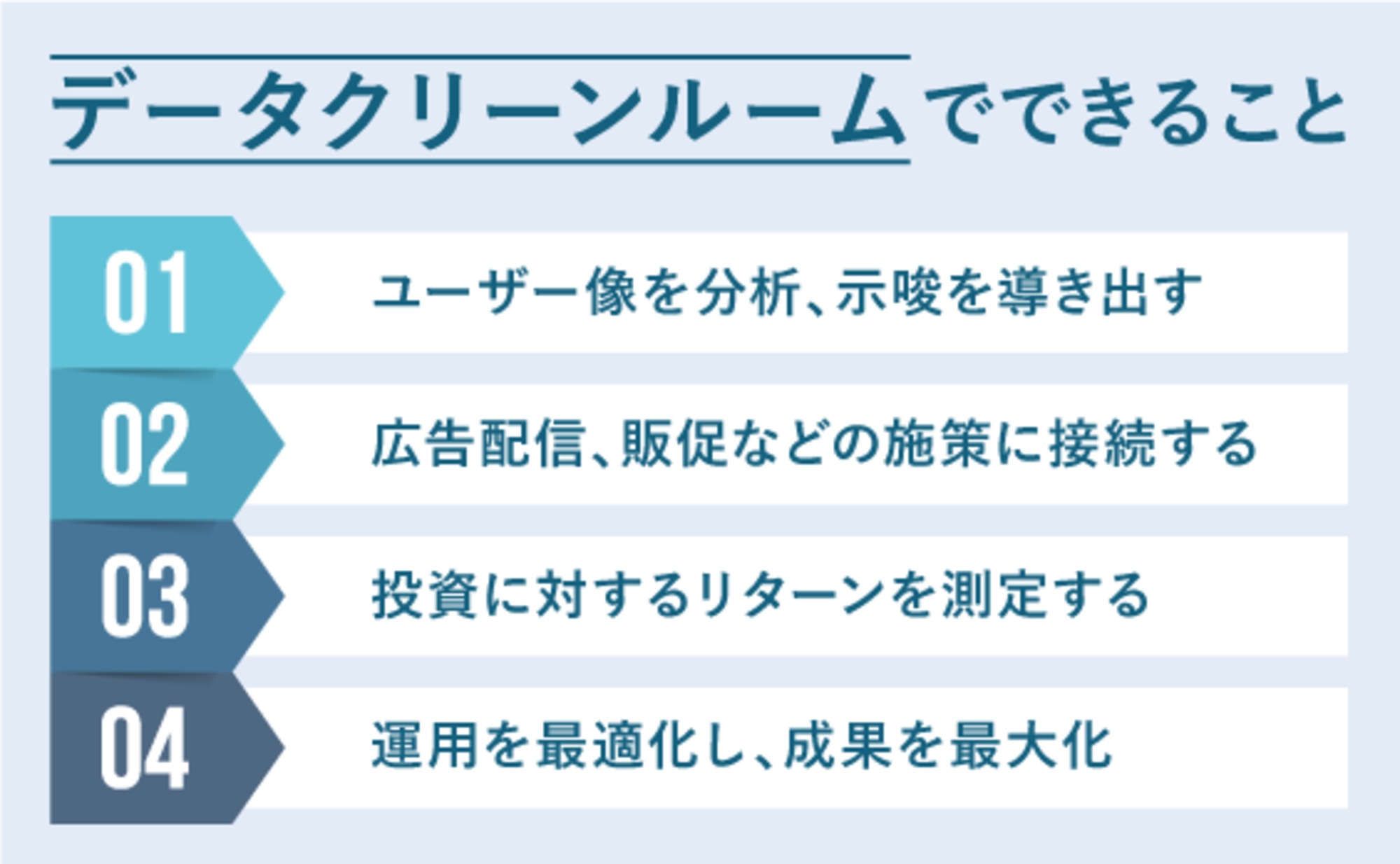
At Dentsu Inc., we categorize the diverse challenges unique to each client company and provide DCR-powered solutions across the following four domains:

■Insight: Analyze user profiles and derive actionable insights
<Challenge>
User profile analysis often relies on conscious surveys. However, these alone cannot measure unconscious behaviors or loyalty, making it difficult to link analysis results to specific campaign targets.
<Solution>
DCR enables the discovery of higher-resolution user insights by analyzing large-scale user interests, behaviors, and purchases.
■Activation: Connecting to Initiatives like Ad Delivery and Promotions
<Challenge>
It's not always possible to deliver ads directly to the targets identified through analysis. There are cases where the carefully defined target profile changes to a different target group by the time actual delivery occurs.
<Solution>
DCR performs both "analysis" and "delivery" on platforms with high consumer touchpoints, enabling seamless outreach to the target audience defined by analysis results.
■Measurement: Measuring return on investment
<Challenge>
Ad effectiveness verification requires alignment between campaign objectives and evaluation metrics. For example, if the objective is target reach, the metric should be "target inclusion rate," not overall click-through rate. However, technical limitations sometimes forced the use of metrics that didn't match the objective.
<Solution>
By combining various data accessible through DCR, we can perform precise effect measurement aligned with the campaign's objectives. Furthermore, by explaining the relationship between these measurement results and business outcomes using DCR's machine learning models, we can demonstrate actual contributions to business results and estimate the ROI for future campaigns.
■Optimization: Perform operational optimization to maximize results
<Challenge>
When considering contribution to ultimate business outcomes, the role of digital programmatic advertising cannot be overlooked. No matter how sophisticated the analysis, results will be poor if ad operations are full of holes. Both analysis and operations must work together as two wheels to drive business growth.
<Solution>
As mentioned several times, platform operators possess diverse customer touchpoints, with their strength being the direct link between data analysis and ad delivery based on those insights. However, even if technically feasible, the know-how for actual operation is necessary. As discussed later, Dentsu Inc., being not just an analytics company but also an advertising agency, achieves analysis design that looks ahead to connecting to ad operation optimization.
Furthermore, these four areas are not independent; in most cases, they are executed as a continuous marketing activity on the DCR.
It is crucial to use data relevant to the specific challenge being addressed for user analysis, obtain actionable insights leading to final strategies, and implement them as a comprehensive package that spans multiple domains.
Of course, DCR alone does not need to solve every challenge; it can be flexibly applied according to each company and specific issue.
Dentsu Inc. provides companies with a solution called "TOBIRAS," which packages these four domains as a product.
The name "TOBIRAS" embodies the meaning of being a "door" that supports analysis within the DCR (room) and maximizes its value. Details here
In this series, we plan to introduce various DCR use cases developed in collaboration with Dentsu Inc.'s clients.
Finally, we'd like to touch on a crucial aspect of DCR utilization: "Strategies for Deriving Insights from Data that Drive Corporate Growth."
■ Strategy 1: Avoid analysis for analysis' sake
When more data and techniques become available for analysis, there's a tendency to pursue "advanced analysis." However, if the insights gained from such analysis are too granular to effectively target, or if the target audience is too small to have any real impact, they cannot contribute to business growth.
It is crucial not to lose sight of the "purpose of analysis": connecting analytical results to concrete initiatives and achieving tangible outcomes.
■Tip 2: Re-evaluate the validity of the KPIs themselves
A common approach to setting business KPIs involves defining them as intermediate milestones toward the ultimate business outcome, since there's no direct way to measure the contribution to that outcome.
However, using DCR increases the data available, and with the advancement of analytics like machine learning, there are more cases where we can evaluate the contribution of initiatives to business outcomes more "directly." Appropriate KPIs are the starting point for appropriate initiatives, so it's best to start by re-examining the KPIs themselves.
■ Approach 3: Incorporate Effect Verification into the Design
This falls under the "Measurement" category of DCR's four application areas. By correctly designing the "criteria for judging initiative success" according to the objective, you can improve both analysis and initiative implementation. Most crucially, it involves properly evaluating the cost-effectiveness of initiatives using DCR. This enables continuous implementation not merely as a cost, but as an investment yielding returns.
Of course, even with these three improvements, you won't always get perfect insights due to data gaps or technical limitations. However, even a 60% score should offer higher reproducibility than decisions based solely on intuition or experience. Furthermore, accumulating data allows you to improve accuracy over the medium to long term, reaching 70%, 80%, and beyond.
Fundamentally, DCR is an "analytical environment." What is the purpose, and what kind of analysis will be performed? Only with this clear intent can insights that drive corporate growth be obtained, enabling the analytical environment to be leveraged as a "marketing foundation."
Through this series, we hope to deliver the latest insights on mastering DCR.

Was this article helpful?
Share this article


Newsletter registration is here
We select and publish important news every day
For inquiries about this article
Author

Sohei Mitani
Dentsu Inc.
Data & Technology Center Platformer Data Division 2