Note: This website was automatically translated, so some terms or nuances may not be completely accurate.
 Don't Miss Out! How to Leverage Data Clean Rooms [2/9]
Suntory's "Bond-Driven Marketing" Approach Based on LTV Thinking

Related Articles:
Cutting-edge case studies keep coming! What you can achieve with "Data Clean Rooms"
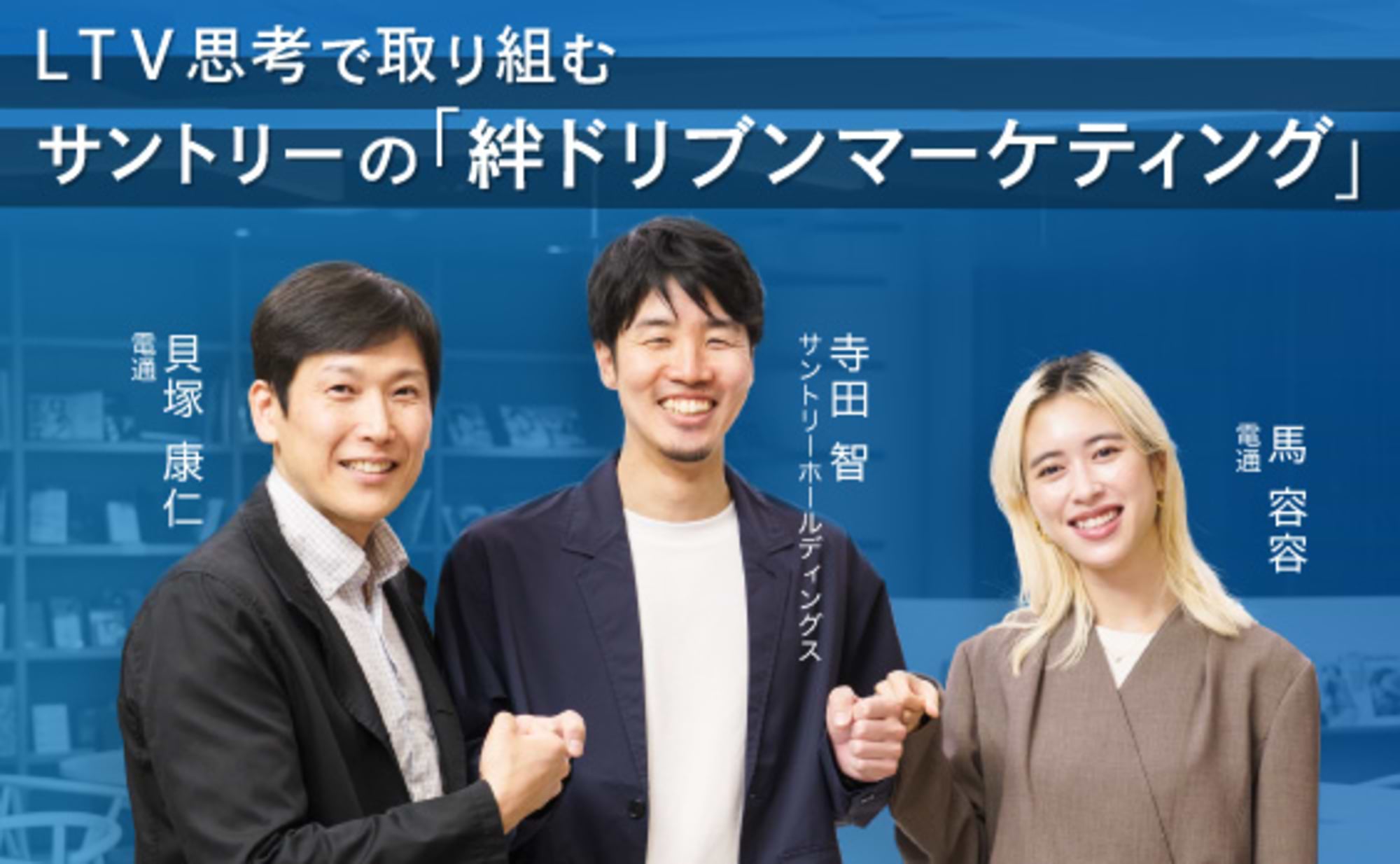
This time, we introduce Suntory's long-term fan engagement initiative, "Bond-Driven Marketing."
We spoke with Satoshi Terada, who oversees all digital marketing at Suntory Holdings; Yasuhito Kaizuka of Dentsu Inc., who has worked with Suntory on Bond-Driven Marketing; and Ma of Dentsu Inc., who serves as the liaison with the platform provider offering the DCR.
<Table of Contents>
▼Realized with DCR: Bond-Driven Marketing that Forges Bonds with "Individual Customers"
▼A Steady Purpose is Essential to Avoid Being Overwhelmed by Data and Technology
▼Feedback to the Company That Leads to Action, Not Just Analysis
Achieved with DCR. Bond-Driven Marketing: Forging Connections with Individual Customers
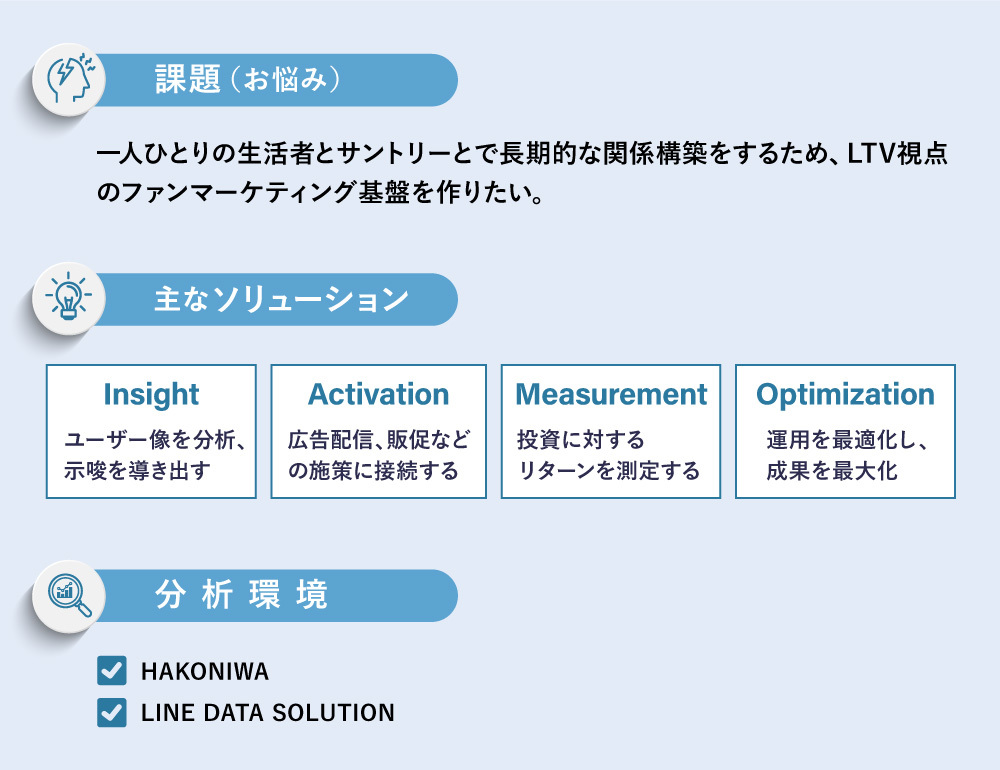
──What exactly is the "bond-driven marketing" (KDM) that Suntory is pursuing?
Terada: Broadly speaking, it's an initiative to increase the number of "Suntory fans" in the world. By visualizing relationships with various consumers from a Lifetime Value (LTV) perspective, we aim to improve the quality of internal decision-making. This ultimately creates "fans" who love us long-term and advances our relationships with them.
What is Suntory's "Bond-Driven Marketing"?
A marketing framework to increase Suntory fans across society. Since 2021, we have collaborated with the Dentsu Group to analyze multiple data platforms, creating a machine learning-based model to visualize "bonds" with fans and deepen relationships with individual customers based on IDs.
──What challenges led to this initiative?
Terada: Building relationships with customers has always been something Suntory has strived to do. Balancing long-term branding with short-term sales has also been a longstanding challenge.
Personally, I was assigned to the advertising department right after joining the company and worked on branding. However, branding initiatives don't directly translate into daily sales. Visualizing their impact is also difficult, leaving me frustrated, thinking, "We must be doing something good, yet..."
Companies in the so-called daily consumer goods sector are sometimes said to find long-term branding difficult. But precisely because these are everyday, familiar products, we want Suntory to be the most trusted brand.
That's when Mr. Kaizuka and his team proposed, "With current technology, we can make that happen." We believed that visualizing relationships with each individual customer at the ID level could propel our marketing forward, so we decided to collaborate.
──So the Dentsu Group is partnering with you on this initiative. Could you each describe your roles within KDM?
Terada: I represent Suntory's overall challenges, communicating our aspirations—"We want to achieve this"—to Mr. Kaizuka's team. My role is to translate Suntory's vision of "what we want to do" and the technical feasibility of "what might be achievable," connecting these perspectives across various internal departments.
Kaizuka:We are the operational team, working alongside Suntory's staff to formulate hypotheses and analyze data, starting from the challenges Mr. Terada mentioned earlier.
However, using digital marketing or DCR is not the goal itself. What truly matters is building lasting relationships where Suntory continues to be cherished by more consumers. And achieving marketing that sustainably generates a positive loop of sales growth. We constantly strive to keep our focus firmly on that.
Uma: I handle data utilization support and solution development to solve client challenges, including DCR. Together with platform operators like Yahoo and LINE, which form the foundation of KDM, and data holders, we consider "what kind of data would be most beneficial to clients." We also propose new data foundations and utilization approaches tailored to client objectives.
Recently, we're "expanding" fan management on the HAKONIWA platform—a joint analysis project utilizing Yahoo and Dentsu Inc. data—to LINE DATA SOLUTION. This expansion allows us to capture broader customer touchpoints between Suntory and consumers, enabling deeper relationship building.
*All data acquired and utilized by Yahoo and LINE is information for which user consent has been obtained.
──I imagine there are various tools and methods for customer relationship management (CRM). What unique aspects does KDM offer?
Kaizuka: The most significant aspect is that we used the ID on the DCR platform—which allows analyzing diverse data without identifying personal information—to "build relationships with consumers over the medium to long term."
The driving force behind this initiative is the mindset: treating the ID with respect as a "person = customer" embodying lifestyle behaviors and emotional states, aiming to "build relationships with customers based on continuous mutual trust, transcending short-term evaluations based solely on whether they buy a product or not." I feel this approach itself is highly unique.
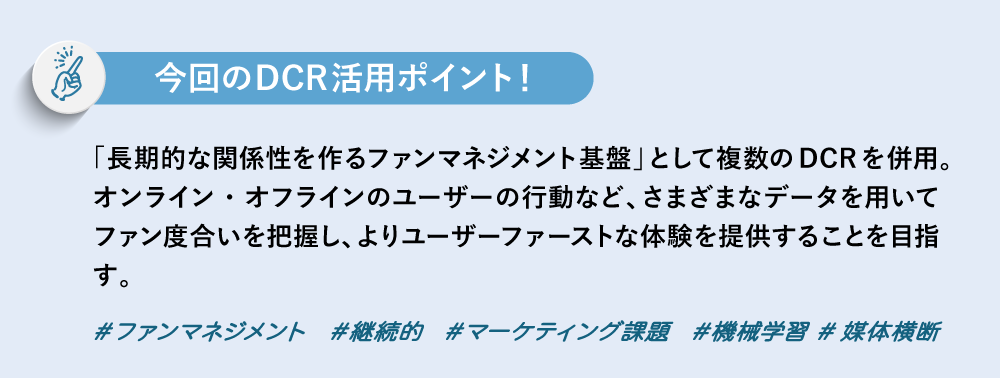
Ma: From my perspective as someone who regularly handles DCR, I often see it used by clients, particularly those in consumer goods, to verify and evaluate the effectiveness of individual advertising campaigns—asking questions like, "Did the client's advertising efforts contribute to subsequent purchases?" Of course, one strength of DCR is its ability to visualize and evaluate contributions to in-store purchases that were previously invisible. However, KDM's unique aspect is its long-term, continuous utilization of DCR.
Furthermore, by leveraging DCR platforms from multiple providers rather than just one, they can capture consumer behavior from initial product awareness all the way to repeat purchases. This cross-platform DCR utilization allows them to capture customer touchpoints beyond just advertising initiatives, which I consider a cutting-edge approach.
The key to achieving all this, I believe, was first concretely defining and articulating "What exactly does 'fan' mean?"
Terada: The term "fan" is commonly used in marketing, but everyone tends to have different ideas about what it means, right? So, this initiative started by first aligning that perspective.
We defined "fan" first, then iteratively refined the data needed to visualize it. Visualizing fan relationships at the ID level—not as vague platitudes—and implementing corresponding strategies is unique to this initiative: .
To avoid being swayed by data and technology, a "clear purpose" is essential

──While digital marketing is often used for efficiency, like measuring advertising effectiveness on sales, KDM's origin wasn't rooted there. What was the key point that allowed you to visualize and analyze the defined "fan profile"?
Terada: It was definitely being able to utilize "diverse data across diverse customer touchpoints." This significantly increased the resolution of our understanding of consumers, allowing us to grasp them broadly and three-dimensionally, and to truly connect with each individual.
Ma: Using DCR dramatically expands the range of usable data. We can leverage data held by platform operators, data from partner data holders, Suntory's own first-party data, and even the People DMP's attitudinal data and TV viewing data from the Dentsu Group. This significantly increases the resolution of our understanding for each individual consumer.
However, more data isn't always better. We went through considerable trial and error to determine which data and how to utilize it would best capture customers' "feelings."
Terada: We've always had customer data based on various surveys. But people's actions aren't always consistent, right? Even looking back at myself, I sometimes think, "Why did I buy that yesterday?" (laughs). In that sense, even purchase data only captures one facet of a person. Yet, we sometimes analyze it as, "They bought this, so they must be this kind of person." With KDM, by gathering data from a wide range of customer touchpoints, we can see the real human being more clearly.
Ma: Higher resolution allows for more appropriate approaches to these consumers. That's precisely what leads to "advancing the relationship," right?
However, when there's too much data to analyze, it can become analysis for analysis' sake – "Let's do this analysis too," "Let's verify this effect too." To avoid being swayed by the data, we consciously approach and utilize it with a hypothesis in mind: how does this connect to solving Suntory's challenges or driving business growth?
──Suntory has various content aimed at building a fan base, and I imagine each piece of content garners support from different segments. Within that context, wasn't it difficult to decide on a metric like "increase this type of customer"?
Terada: We had extensive discussions on this, but the conclusion was "those who love us for the long term." We defined "fans" as those who react to the "Suntory" name amidst numerous competing products. We've developed a "fan metric" that captures fan sentiment, leveraging not only Suntory's own data but also data from platform operators and data holders.
Kaizuka: Based on this unique fan metric, we built a system to evaluate, using data, how effective the various content offerings from Suntory actually are in building relationships with fans.
For example, data revealed distinct characteristics between "people who become Suntory fans through specific content" and their "subsequent purchasing behavior" for each content type contributing to fan growth, such as the "Suntory 10,000-Person Ninth Symphony" or the baseball "Suntory Dream Match."
At KDM, based on the hypothesis that maximizing this "multiplication of content and 'customer DNA'" is effective, we aim to further unravel the mechanisms through trial and error using IDs as our foundation.
Terada: On the other hand, I believe it's crucial not to definitively label a visualized ID as "this person loves sports." It's merely someone "identified as a sports enthusiast based on this analysis." Keeping that in mind, we constantly iterate the process together.
Kaizuka: It's about moving away from uniform definitions and static clustering, right? For example, someone classified last week as part of the "health-conscious" cluster might be binge eating this week (laughs). Capturing these "spike-like changes in interests" dynamically is also a characteristic of DCR. I feel it's extremely effective for building good relationships with customers.
Ma: The data and functions available within DCR are updated daily. We continuously tune and evolve the KDM framework to better capture consumer behavior.
――In KDM, do you prioritize acquiring new customers or increasing the LTV of existing customers?
Terada: Honestly, we don't consciously distinguish between new and existing customers. While saying "everyone" might sound a bit grandiose, our mindset is to become a company loved by all. In other words, we view "fan level" as existing for everyone, spanning a spectrum from 0 to 100.
Kaizuka: For a product like beverages that's integrated into daily life, the very concept of "new" versus "existing" doesn't quite fit. When building relationships with customers who love us long-term, moving beyond the binary of "fan" or "not a fan" is crucial. In reality, there's a "gradation" of feelings toward Suntory between those two extremes. By quantitatively visualizing this, we aim to manage the process of "building customer relationships."
Terada: Currently, Japan's population is steadily declining. Considering consumers' disposable time, I believe various forms of content are competing for it in a sense. That is, within the choices people make with their time – whether to drink alcohol or watch an hour-long drama on Netflix – we aim to create a state where the Suntory company exists within the lives of diverse people. In that sense, while capturing "everyone," we are thinking about how to increase the level of fandom.
――In building relationships with fans, is there anything you particularly prioritize?
Terada: Maintaining "the essence of Suntory" consistently. Since joining the company, I've always been told that what Suntory does isn't just about selling products to customers; it's about creating culture. For that, analysis alone is meaningless. We must feed analysis results back into the company and use them to help enrich customers' lives. We place paramount importance on translating that into "action."
Uma: I also value the mindset you just mentioned, Mr. Terada—working with platform operators with a genuine "purpose" in mind, thinking, "If we had this kind of data, couldn't it contribute to Suntory's goals?" Regarding action, I believe we've now implemented a system where, based on the "fan level" metric, we measure consumers' interests and levels of engagement across various subjects, and determine how to approach each one.
Kaizuka: When pursuing such cutting-edge initiatives, even with caution, there's a risk of the means becoming the end – focusing too much on "how to evolve the KDM project." To avoid this, we consistently prioritize how to increase the number of customers who will love Suntory for the long term, and ensuring our decisions support that goal.
When we first proposed this, we didn't mention "let's use DCR" at all. We only discussed how to continuously manage deepening relationships with consumers and grow our fan base. If that goal can be achieved, it doesn't necessarily have to be through KDM; the means should flexibly adapt to serve the purpose.
Terada: Indeed, KDM itself has evolved significantly over these past three years. While we call it marketing, we don't view it as confined solely to marketing. We see it as something that forms the foundation for Suntory's organizational management and business operations. Considering this, the way we use data and its purpose shift beyond mere marketing.
Feedback to the company in a way that leads to action, not just analysis

──How is this visualized fan data shared internally?
Terada: We prioritize two things for internal sharing. First, distilling the truly essential elements—showing what's fundamentally important—and translating them into language everyone can understand. Showing 100 PowerPoint slides saying "We collected this much data" just confuses people (laughs).
The second is ensuring clear "actions" on how we can change based on those analysis results. I feel that relationships with people involved in various internal businesses are also part of KDM when viewed broadly. To achieve this, I think the key is to share the vision that "balancing long-term fan building with short-term sales is crucial," and then engage everyone so it becomes "everyone's shared goal."
Kaizuka: When introducing DX or new technologies, the most crucial driver is often internal adoption initiatives. Mr. Terada handles that part entirely, but we at Dentsu Inc. also constantly focus on making things "easy to understand" and "actionable." We still occasionally end up explaining things with 100 PowerPoint slides, which is a hassle... (sweat).
Uma: As the team building the underlying systems, we also need to ensure the metrics are as simple, user-friendly, easy to view, and understandable as possible, so more departments and stakeholders within Suntory will adopt them. We hope these metrics become a kind of "compass" for everyone.
Also, when various departments actually use it, we must simultaneously demonstrate how reliable that data and those metrics are. That requires a certain level of "scale" and, at the same time, "accuracy," right? KDM utilizes machine learning, but without sufficient training data volume, accuracy suffers. Conversely, if we prioritize accuracy too much, we risk limiting the scale of people who can manage it or the impact it can deliver. We constantly balance and experiment with achieving reliable "accuracy," implementable "clarity," and actionable "scale" for evaluating initiatives.
Terada: We really can't afford to be self-serving. Rather than just saying "use KDM's data," we focus on working with Dentsu Inc. to tailor and fine-tune it – to make it the most usable for each business unit's managers, enabling them to see the relationships with their customers and connect it to value.
That said, everyone I talk to internally initially says, "This is really great." I think we're doing the right thing because we strongly emphasize bonds and Suntory's core philosophy. I also feel this is starting to translate into actual action.
Uma: A recent example is our approach for Suntory-hosted real-world events. We visualized whether attendees' love for Suntory deepened through their experience at these events. We then dug deeper into how we could make future experiences richer and evoke even greater affection. This fan management scheme allows us to evaluate the impact of offline event initiatives, something that's usually hard to capture.
Kaizuka: Unfortunately, there is no "universal, perfect solution" for implementing quantitative fan management initiatives. Yet, Suntory's team embodies a spirit of challenge: if we can move forward even one or two steps, if we can slightly improve decision-making accuracy, then we should try it. I feel this mindset is the source that has enabled them to achieve such cutting-edge initiatives. I'm impressed that they haven't wavered from their desired worldview and Suntory's unique identity. This allows them to effectively leverage new technologies and data without being swayed by them.
Terada: Thank you. Precisely, if we can enrich our customers' lives even by one or two steps—even if it's just 3%—we believe that's Suntory's essence: making a difference by improving decision-making, however slightly.
Kaizuka: Even if it seems unassuming at first glance, the precision gradually increases. I feel that holds tremendous long-term value. Through KDM, you're truly building infrastructure. It feels like creating a major framework to shift relationships with consumers toward a data-driven approach.
──Since you're tackling something with almost no precedents, it must be a constant process of trial and error.
Terada: Yes. That requires diverse perspectives, so our relationship with the Dentsu Inc. team isn't just about receiving proposals and making decisions. They've integrated as part of the same team working toward the same goal. Honestly, I probably spend more time talking with Kaizuka and the team than with my own family (laughs).
Kaizuka: Since there are no clear answers in this field, rather than just preparing proposals and presenting them, we often share insights even during the data extraction phase. We work together as one team, discussing potential factors and hypothesis directions. Of course, we also receive many ideas and insights from Mr. Terada. It wasn't like this from the start, but we've evolved to challenge things quickly.
Ma: Suntory's "Go ahead and try it" spirit has been a huge help. Their challenging, proactive approach means we platform operators also discover new ways our services can be utilized.
By conveying Suntory's vision to platform operators, it sparks new conversations like, "How about this kind of data?" or "Would this feature be useful?" We want to strengthen our collaboration with platform operators and data holders going forward to meet diverse needs.
Terada: Suntory has this "Go for it!" culture where we challenge ourselves, and even if we fail, we don't give up or get discouraged—we just keep challenging ourselves (laughs). What we always ask is, "Accuracy can be half as good, but please double the speed." In this world, you often don't know until you try, so we've accumulated insights and processes by trying things out relentlessly.
Kaizuka: I believe the "process" we've built up through this—including discussions that lead from data to hypotheses—is incredibly important. The very experience and process of trial and error in scientifically developing ID-based fan creation has become an asset for Suntory, a valuable intangible asset.
Terada: While KDM is a digital marketing framework, as both of you mentioned, I don't believe it needs to be confined to digital or even strictly to marketing. It's reassuring that Dentsu Inc. shares this perspective.
Kaizuka: The next-generation approach to building bonds—or fan management—that you're pursuing, with its unique perspectives and practical challenges, such as "utilizing DCR from an LTV viewpoint" and "data-driven marketing for FMCG manufacturers," is something only Suntory, a top runner driving Japanese marketing, could achieve.
Through KDM, I witness daily how Suntory genuinely strives to delight customers, move them, and deepen bonds. As a consumer myself, I feel my own connection with Suntory has grown stronger than ever.
――Thank you for today!
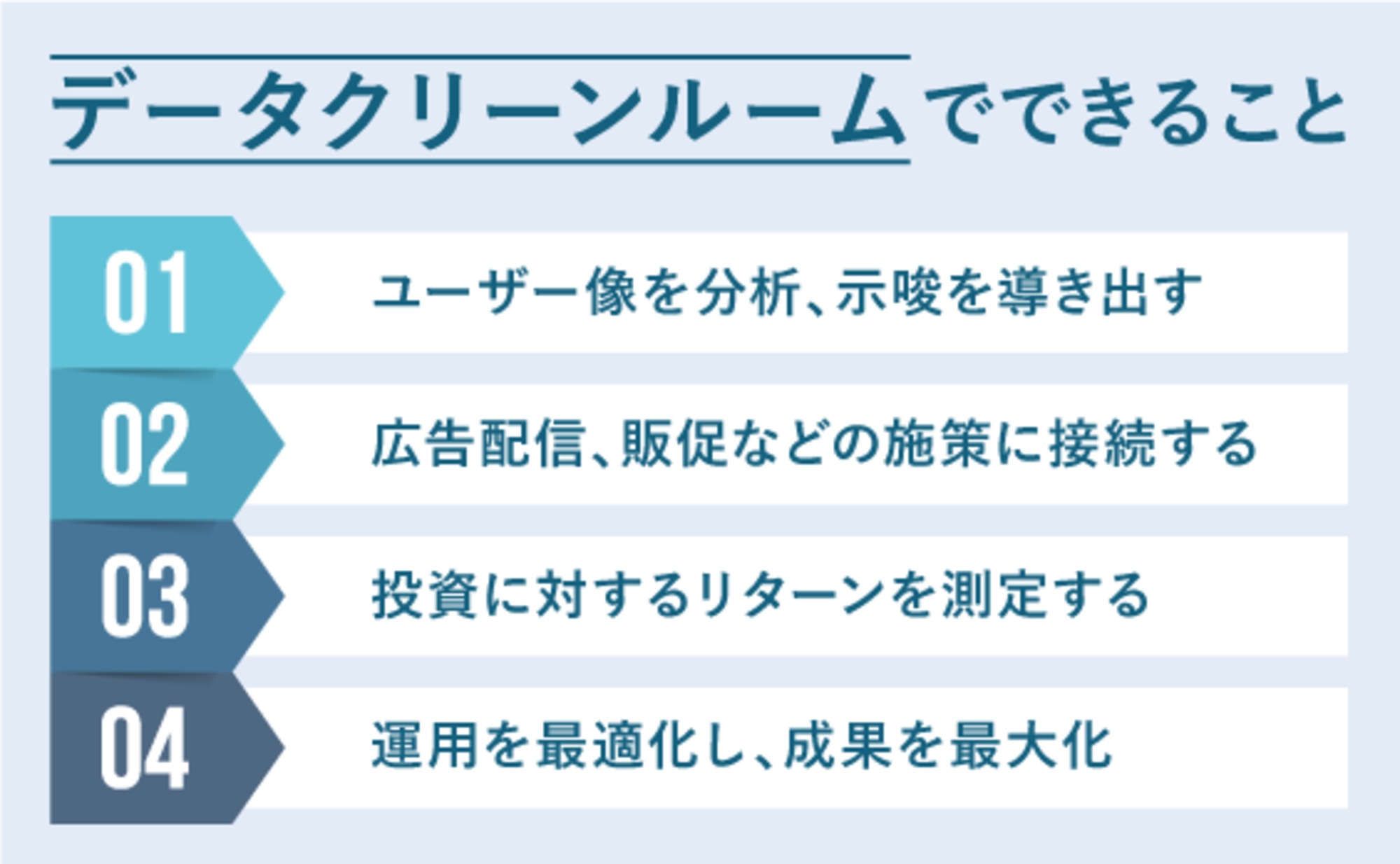
Dentsu Inc. PR Release:
Develops "TOBIRAS" to centrally manage multiple data clean room environments
For inquiries, please contact:
Dentsu Inc. Data & Technology Center
Email: data-alliance-unit@dentsu.co.jp

Was this article helpful?
Share this article


Newsletter registration is here
We select and publish important news every day
For inquiries about this article
Back Numbers
Author

Satoshi Terada
Suntory Holdings Limited
Digital Headquarters Digital Marketing Department

Yasuhito Kaizuka
Dentsu Inc.
Data & Technology Center

Ma Yongyong
Dentsu Inc.
Data & Technology Center
Consultant