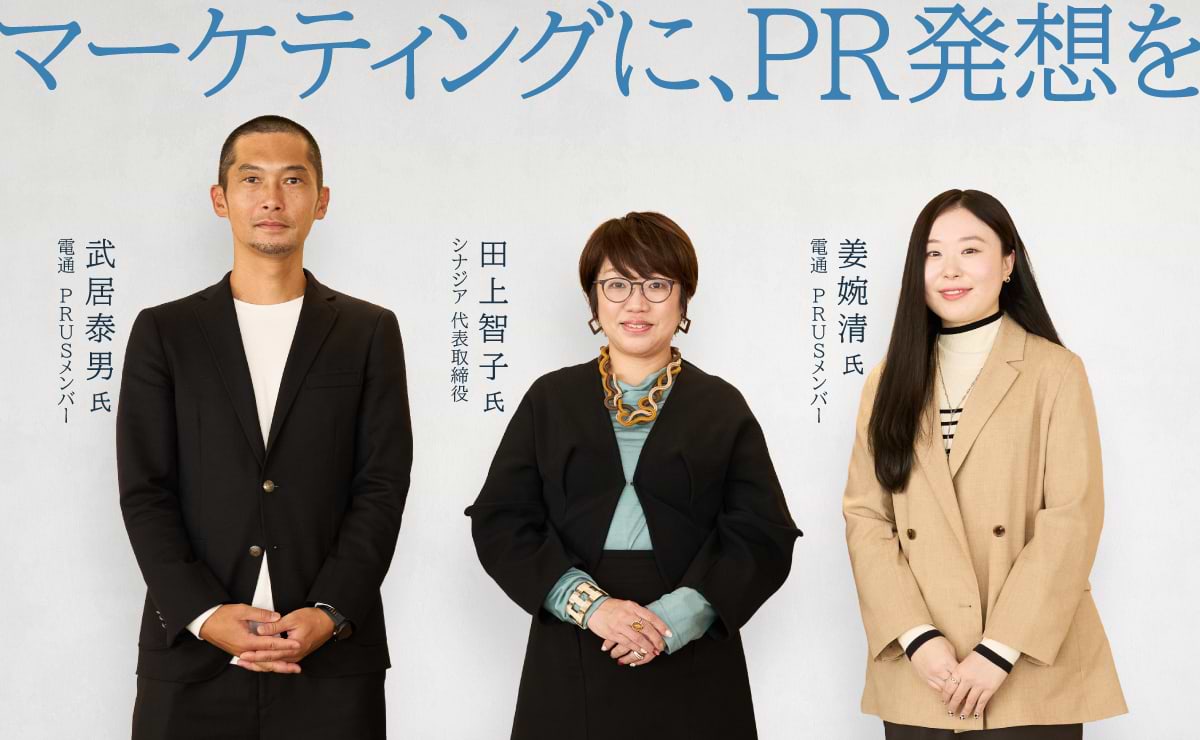
Dentsu Inc. champions its new-era model " Marketing For Growth " to support clients through data-driven marketing.
Members with diverse PR backgrounds launched the virtual organization "PRUS (Plus)" to integrate PR thinking into integrated planning and marketing. This series explores the often-misunderstood essence of PR and why it's now essential for all corporate activities.
Continuing from the previous installment, Rie Matsumoto, Director of Sunny Side Up—a PR and communications group tackling social issues through PR-driven communication under the slogan "Let's create fun commotion"—was interviewed by Dentsu Inc.'s Marketing Division 6 members Yuto Fujita and Ensei Kang.
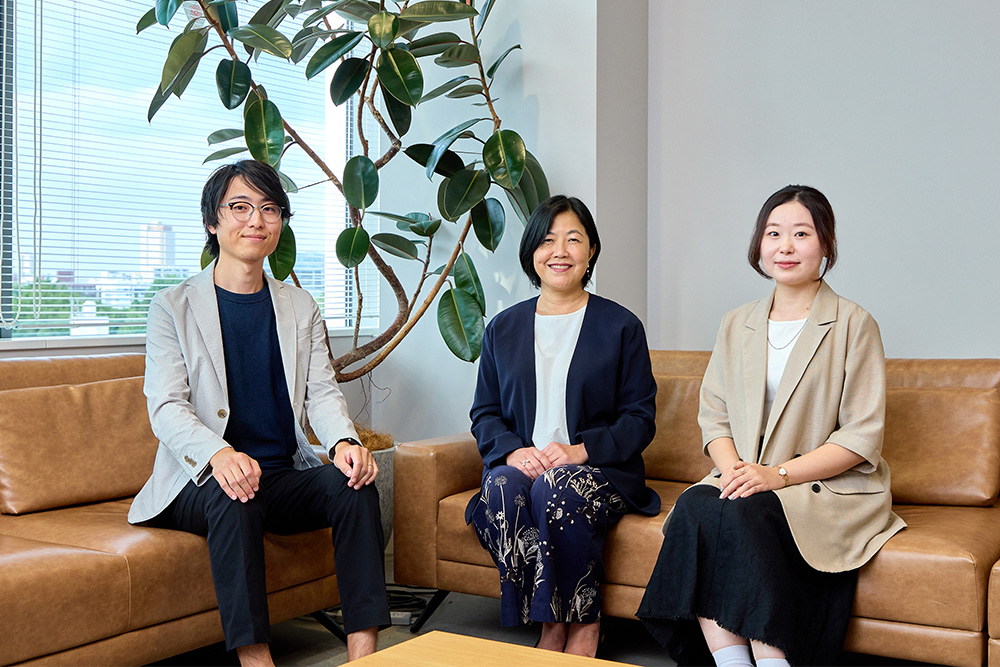
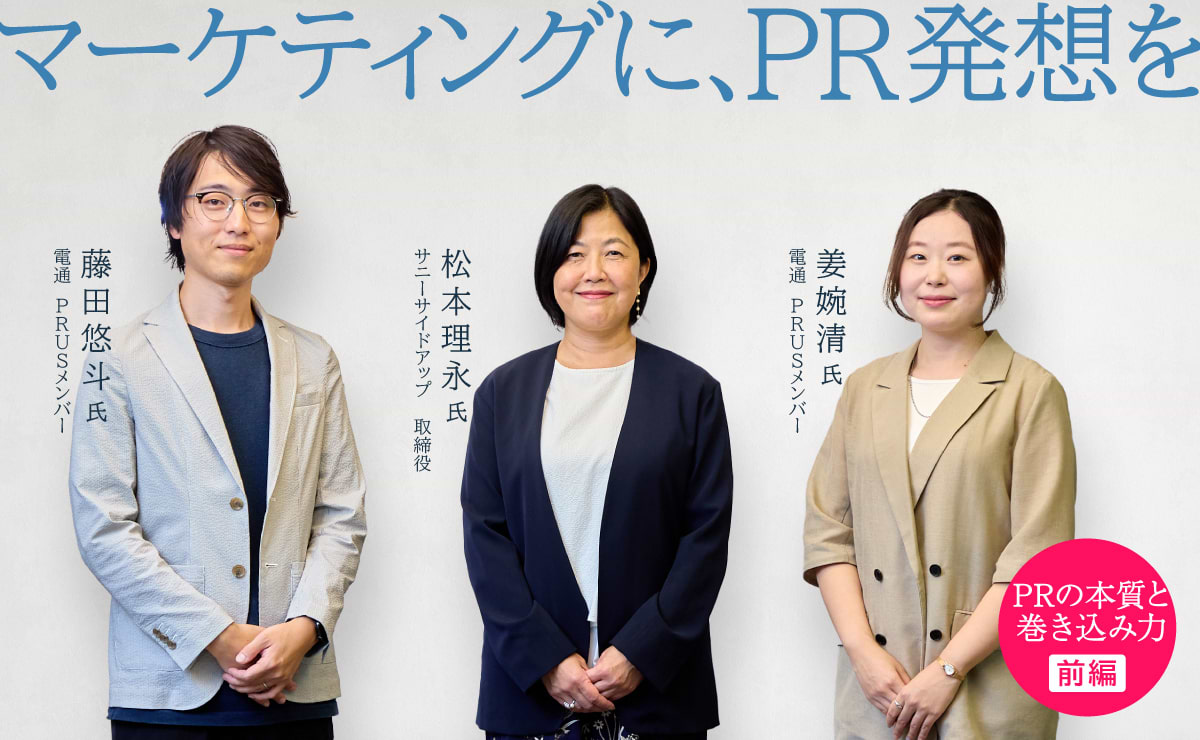
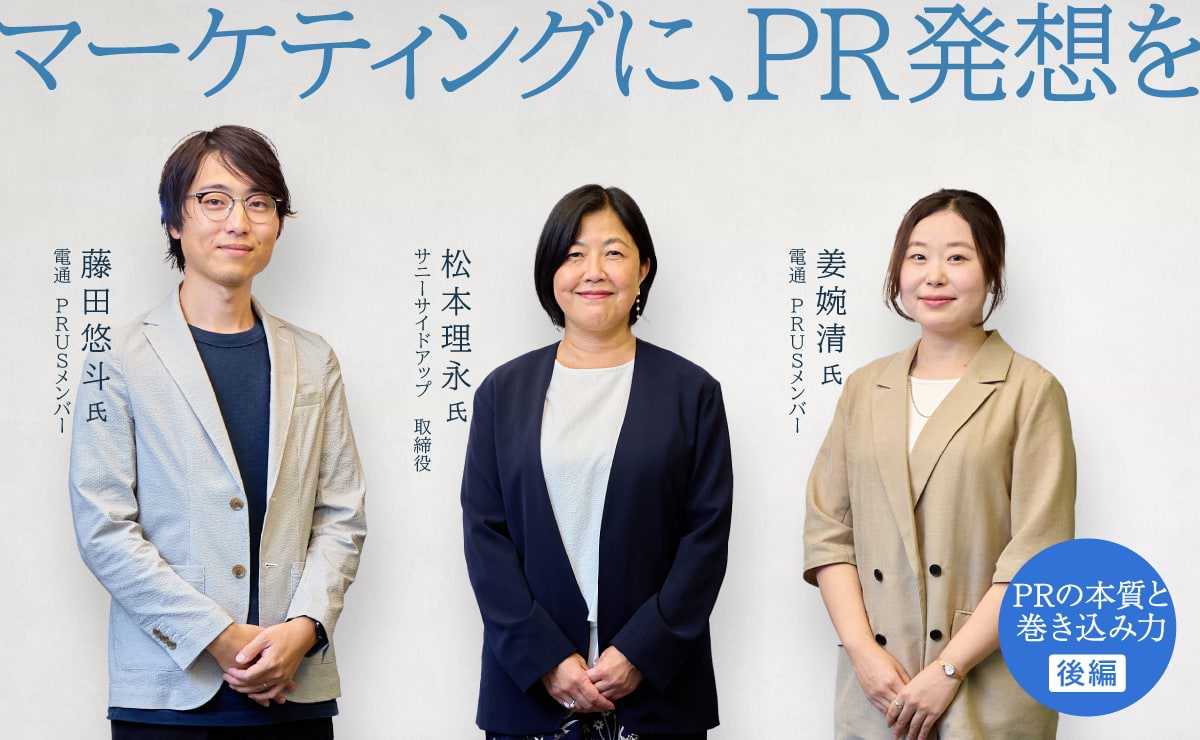
From left: Yuto Fujita (Dentsu Inc., Marketing Division 6), Rie Matsumoto (Director, Sunny Side Up / Vice President, Japan Public Relations Association), Wanqing Jiang (Dentsu Inc., Marketing Division 6)
How to Overcome Divisions and Barriers for Co-Creation?
Jiang: We've been discussing the essence of PR, the current state of corporate communications, and designing "engagement power" with Ms. Matsumoto. Even when we believe collaborating with various stakeholders could lead to better projects, it often doesn't happen as easily as we'd like in practice, right?Personally, I once proposed a sponsorship project that received praise as "a very socially conscious and excellent plan," yet it was ultimately shelved due to reasons like "collaboration between group companies is difficult" and "it requires too much energy for coordination."
Mr. Matsumoto, I imagine you've frequently encountered such barriers while collaborating with various companies. How do you approach and overcome these challenges?
Matsumoto: It's certainly not easy. Companies each have their own circumstances, so it's often a case of "I understand, but it's not easy to act." That's precisely why I consciously focus on working to shift the perspective of management and decision-makers, even just a little. What's crucial here is presenting success stories on a scale that resonates. Showing that "this kind of collaboration has yielded significant results, both socially and commercially" becomes the persuasive argument that gives them the push they need.
Fujita: Organizational silos don't disappear overnight, do they? That's why I also accept that "this structure can't be changed immediately." Instead, I constantly focus on how sincerely I can engage with the person in front of me. Working to influence each individual's mindset – that, I believe, creates small but sure breakthroughs.
Matsumoto: Exactly. I think our clients now feel more strongly than ever that they "can't turn their backs on society." In fact, "how to win society over" has become an indispensable perspective for business growth.
As PR professionals, we can predict to some extent "where to throw a stone and how the ripples will spread." Based on that insight, we can structurally propose where to make changes and who to involve to reach society. I truly feel we're increasingly able to think through this together.
Fujita: Winning society over. To achieve that, companies must transcend internal and external divisions and truly co-create, right?
Jiang: Can we transcend divisions and envision the future from the same perspective? Building the relationships that enable this is the capability now required not only for PR, but for all corporate communications.
Social Change Through PR Thinking Starting Internally
Fujita: We've discussed methods for engaging external stakeholders, but I feel the real engine of transformation lies in the power to engage internally. For example, your company implements many unique internal initiatives, starting with your distinctive "32 Systems" welfare program. I see the "32 Systems" as one mechanism for involving employees. What was the original impetus for launching this initiative?
Matsumoto: Before moving society, we first asked ourselves: How can we create "joyful commotion" within our own organization? That question was the starting point for designing our systems. We engaged in dialogue with members about what kind of company we wanted to be, what kind of people we wanted to work with, and what kind of environment we wanted to work in. During these discussions, many voices emerged, such as "I want to know more about my colleagues" and "I want to improve myself more."
From there, we systematically considered the systems needed to realize our vision. For example, the "Sunny Library" system subsidizes book purchases for self-improvement, while the "Fun Commotion Creation Support" system subsidizes entertainment like music, movies, theater, and sports to cultivate the ability to gain input from the outside world. The result of systematically organizing these systems is the "32 Systems."
Fujita: It seems each system goes beyond being mere employee benefits; they also serve as messages to the outside world about "what kind of society we want to create."
Matsumoto: That's right. For example, the egg freezing cost assistance under the "Dear WOMAN" program is a perfect example. We introduced this program not just to provide support, but with the hope it would encourage people to start thinking early about their life, work style, and future.
Both myself and Tsugihara, who serves as the representative of Sunny Side Up Group, had children while working. However, we've also seen colleagues who worked just as hard struggle because they "didn't know" or "didn't have time." Of course, having children isn't about being good or bad. What's crucial is knowing when the time comes to make choices in your own life and understanding what options are available to you at that moment.
Jiang: Thank you. Today, we covered a wide range of topics, starting with the essence of PR, how to face changing times, the power to engage and expand empathy, the potential for co-creation that transcends divisions, and even transformation originating from within the company. It reaffirmed how the PR perspective can be a powerful force connecting society and businesses from various angles. We at the PRUS team also want to further explore how to leverage this perspective in future marketing.
Founding member of Sunnyside Up Group. Engaged in PR work since high school, consistently handling client projects across diverse industries. Currently oversees major projects while also contributing to in-house branding, HR, and education. Contributes to the development of the PR industry through activities with industry associations and educational institutions. Appointed Vice President of the Japan Public Relations Association (Public Interest Incorporated Association) in 2024.
Specializing in communication planning centered on social media marketing and public relations. Consulting experience spans diverse industries including automotive, beverages, confectionery, cosmetics, and leisure.
Born in China. As a solution planner, I develop marketing strategies primarily for the food, pharmaceutical, and theme park industries. Recipient of the Gold Award at the OSAKA Future Presentation Grand Prix.

 PR-Driven Marketing "MARKETING+PRUS" [3/4]