Dentsu Inc. champions its new-era model " Marketing For Growth " to support clients through data-driven marketing.
Members with diverse PR backgrounds launched the virtual organization "PRUS (Plus)" to integrate "PR thinking" into integrated planning and marketing. This series explores the often misunderstood essence of PR and why it's now essential for all corporate activities.
This installment features Rie Matsumoto, Director of Sunny Side Up, a PR and communications group whose slogan is "We want to create fun commotion" and which tackles social issues through PR-driven communication.
Yuto Fujita and Ensei Kang from Dentsu Inc.'s Marketing Division 6 engaged in a deep conversation with her, covering everything from the essence of PR and the current state of corporate communications to designing "engagement power."
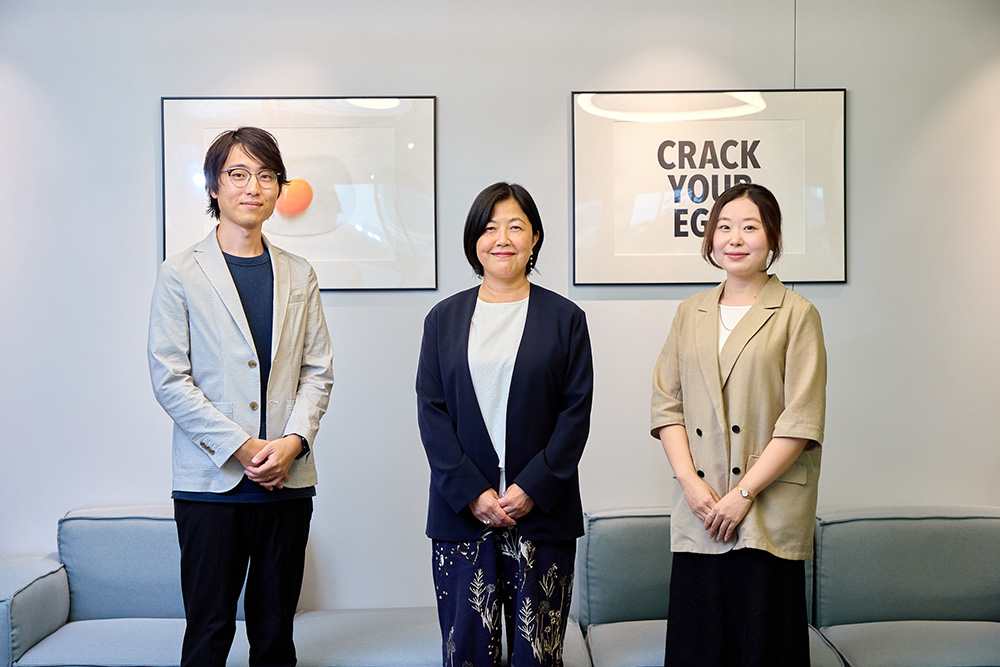
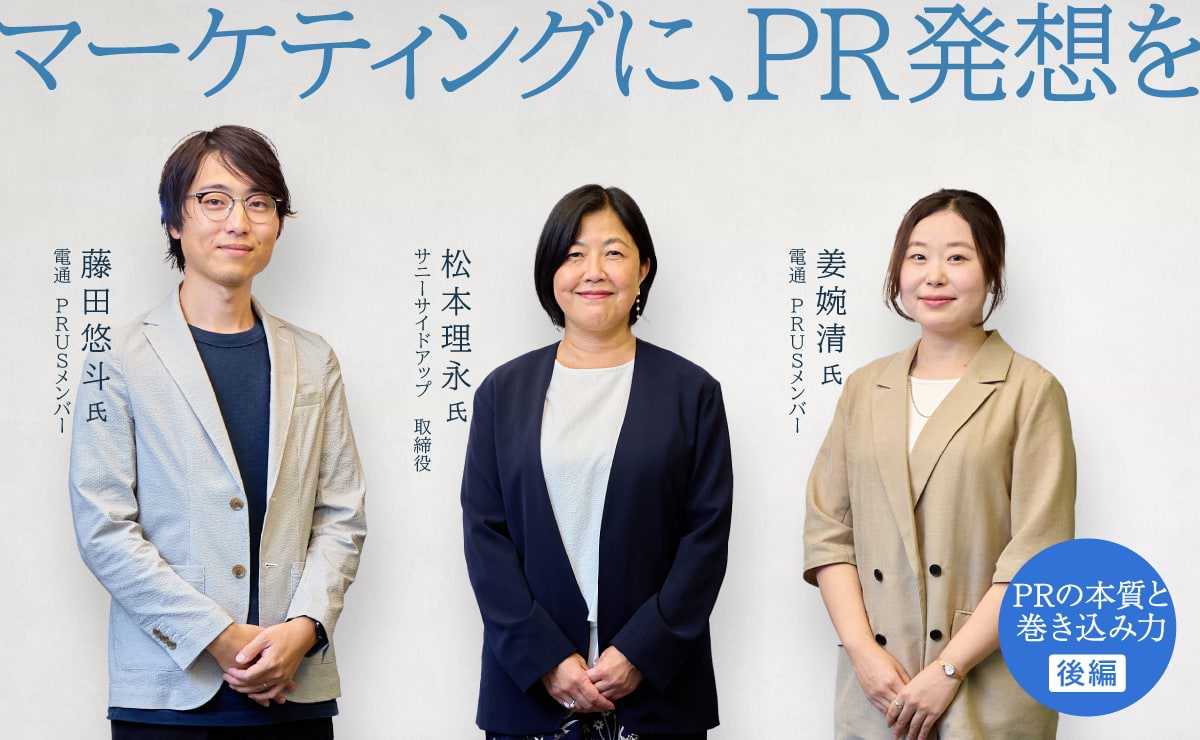
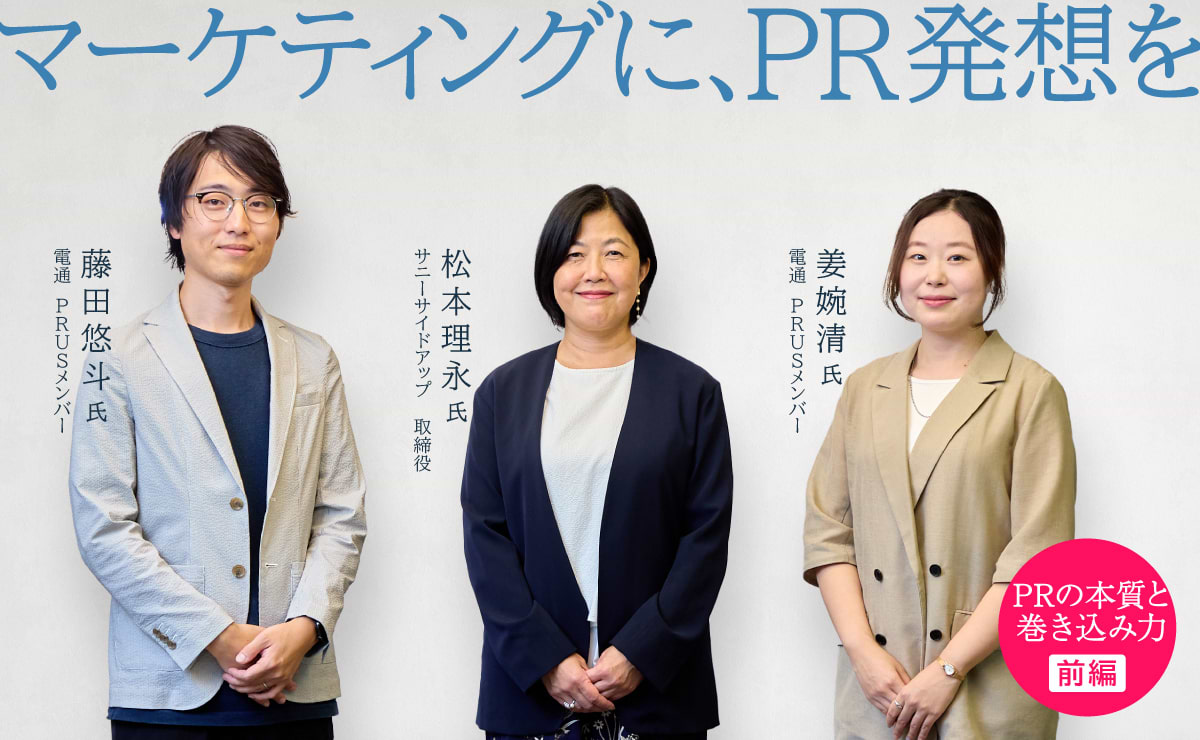
From left: Yuto Fujita (Dentsu Inc., Marketing Division 6), Rie Matsumoto (Director, Sunny Side Up / Vice President, Japan Public Relations Association), Wanqing Jiang (Dentsu Inc., Marketing Division 6)
Kyo: Today, we're discussing the theme "How to Incorporate PR Thinking into Marketing?" with Riei Matsumoto of Sunny Side Up. First, could you please introduce yourself?
Matsumoto: In high school, I was a classmate of Etsuko Tsugihara, who served as our group representative. My involvement with Sunny Side Up began when Etsuko asked me to join her mother's business, saying, "We're short-staffed, so I'd like you to help out."
Before I knew it, over 40 years had passed. My activities have spanned diverse fields: athlete management, corporate communications and PR support, developing our own ventures, and tackling social issues. While I now serve as a director responsible for management, I still visit the field and continue client work. Since 2024, I have also served as Vice President of the Japan Public Relations Association, a public interest incorporated association.
Jiang: Last time, our article focused on the revision of the marketing definition. This time, as a follow-up, I'd like to ask Mr. Matsumoto about the essence of PR.
Matsumoto: Until now, I believe people working in different fields—advertising, public relations, marketing—each described their own definition of PR using "their own language."
But when you get down to the core, the purpose is the same for everyone: building good relationships with society and aiming to create a better society. I feel that it's something the PR industry should welcome that this common purpose is finally starting to be expressed in common language.
Jiang: I completely understand that sense of it becoming a common language.
Matsumoto: On the other hand, in recent years, the term "PR" itself has sometimes led to misunderstandings. When the Consumer Affairs Agency announced two years ago that it would require "PR" labeling on advertisements and promotions, the Japan Public Relations Association opposed it.
This was because there was a risk that Public Relations (PR) would be treated as synonymous with promotion. However, survey data revealed the reality that many consumers perceived "PR = advertising," and this perception ultimately influenced the policy. This reflects the current state of societal understanding surrounding PR.
Fujita: It's true that within companies, the PR perspective has become widely accepted. But in society as a whole, it's still often seen merely as "a form of promotion," isn't it?
Matsumoto: Fundamentally, PR is the activity of maintaining good relationships with society, customers, the media, and others, and gaining their trust and understanding. In other words, it's "dialogue with the world." Everything, including advertising and in-store expressions, is a "point of contact with society," and how you behave there is the essence of PR. And if a company is a public institution within society, then the PR perspective should be central to its management.
Jiang: When I first joined the company and thought, "I want to do PR work," I was confused because it wasn't clear what each department did or how PR fit in. But now, I truly feel PR isn't just a specialized field handled by a few people; it's an essential perspective needed at the core of all corporate activities.
I especially feel the importance of PR thinking daily when addressing social issues. For example, even if you care about LGBTQ+ issues, when you try to communicate that to others, it can feel like you're imposing some kind of "correct answer." But ideally, I think a natural connection should form between the communicator and the recipient. Depending on how you design the communication, you can create a situation where people become interested in social issues while enjoying a positive experience. I'm always exploring how to make that happen.
Matsumoto: That is the ideal. In 2005, we engaged in an advocacy campaign called the "White Band Project," aimed at eradicating global poverty. It was an international awareness campaign to widely share the fact that one child dies every three seconds due to poverty, encouraging each person to raise their voice for change.
The catalyst for launching this project in Japan was a single monochrome film produced overseas, the "Clicking Film." It featured global celebrities, and through the act of clicking their fingers every three seconds, it powerfully and stylishly conveyed the reality that "one life is lost every three seconds."
Representative Tsugihara saw this film online, was deeply moved, and decided, "I want to spread this initiative in Japan too." He took the initiative to produce a Japanese version, which also generated significant domestic response. Even back then, we believed it was crucial to create an entry point that makes people think, "What is this?" or "That's kind of cool," and makes them want to reach out.
※One of the umbrella terms representing sexual minorities.An acronym formed from Lesbian, Gay, Bisexual, Transgender, Queer, and Questioning. The "+" signifies the diverse genders that do not fit into the categories of L, G, B, T, or Q.
An era where "good things" alone aren't enough to be chosen
Kang: Lately, when I look at corporate communications, I feel like expressions like "doing good for society" are decreasing. I wonder if that's because doing good for society has already become a given. It seems like the baseline for what companies consider "normal" has changed. Mr. Matsumoto, in your actual interactions with various companies, do you sense this kind of shift?
Matsumoto: I definitely feel the quality of information sharing has changed significantly. Fundamentally, companies have always been entities that continuously create good things. Those "good things" undoubtedly served someone's needs. But now, that alone isn't enough.
For example, society increasingly wants to know why a company continues creating things that benefit others. It seeks to understand the underlying reasons and purpose behind a company's existence. Companies themselves are also starting to communicate this.
Fujita: I see. So the depth of communication has shifted from simply "introducing good products" to conveying the "company's will and stance."
Matsumoto: I feel that shift is also reflected in advertising and creative expression. We're seeing more ads that carefully convey the background and significance behind the product, aren't we?
Jiang: Perhaps the "tone" of what companies communicate is shifting closer to a PR perspective.
Matsumoto: I agree. Beyond just product specs or campaign details, there's a growing demand across all communications to thoughtfully convey why the company is pursuing this business—the core values and convictions driving it. In that sense, I feel the entire company's "narrative style" is becoming more PR-oriented.
The "Power to Engage" Born from "Follow This Finger"
Fujita: Next, I'd like to explore the "power to engage" in PR. Earlier, Matsumoto mentioned PR initiatives like the "White Band Project," where "coolness" or "curiosity" served as entry points, ultimately leading to engagement with social issues. While SDGs have become widely recognized in recent years, and many companies now champion social initiatives in some form, whether these efforts truly resonate as "personal" ultimately depends on that "power to engage."
Even as understanding and empathy for social issues grow, preventing them from becoming the concern of only a select few requires figuring out how to engage more people. In other words, designing that "entry point" is becoming increasingly crucial. How can we engage society, starting with our immediate surroundings? What are your thoughts on this, Matsumoto-san?
Matsumoto: In the PR world, we often talk about the concept of "come join us." The key is who extends that invitation and how. For example, Heralbony, our content partner focused on "welfare × art × business," has a very natural and open approach to extending that invitation.
They manage data on artworks by people with disabilities as licenses, promoting them as valuable art to the world. Their starting point is the mission: "Let your brilliance shine." Companies that resonate with this mission participate not just in the direct context of supporting people with disabilities, but because they respond to the value of the art itself, aligning it with their own corporate purpose. I find that way of expanding their reach very ideal.
Kang: Heralbony's approach seems to transcend the framework of "disability art," expanding instead around the appeal and philosophy of art itself.
Matsumoto: Exactly. It doesn't start with the motivation of "wanting to support people with disabilities." People gather because they feel "I resonate with this worldview" or "I can engage in a way that feels true to our company." There's an atmosphere there where you can say, "Art has no walls," transcending even competition between companies and industry divisions. This open structure is ultimately creating a chain reaction of involvement.
Fujita: That's truly putting "co-creation" into practice. For details, please refer to our previous article, but I think it's symbolic that when the Japan Marketing Association revised its definition, expressions strongly evoking "co-creation" were prominently featured alongside "relationships with stakeholders" and "sustainability." Even the often-mentioned "building relationships with stakeholders" in PR isn't just about "establishing connections with interested parties" anymore; I feel the perspective of "how to get them to become allies" is becoming increasingly important.
Matsumoto: You're absolutely right. In the PR context, stakeholders truly encompass "every single person involved." Personally, I've always believed PR isn't about "fighting," so I resonate with the concept of "co-creation" rather than strategy.
Jiang: This idea of building relationships through connection and co-creation, rather than conflict, feels precisely what society and companies need from PR today.
Matsumoto: Exactly. Take functional foods, for example. If their benefits hold value for society as a whole, there's potential to engage diverse stakeholders—companies, researchers, consumers—given the right catalyst. What becomes crucial here is an open mindset: "We all want to improve together."As everything in the world becomes commoditized, it's increasingly difficult to differentiate solely based on functionality. That's precisely why openly calling out, "Let's spread this value together," fosters empathy and ultimately becomes a reason for being chosen. I feel this perspective will be increasingly demanded in PR going forward.
Fujita: I see. I'd like to continue our discussion about the "power to engage"—the ability to overcome divisions and barriers for co-creation. (Continued in Part 2)
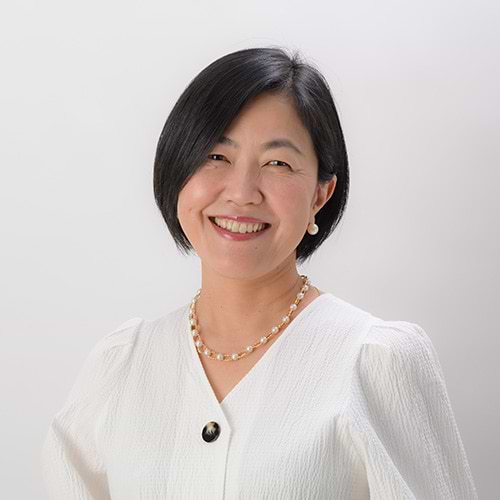
Founding member of Sunnyside Up Group. Engaged in PR work since high school, consistently handling client projects across diverse industries. Currently oversees major projects while also contributing to in-house branding, HR, and education. Contributes to the development of the PR industry through activities with industry associations and educational institutions. Appointed Vice President of the Japan Public Relations Association (Public Interest Incorporated Association) in 2024.
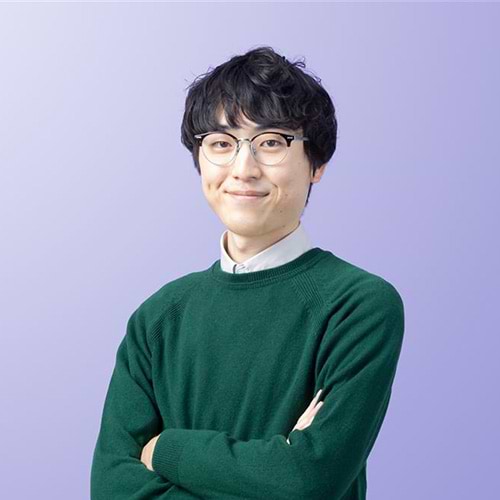
Specializing in communication planning centered on social media marketing and public relations. Consulting experience spans diverse industries including automotive, beverages, confectionery, cosmetics, and leisure.
Born in China. As a solution planner, I develop marketing strategies primarily for the food, pharmaceutical, and theme park industries. Recipient of the Gold Award at the OSAKA Future Presentation Grand Prix.

 PR-Driven Marketing "MARKETING+PRUS" [2/4]