Category
Theme

Note: This website was automatically translated, so some terms or nuances may not be completely accurate.

Can Even Playlists Become Ads on Spotify!? Analyzing “Hits” Award-Winning Works from a Creator’s Perspective

Koichiro Shima

Koichiro Shima

Hakuhodo Inc. Hakuhodo Kettle Inc.

Susumu Namikawa

Susumu Namikawa

Dentsu Japan

Takuma Kawada

Takuma Kawada

Dentsu Inc.

Spotify is one of the world’s largest audio streaming services. Its advertising creative award, “Spotify Hits,” was held in Japan for the first time ( click here for an overview). In this article, we’ll explore the characteristics of successful creative work and ads on Spotify, the platform’s marketing value, and the potential of audio advertising, while showcasing the award-winning entries.

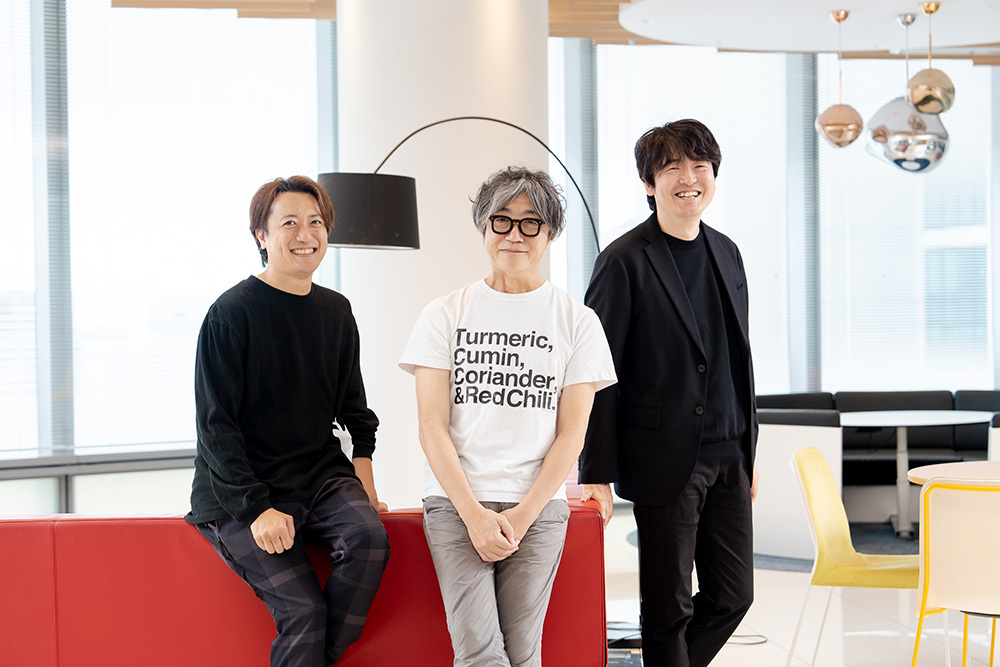
We welcomed Koichiro Shima (Executive Officer, Hakuhodo), who served as a judge for “Hits,” and Takuma Kawada (Creative Director, Dentsu Inc. CXCC), who worked on the winning entries, as guests. Susumu Namikawa (Center Director, Dentsu Inc. CXCC), an expert in audio advertising, led the discussion.

Spotify Hits
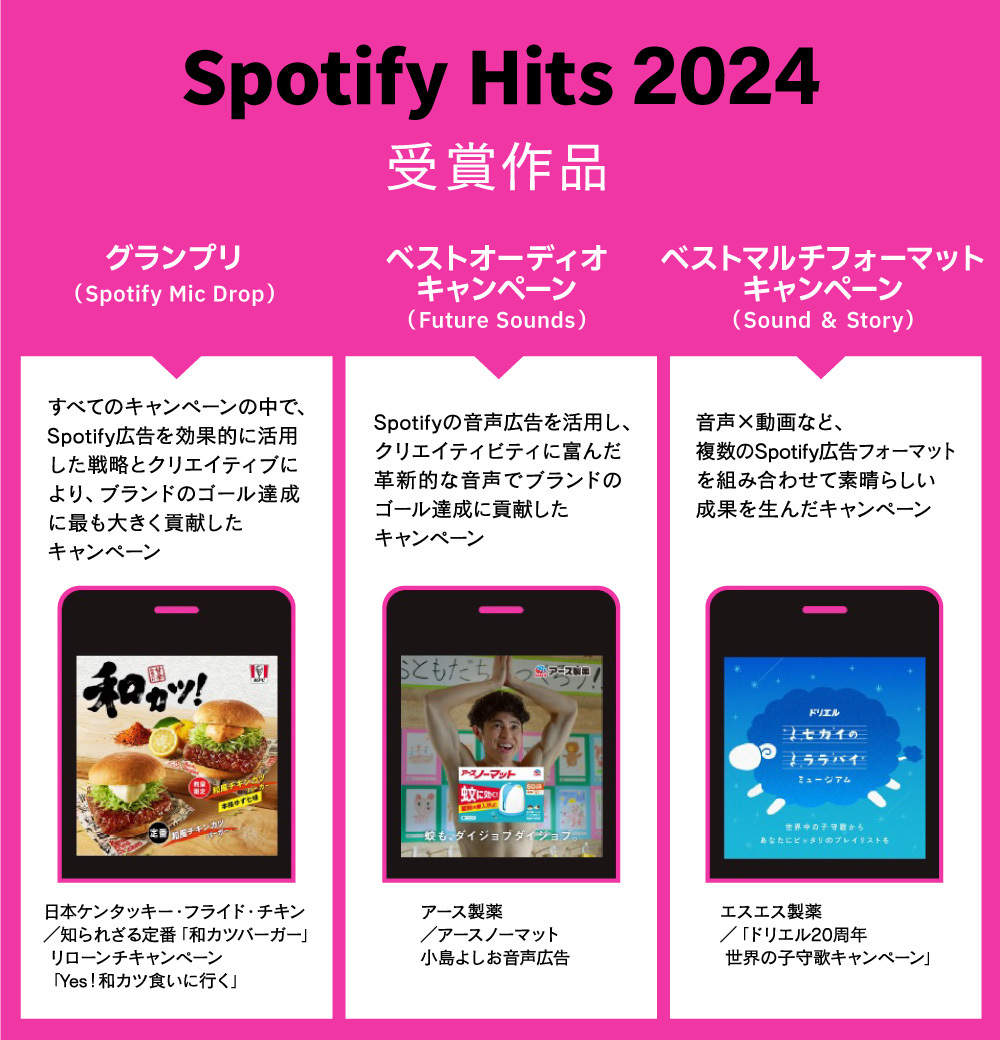
An award that recognizes campaigns by companies and brands that have moved people’s hearts through creative approaches that leverage the unique characteristics of Spotify advertising, thereby contributing to business growth. In addition to the Grand Prix (Spotify Mic Drop), two category awards were presented: Best Audio Campaign (Future Sounds) and Best Multi-Format Campaign (Sound & Story).
Spotify Hits
From left: Takuma Kawada (Creative Director/Copywriter, Dentsu Inc. CXCC); Koichiro Shima (Executive Officer, Hakuhodo; Director, Creative Director, and Editor, Hakuhodo Kettle); Susumu Namikawa (Center Director and Executive Creative Director, Dentsu Inc. CXCC)

It’s Not Just Audio Ads! Award-Winning Works That Explore the Potential of Spotify Advertising


Spotify Hits
Namikawa: “Spotify Hits” is an advertising award organized by Spotify that began in Brazil and Mexico in 2023, and in 2024, it will be held in countries around the world, including Japan and the United States. Mr. Shima, who served as a judge, could you share your thoughts on the entries as a whole?

Shima: We saw a wide variety of advertising approaches from diverse industries, including food and beverage, consumer goods, IT, finance, automotive, and mass media. About 80% of Spotify users listen with headphones, immersing themselves in their favorite music and content.Companies are delivering their ads to users while they’re each immersed in their own worlds. So, what kind of hook can they create in that context? While judging the entries, I felt that there’s a unique way to foster engagement between companies and users on Spotify—one that differs from radio advertising.

Namikawa: The “Grand Prix” winner was an ad for KFC Japan’s “Japanese-Style Chicken Katsu Burger” (commonly known as the “Wakatsu Burger”).

You can listen to the ad here


Shima: This ad is a parody of the Takasu Clinic commercial jingle. Starting with the closing line, “Let’s go eat some Wakatatsu,” which rhymes “Takasu → Wakatatsu” and “Clinic → go eat,” the ad is meticulously crafted to closely mimic the original—including the sound effects and the music used.It’s really funny—you start listening thinking, “Huh? Is this a Takasu Clinic ad?” and then at the very end, the KFC name pops up, and you realize it was actually an ad for their Wa-Katsu Burger.

Namikawa: It’s a unique idea to base the production on a commercial that everyone knows.

Shima: What’s particularly noteworthy about this ad is how much emphasis it places on the auditory experience. The approach of creating it while thinking, “This sound should be perceived this way,” is a production process unique to Spotify. Although we obtained permission from Takasu Clinic to create it, I could also sense a deep respect for the original ad.

Namikawa: The “Best Audio Campaign” award, given to an ad that stands out for its audio, went to Earth Pharmaceutical’s “Earth No-Mat” ad. This ad introduces the features of Earth No-Mat through a track that mixes the three-dimensional sound of a mosquito’s wings with Yoshiro Kojima’s signature catchphrases, such as “That’s got nothing to do with it” and “It’s okay, it’s okay.” What did you two think of it?

You can listen to the ad here


Kawada: I thought it was particularly interesting among all the entries.Since many people listen to Spotify with earbuds, effectively incorporating “spatial audio” has become a key element in ad production. The Earth No-Mat ad uses spatial audio to recreate the sound of a mosquito’s wings, creating a sense of realism as if the mosquito were flying from right to left. As a creator, I thought, “They’ve got me!”—both for focusing on the sound of the mosquito’s wings and for achieving that exquisite balance where the sound is clearly audible yet not jarring.

Namikawa: This ad even feels “stylish” when you listen to it. It gave me the impression that a DJ was sampling and remixing various sounds.

Shima: The sound design—especially the wing sounds—is incredible. From grabbing the listener’s attention to leading them to the product, various elements are compactly woven into a single track, opening up a whole new world unlike any commercial jingle we’ve heard before.

嶋浩一郎

Namikawa: The “Best Multi-Format Campaign” award—given to campaigns that achieved results by utilizing multiple Spotify ads—went to the “Driell” ad for SS Pharmaceutical, which was created by Mr. Kawada.

You can listen to the ad here


Kawada: On Spotify, API integration allows us to utilize streaming data and playlists to create landing pages with interactive features.On September 3—which is “Sleep Day”—we launched a special page called “The World’s Lullaby Museum” in collaboration with Spotify, featuring 100 different lullabies from around the world. Additionally, listeners can select playlists based on their “current mood.” To drive traffic to “The World’s Lullaby Museum,” we also created audio and display ads on Spotify.

Namikawa: Please tell us about the background of this project.

Kawada: As the sleep aid “Driell” celebrated its 20th anniversary, the client requested that we “boost brand favorability through an advertising approach different from anything we’ve done before.” While brainstorming ideas, we focused on the fact that “there are various lullabies all over the world.”We felt that Doriel’s philosophy of “wishing everyone a good night’s sleep” was aligned with the message embedded in lullabies from around the world—“May you sleep well”—so we launched the “Doriel × Lullabies” campaign.

Namikawa: Creating content that lets people listen to lullabies from around the world to enhance the brand image—that’s something only Spotify could pull off. Mr. Shima, as a judge, what aspects did you find particularly impressive?

Shima: I felt that Driel’s project, which leveraged playlists, transcended the boundaries of traditional advertising and evolved into a full-fledged entertainment content service, resulting in effective branding. While the playlist feature is one of Spotify’s key characteristics, a playlist is a kind of “curated collection,” and even with the same songs, different curations can convey a variety of atmospheres.

Namikawa: This demonstrates that Spotify’s advertising isn’t limited to audio, video, and display ads, right? I sensed new possibilities for allowing users to experience a brand’s worldview in a multidimensional way.

並河進


What are the three key features of Spotify to keep in mind when creating ads?

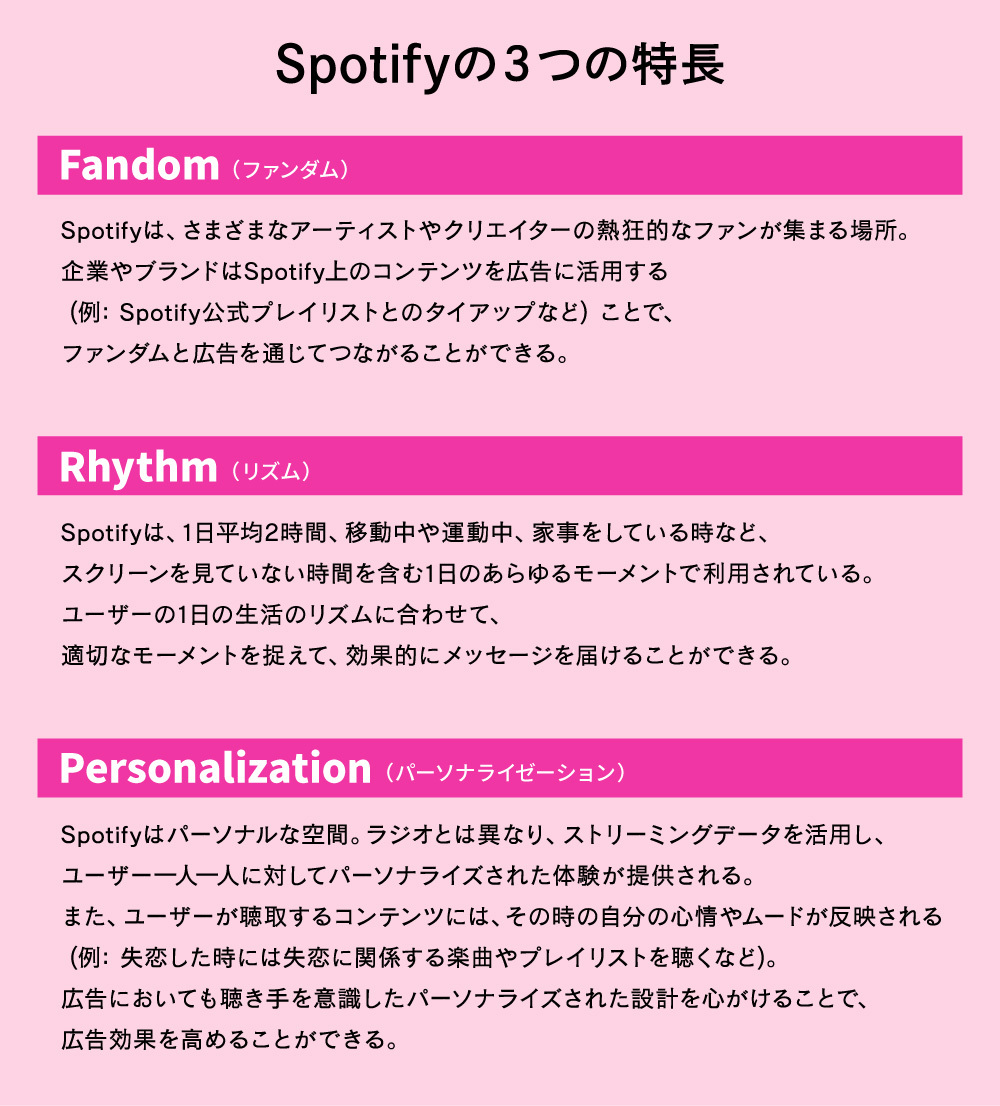
Namikawa: When creating Spotify ads, it’s recommended to take into account the three key features Spotify emphasizes: “Fandom,” “Rhythm,” and “Personalization.”

Spotify

Namikawa: First, regarding “Fandom,” since Spotify is viewed as “a place where passionate fans of artists and creators gather,” it becomes crucial to consider how companies can effectively communicate within such a space.

Shima: Among the entries this year, one that was created with a strong understanding of “Fandom” was the audio ad for “Asahi Draft Beer” (commonly known as “Marufu”). This ad features an artist selected for “RADAR: Early Noise”—Spotify’s program supporting the next generation of artists—who reflects on their past year and addresses listeners with the message, “Thanks for another great year.”

You can listen to the ad here


Namikawa: It really stuck with me because it felt like the musician was speaking directly to me. It also gave the impression of a conversation from backstage, so I think one key point was the design that made you consciously wonder, “Where exactly are they speaking from?”

Shima: They’re also great at capturing the right moment. At the end of the year, when the music scene is really heating up, hearing a musician say, “This was a great year—I released this album and played these live shows. Thanks for everything this year, everyone,” is just irresistible for fans. Since many musicians are Spotify users themselves, it felt like they were appearing naturally on their favorite platform.

Namikawa: The second of Spotify’s three key features, “Rhythm,” refers to the ability to deliver ads at the right moments—such as while commuting, doing chores, or working out—in sync with users’ “daily rhythms.”

Shima: Among the submitted entries, there were ads for cars, tires, and delivery driver job openings targeted at Spotify users while they were driving. Spotify has a unique targeting method called “In-Car,” which allows audio ads to be delivered in real time exclusively to users actively using the Spotify app in their cars.

Namikawa: In addition to driving, playlist targeting allows us to precisely deliver ads to users in various situations—such as while studying or running—can’t we?

Shima: From a creative perspective, I think ads become more memorable when you keep in mind what resonates with users at a specific moment.

Namikawa: The third feature, “Personalization,” allows us to tailor creatives based on listeners’ attributes and moods. This enables communication that’s more optimized for the target audience than traditional advertising.

Shima: Combined with Rhythm’s “moment-based targeting” we mentioned earlier, this allows us to tailor ads across multiple dimensions—such as age, gender, mood, and music preferences.Among the submitted entries, the Sumitomo Mitsui Card (NL) campaign stood out to me because it used three different creative assets tailored to various Spotify listener personas—such as music lovers, radio listeners, and women actively supporting their favorite idols—which showed they were very mindful of this aspect.

Kawada: With traditional radio commercials, even if you wanted to run an ad targeting, say, “women in their early 30s who practice yoga and enjoy classical music,” it was uncertain whether you could actually reach them due to system limitations. Spotify can identify a person’s interests and preferences based on data such as the songs they frequently listen to and their demographic attributes. The certainty of reaching your target audience is higher than with traditional mass media advertising.

川田琢磨

There are still many untapped approaches to audio advertising

Namikawa: Let’s explore the potential of Spotify and audio advertising in marketing a bit further. Even though they’re both forms of audio advertising, what do you think are the differences between Spotify and radio?

Kawada: Radio is often listened to in groups or “in the background.” In contrast, with Spotify, people tend to listen alone and become fully immersed in the content. Also, users can listen to whatever content they want, 24 hours a day. Given these characteristics, I think the major difference is that, compared to radio, Spotify is a platform where “users engage very proactively.” Furthermore, from the perspective of ad delivery, the ability to target listeners with such precision is a major strength.

Shima: Precisely because users are actively and immersively listening on their own, it seems like ads would be highly effective if they could be seamlessly integrated into that experience.

Namikawa: How does it differ from TV commercials or video ads?

Shima: It’s hard to generalize since there are so many different approaches, but I think there’s a tendency with audio ads that once you come up with a single sound-based concept—like, “This sound will resonate”—it becomes the core idea, and you can build the entire ad around it in one go. Like with the “Wakatsu Burger” ad: “Wakatsu and Takasu sound similar, so this will work.” It’s about building the entire ad around that core sound concept.

Kawada: That’s true. With TV commercials or video ads, I feel like a sound-based idea alone isn’t enough to form the backbone. You tend to think you need another core idea. You have to mull over things like the visuals, how to shoot it, and who to cast.

Shima: Another characteristic of audio ads is that, in a world of sound alone, you can really spark the listener’s imagination. The moment a listener visualizes the ad’s narrative in their mind—even though it’s conveyed solely through sound—that’s when you’ve “won.”As with radio, the strength of audio media lies in the one-on-one relationship between the broadcaster and the listener. There’s an intimacy to it—it’s almost like talking to a friend—and there’s a definite sense that the medium is “speaking directly” to the listener. On top of that, since people often listen to Spotify immersively through headphones, depending on how you approach it, you can create an even stronger “one-on-one” feeling than with radio.If we keep that in mind, I think we can create ads that build a deeper sense of partnership with listeners.

Namikawa: Mr. Kawada, are there any types of ads you’d like to try in the future?

Kawada: This time, we had ads featuring a parody song for Takasu Clinic and one using Yoshio Kojima’s signature comedy routine, but I’m wondering if we could revive famous jingles from the past.

Namikawa: I see. Music is deeply tied to memories for each generation, after all. Stimulating the memories of a specific generation might actually boost the effectiveness of the ads.

Shima: It’s true—"auditory memories" can strongly evoke the feelings of that time the moment you hear them, can’t they?

Namikawa: When we talk about “brand assets,” we often think of visual elements like logos, but this makes me realize once again that “sound”—such as commercial jingles and jingles—is also a key part of that.

Kawada: Also, while it’s audio-based, one of Spotify’s major features is its wide range of “derivative applications.”Since listeners often listen to music while looking at the app screen, it would be a waste to view it solely as an audio-only medium. Also, while we can certainly create “tricks unique to audio-only formats”—and we tend to focus on that in Spotify ads—we might also be able to develop strategies that combine audio ads with video. For example, an ad that “works perfectly well with audio alone,” but where the impression changes dramatically when viewed as a video.

Namikawa: Thinking about it this way, it seems there are still many untapped approaches for Spotify and audio ads. When I consider what a brand is, I think of it as “what sets it apart from other companies,” and I believe that by taking on the challenge of new media like Spotify, we can express that “difference” in various ways. Listening to both of you, I felt that by thinking about this, we can create new experiences that leave a lasting impression of the brand on listeners. Thank you both very much for today.

Spotify Hits

Twitter

Was this article helpful?

Share this article

Author

Koichiro Shima

Koichiro Shima

Hakuhodo Inc. Hakuhodo Kettle Inc.

Executive Officer, Hakuhodo, Inc.; Director, Hakuhodo Kettle, Inc.; Creative Director/Editor

Joined Hakuhodo in 1993. Engaged in corporate PR activities at the Corporate Communications Bureau. Seconded to The Asahi Shimbun Company in 2001. Participated in the launch of the “Bookstore Grand Prize” in 2004. Currently serves as a director of the NPO Bookstore Grand Prize Executive Committee.In 2006, he founded Hakuhodo Kettle. In 2012, he opened the bookstore “Bookstore B&B.” His edited and authored works include *Koichiro Shima’s Guide to Generating Ideas* (Discover 21) and *How to Create a “Media” Brand: Editorial Techniques That Move People and Sell Products* (Seibundo Shinkosha).

Susumu Namikawa

Susumu Namikawa

Dentsu Japan

Chief AI Officer / Executive Creative Director / Chief AI Master

Specializes in AI-driven projects and social initiatives connecting businesses and society. Launched Dentsu Creative Intelligence in September 2022. Initiated joint research with the University of Tokyo AI Center. Serves as Unit Leader of the Augmented Creativity Unit. Author of numerous publications including "Social Design" (Kiraku-sha) and "Communication Shift" (Hatori Shoten). Recipient of multiple awards including the Yomiuri Advertising Grand Prize and the Dentsu Advertising Award.

Takuma Kawada

Takuma Kawada

Dentsu Inc.

Customer Experience Creative Center

Creative Director / Copywriter

Started career as a copywriter, winning the TCC Newcomer Award in 2013. Transferred to Dentsu Digital Inc. in 2017. Developed AI copywriter "AICO2" using a creative thinking model. Assumed current position in 2020. Won ACC Gold/Craft that same year. Won Spikes Asia Grand Prix in 2021. Received Spotify Hits Best Multi-Format Campaign (Sound & Story) award in 2024.

Also read