Note: This website was automatically translated, so some terms or nuances may not be completely accurate.
 These young people nowadays. [2/6]
Friendship with Young People ~ The Era of Friendship Maintenance ~
Reading the air. Since "KY (air-reading-impaired person)" was nominated for the 2007 U-CAN New Words and Buzzwords Awards, the ability to read the invisible atmosphere has become a form of etiquette everyone pays attention to. Compared to the past when "reading the air" itself was a survival skill for navigating adult society, it has now become a form of general knowledge for people of all ages and genders. I keenly feel this through Wakamon's activities and meeting many students.
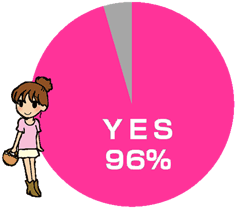
This tendency is particularly strong among today's youth. In a survey conducted in September 2012, nearly 100% of high school students reported that they "act by reading the air."
Q. Do you read the air and adjust to the atmosphere?
Looking at the friendships among these young people who read the air, they belong to an average of 6 different groups.
When we asked one female university student, her current group affiliations included "middle school classmates," "club friends," "close high school friends," "high school classmates," "university club," "part-time job friends," and "hobby friends," totaling over 10 groups.
The old scenario of "middle school is middle school, high school is high school, reuniting after decades at a class reunion!" is becoming rare. Instead, it seems increasingly common to maintain old friendships like a chain reaction while simultaneously expanding the number of communities as one grows up.
However, the concept of "friends" is clearly changing. Among university students in the Tokyo metropolitan area, the average number of contacts saved in their phone address book is 142.7, while the average number they consider actual friends is 42.4. It's surprising that they see about two-thirds of their phone contacts as merely casual acquaintances.
Furthermore, the average number of people considered close friends is only 4.9, meaning only a very limited number of people are those with whom one can be completely themselves. As one high school boy put it, he spends time with his "Itsumen" (always-together crew) not just at school or after school, but also exchanges over 100 messages daily via group chats on LINE, including stickers, and they even like and comment on each other's posts on social media. Compared to one-on-one communication like email or phone calls, the group features of SNS and LINE have made communication with multiple people smoother, making it easier to maintain friendships these days.
Q. Only a very limited number of people can see the real me
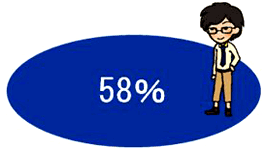
* Original Dentsu Inc. Wakamon survey conducted in September 2012 targeting high school and university students in the Kanto region (Tokyo and six prefectures)
As communication via SNS increases and relationships with real-life friends become more visible, we've entered an era where both the number and quality of communities matter. Not only the number of friends, but even detailed aspects like where they live and what hobbies they have are already visible from high school. They seem to spend time on regular maintenance for their communities, such as exchanging comments via email or SNS, planning gatherings like tea parties, or having girls' nights out.
When it comes to how they spend their allowance, dining out at family restaurants or fast food places ranks high as a top category for [socializing with friends]. At first glance, many might think, "That hasn't changed from the past."
However, when asked what they actually do daily, one high school girl explained, "Since I have to hop between different group gatherings on the same day, I want to keep each outing cheap. Sometimes I just get a 100-yen drink." As mentioned in the previous column, the increase in the number of communities they belong to means that even if the places they go and the amounts spent are the same, the "frequency" of these "friendship maintenance" activities has increased.
What's driving young people's actions these days might be shifting from "what" they do to "who" they do it with.
How have your friendships changed recently?
How have your relationships with the young people around you changed?
Observing young people might reveal glimpses of a new tomorrow or signs of fresh change.
Was this article helpful?
Share this article


Newsletter registration is here
We select and publish important news every day
For inquiries about this article
Back Numbers

Author

Nishii Mihoko
Dentsu Inc.
6th Marketing Bureau
Senior Branding Director
These young people nowadays.Everything About WakamonA Classroom Connecting You and SocietyLet's change how we create jobs!Innovators Shaping the FutureWhat do you think of this future for Dentsu Inc. Business Design Square?Dentsu Inc. Business Design Square's New Secret ManualRecruitment challenges are management challenges. Bring creativity to recruitment.The Current State of Creativity【Web Dentsu Inc. News 10th Anniversary】Want to know what happened next with that popular article?From the Field of Hiring Branding Experts: Internship Edition