
Note: This website was automatically translated, so some terms or nuances may not be completely accurate.
 The Potential of "Social Sourcing" to Obtain Resources from Society [4/11]
Frameworks for Co-Creation with Society (2)

Toshiaki Hasamura
Dentsu Inc.
※Glossary
【Social Sourcing】
A mechanism for co-creation with society by obtaining necessary resources—such as ideas, funding, and skills—from the community.
【Crowdfunding】
A mechanism for broadly raising money from individuals via the internet. Various methods exist, including "donation-based," "reward-based," "lending-based," and "investment-based."
【Fundraising】
The act of raising money for a specific purpose.
◆What is the Dentsu Inc. Fundraise Honeycomb Model?
In Part 2 of this series, we introduced the "Dentsu Fundraise Power Analysis '3C×2 Frame'". This time, we present another framework: the "Dentsu Fundraise Honeycomb Model". This is a customized version of the "Dentsu Inc. Honeycomb Model"—used for brand planning by Dentsu Inc. for over a decade—adapted specifically for fundraising.
In Part 3 of this series, we discussed how crowdfunding should aim to gather not just "money," but "allies" and "empathy." Corporate branding also employs approaches to gain "a sense of belonging" and "empathy" from consumers. This enhances brand loyalty and secures market advantage. Branding and fundraising share significant common ground in their focus on gaining "a sense of belonging" and "empathy."
Therefore, we customized the Dentsu Inc. Honeycomb Model—a framework for branding—into a framework useful for organizing fundraising planning.
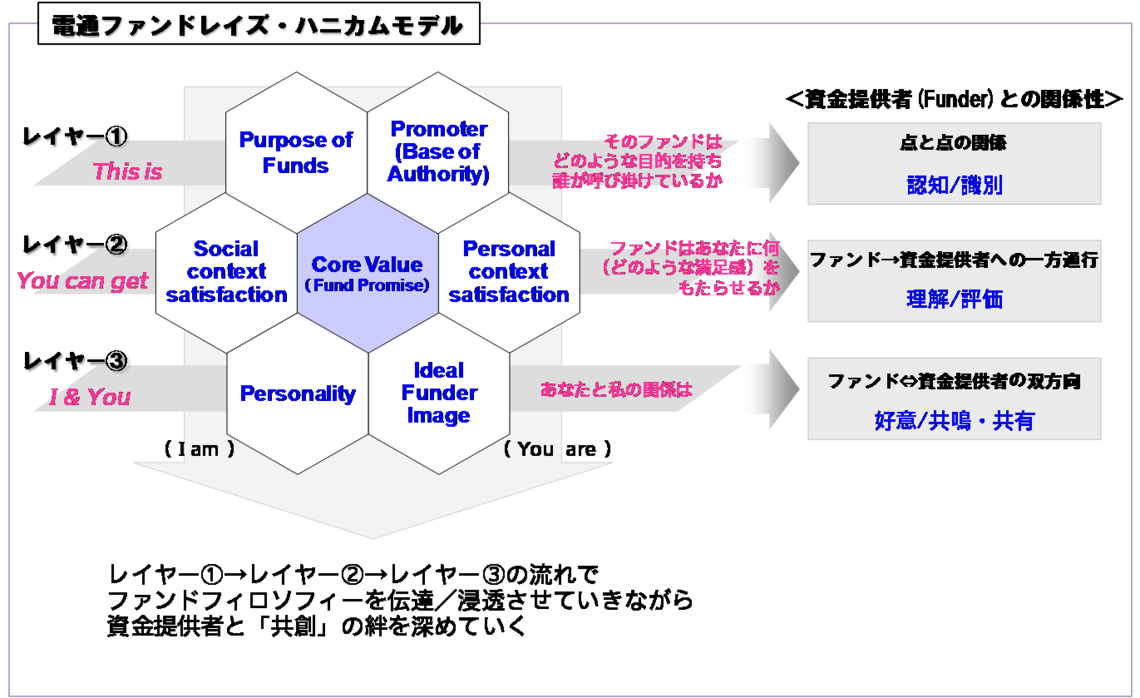
Within this framework, a fund is defined by three layers and seven elements.
Layer ①
The first layer contains the surface-level elements that consumers immediately recognize when viewing fund information. Specifically, this includes the "fund's purpose"—its raison d'être—and the equally important "fund initiator (along with the fund's rationale and credibility information)." Based on this content, consumers quickly identify and judge whether the fund is beneficial to them or falls within their sphere of interest.
Layer 2
Layer 2 is the next stage after Layer 1. Here, consumers evaluate the fund by comparing their personal preferences and social background with the fund's characteristics. The assessment of the fund's most important value—its core value—also occurs at this stage. This evaluation can lead to different conclusions for each individual.
Layer 3
Those who reach Layer 3 are the actual supporters. Here, the relationship and bond between the fund and the supporter must be defined. This layer specifies "what kind of entity the fund is for the supporter" and "what kind of entity is the ideal supporter for the fund (the target profile)."
Applying the Dentsu Inc. Fundraise Honeycomb Model to the first installment of the J-WAVE LISTENERS' POWER PROGRAM, 'Let's Create a Program Together to Share the Story of Miyakejima Island on the Road to Recovery! ' , provides one example, as shown below.
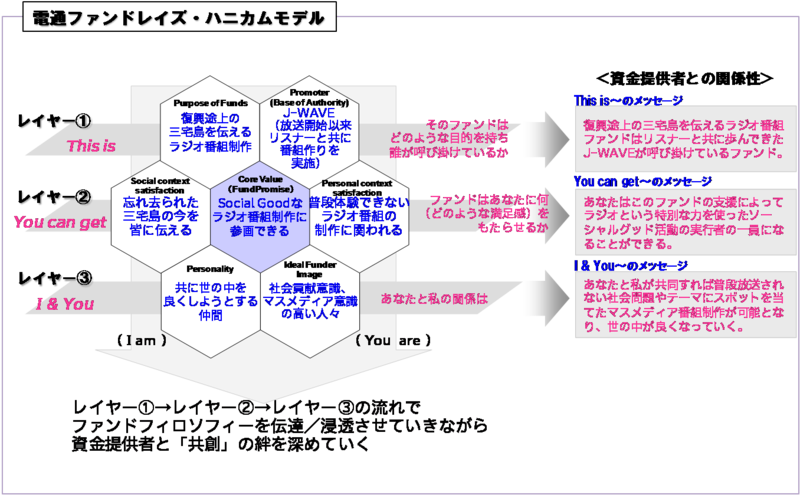
There is no single correct answer for this framework. It is a tool for organizing thoughts during the planning phase of launching a fund. Even using the same framework, various organizational outcomes are possible. However, by extracting and organizing each element individually, we can achieve far more focused thinking than vague consideration. Furthermore, by agreeing upon and sharing the messages for each extracted element and layer among stakeholders, we achieve consistent communication. That is precisely the purpose of using the framework.
◆Hiroshima TV's "Television Funding Hiroshima" Phase 2 Begins
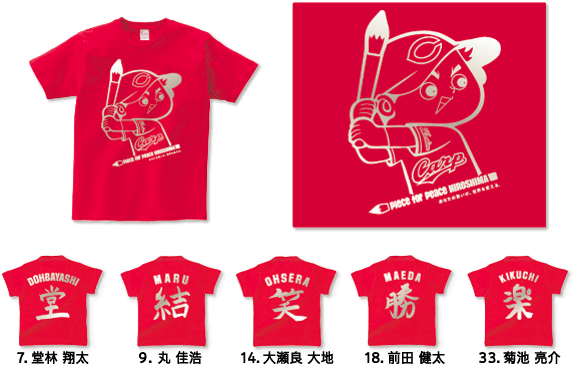
Hiroshima TV's second crowdfunding campaign launched on July 30th (running until August 13th). Its name: " Wear the PFP×Hiroshima Carp Collaboration T-Shirt and Think About Peace! Commemorating the 8/28 'Piece for Peace HIROSHIMA' GAME ". "Piece for Peace HIROSHIMA," a project Hiroshima TV has run since 2012, carries the theme "Transforming the world with the power of each individual's wish for peace." As part of this, a crowdfunding campaign is underway to produce a limited-edition red collaboration T-shirt featuring the Carp and Hiroshima TV for the Hiroshima TV-sponsored "Piece for Peace HIROSHIMA" GAME (Carp vs. Yakult). And to support the Hiroshima Toyo Carp as they charge toward their first championship in 23 years, the campaign recently reached its funding goal.
Applying the honeycomb model to this new fund from the perspective of its most likely target audience—"local Carp fans"—yields the following analysis.
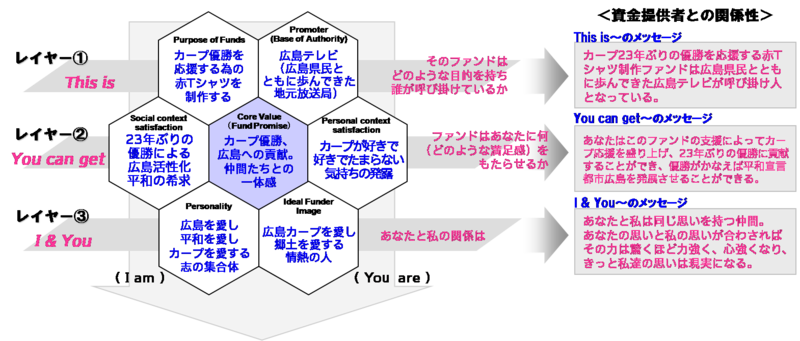
It clearly reveals who is doing this, why, and what dream they want to share with whom. Since it feels like a dream that could gather many like-minded people, this funding is expected to succeed.
◆What Makes Crowdfunding Succeed or Fail
Of course, no matter how hard you try or how meticulously you plan, crowdfunding campaigns can succeed or fail. Campaigns guaranteed to succeed might be better described as PR campaigns using crowdfunding-style presentation.
Does that mean projects that don't succeed are "failures"? I don't think so.
Countless ideas exist in the world that would never see the light of day without the crowdfunding mechanism. For example, many ideas within companies vanish during planning meetings or approval processes without ever reaching the market. The reasons for their disappearance vary, but some of these ideas could have gained popularity or benefited society if they had seen the light of day.
Crowdfunding represents a mechanism that exposes these previously unseen ideas to public scrutiny, allowing them to be nurtured by societal feedback.
Viewed this way, even if a crowdfunding campaign doesn't succeed, it provides valuable insights: "Why didn't this project reach its funding goal?" This offers material for refinement and moving to the next stage. This is something unthinkable within the traditional corporate planning meeting structure. As long as the project creator and stakeholders don't give up, they can iterate through the PDCA cycle multiple times and keep challenging themselves with crowdfunding.
The crucial point is that "failure to raise funds through crowdfunding" is never the "failure of the project itself." Even if crowdfunding fails, the connections and insights gained during the campaign can sometimes open doors to alternative funding methods.
Fundraising itself should be a means to an end for any project, not the end goal. You might even discover methods that don't require funding. While crowdfunding is fundamentally a method for "raising funds," the process inherently involves gathering "supporters" and building "empathy." Therefore, even if the full funding goal isn't met, there's a strong possibility of gaining new insights and collaborators.
In that sense, I feel that simply attempting crowdfunding itself is a valuable first step in making your project known to the world and driving the PDCA cycle forward.
Finally, I'd like to share one of my favorite sayings:
Do not hesitate, wondering what will become of you if you take this path.
If you hesitate, the path will vanish
Take that first step, and that step becomes the path. That step is the path.
Even if you don't understand, keep walking. If you walk, you will understand.Tetsuo Kiyosawa, "Fragments of Impermanence," pp. 172-173 (Hōzōkan, 1966)
This is Tetsuo Kiyosawa's poem "The Path," read by Antonio Inoki upon his retirement. As that first step, isn't crowdfunding a very good means?
For now, crowdfunding itself—this new system—may be just that "first step taken." But I want to proceed without hesitation. Surely, the path will form as we go.
Was this article helpful?
Share this article


Newsletter registration is here
We select and publish important news every day
For inquiries about this article
Back Numbers
Author
Toshiaki Hasamura
Dentsu Inc.
Business Development & Activation Division
During my student years, I incorporated a photography business (started a company). I covered approximately 40 countries. Subsequently, I joined Dentsu Inc. with the goal of launching a social business within an organization capable of significant social impact. While working on new business development led by Dentsu Inc., I also engaged in PRE/PFI consulting, such as advisory services for PFI concession bidding projects like airport privatization, and consulting for new commercial facility development project planning. Examples of business development include: - 2013: Conceived and participated in launching Japan's first crowdfunded mass media broadcast project, "LISTENERS' POWER PROGRAM." - 2016: Conceived and participated in establishing Japan's first FinTech industry hub, The FinTech Center of Tokyo "FINOLAB Inc.", where I remain active daily as part of the operational team. - 2018: Left Dentsu Inc.