
Note: This website was automatically translated, so some terms or nuances may not be completely accurate.
 The Potential of "Social Sourcing" to Obtain Resources from Society [5/11]
Frameworks for Co-Creating with Society (3)

Toshiaki Hasamura
Dentsu Inc.
※Glossary
【Social Sourcing】
A mechanism for co-creation with society by obtaining necessary resources—such as ideas, funds, and skills—from the community.
【Crowdfunding】
A mechanism for raising funds broadly from individuals via the internet. Various methods exist, including "donation-based," "reward-based," "lending-based," and "investment-based."
【Fundraising】
The act of raising money for a specific purpose.
In Part 2 of this series, we introduced the 'Dentsu Inc. Fundraise Power Analysis 3C×2 Framework' and explained how three factors significantly influence the success of crowdfunding: content power, context power, and community power.
Among these three, community strength serves as the foundational element for a fund's success. This time, using the crowdfunding campaign "We want to create a radio program that conveys the appeal of soccer club 'Shonan Bellmare'!" as an example, we will delve deeper into this community strength.
◆J.League Bellmare Supporter-Led Club Support Program Production Funding
A new fund has launched as the second installment of the crowdfunded radio program production initiative " J-WAVE LISTENERS' POWER PROGRAM."
Its name: " We want to create a radio program that conveys the appeal of soccer club 'Shonan Bellmare'! "
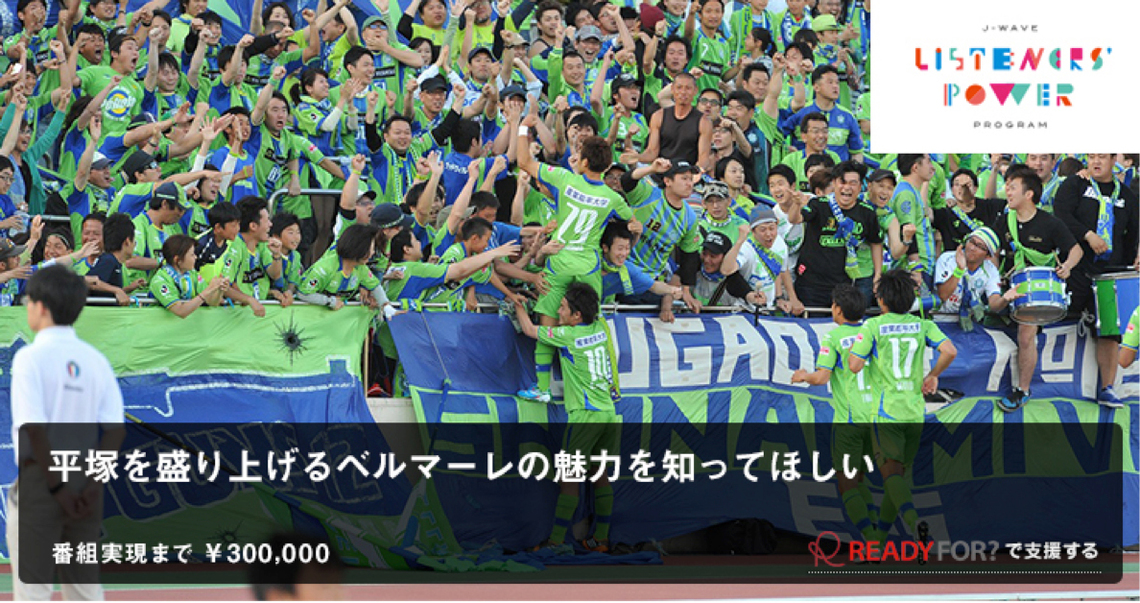 |
" We want to create a radio program that conveys the appeal of the soccer club 'Shonan Bellmare'! " |
This crowdfunding initiative, led by supporter Aya Shirota—born and raised in Hiratsuka who never misses a weekend Belmare match—aims to convey the club's appeal through its bond with the local community.
◆Who to approach, what to offer, and how to approach them
"Fundraising Community Analysis Framework"
Figure 1 illustrates the relationships between the fund's initiator and their group, supporters, cheerleaders, and others. While various funding models exist and it's hard to generalize, the following players typically exist:
Figure 1: "Fundraising Community Analysis Framework" |
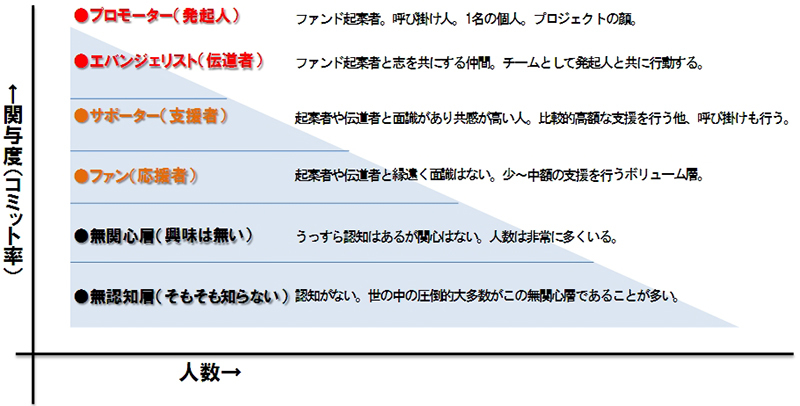 |
Fund stakeholders form a pyramid structure, with the fund initiator—a single individual promoter—at the apex. The Y-axis represents level of involvement, while the X-axis shows the number of people. As involvement decreases, the number of people increases.
Applying this framework to the participants in the Shonan Bellmare radio program production fund, which aims to convey the team's appeal, likely results in the structure shown in Figure 2.
Figure 2 "Fundraise Community Analysis Framework"
|
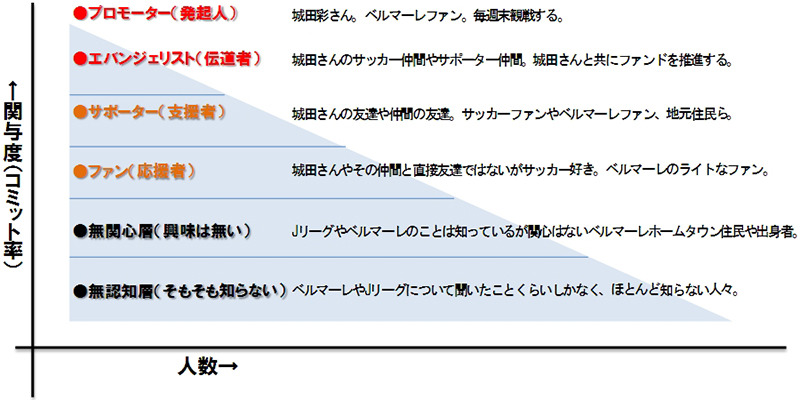 |
By classifying participants based on their level of involvement and position, we can see "what approach should be taken with each group and how."
(1) The promoter's first task is team building—securing evangelists. While recruiting from existing friends or like-minded individuals is efficient, the focus extends to finding people who will pursue the dream alongside them.
(2) Once the team is formed, promoters and evangelists should envision friends and acquaintances who might support their dream. They need to consider how to communicate in a way that makes these people happy to support them, and how to get them to actively share and spread the word with enthusiasm.
(3) They then consider how to capture the hearts of potential fans—people beyond their immediate circle who might be interested but whom they don't personally know—and turn this into a movement. Identifying who these fans might be can sometimes be unclear. It's essential to analyze the fan base and potential fans as the primary funding targets.
By implementing (1) to (3), we build a community and generate active word-of-mouth, aiming to reach the uninterested and unaware segments. We create a situation where they think, "This seems fun somehow," or "It's been coming up a lot in conversations lately," thereby gaining their awareness and interest.
◆The Relationship Between Crowdfunding and Community
As mentioned in the previous installment (Part 4), crowdfunding is ultimately just "one method of raising funds to realize a project." It is one of several available means and is not an end in itself.
Therefore, rather than building a community solely to raise funds, it's better to approach it as gathering partners and supporters to realize the project, forming a community of supporters, and naturally raising the necessary funds in the process.
At the very least, we must avoid damaging relationships by persistently asking friends and acquaintances for support (or money).
"Community power" holds significant importance. If the friends who help raise funds and the fans who offer support form and expand into a community, the fund itself grows larger. Furthermore, even after the funding campaign ends, the community gained there can become an asset as social capital. It has the potential to become a major force for advancing the project—the original goal that continues beyond the fundraising phase.
Depending on how it's approached, crowdfunding can be highly effective not just for raising funds, but also as a method for building this very community.
Was this article helpful?
Share this article


Newsletter registration is here
We select and publish important news every day
For inquiries about this article
Back Numbers

Author
Toshiaki Hasamura
Dentsu Inc.
Business Development & Activation Division
During my student years, I incorporated a photography business (started a company). I covered approximately 40 countries. Subsequently, I joined Dentsu Inc. with the goal of launching a social business within an organization capable of significant social impact. While working on new business development led by Dentsu Inc., I also engaged in PRE/PFI consulting, such as advisory services for PFI concession bidding projects like airport privatization, and consulting for new commercial facility development project planning. Examples of business development include: - 2013: Conceived and participated in launching Japan's first crowdfunded mass media broadcast project, "LISTENERS' POWER PROGRAM." - 2016: Conceived and participated in establishing Japan's first FinTech industry hub, The FinTech Center of Tokyo "FINOLAB Inc.", where I remain active daily as part of the operational team. - 2018: Left Dentsu Inc.