
Note: This website was automatically translated, so some terms or nuances may not be completely accurate.
 Introduction to Robotics Business [1/10]
The Creator of Robi, Tomotaka Takahashi, Speaks Communication Robots Are Japan's Path Forward

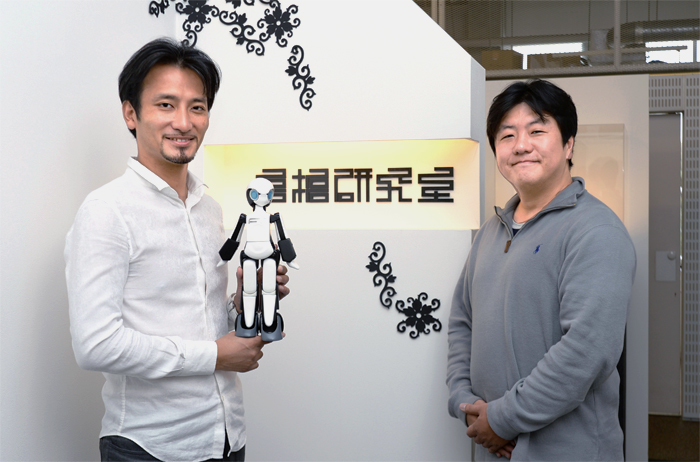
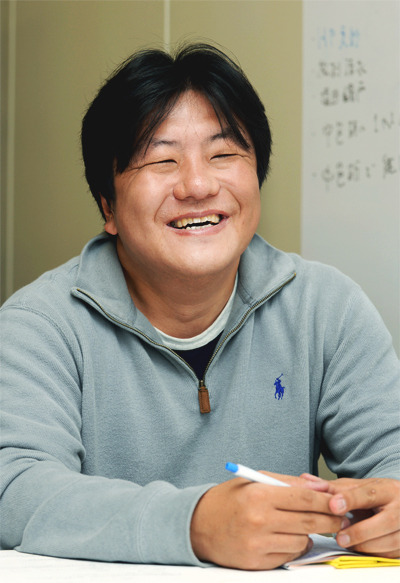
Tomotaka Takahashi
University of Tokyo
Nishijima Yorichika
Dentsu Inc.
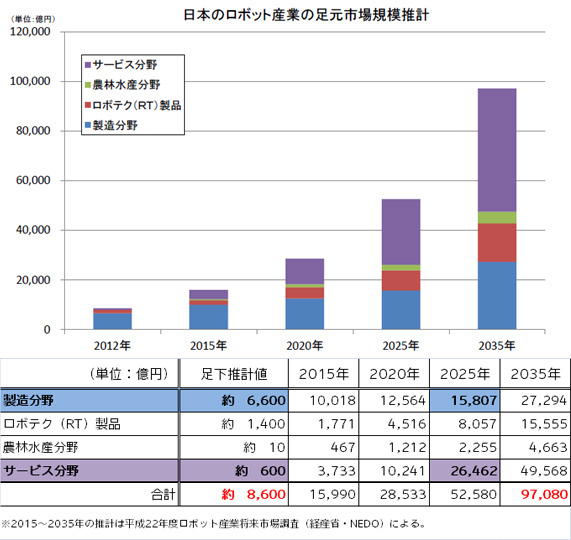
Currently, the domestic market size for the robot industry is approximately ¥900 billion. The Ministry of Economy, Trade and Industry predicts it will grow to about ¥9.7 trillion—roughly ten times larger—by 2035, approximately 20 years from now (based on the FY2010 Robot Industry Future Market Survey).
Amid this growth, Dentsu Inc. is participating in various robot development projects, leveraging its accumulated expertise and know-how in communication design. In November 2014, aiming to contribute to realizing a richer society coexisting with robots, Dentsu Inc. established the cross-functional "Dentsu Robotics Promotion Center."
In this series, Yoriaki Nishijima, head of the Center, serves as the interviewer. Each installment features a renowned Japanese robot creator or a pioneer from a robotics-related company, who will explain "What is the Robotics Business?"
Robotics has entered a phase where it is viewed as a business
Nishijima: For our first installment, we'd like to ask Professor Tomotaka Takahashi—a central figure in the " KIROBO " robot astronaut project alongside Toyota Motor Corporation and Dentsu Inc., and also the designer of De Agostini's assemble-it-yourself robot "Robi"—about what robotics business entails, and further, about future prospects. Professor, thank you for joining us.
Takahashi: Thank you.
Nishijima: Currently, not only humanoid robots but also single-function robots like robotic vacuum cleaners have penetrated the consumer market and formed a distinct segment. Furthermore, "smart robots*1" connected via networks and the cloud are becoming a key term. This recent surge in robot attention seems different from past booms. What are your thoughts?
*1 Smart Robot: A type of robot that is not designed to think and act autonomously as a standalone unit, but rather connects to the internet or similar networks and performs information processing in the cloud. Some models are equipped with built-in cameras, allowing users to check inside their rooms remotely. They can also integrate with HEMS (Home Energy Management Systems) and coordinate with other robots.
 |
Takahashi: We've seen several robot booms before, like during the Osaka Expo or the Tsukuba Science Expo. However, the feeling was that the boom faded away as soon as the events ended. The biggest difference this time is that it's originating from Silicon Valley. Google acquired eight robotics startups at the end of 2013, and now IT companies, from major corporations to startups, are investing in the robotics field, driving a significant wave.
Investors who believed the IT field had matured and lost its appeal are now entering robotics as their next target. The current landscape surrounding robotics has shifted from a phase where academic research led technological development to one focused on output, involving private companies as well.
Nishijima: So, we've moved from viewing robots as purely academic to seeing them as a business opportunity.
Takahashi: Exactly. What we must be careful about is that this robotics business is not simply an extension of the robot development Japan has pursued until now. Japan was once called the "Robot Superpower," and I believe we took pride in being ahead in robot technology. However, if we try to re-enter using the methods Japan focused on in the past, we risk misjudging the direction. I believe there are "fields where we can compete" and "ways to compete" that align with the context of the current era. This isn't traditional robotics; it lies beyond IT, and the way technologies are linked is fundamentally different.
Nishijima: Looking ahead, promising fields beyond industrial robots in manufacturing—where Japan has led—include caregiving, autonomous driving, drones (flying types), military applications, light industrial tasks, and the service-oriented communication robots you're developing.
Takahashi: When something becomes a business, it's serious competition. Take drones: competing against development fueled by America's military budget or research backed by Google's massive capital is a losing battle.
I believe that within the next five to ten years, we will enter an era where everyone has a pocket-sized humanoid communication robot as the next new device after smartphones. While the iPhone 6 is said to be doing well now, it's clear that the smartphone device itself is reaching its peak. Everyone is searching for the next device after the smartphone. People talk about watch-type or glasses-type devices, but I think neither is it.
Nishijima: What were the key success factors for smartphones, and where do you see opportunities for small communication robots?
Takahashi: The smartphone succeeded because it changed the interface from button controls to touch panels and motion sensors, making it easier to use. That's the core reason. Another key interface built into smartphones is voice recognition. However, it stumbled because "it wasn't used as much as developers anticipated." To break out of this stagnation, the most important thing is to figure out how to get everyone to use voice recognition as an interface. That's where I see the opportunity for small communication robots.
Despite having sufficient accuracy for practical use, smartphone voice recognition still hasn't become firmly established. That's because the thing you talk to is a "square box." We talk to our pet goldfish, our turtle, or even, to take it to the extreme, a stuffed bear, right? Why? Because we sense life there. No matter how smart it is, it's hard to talk to a square box.
Therefore, by giving smartphones a proper body, movement, and character design, people will happily start talking to them. And of course, talking generates information and life logs. Utilizing this as big data can then be fed back as services. I believe these small humanoid robot terminals will be the next step after smartphones.
 |
Nishijima: So it's like carrying a small robot around?
Takahashi: Yes, that's right. But Robi is too big for that. Imagine something pocket-sized, like Medama Oyaji from Gegege no Kitaro, that can talk.
Nishijima: In this transition phase from smartphones to robots, is there potential for characters that operate on smartphones?
Takahashi: I don't think so. Because right now, the value of virtual things is plummeting. Over the last decade or so, owning physical things, personal ownership, has been increasingly avoided because it wasn't seen as rational. People stopped buying CDs, and even stopped downloading them. But then, they started feeling a sense of emptiness, thinking, "I still want to own my own things," "I want to cherish something I have an attachment to." In other words, there's a return from virtual to real.
Ultimately, people aren't moved by CG or apps anymore. They can't develop affection for things that lack physical substance. The key now is how to bring virtual things into the real world. Technologies like 3D printers and projection mapping are precisely about extracting elements from the virtual world into reality. That's why I don't believe virtual characters can foster genuine relationships with users.
Moreover, there's a sense that everything possible on smartphone screens has been done. Creating hardware and platforms with arms, legs, and heads opens up endless possibilities for new software and services. I believe it's a cycle: revolutionary hardware emerges, attracting people with diverse ideas who then create services around it...
Nishijima: From my experience working with Professor Takahashi to create KIROBO, I truly felt that creating new hardware requires time and effort. From a business perspective, it also seems to carry risks. What are your thoughts?
Takahashi: Of course, creating hardware takes time and involves risks. It's not exactly efficient. But that's precisely why I find it interesting. Being "efficient" essentially means building on someone else's innovation to create software or services. If you get used to that, everyone just waits for the next piece of hardware to emerge. However, I want to create "killer hardware" that changes the times – like the Famicom back in the day, or the iPhone more recently.
Industrial Products That Appeal to Emotion
Nishijima: Colin Angle, CEO of iRobot, has stated, "Japan is too fixated on humanoid robots." Indeed, their Roomba vacuum robot has reportedly sold over 8 million units worldwide. In terms of business success for single-function robots, it certainly demonstrates one valid approach. Of course, I believe there's more to it than that. Could we hear your thoughts on this?
Takahashi: Human-shaped robots are indeed inefficient for performing tasks. I also think it's clearly a mistake to have humanoid robots do tasks like cleaning or washing dishes. However, as I mentioned earlier, for communication robots, I believe a humanoid form is best because humans can develop affection for it or empathize with it.
Moreover, this is an area where Japanese people have a significant advantage. Many foreigners are unfamiliar with well-designed humanoid robots, so they likely think, "What's the point of humanoid robots? There's no use developing them." But Japan has traditionally cultivated an image of cute robots in manga and anime, elevating it to a level that resonates nationally. I believe this is precisely where we can compete with the rest of the world.
Nishijima: Professor, the KIROBO you designed currently focuses solely on Japanese language recognition (with Toyota Motor Corporation handling voice recognition and intelligence). Yet, it's more popular overseas—especially in Russia, China, and South America—than it is in Japan. In Russia, a replica is displayed at the National Museum (※2). In China, the farewell scene with astronaut Wakata became a hot topic online. And in Brazil, every single TV station came to cover it. I truly feel that Japanese robot design possesses strengths in areas that can't be quantified.
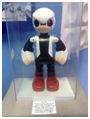 |
※2 KIROBO displayed at the Baikonur National Museum. Reportedly a meticulously crafted wooden model, it was pointed out online as potentially being "Wood Robot" rather than "KIROBO."
Takahashi: That's right. This is closely tied to culture, so even if other countries think, "Japanese robots really are cute, aren't they?", it's not something they can replicate overnight.
Changing the subject slightly, advertising and theme parks are businesses that, in a sense, control people's psychological attachment or emotional investment. I believe this is a genre industrial products haven't traditionally addressed. Most industrial products have only competed on functionality, performance, or cost-performance.
A notable exception was the branding of Sony and Apple products at certain periods, which went beyond mere industrial goods to create a worldview that skillfully elicited affection. If we could evolve that further and create industrial products capable of evoking the kind of emotions people feel toward living creatures or other people, it should open up entirely new and fascinating possibilities.
Nishijima: At Dentsu Inc. Robotics Promotion Center, we also prioritize two perspectives: not just "creating robots that function correctly," but also leveraging our expertise as a communications company to consider "whether the robot is more easily accepted by people and beneficial to society." We aim to support the robot designs you create, which evoke affection, from both branding and business perspectives.
In the second part, we continue our conversation with Professor Takahashi, delving deeper into topics like "Is it possible for communication robots not to be humanoid?" and "Robotics Business and Education."
This series will feature key figures from Japan's leading robotics businesses, so please stay tuned.
Was this article helpful?
Share this article


Newsletter registration is here
We select and publish important news every day
For inquiries about this article
Author
Tomotaka Takahashi
University of Tokyo
Center for Advanced Science and Technology Research
Specially Appointed Associate Professor
Nishijima Yorichika
Dentsu Inc.
Business D&A Bureau