
Note: This website was automatically translated, so some terms or nuances may not be completely accurate.
 Introduction to Robotics Business [2/10]
The Creator of Robi, Tomotaka Takahashi, Speaks Communication Robots Are Japan's Path Forward (Part 2)

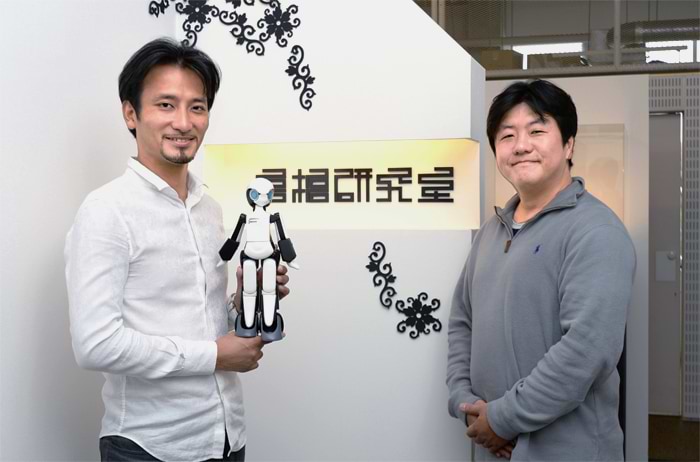
Tomotaka Takahashi
University of Tokyo
Nishijima Yorichika
Dentsu Inc.
Continuing from the first session, we spoke with robot creator Mr. Takahashi. We discussed topics ranging from "A Future Where Robots as Communication Interfaces Become Widespread" to "Could Communication Robots Be Non-Human-Shaped?" and "Robotics Business and Education."
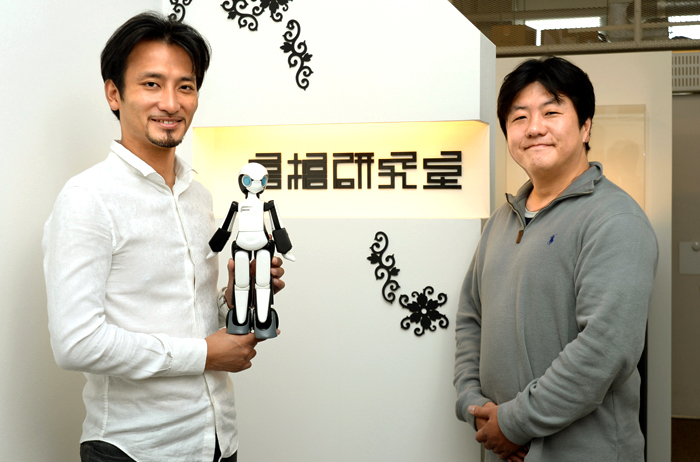
A sudden transition will fail. Take steps for a soft landing.
Nishijima: Despite the anticipated rapid market expansion in the service robot field (*1), the Ministry of Economy, Trade and Industry's "Technology Strategy Map 2010" states under "Robotics Field": "Currently, the majority of robots deployed in the market are industrial robots. The market for so-called service robots cannot be said to be established, and practical implementation cases remain scarce." (See figure below). Hopes are now pinned on the spread of robots active in actual living spaces and their ability to meet societal needs. Could you please share your thoughts again on communication robots, which have the potential to play a central role in this?
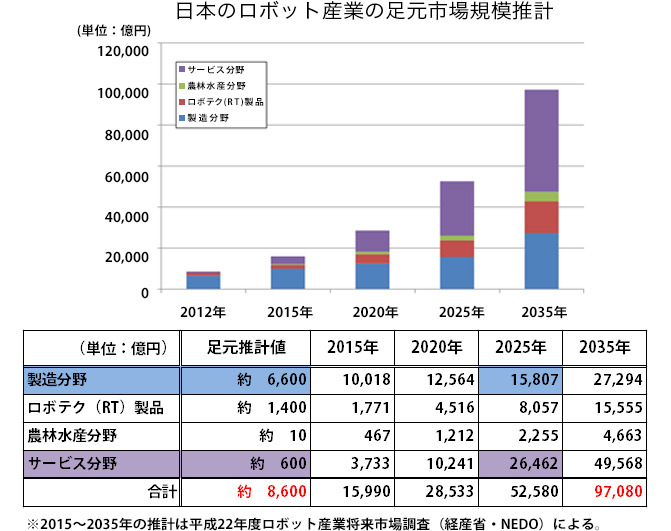
※1 Service Robotics Field: One of the four robotics categories classified by the Ministry of Economy, Trade and Industry (METI). Starting with demonstration experiments for practical service robot applications at the 2005 Aichi Expo, the introduction of robots such as cleaning robots and meal assistance robots is currently being promoted. With market expansion in the manufacturing sector (industrial robots) currently showing only moderate growth, the service robotics field is expected to develop as a more accessible solution to address the declining working-age population, aging society, and the need for a safe and secure society. (Excerpted from key points in the Ministry of Economy, Trade and Industry's "Technology Strategy Map 2010")
Takahashi: I believe the key to spreading new technology lies in how smoothly we can guide its adoption. Users are conservative in a sense, so it's difficult to get them to immediately accept the ultimate future vision imagined by the creators. Designing the steps to get there is the most crucial part. Otherwise, it will just remain a pipe dream forever.
 |
Take cars as an example. Sure, electric vehicles are superior, and their design freedom allows for shapes completely different from conventional cars. But nobody would buy that now. That's why we need to sell them as hybrids – with four tires, four doors, and an engine to eliminate range anxiety. From there, we gradually shift towards fully electric vehicles.
People don't want new technology suddenly barging into their lives and drastically changing their environment. We must strategically design the stages to avoid a leap from the familiar life we've grown accustomed to. The iPhone, Tesla electric vehicles, and the Roomba robot vacuum all owe their current success to focusing their ingenuity on this point. Some say Japanese manufacturers had the technology too, but on this point, I feel overseas players understand it better. Robots are no different. It's simply unrealistic to expect people to suddenly visit a robot specialty store, carve out a new budget for a robot from their household finances, buy one, and then live with it.
Nishijima: I see. So, expanding the market for communication robots requires not just technological advancement, but also taking steps to make them more consumer-friendly.
Takahashi: Exactly. I believe compact communication robots will become the next generation of mobile devices after smartphones. One day, you walk into your local phone shop and see a humanoid robot sitting next to the square phones. It has calling and internet functions, so you buy it as a phone. You pay a monthly robot fee that covers what you used to pay for smartphone data and device costs. Because it's humanoid, you use voice recognition more often, and it uses that information to provide you with necessary services. A kind of trust and attachment develops, making it a device even more integrated into daily life than today's smartphones. I believe this approach can smoothly create a massive market.
From the History of Communication Robots
 |
Nishijima: Looking back at past achievements in the development of service robots, Sony's pet-like robot "AIBO" sold 150,000 units over seven years starting in 1999, undoubtedly defining an era, though production eventually ceased. On the other hand, I understand that the DIY robot "Robi," designed by you for De Agostini, sold over 200,000 copies just with its first issue. Given that, it might not be an exaggeration to say it's the best-selling communication robot in Japan, one that truly thrives in actual living spaces.
Takahashi: Thank you. However, I believe that if we don't take the next step now, Robi will also come to an end just like AIBO. That next step is connecting to a network. Robi includes a full set of functions meant to help people imagine a future living with robots. However, at this stage, we deliberately cut out communication functions and avoid exchanging data with the outside world. This is because we felt that connecting it to the internet now would only make it a robot that seems capable of anything but ultimately can do nothing. Instead, we prioritized properly designing its limited functions first.
Nishijima: Last time, we discussed how "smart robots" – single-function robots connected via networks and the cloud – are becoming a key concept. What are your thoughts on this?
Takahashi: While there is a trend of non-humanoid, single-function robots entering people's lives, I also believe the role of small communication robots will grow significantly. These robots will serve as intermediaries, connecting multiple task robots with people and mediating all kinds of information to people.
Nishijima: So that requires attachment, affection, and emotional connection, right?
Takahashi: Exactly. And compact is perfectly fine. The actual work is done by cleaning robots or appliances; humanoid robots themselves are merely interfaces, so they can be small and less powerful.
Nishijima: Indeed, viewing robots as the interface for next-generation communication opens up many possibilities.
Takahashi: Exactly.
Nishijima: By the way, SoftBank officially launched a robot called "Pepper" in February 2015. Considering your advocacy for "small size," this is quite a large type. How do you view it as a pioneering example of a communication robot utilizing cloud AI (※2)?
※2 Cloud AI: Instead of embedding AI (artificial intelligence) within the robot itself, tasks like voice recognition and language processing are performed on servers connected via the internet. This approach is said to have advantages, such as accumulating conversation logs with humans to build better language systems and facilitating easier information gathering and utilization.
Takahashi: I completely agree that using cloud AI is the right approach. More than anything, the achievement of manufacturing and selling high-risk hardware is significant. Everyone wanted to work on profitable software efficiently, leading to a stalemate where no one developed hardware. But just like with the Famicom or the iPhone, you first need an excellent killer hardware platform. That's why I feel the decision to release Pepper was brilliant. However, its size and design differ from what I envision.
On New Entrants to the Robotics Business
Nishijima: I sense that every industry is now focusing on the robotics field. This means there's potential and benefit in attracting attention from sectors that previously considered robotics irrelevant. For example, if you have key points for evaluating "What aspects of our products or technologies can be applied?" I'd appreciate hearing them.
Takahashi: Simply replacing tasks done by people or animals with robots is still novel enough to attract attention. That's why I hope creative professionals from advertising agencies and media art specialists will start utilizing robots as a form of communication output. Ultimately, I believe this will help convey the vision for robotics and be highly beneficial for the future of robots. I believe it's crucial to bring in partners who can handle not just robot creation and proprietary technology, but also experience design and broader scenario development. For instance, I expect the Dentsu Inc. Robot Promotion Center to fulfill such a role.
Nishijima: Thank you. For instance, is it like Murata Manufacturing's corporate advertising series "Murata Seisaku-kun," where a company previously known as a solid electronic parts manufacturer in Kyoto successfully showcased not only its technical prowess but also its corporate culture?
Takahashi: Yes, that's right. I heard they gained a significant edge over competitors in recruiting top talent. Even in their latest corporate ad, the "Cheerleading Club" edition, they're promoting their new business of providing solutions.
Is there a necessity for humanoid robots?
Nishijima: Here, I'd like to ask you directly, Professor: Do you think communication robots could exist without being humanoid?
Takahashi: That depends on shifts in human consciousness. Just as robots evolve to fulfill necessary functions or shed unnecessary parts, their form might change to align with user perceptions. However, I believe they must initially resemble humans to gain acceptance. That's why I think taking the humanoid step first reveals the path to future forms.
Nishijima: I see, that makes perfect sense.
Takahashi: In terms of designs that are easier to accept, I'm very interested in user psychology. On the other hand, I think market research is completely meaningless. If you ask an auntie in the shopping district, "What kind of robot do you want?" you'll only get answers like "Cleaning up after dinner" or "Slicing cabbage."
Nishijima: (laughs) But it's true that users often can't articulate their needs precisely. There's also the idea that we should focus on behavior rather than surveys.
Takahashi: No, the concept of "needs" itself is meaningless. As Jobs said, people don't know what they want until they see it. Conversely, the needs we think of now are usually simplistic. That's why creators and designers must build things based on their own sensibilities and then propose them to users.
Nishijima: Seeing how you run Robo Garage single-handedly, I think I glimpsed why it keeps succeeding while many companies are stuck in a cycle of trial and error. You have a clear vision of the future you want to create, and you work backwards from that to determine what kind of robot is needed now, then create it.
Takahashi: I didn't start with any clear vision, but observing the world and the technological landscape, I realized the future was already right there. So, I just see it as designing the steps towards its gradual realization.
Robotics Business and Education
Nishijima: I understand you were already building robots back in kindergarten. That long experience with robot prototyping and the intuition honed there can't be replicated overnight.
This might relate to that point, but you also oversee the curriculum for the "Human Kids Science Robot Classroom," which has over 500 locations nationwide, right? Today, more than 5,000 children participate in robot building there. In an era where declining interest in STEM fields is a concern, I feel this is incredibly important work for broadening the base of the robotics field.
Takahashi: For children, robots are just as much a surefire hit as beetles or dinosaurs. I hope that through robots, they develop an interest in science, math, and science in general. The ideal in education, I think, is when they become so absorbed in play that they learn without even realizing it.
Nishijima: Robotics isn't just an engineering field; it's a highly interdisciplinary discipline with potential to span information and communications, design, and even psychology.
Takahashi: Until now, robot development was confined to a closed world of engineering specialists. But it's no longer just an academic pursuit for a select few; it's dynamically evolving as a global business. It's no exaggeration to say that soon, there won't be a single field untouched by robots. That's why it's essential for people from diverse fields to generate ideas by combining their expertise with robotics. I believe this will make Japan's vision of a future where everyone lives with a robot a reality within the next decade.
Nishijima: Professor, thank you very much for sharing your valuable insights.
We've heard from Professor Takahashi over two sessions. Next time, we will speak with Mr. Yasushi Omori, Executive Officer at Bandai Namco Studios, and Ms. Yuka Ichiki, General Manager of the New Business Division in the President's Office at Bandai Namco Games and Representative of Game Method Consulting "Special Flag". For those in their 30s and older, you might wonder why the company behind "Xevious" and "Pac-Man" is getting into robots? There are key points deeply involved in the robotics business. Please look forward to it.
Was this article helpful?
Share this article


Newsletter registration is here
We select and publish important news every day
For inquiries about this article
Author
Tomotaka Takahashi
University of Tokyo
Center for Advanced Science and Technology Research
Specially Appointed Associate Professor
Nishijima Yorichika
Dentsu Inc.
Business D&A Bureau