Note: This website was automatically translated, so some terms or nuances may not be completely accurate.
 WMS2015 Special Interview [2/3]
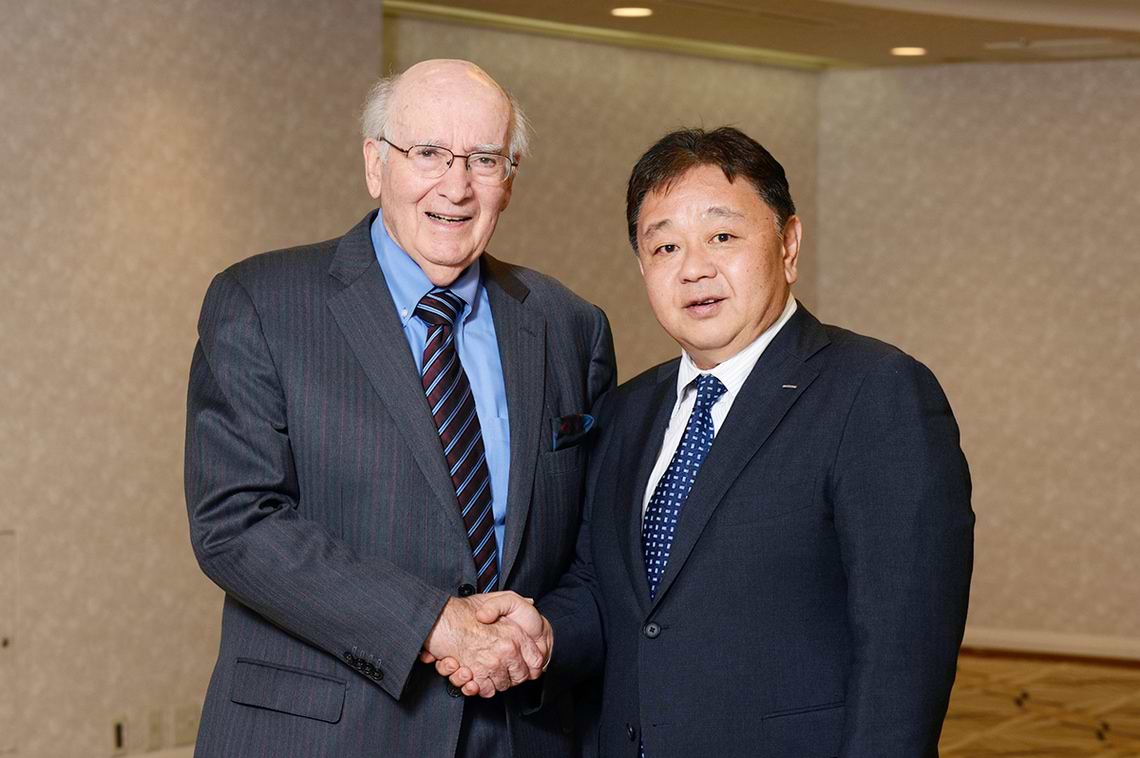
"Rethinking the New Form and Mission of Sales" Andy Soltzners × Tetsuji Hirose

Andy Zoltners
Northwestern University Kellogg School of Management
Hirose Tetsuji
Dentsu Inc.
Innovation and Organization
―How to Win in the Digital Age, as Seen by a Marketing Pioneer
Part 2: Andy Soltzners × Tetsuji Hirose "Considering the New Form and Mission of Sales"
The second part of the special interview from Japan's largest international marketing conference, "World Marketing Summit (WMS) Japan 2015," features Andy Soltzner. He is Professor Emeritus at Northwestern University's Kellogg School of Management, specializing in sales organization management. The interviewer is Tetsuji Hirose, President of Dentsu Consulting Inc. and Head of Dentsu Inc.'s Marketing Solutions Division, who studied under Professor Soltzners at the same business school. Amidst rapid digitalization and technological evolution, what is happening to sales organizations in the US? What perspectives are essential for strengthening sales organizations? A former student poses these questions to his mentor.

The Trend Toward Smaller Sales Teams and the Shift to Inside Sales in the U.S.
Hirose: Actually, I took your class at the Kellogg School of Management back in 1991.
Zoltzner: I remember you! You were much slimmer back then (laughs).
Hirose: Getting right to it, could you share the recent trends in U.S. "sales organizations"?
Soltzner: It varies by industry, but in the U.S., sales organizations are trending toward smaller sizes. For example, in the U.S. pharmaceutical industry, there were 102,000 salespeople in 2005, but ten years later in 2015, that number dropped to 63,000—a 38% decrease. This is because physicians can now independently access various information without needing salespeople. This phenomenon, occurring across other industries as well, is drawing significant attention.
Here's an interesting piece of data from the U.S.: 94% of B2B buyers conduct thorough online research before making a purchase. Furthermore, 57% of customers have already made their purchasing decision before meeting with a salesperson. This represents a very significant change.
Hirose: So, as customers' information channels diversify and the volume of information explodes, the very purpose and role of sales are being forced to transform?
Zoltzner: Precisely. In the pharmaceutical industry, direct mail, TV/magazine ads, and large sales organizations were traditionally prioritized as channels to reach physicians. However, new channels like online banner ads, email, and speaker programs are now being leveraged, driving major change.
Another major trend is the rapid expansion of phone sales. Statistics show that 42% of sales in the US, excluding retail, are now inside sales (non-field sales activities). The fact that 42% of sales are conducted solely via phone, email, web, and direct mail, without visiting clients, represents a significant shift.
Another trend is the increased emphasis on major accounts. 89% of companies believe the importance of Key Account Management (KAM) will continue to grow. They anticipate strategic clients will grow 1.5 times faster than other clients, aiming to identify key customers, offer them above-average benefits, and build strong relationships.
However, only 14% of companies report that their KAM programs are functioning effectively. This indicates that while KAM is widely recognized as crucial, most organizations are still figuring out how to make it work well.
Hirose: Please explain the background of the "shift to inside sales" in the U.S.
Zoltzner: Inside sales wasn't previously seen as particularly effective. But with the dramatic evolution of digital communication driven by the rapid proliferation of email and mobile devices, the rise of inside sales was an inevitable phenomenon.
If I were a salesperson and you asked me about a product, I would consider simply sending you the product information via email, without needing to visit you in person. However, for highly sophisticated and complex products or services, the salesperson's knowledge itself becomes valuable, so there are industries where inside sales may be less effective.
The Changing Face of Sales: Multi-Channel Management as the New Mission
Hirose: How do you view the impact of technological advancements, such as digitalization and marketing automation, on sales activities and organizational structures?
Zoltzner: We're seeing truly diverse impacts and changes. Customers can now access far more information independently, shifting the initiative entirely to their side. In this environment, the critical perspective becomes: "What value can we, as salespeople, provide?" Since customers might make direct purchases online, delivering sales value has become more challenging. Therefore, we must constantly explore how we can be useful and what value we can offer.
Hirose: We've always valued being "solution-based sales" that provide problem-solving, not just selling products. Recently, there's also discussion about promoting "challenger sales" that proactively address unknown challenges customers haven't even recognized yet.
Zoltzner: That is precisely what delivering value to customers means. Today, sales contact with customers is just one part of a multi-channel marketing approach. Sales professionals are now expected to manage their activities organically, integrating them with call centers, digital media, and various technologies.
Hirose: What about consulting firms that provide customized services for each client? You founded the consulting firm ZS Associates, didn't you?
Zoltzner: The consultant themselves is the "product," and top consultants are exceptionally skilled at selling "the product = themselves." Furthermore, inside sales call centers can play a crucial role in consulting businesses by qualifying prospects. By asking inquiries a few questions and cross-referencing this with information held by the sales force, they can efficiently build a highly accurate portfolio of qualified prospects.
Hirose: So, even for B2B companies, it's necessary to efficiently conduct sales by preparing materials that aggregate valuable information for customers who inquire via the web or phone. Is this background creating the major trend toward downsizing sales organizations?
Zoltzner: Exactly. In an era where customers can easily access diverse information online, meeting with salespeople who don't provide value is a waste of time.
Balancing "Effectiveness" and "Efficiency" Strengthens Sales Organizations
Hirose: What points should we keep in mind to build a strong sales organization?
Zoltzner: When considering the structure of a sales organization, two perspectives are crucial: "Effectiveness" and "Efficiency." A highly effective sales organization means one that generates revenue. High sales effectiveness is achieved by enhancing the expertise of each salesperson. By focusing on a limited number of customers and offering them specific products/services within their area of expertise, high sales effectiveness is achieved.
On the other hand, efficiency in a sales organization comes from generalists. Generalists serve a diverse range of customers with a broad portfolio of products/services and have a wide scope of activity. A small sales organization where each salesperson handles all services achieves high efficiency.
If individual salespeople excessively pursue specialization in specific products/services, their areas of activity overlap. This leads to multiple people approaching the same customer, reducing organizational efficiency. Since "effectiveness" and "efficiency" are in a trade-off relationship, every company seeks the optimal balance.
The downfall of organizational reform is knowledge loss. Consider innovator discovery plus talent retention.
Hirose: Many Japanese companies maintain a lifetime employment system starting with hiring new graduates without job experience. Compared to Western countries, Japanese companies have less fluidity in the job market, which seems to make it difficult to respond to rapid change. What are your thoughts?
Zoltzner: The speed of that "change" is incredibly fast. With a lifetime employment system spanning 40 years, Japanese companies face a difficult challenge in situations requiring them to flexibly secure or replace necessary talent.
However, I believe it's crucial for Japanese companies to ensure that many existing employees who aspire to succeed fully understand the new reality of rapidly advancing digital transformation. Furthermore, when hiring new talent possessing sought-after value, it's important to let surrounding employees perceive the "value" that forms the source of that talent's competitiveness, as well as their attitude and mindset of continuous evolution.
Sometimes, younger employees may even lead their older counterparts. Personally, I enjoy working with younger employees, partly as a way to sharpen my own skills.
Hirose: Could you offer advice for companies attempting organizational transformation to respond to a rapidly changing business environment?
Zoltzner: It often happens that companies implement organizational change, only to do it again two years later. They seem to forget what didn't work in the past and somehow believe it will succeed this time. While a structural flaw—the lack of a system to evaluate the results of organizational reform—contributes to this, I believe the most significant factor is workforce mobility.
In Europe and the US, the departure of key personnel holding critical past knowledge through job changes leads to significant "knowledge loss" for the organization. In this regard, Japanese companies with lifetime employment systems might actually have an advantage.
Hirose: To drive innovation forward, recruiting diverse talent is also crucial. What points should we keep in mind when pursuing talent acquisition?
Zoltzner: Integrity, motivation, ambition, and diligence are vital. However, the most effective way to assess a person's potential is to look at their past actions. I place significant weight on academic performance during their student years. In that regard, Mr. Hirose, you earned an "A" in my class, so you're in good shape (laughs).
Hirose: Yes, thank you!
Was this article helpful?
Share this article


Newsletter registration is here
We select and publish important news every day
For inquiries about this article

Author
Andy Zoltners
Northwestern University Kellogg School of Management
Professor Emeritus
Hirose Tetsuji
Dentsu Inc.
Executive Officer