
Note: This website was automatically translated, so some terms or nuances may not be completely accurate.
 Kimezo's "You don't really get digital solutions, do you?" [3/8]
+fooop! (ISID Chijo Masaki)
To uncover the true nature of "+fooop!", a social city platform developed by Dentsu Inc. International Information Services Inc. (ISID) that supports communication between cities and their visitors, Kimezo—who knew absolutely nothing about it—interviewed Mr. Chijo Masaki from ISID's Communication IT Business Division.
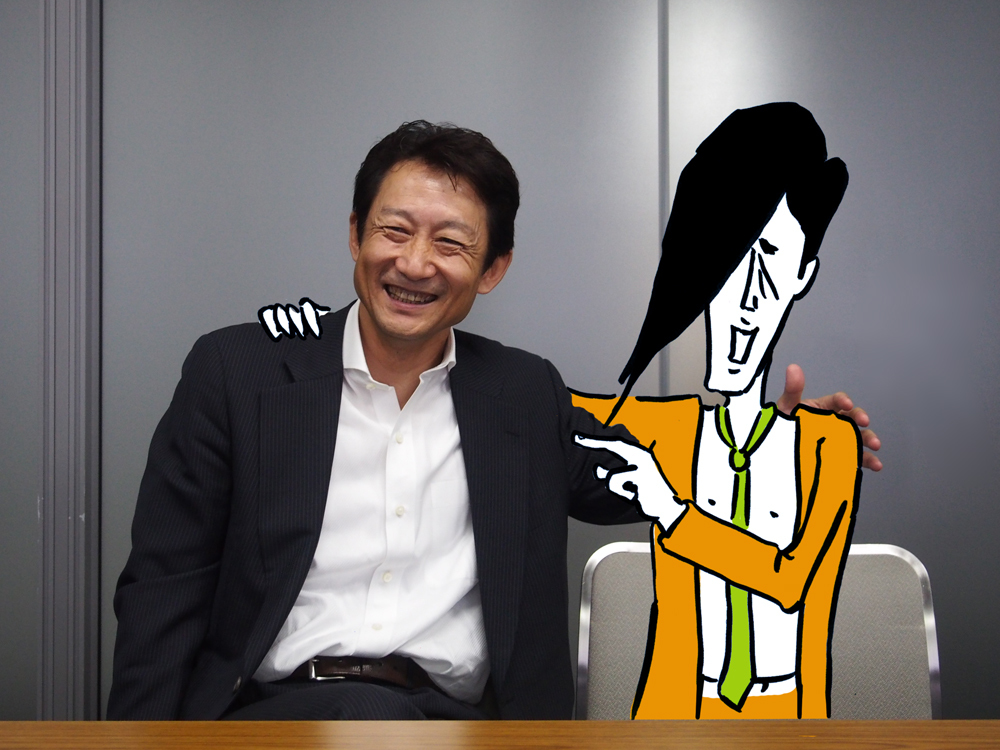
──So it's written as "+fooop!" and pronounced "Purafūpu," right?
Masaki: The origin comes from "hula hoop." It came up during a team brainstorming session—we wanted a circle that connects communication. But using "hula hoop" directly was a no-go trademark-wise and wasn't interesting design-wise, so we went with "+fooop!".
──Wait, if that's the case, it should be "+foop!" not "+fooop!". There's one extra "o". That's a typo. You're lucky I pointed it out, so give me a million yen as a thank you.
Masaki: Hahaha, no way! We found out "foop" is slang with negative connotations, so we deliberately added the extra "o".
──I see. I knew that.
Masaki: Really? (laughs). Also, we added the "+" because during brainstorming with the creative team, we thought it looked good—or to put it bluntly, it looked cool (laughs). System engineers tend to come up with pretty cheesy product names. That's no fun, right? Since it's a BtoC service, we all agreed it'd be boring to stick with the usual system engineer mindset. We really stretched ourselves (laughs).
──That's cool.
Masaki: Thanks (blush).
──But I'm cooler, you know. So, when exactly can this system be used?
Masaki: We envision it being used during the development of commercial facilities, or as a communication tool for existing ones.
──I heard it was used extensively at "Grand Front Osaka," which opened on April 26th this year. How effective was it, really?
Masaki: Since it's a new commercial facility, we'll have to see how much it contributes going forward. However, in terms of sales, tenant revenue reached 20 billion yen within about five months of opening, exceeding the first-year target of 40 billion yen. Also, we know users aren't just visiting food and beverage spots; they're actively exploring the commercial tenants too. So far, it's undoubtedly succeeding as a commercial facility.
──I see. From what I've heard, it seems like two major factors drove the success: "+fooop!" and Kimezo. So, specifically, how is the "+fooop" system being used at Grand Front Osaka?
Masaki: First, there's the "OSAMPO CARD," which users register for and create beforehand. There are 36 digital signage poles throughout the commercial facility. When you touch this card to one of them, it displays personalized information for that person. We're still in the data collection phase, but we analyze their movement patterns and purchases. For example, we can prioritize and display up to 10 pieces of information based on that analysis.
──I hear there's also an app you can download on your smartphone. Well, I don't even use a cell phone, let alone a smartphone. You know why? Because I'm a man who doesn't want to be tied down by anyone.
Masaki: Oh, then maybe we shouldn't talk about smartphones. Let's drop it.
──My deepest apologies. Would you mind sharing more? Honestly, I'd love to buy a phone with the fee from Dentsu Inc.
Masaki: Just kidding (laughs). Downloading the app on your phone lets you route to places while viewing maps, get tenant information, and use the "machi-twi" SNS feature. It can connect to Facebook if you want, serving as a tool for customers to share and spread information. Using this builds up information about the town. Then there's the "Socio" community, which means "companion" in Spanish. It's like the "flower arrangement clubs" you'd find in old department stores, but it's not just about real-world activities. You can connect with members and see what they're up to using the app. For example, a group discussing Kyoto pottery. We want to create communication spaces within the city itself.
──You know, it's not just about directly pushing sales.
Masaki: Exactly. Many department stores and commercial facilities tend to differentiate themselves by focusing on the novelty or buzzworthiness of their tenants, but that approach quickly becomes stale. Grand Front Osaka isn't like that. We wanted to differentiate ourselves through the concept of the "space" itself, by creating mechanisms that encourage communication between people. In the old days, people would come to department stores, see the mannequins, the shop staff, and the other customers there, and get a sense of what was trendy or find things they wanted. But now, it's an era where people look things up on their smartphones, check samples at the department store, and then buy online. We thought that building a large-scale commercial facility based on the traditional concept wouldn't serve society well in such times.
Even in this age of electronic devices, I believe there are ways to foster communication. At Grand Front Osaka, we call this place a "town." We wanted people to feel that coming here would lead to some kind of interaction, that just wandering around would lead to something fun. We supported that vision with "+fooop!".
──That's passionate. By the way, is there an ultimate ideal for "+fooop!"—something like "someday, it'd be great if we could do this"?
Masaki: Well, assuming we get personal authentication permissions, it wouldn't be limited to just one commercial facility. Imagine a shared platform across the whole world, analyzing the behavioral history of the people living there. This might sound a bit creepy (laughs), but for example, a couple could secretly share the girlfriend's preferences with the boyfriend (laughs).
──That's creepier than me.
Masaki: We think that's creepy too, so it's just a joke. But imagine if a clueless boyfriend's phone buzzed when they arrived at a restaurant, prompting him with info like "Open the door for her" or "Don't get off the elevator first"—that kind of thing could be nice (laughs). Or maybe it'd lead to lots of international couples forming (laughs).
──International couples... Tell me more about that later. Domestic women just don't see me. Seriously, tell me more about your dreams! This is getting exciting!
Masaki: For example, imagine a crowded, hot summer day when a family with kids comes in. Let's say the child is still pretty young, and this family ends up wandering around the facility for three whole hours. We'd understand that situation completely. And because we feel sorry for the child, we'd want to do something like give them a coupon for free ice cream at this shop. I don't think that's something a system alone can do. We want to think about how we can contribute to society without becoming a system's ego, and where to place that delicate point of contact.
At Grand Front Osaka, we're not just focused on turning everything into immediate profit. We're trying to cultivate an atmosphere where people feel, "Hey, coming here is fun." All the interaction data is stored for each individual, and in the future, using the trendy term, it will become big data.
──By the way, this "+fooop!" seems to be the world's first system of its kind.
Masaki: I looked into it. While there are many coupon distribution and stamp rally tools out there, bundling them into a communication package tool like this is indeed a world first.
(As of February 2013 research)
Incidentally, we exhibited at the Mobile World Congress in Spain last year, and I felt our approach stands out quite distinctly even by global standards.
──Any interesting development stories?
Masaki: Initially, this system was called the "Ubiquitous Platform," or "UPF" for short. It was incredibly generic (laughs).
──Kind of like "KMZ," the nickname for "Kimezo" (laughs).
Masaki: (Ignoring that) Originally, there was a team within ISID called the "Innovation Lab." Before Grand Front Osaka was built, we participated in an industry-academia collaborative study group called the "Ubiquitous Services Research Group." There, we got really excited with developers about ideas like "We want to create a city with a new sensibility" and "This is the kind of city we want to build." To put it bluntly, we got ourselves into a situation where we couldn't back down (laughs).
When systems engineers build systems, they often play it safe—doing what's feasible without risk. But this time, the wild ideas came first, and we worked backward, constantly asking, "How do we actually build this?" From conception to completion, it took five years. It was a massive undertaking (laugh).
But I think it's precisely because we overcame that reckless challenge that we created something interesting, and it's garnered attention from various commercial facilities and developers all over Japan.
──Yeah. I hope it becomes a huge hit, just like the hula hoop was back in the day!
Masaki: Huh?
──Well, you know, like how hula hoops were a huge craze back in the day, I'm hoping this "+fooop!" will become a huge craze too... kind of a play on words...
Masaki: Huh?
──Thanks for today!!
Was this article helpful?
Share this article


Newsletter registration is here
We select and publish important news every day
For inquiries about this article
Back Numbers

Author
Masaki Senjō
Dentsu International Information Services, Inc. (ISID)
Strategic Business Promotion Division
Articles by this person

Kimezo
He's a man who personally demonstrates a free way of life to businesspeople everywhere.