Note: This website was automatically translated, so some terms or nuances may not be completely accurate.
 Toward Digital Technologies That Move People [4/6]
The strength of connecting directly with consumers through local media New value emerges from dialogue with the community
Last time, we discussed how communication on social media actually originates from offline events. This time, I'd like to consider how we can spread those offline events online.
Those who regularly use Twitter, Facebook, and similar platforms may intuitively understand this: the posts and photos shared by your followers or friends are essentially snapshots of events they encountered in their daily lives or things that moved them.
This is actually the crucial part: the main drivers of communication on social media are first "① the person who encountered that thing or event," and second "② the community that person is connected to." Posts originate from ①, and diffusion occurs at the ② stage, allowing offline events to spread online.
In other words
① = Experience (Personalization)
② = Sharing (Making it a shared experience)
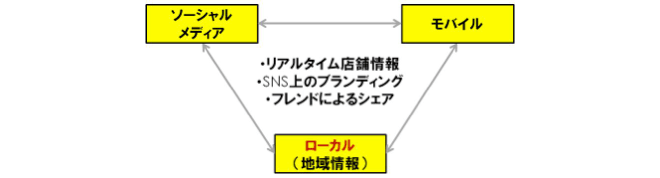
Local media is what effectively bridges these two.
Example: Rainy Days, Good Things. Happy Rainy J-WAVE
During this year's rainy season, radio station J-WAVE ran a campaign titled "Make Rainy Days Happy." When rain began falling near the studio during a program's broadcast, the show's theme shifted to "making rainy days enjoyable." Listeners accessing a special website via PC or smartphone could receive limited-time services from sponsors and stores in the Tokyo metropolitan area.
For details, please see this news release.
http://www.dentsu.co.jp/news/release/2013/pdf/2013071-0603.pdf
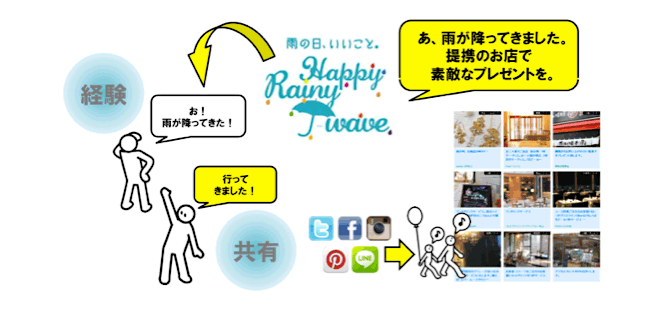
What's noteworthy here is how the radio medium delivered real-time information, creating shared experiences among many listeners. By then feeding back these shared experiences into the program (e.g., live-tweeting listener reactions), it built a system that transformed individual experiences into a collective societal phenomenon.
Events × Sampling × Local Broadcasters/Regional Newspapers
Communication methods like this J-WAVE case study are gaining attention recently. However, when companies interact directly with consumers, it's crucial to recognize that what resonates varies by region. Beyond a nationwide communication plan, when engaging consumers locally, events will be more successful if communication tailored to that area is delivered by popular local talent or announcers. To achieve this, companies need to partner with local radio stations and regional newspapers.
Traditionally, such events and sampling remained experiences between "the company and individual consumers." However, with the spread of social media, the touchpoints between companies and consumers no longer stay confined to individual consumers' direct experiences. Instead, these experiences become part of the public discourse through their "sharing." By skillfully designing this communication, offline events can generate positive online diffusion.
For example, at an event hosted by a local broadcaster, a famous announcer from that station distributed snacks from a sponsoring company to children. This scene was filmed and shared by the children's mothers, and the images filled with smiles spread widely across social media.
Reaching people who didn't attend the event
Previously, events primarily focused on "giving consumers an experience," while sampling was about "distributing products for consumers to try." However, when combined with social media, the "fun!" and "happiness!" spread in real-time to people who weren't even at the event. Not only did this achieve reach equal to the actual participants multiplied by their followers and friends, but it also meant smiles and joy were shared alongside.
By partnering with local media that regularly engage with communities to host events, we can seamlessly connect the communication design around "consumer experiences" with the "socialization" of what users share. Furthermore, the content shared here isn't just one-way information dissemination; it's "fun" and "happy" information shared by trusted friends and communities. The value of this new form of information sharing seems poised to continue expanding.
Next time, I'd like to explore communication that extends beyond mere information dissemination—communication that leads to product design itself—by engaging in deeper conversations with that community.
Was this article helpful?
Share this article


Newsletter registration is here
We select and publish important news every day
For inquiries about this article
Back Numbers

Author

Sato Jun
Dentsu Hokkaido Inc.
Media and Digital Bureau