Note: This website was automatically translated, so some terms or nuances may not be completely accurate.
 Working at the British company we acquired [2/5]
London Correspondence: Talent Utilization ~ DAN's Distinctive HR System ~
The other day, I was having drinks with one of my few Japanese colleagues.
Koyanagi: "The other day, an Italian staff member asked me, 'Takashi, tell me who's handling this at Dentsu Inc. HQ.' So I said, 'Oh, just email Mr. A and Mr. B about it.' Then he asked back, 'Mr. A and Mr. B? Which one is it?'"
Colleague: "That's a Japanese way of distributing responsibility, which might be hard to grasp overseas. By the way, did you know that concept dates back to the Edo period? Back then, the town magistrates were the Northern Magistrate and Southern Magistrate, working in rotation. The idea was that concentrating all power in one person could lead to trouble, so the higher-ups used this system to prevent that."
Koyanagi: "Huh. But I get it. Even at headquarters, we often have multiple people handling things, like a lead and a sub. That way, if something happens to one person, we can still manage."
Team Structure and Responsibility
At Dentsu Inc. Aegis Network (DAN), a typical team structure consists of about 4 to 5 people, or at most around 10. This unit is similar to what we'd call a "department" at headquarters. Especially with global teams, the scope of work is vast. It's often surprising to see such a small number of people handling so many clients across so many regions.
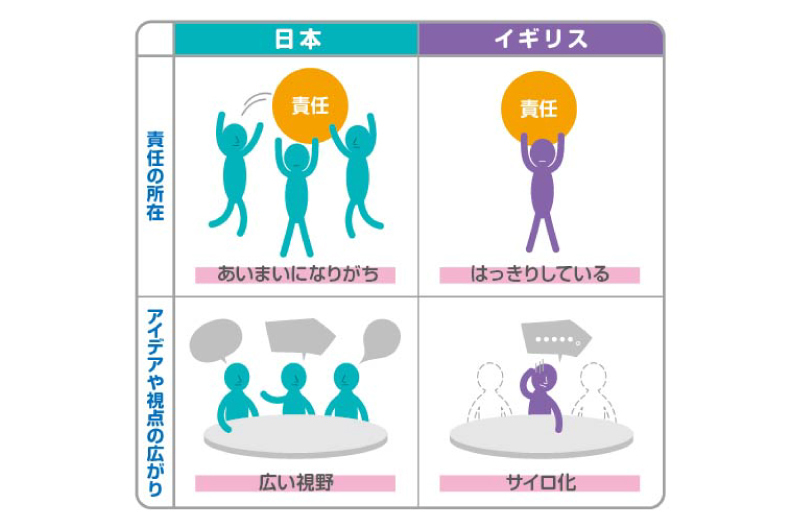
A distinctive feature is how assignments are handled within the team. At Dentsu Inc., while it's not the Japanese-style diffusion of responsibility mentioned earlier, it seems common for multiple people to work on the same project. Here, however, when managing multiple projects within a team, it's common to assign one person per project to clearly define responsibility. The advantage is that individual accountability ensures the work is executed under their responsibility, with clear ownership regardless of success or failure. On the other hand, (though some handover does occur) progress during vacations can't always be expected.
Here's an example of the pros and cons of this individual responsibility. Recently, while having drinks with a British colleague (at the team leader level), he shared a minor concern: excessive competition and "siloing" within his team. Within his team, individuals were controlling information and working to boost their own KPIs (like personal new client acquisition numbers). While this approach itself isn't bad, it could lead to proposals for clients that are biased and narrow in perspective. Because of this, his team has introduced something akin to regular departmental meetings (quite Japanese, actually) to promote information sharing within the team.
Personnel Mobility within the DAN Group
In such a clear-cut organization where individual responsibilities are well-defined and bonuses are tied directly to KPIs, the primary focus tends to shift from company growth to pursuing personal evaluation and success, and developing one's own career path. Foreign companies are often said to have high turnover rates. At DAN, while some job-hopping within and outside the industry is expected, the HR system is built with the goal of retaining as many talented individuals as possible within the group, employing various strategies to achieve this.
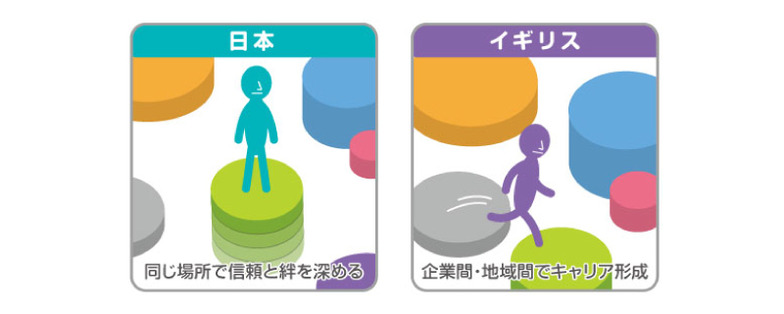
One such measure is enhancing talent mobility within the group. By offering talented individuals opportunities for both "vertical" (between companies) and "horizontal" (between regions) movement within the DAN Group, we increase their career development options. This allows them to approach their roles with renewed enthusiasm and elevate their performance. Furthermore, this approach not only helps prevent talent outflow but also increases the number of individuals with diverse functional expertise within the group, thereby enhancing the group's overall proposal capabilities.
On the other hand, at Dentsu Inc. headquarters, it's common for employees to handle the same clients and media companies within the same department for a certain period. The philosophy is to build diverse specialized knowledge, deep relationships with all departments at the client company, and above all, trust. This approach aims to connect not just advertising, but also upstream business opportunities. Both approaches seem to have their pros and cons, and given that Japan operates on the premise of lifetime employment, they cannot necessarily be compared from the same perspective. However, I found the concept of personnel mobility within DAN to be highly instructive.
Individual Evaluation and Collaborative Effects Within the Group
The essentials for organic growth, obviously, boil down to maintaining and expanding existing client relationships and acquiring new clients. The primary reason DAN continues to achieve high organic growth is the effective and efficient collaboration between its agencies in both scenarios. Crucially, this collaboration is simply tied to individual evaluation and bonuses.
Regarding expanding existing client relationships, there are two primary methods. For the assigned agency, this involves broadening the scope of services provided (upselling) and thereby increasing compensation, and introducing other agencies within the group to provide new services (cross-selling). Particularly for cross-selling, I believe the key to its success lies in the institutionalized system where introducing other agencies within the group directly boosts one's own KPIs and evaluations. This approach seems to be the polar opposite of agency groups that encourage internal competition.
DAN's institutional support, where promoting collaboration within the group directly contributes to individual evaluation, fosters excellent relationships between companies within the group and creates an atmosphere that encourages collaboration. Naturally, everyone prefers a friendly, positive working environment over a tense one. People who have worked at DAN for a long time especially say they love this "atmosphere of collaboration." I feel this ultimately contributes to employee retention.
Was this article helpful?
Share this article


Newsletter registration is here
We select and publish important news every day
For inquiries about this article

Author
Takashi Koyanagi
Dentsu Inc. Media & Holdings India
Director