Note: This website was automatically translated, so some terms or nuances may not be completely accurate.
 Viral Videos and Regional Revitalization [2/2]
When you want to start something new, why not give us a call?
Last time, we discussed Kobayashi City's initiatives for fiscal year 2016.
This time, though it feels incredibly belated, we want to delve deeper into the first video, "Ndamoshitan Kobayashi." While luck played a major role in its success, we gained numerous insights and discoveries. We hope this serves as a reference for those working in local government, even if only a little.
Why did this project come about?
Kobayashi City in Miyazaki Prefecture is my hometown. People often ask me: What led to this project? Was it a direct request from the client? Did we pitch it ourselves? I'd like to start by explaining that. The origin of this project was a bit unusual.
It happened while having drinks in Tokyo with a local classmate.
"You know, I really wanted to become an English teacher,"
Incidentally, he now works in sales for a private company.
Miyazaki Prefecture only has two commercial TV stations, and Kobayashi City only recently got its first vocational school. Our town was extremely lacking in information. For us high school students back then, the options available for considering our future paths and job prospects were far too limited.
So, regardless of whether it was good or bad that he didn't end up in his dream job, I started thinking: if you're young and interested in something, isn't it important to learn about related information and jobs in that field?
I started looking for opportunities, wondering if I could share even a little useful information with the local youth. I fantasized alone about how things might change if I could tell them, "Hey, there are jobs like this out there in the world..."
But of course, no one would listen to someone like me with no track record. So my days continued searching for any news that might help me sell myself.
Then one day, I won an award at an overseas animation film festival. When I told a junior from my university days who had moved to America, he gave me some very American advice: "You have to properly tell the media and local government about things like that." That made me decide to use it as a way to connect with my hometown.
So, I started calling everyone—the city hall, prefectural office, TV stations, newspapers—asking if they could cover my award as news. The city hall did respond, but apparently, they were pretty suspicious at first: "A company like Dentsu Inc. calling us? That's impossible. It must be some kind of sales pitch!" (laughs).
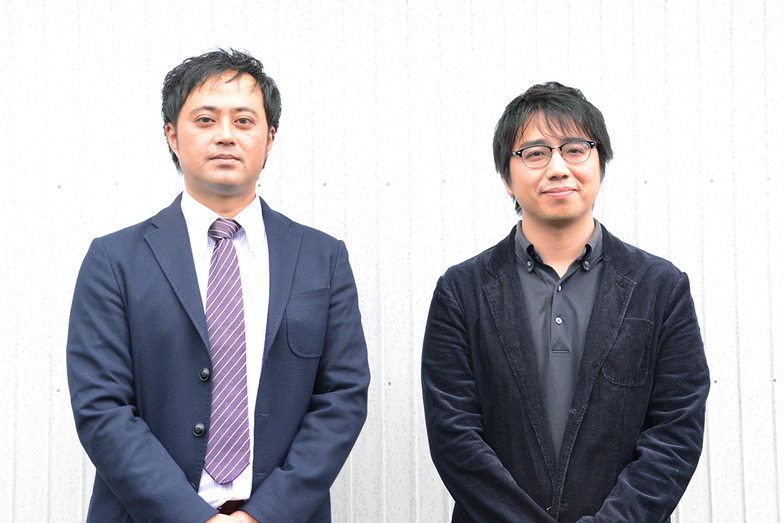
Shortly after, I was asked to contribute to the alumni newsletter of a local high school. After honestly sharing my thoughts, they finally seemed to trust me, leading to the request: "We're thinking of creating a PR video for the town next time. Would you be willing to supervise it?" With a limited budget, they planned to produce five videos annually. I suggested reducing it to four videos since the budget seemed insufficient. The first video was intended for entry into the National Relocation Navigator program hosted by the Ministry of Internal Affairs and Communications, specifically a "Relocation Promotion" video.
After much deliberation, I ultimately proposed taking on the project as company work rather than volunteering, considering factors like operational feasibility.
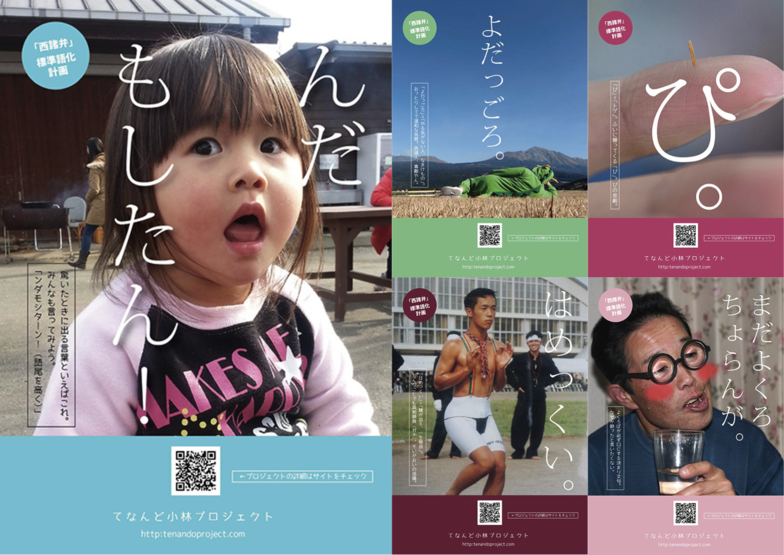
Shortly before this, I had noticed posters created by Kobayashi City Hall staff suddenly gaining attention online. I distinctly remember having an intuition at that moment: "I could probably do something with these people." (As mentioned previously, Kobayashi City's staff truly possessed exceptional internet literacy and motivation.)
The idea itself wasn't particularly novel
As those who watched the video may know, this clip went viral as " a video everyone watches twice," yet the idea itself was hardly novel.
Dialects, long said to resemble foreign languages, exist everywhere, starting with Tsugaru-ben. There are also plenty of commercials and comedy sketches based on this. My hometown, Kobayashi City, also had quite a unique linguistic character, likely due to its location, blending elements of Satsuma-ben with Miyazaki-ben.
While the truth of this is uncertain, one theory suggests the dialect evolved into deliberately complex intonations as a language for identifying outsiders within the region.
It's funny to think about now, but back in my student days, most friends who moved to the city told me they were constantly teased about their dialect sounding like French in all sorts of situations. Of course, I myself and the city hall staff were no exception to this experience. The hint for this idea actually comes from those bitter memories of youth (laugh).
Actually, the initial plan was to create an infographic featuring interesting statistics about Kobayashi City, but it just didn't fit budget-wise or time-wise. So we landed on the idea of overlaying numbers and relatable local quirks onto live-action footage. But we wanted one more twist. That's when we came up with the idea for a "misheard" video, playing on the fact that the Nishimoro dialect (spoken around Kobayashi City) sounds like French. The phrase "Mostly forest, yet 'small' forest city..." is a leftover from the original idea to express the green coverage with infographics.
This project didn't come together smoothly from the start. It was actually the result of considerable twists and turns before settling into its final form (some might call it a lack of planning).
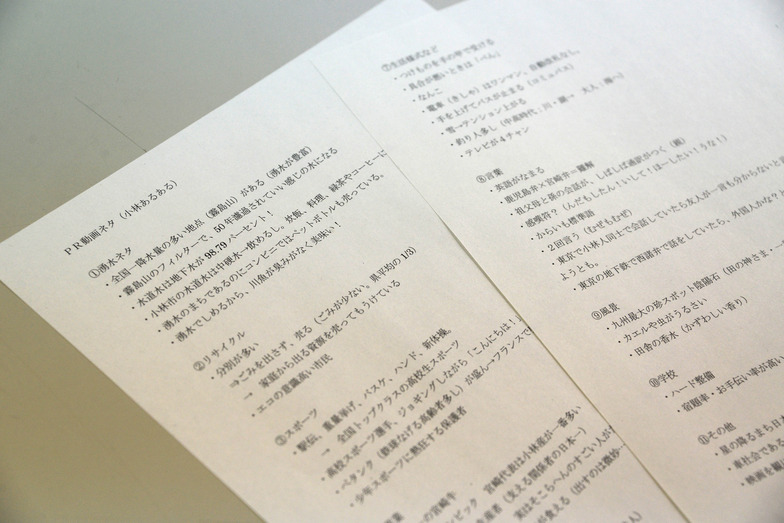
Then, I gathered various "local quirks" by interviewing city employees.
"Tractor traffic jams" and "Having a planetarium even though the stars are already beautiful" came from the unique perspective of locals. "Bottled water sold at convenience stores" stems from my experience buying bottled water sourced from Kobayashi City while attending university in Fukuoka. I remember being shocked: "We were using this water for baths just the other day, and now it costs 200 yen for this amount...!?"
Pure Hypothesis and Verification
Once we'd roughly settled on the ideas and material, I asked my junior colleague Murata-kun to write the storyboard. At the end, he'd added a small note: "It might be funny if we could display subtitles in the Nishimoro dialect." This was the key to our success (though how we displayed them was also crucial).
Next question: "Do they really sound so similar it could be a case of misheard lyrics?" To test this, we consulted a bilingual Japanese-French narrator well-versed in Japanese culture. We made the unreasonable request that they read the dialect in a French-like manner. However, this narrator was remarkably perceptive, and the feasibility shot up dramatically.
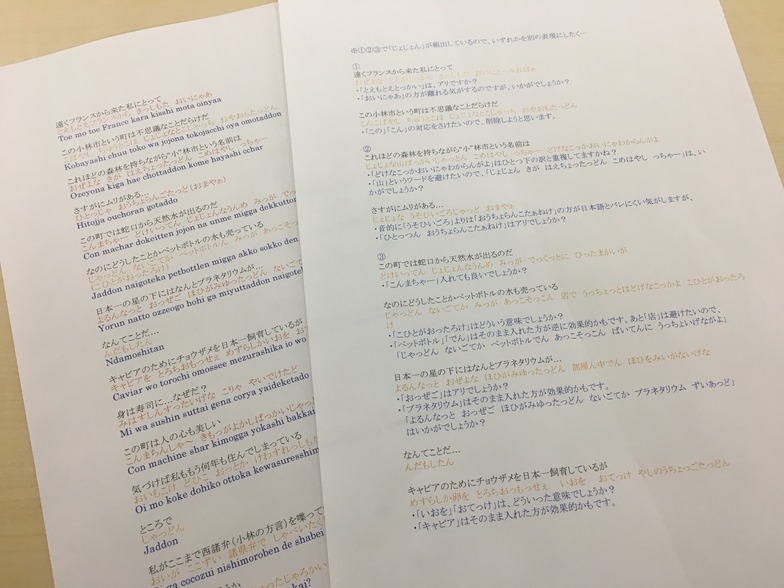
Initially, we envisioned a structure where the dialect would gradually become apparent. However, once we started the actual recording, we realized it wouldn't work that smoothly. So, we shifted direction: what if we kept listeners guessing about the dialect until the very end, only to deliver a major twist? In the recording studio, we connected via chat with city hall staff and had local friends present. We flexibly adjusted the dialect, focusing on word order and phrasing to further mislead listeners. We kept throwing impossible requests at the narrator, like, "Can you make 'Towa e mo' sound like 'Towa e mo'?" (We were dead serious). After six hours of recording, we ended up with an amazing narration.
We debated extensively about subtitles. By making them the main focus rather than an afterthought, we created "misheard content with an answer key." We believed this would make it easier for media to cover and increase the reassurance when people share it with others. When sharing content, having convincing evidence or backing is crucial. If we could prove "This really is a dialect!", viewers wouldn't think "I didn't get it" or "Give me my time back!", making it easier to recommend. 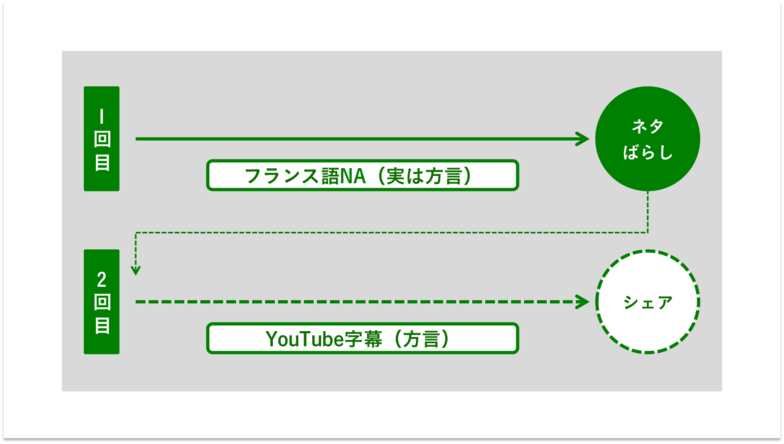
The ability to check answers a second time increases sharing potential
After this edit, we obtained permission from the city office and had dozens of acquaintances watch the video to get their honest feedback. The two most common issues were: "I noticed the betrayal but wasn't very surprised" and "I didn't even notice the subtitle cues in the first place."
Therefore, we made two rounds of edits, meticulously refining elements like the subtitle cues.
Choosing "French" as the YouTube subtitle language was also to make the selection feel as natural as possible.
Incidentally, the final line, "This is a nice place to live, isn't it?", isn't actually positioned as the catchphrase. It's the very first "Nishimuro dialect subtitle" viewers encounter. Right after the reveal that "we've been speaking Nishimoro dialect this whole time," the narration in dialect suddenly gets subtitles in the dialect itself, not standard Japanese. We thought this would make it more likely viewers would notice the twist on their first watch, like a final confirmation. That's why we selected words like "jōjon" and "~miyan" – sounds that really do seem like they could be French.

Reverse-engineering output from a societal perspective
Working in web for a long time means that with most low-budget projects, reach isn't guaranteed. This often forces you to figure out "how can we get more people to come see this?" You don't aim for virality as an end goal; you have to choose virality as a means. Regarding the aforementioned subtitle idea, we thoroughly simulated how viewers would feel and what actions they might take, thinking from a societal perspective.
The concept itself was relatively ordinary, but when you create output while consciously adopting a societal perspective, you realize "opportunities" to elevate execution quality are hidden everywhere. If we had been satisfied just by conceiving the "dialect mishearing project" without deeply imagining the viewers or media, it wouldn't have become something that garnered this much attention.
We also decided to completely stop promoting to overseas media, which has become mainstream lately. We were concerned that simply adding one more English subtitle option would cause confusion in the user flow and significantly reduce the number of viewers who would turn on French subtitles (English subtitles are now also implemented).
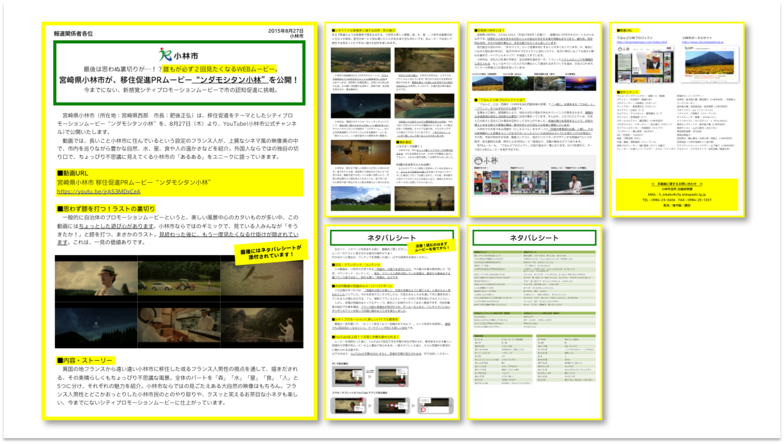
"Ndamoshitan Kobayashi" Release
And above all, I believe placing the lead copy "Everyone watches it twice" at the forefront of the release was another key to its success. While web videos allow viewers to control the seek bar and watch multiple times, they also make it easy to abandon the video. By hyping it up in the lead, viewers are more likely to stick with it at least until the end.
Furthermore, content that follows the "the answer was right in front of me all along" pattern, common in movies too, almost always makes viewers want to watch it again from the beginning.
Furthermore, if a single viewer can watch it multiple times, it allows for rapid accumulation of views, making it easier for media outlets to feature it as a popular video (even if consecutive views aren't counted by the platform's specifications).
What I Want to Convey Through This Work's Background
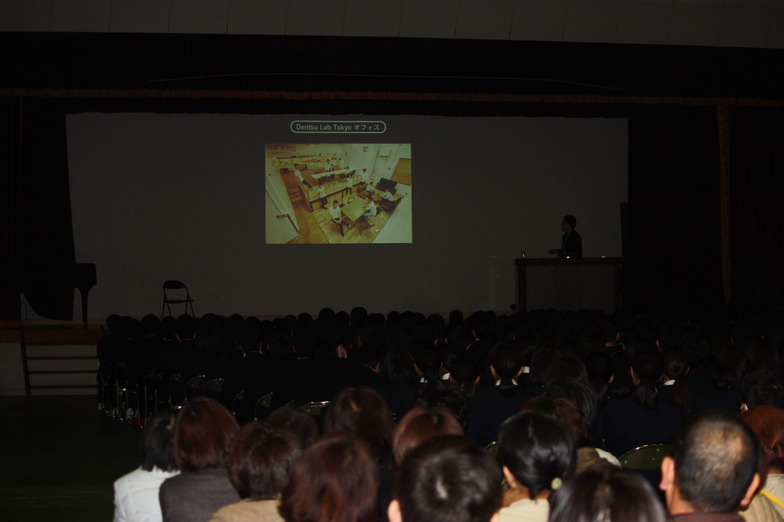
Thanks to the success of "Ndamoshitan Kobayashi," I managed to save face and finally got my wish: in February 2016, I was invited to give a lecture at my alma mater, Miyazaki Prefectural Kobayashi High School. The theme was "Adults and Work (and a Little Bit About Dreams)."
I'm a bit uncertain how many students it actually prompted to think about their future, but I'll take comfort in the fact that they seemed to enjoy listening.
Why did I go into such detail about the background of this case? Because this work reaffirmed my belief that regional revitalization is simply impossible without "passion" and "love for one's hometown." In most cases, it involves tackling challenges with significant hurdles in terms of budget, distance, and time (though I'm sure there are many exceptions). And sometimes, the spark comes from a single suspicious phone call.
In my case, it started with a friend's comment at the beginning, which made me think, "I want to do something for the local high school students..." That passion undeniably stemmed from my own, perhaps self-serving, love for my hometown.
While I'm delighted to see more talented planners taking on projects for small municipalities, I also hope we move beyond one-off fireworks and see more sustained, long-term involvement in promoting these towns become the norm.
I especially love Ono City, Fukui Prefecture's "Come Back to Ono" initiative. Instead of a one-off event, they've involved local staff in the team and are undertaking a sustained effort over several years – I think it's ideal. It's also wonderful that they've completely shifted their communication target to the inner circle. Kobayashi City also values the inner circle perspective.

[Official Site] http://www.return-to-ono.jp/
【Related Article "Come Back to Ono ~ Regional Revitalization in a Certain Basin~"】http://dentsu-ho.com/articles/3864
Local knowledge and community spirit, understood precisely because one is from the area, offer abundant material effective for regional revitalization.
For example, in my case, memories of being teased about my dialect or how the local water was sold for a fee. Hints that strongly capture people's interest might be hidden within experiences only those who've spent a long time locally can understand.
Next time, I'll talk about how to work with local governments!
Was this article helpful?
Share this article


Newsletter registration is here
We select and publish important news every day
For inquiries about this article
Author

Kazuhito Ochi
Dentsu Inc.
Dentsu Lab Tokyo
Creative Director
Video-Based Regional Revitalization for the FutureViral Videos and Regional RevitalizationDentsu Lab Tokyo × Dentsu Craft Tokyo The Delicious Relationship Between Technology and IdeasWeb Dentsu Inc. × WASEDA NEO — Hope Lies Beyond Learning —Hitachi, Ltd. × Dentsu Inc. × Dentsu Digital Inc.: Tackling Social Issues with Generative AI!