Note: This website was automatically translated, so some terms or nuances may not be completely accurate.
 Media Behavior Data × Social Sequence Analysis [5/5]
Outlook for the Media Lifestyle Project
This concludes our introduction to the Media Lifestyle Research Project undertaken by Dentsu Inc. Media Innovation Lab in collaboration with Video Research Ltd. Hito Research Institute.
The background to this research was the difficulty in comprehensively mapping the overall landscape of how people engage with media, due to the diversification of lifestyles and the proliferation of digital media in recent years.
Therefore, we set as the project's objective to clearly outline the contours of the various media lifestyles currently existing in society and to accurately grasp the proportion each style represents within the population.
As mentioned in the first installment, we analyzed behavioral data from 4,971 individuals across 672 time points (7 days of the week × 15-minute intervals) collected through Video Research Ltd.'s "MCR/ex" lifestyle and media behavior survey. This analysis employed a methodology called "Social Sequence Analysis."
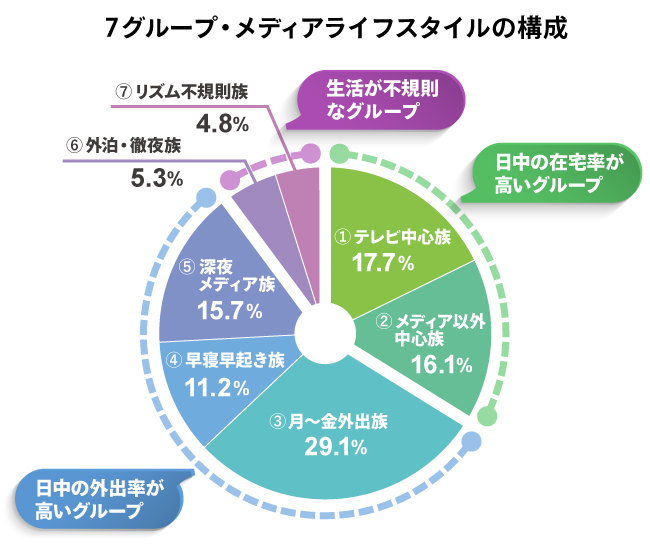
This analysis yielded seven distinct groups and 30 media lifestyles.
Factors Determining Media Lifestyle Segmentation
Let's review the classification results of the 7 groups and 30 media lifestyles.
The most influential factor determining the division into each style was the basic daily rhythm, such as waking up, going out, returning home, and going to bed. Broadly speaking, the seven groups identified this time could also be divided into three basic patterns based on the amount of time spent at home and daily rhythm.
For details, please see the following article.
● Group with high daytime at-home rate
● Group with high daytime outings
● Irregular lifestyle group
The next most influential factor was when and what types of media were accessed within each lifestyle pattern. This revealed further divisions into distinct "media lifestyles."
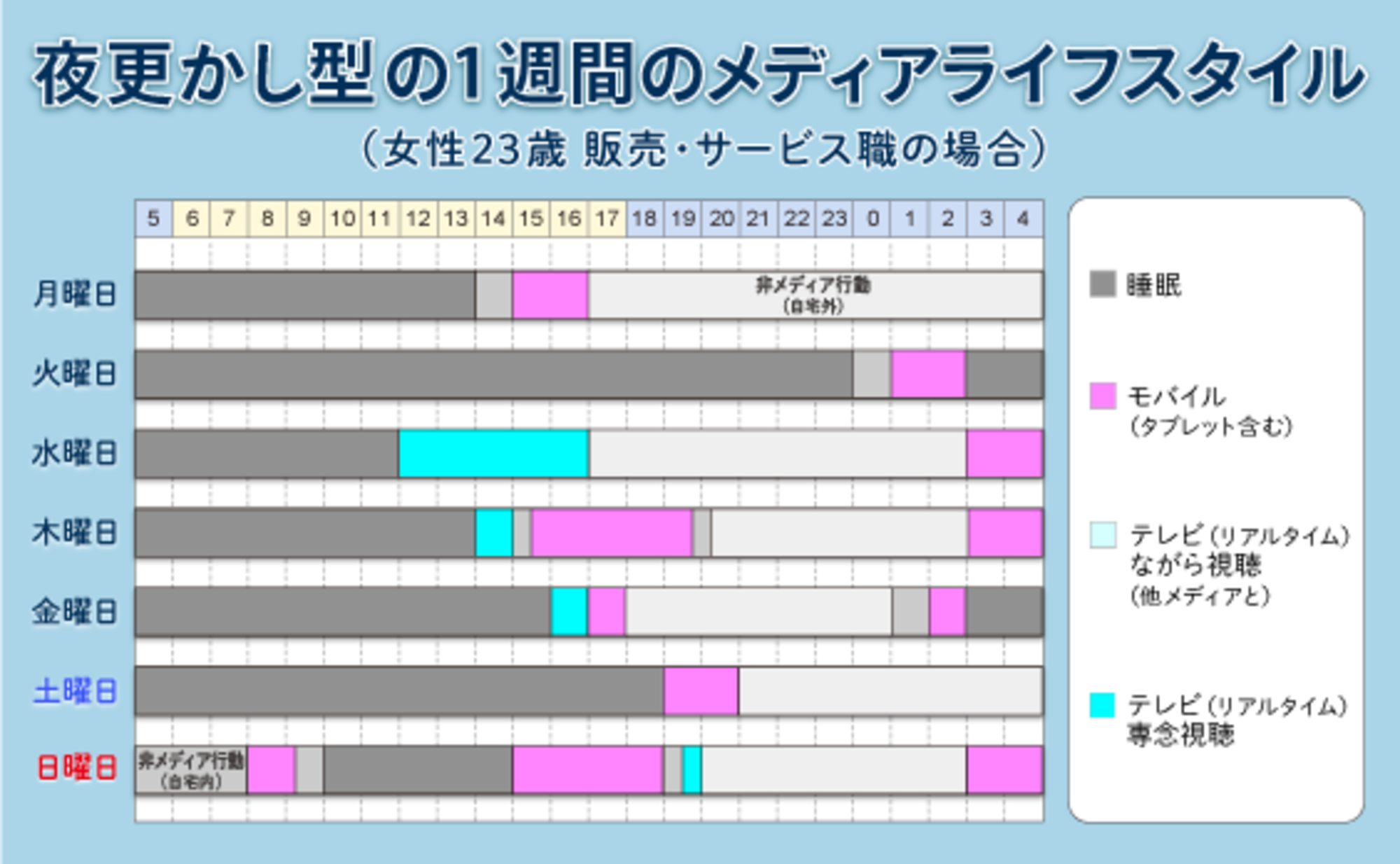
Even with similar daily rhythms—waking, going out, returning home, and sleeping at similar times—different combinations of media contact resulted in distinct media lifestyles. We classified these into 30 distinct media lifestyles.
The Role of Each Media Embedded in Daily Rhythms
This time, we conducted a comprehensive statistical analysis of data concerning daily life and media. This is because people's media behaviors are thought to function in a relationship that is inseparable from their daily rhythms.
Based on this idea, analyzing daily activities and media behavior simultaneously makes it easier to understand the roles each medium plays within various lifestyles and why specific media contacts increase in certain styles.
For example, the following points were particularly interesting in this analysis:
● The Two Roles of Time-Shifted TV Viewing
In lifestyles with more time spent at home and thus more real-time TV viewing, it was evident that time-shifted viewing was used to watch more TV programs.
Conversely, another style emerged where individuals, too busy on weekdays to secure real-time TV viewing time, prioritized time-shifted viewing after returning home or during daytime on weekends and holidays to fulfill leisure needs.
● The Penetration Power of TV and Online Video into Post-Work Relaxation Time
Within typical salaryman lifestyles, real-time TV viewing in the evening after returning home remains deeply ingrained.
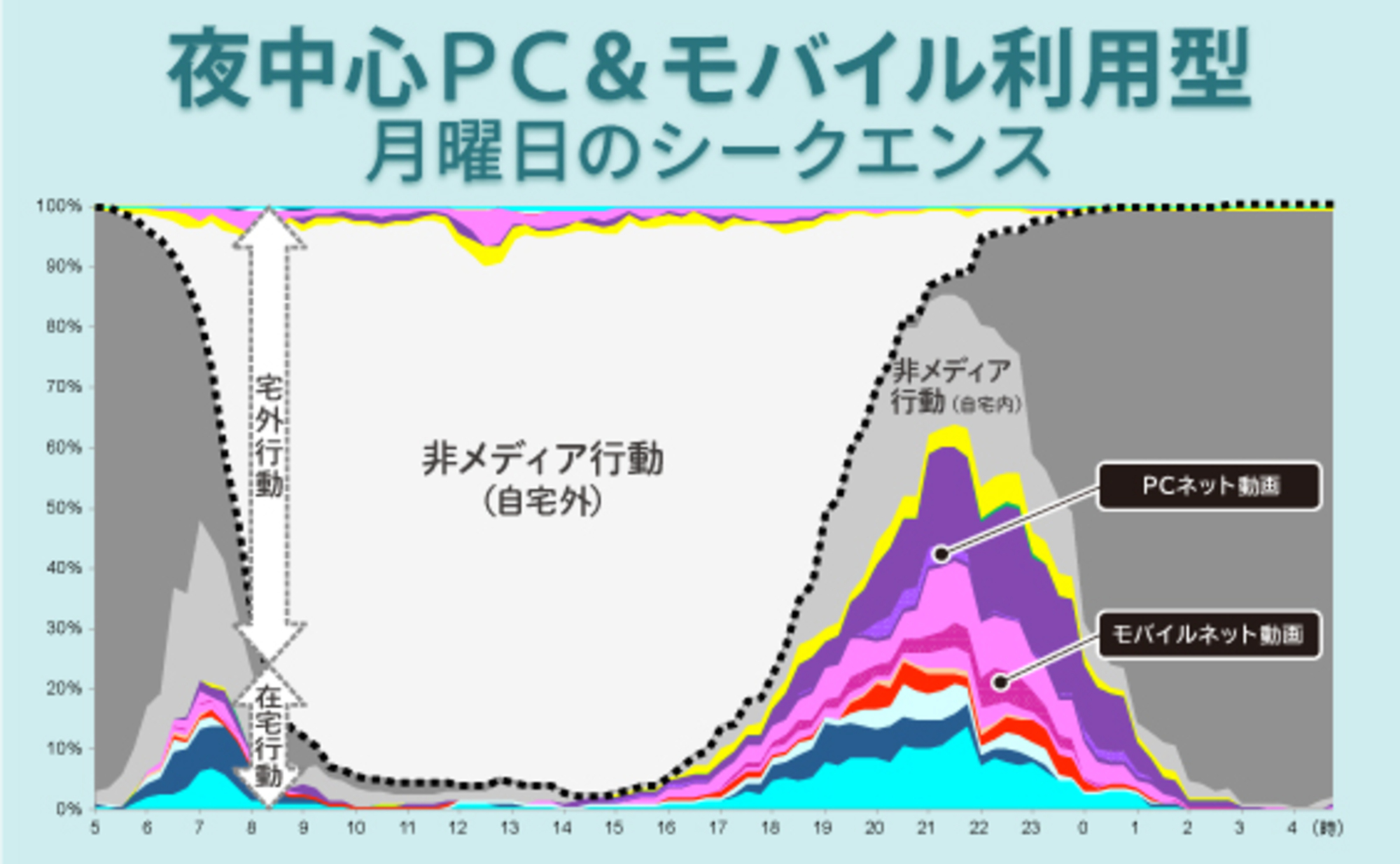
Conversely, a new style has emerged where people watch online videos during relaxation time (particularly notable is the high penetration of mobile video viewing just before bedtime). Online video viewing isn't solely driven by "mobile use while out"; it's actually more likely to occur during the more leisurely time after returning home, sharing a common role with television.
●The Significant Role of Mobile Devices Among Those with Irregular (Non-Typical) Lifestyles
Among groups with irregular lifestyles, a particular style of mobile usage has become especially prevalent, driven by a need for communication spaces unconstrained by location—whether at home or out and about.
Furthermore, while media consumption behaviors are fundamentally intertwined with and embedded in basic life rhythms, we also observed cases where media contact itself plays a crucial role in providing rhythm to life or shaping rhythms. Examples include the mobile usage seen in the final case and real-time TV viewing.
Moving Beyond "Dry" Analysis to Depict the True Nature of Human-Time Interactions
By simultaneously analyzing 15-minute behavioral data combining daily life and media contact, we expressed media lifestyles that felt genuinely relatable, evoking thoughts like "This is exactly the kind of person who exists."
Through "dry" statistical processing of the data, the human reality of how time is spent throughout a day or week emerged in its entirety.
This achievement was made possible by combining the three-dimensional information structure of Video Research Ltd.'s MCR/ex—time slot × location × activity—with the exceptional capability of Social Sequence Analysis to aggregate data without disrupting the sequence of each individual's actions.
Prospects for Social Sequence Analysis
Social Sequence Analysis is a versatile method applicable to any data with temporal or spatial sequencing, suggesting broad potential applications.
For example, it may be possible to analyze media lifestyles based not only on diary-style survey data like the one used here, but also on usage and viewing log data from devices such as TVs, PCs, and mobile phones.
Furthermore, for retailers operating numerous chain stores, it could be used to analyze sales differences when varying product display patterns by store, or to analyze sales differences based on individual customer navigation patterns within the store. Naturally, similar analyses might also be possible using online navigation behavior data.
Moving forward, our joint team aims to further evolve and advance media lifestyle research. Building on these initial findings, we plan to visualize how media lifestyles have changed over multiple years by analyzing survey data from the same region (Tokyo in this case). We also intend to undertake projects focusing on more detailed behavioral data of particular interest, such as video viewing across various devices, including television.
We hope you will continue to follow our future findings.
Was this article helpful?
Share this article


Newsletter registration is here
We select and publish important news every day
For inquiries about this article
Back Numbers
Author

Akira Miwa
Dentsu Inc.
Dentsu Inc. Media Innovation Lab
Director of Media Innovation Research
Insight MemoSmartphones and the JapaneseShiodome Media Researcher CommentaryThe Future of Visual Communication with Dominique ChenThe Future of Video ServicesSmartphones: A Decade of Creative DestructionMedia Behavior Data × Social Sequence AnalysisThe 30 Years of the Heisei Era: The Transformation and Innovation of Information MediaThe Reiwa "New" Era! Where is the Media Society Headed?