Note: This website was automatically translated, so some terms or nuances may not be completely accurate.
 Dentsu Inc. B Team's Alternative Approach [6/10]
When brainstorming hits a wall, flip the "fundamental premise"!
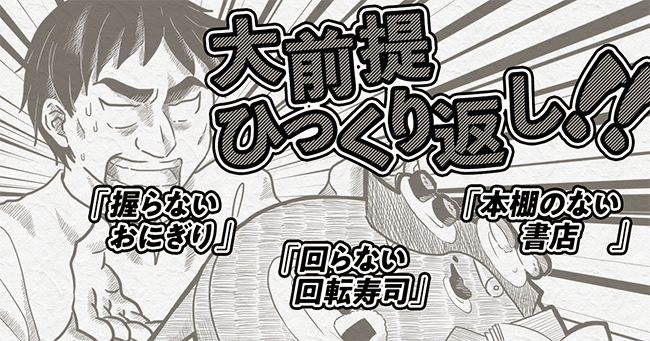
Onigiri that aren't hand-formed. Sushi that doesn't rotate on a conveyor belt. Bookstores without bookshelves. Do you know what these are?
Yes, each is a hit product born by overturning the fundamental assumptions of its category.
Hello, I'm Eita Nakajima from Dentsu Inc. B Team. The B Team explores unconventional "B-side" approaches to solve diverse challenges faced by companies and others.
This time, I'll introduce a creative thinking method for generating new ideas: "Flipping the Fundamental Premise."
Turning the "fundamental premise" of things upside down creates new things and value
At Team B, we routinely collect interesting examples from around the world.
Three years ago, I learned about the "Ultra-Slow Snow Turtle" train operated by Hokuetsu Express in Niigata Prefecture. It's an "ultra-slow train" that deliberately takes about 4 hours to cover a distance that normally takes only about 1 hour (hence the name "Turtle").
This Snow Turtle became a huge hit among railway fans, with people saying, "You can fully enjoy the scenery!" and "You can really observe the structures of tunnels and bridges!" I found it fascinating how it flipped the railway's fundamental premise—that trains exist to get you to your destination as quickly as possible.
So, I started looking for other examples of this kind of "upside-down thinking."

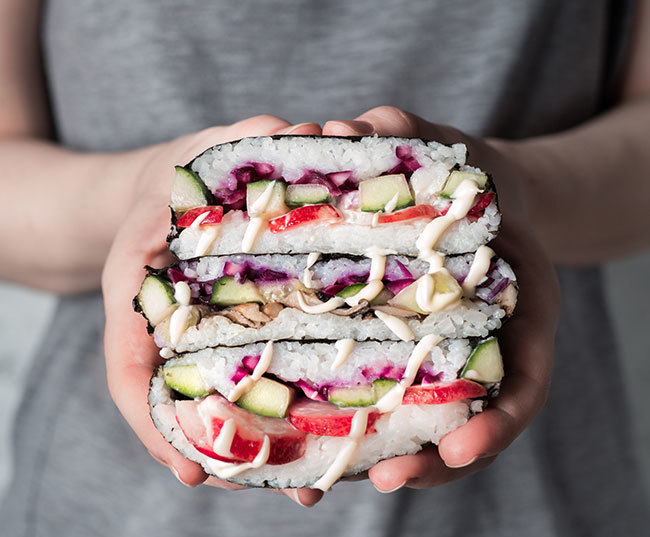
・The "Onigirazu" (no-grip rice ball)
Since you don't need to grip it, your hands stay clean and there's no risk of burns. Plus, it allows for toppings not possible with traditional rice balls, creating unique benefits that led to a huge hit and numerous recipe books.
・Silent Disco: Music without sound on the floor
It overturned the fundamental premise of discos: "dancing to loud music." Its appeal lies in the ability to hold events anywhere, as guests wear headphones in a silent space and dance together while sharing the same song.

Other examples include "non-rotating conveyor belt sushi," where sushi ordered via touch panel arrives directly to customers via a straight lane, and "bookstores without shelves," which sell only one book at a time.
We, Team B, named this technique of creating new things and new value by overturning the "fundamental premise" of objects or experiences the "Overturn Technique." I believe this technique is the simplest idea generation method, even elementary school students can do it.
The difficulty of flipping and the impact are proportional
The Flip Technique has a trick: the harder the flip, the stronger the impact when you pull it off successfully. Take a look at the diagram below.
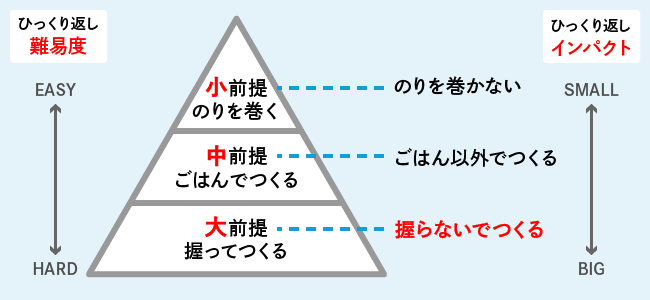
For example, rice balls have "premises" like "wrapping them in nori," "making them with rice," and "forming them by hand."
If you flip the "wrap with nori" premise, the impact is limited because salted rice balls without nori already exist. This is essentially a "minor premise."
Next, the premise of "making it with rice" requires considering alternative ingredients, slightly increasing the difficulty of the reversal. However, if an idea like "making it with beans or tofu instead of rice" emerges, it could create value by cutting carbs for a healthier option. This would be the "intermediate premise" for rice balls.
Then, if you boldly flip the most difficult "major premise" – "made by shaping" – you can create something with significant impact, like "onigirazu."
Identifying various premises is a logical process, but coming up with which ones to flip and how requires inspiration and right-brain creativity. Starting with logical left-brain thinking and ending with a right-brain leap creates new value.
At the workshop, we flipped the "haunted house" concept!
Team B held a "Flip Technique" seminar at Roppongi Academy Hills in December 2018. Our special guest was Hiroki Terai, a master of flip techniques behind concepts like "divorce ceremonies" and "crying activities." The workshop theme was "haunted houses."
Participants played the "Big Premise Game," rapidly listing the "core assumptions of a haunted house" using the same approach as the Yamanote Line Game, generating entirely new haunted house ideas.
1. Using the Yamanote Line Game method, everyone brainstormed foundational elements for a "haunted house"
Everyone clapped along while taking turns quickly suggesting "haunted house premises" in rhythm.
[Haunted House Premises]
・Ghosts appear
・Scary
・Couples often go
・Dark
・Startling...
2.Flip the premise and dig deeper by expanding
We collectively examined all the assumptions that emerged and picked out those that seemed like they could lead to interesting ideas if flipped. The key point is that once you flip an assumption, you then expand on it to deepen the idea.
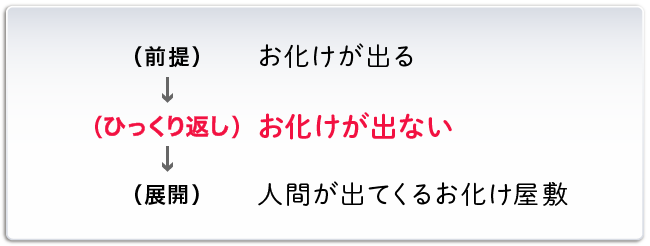
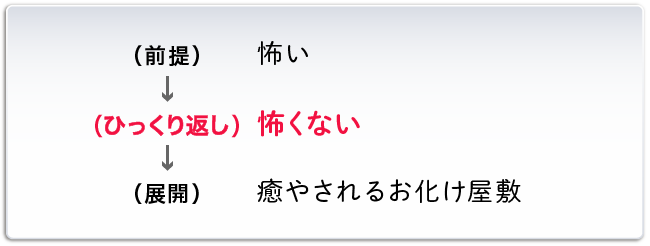
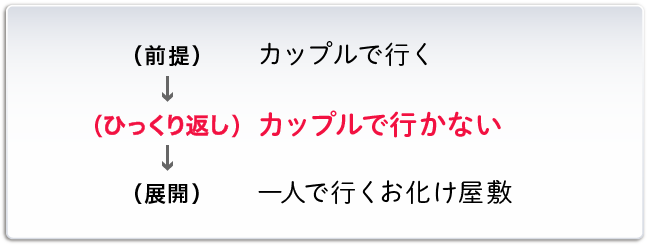
Ultimately, participants presented ideas like the following "haunted house with overturned core assumptions":
■ "Ghost Island"
Revamping the image of a run-down, closed-off haunted house. Turn an entire luxury resort on a deserted island into a haunted house. Enjoy beautiful scenery, delicious food, and relaxation. Wait, where are the ghosts...? While you're relaxing, ghosts suddenly appear.
■ "The Human House More Terrifying Than Ghosts"
This haunted house flips the premise of "a place to experience the fear of ghosts," instead letting you experience the fear of humans. Inside the mansion, there are many exhibits based on terrifying true stories of relationships. There's also a "trap where only one of two people can survive," letting you make your partner experience the horror of human nature. Couples thinking of breaking up are especially encouraged to visit.
■"The Haunted House Without Ghosts"
You'd expect ghosts in a haunted house, but this one uses wind and sound to build terror while nothing ever actually appears. The highlight is the monitor at the exit. Cameras continuously film visitors inside. The surreal attraction sells the terrifying footage of your own frightened faces, thinking "Something's going to come out..."
■ "Ghost Consultation House"
This attraction flips the premise that "ghosts are scary," letting you experience the warmth of ghosts. Positioned as a refuge for weary office workers, various ghosts offer life counseling tailored to your worries. By the time you leave the house, your troubles are resolved.
Many other innovative ideas emerged during the workshop. Team B hopes to continue refining this approach to brainstorming.
This "turning things upside down" approach is also a standard technique for generating advertising ideas. Finally, one anecdote.
About ten years ago, TV commercials were starting to adopt the standard phrase "Search for [product name]" to drive viewers to websites. When tasked with planning a commercial for a new magazine, I deliberately used "Please do not search for [product name]" as the hook.
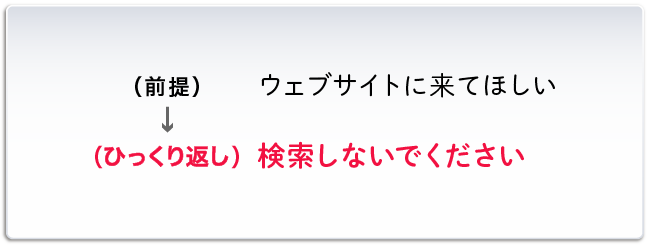
"Please search" is the typical approach because you want people to visit the website. That alone makes getting actual searches difficult. But by deliberately flipping it to "Please don't search," we successfully piqued viewers' interest and got many to search.
This "flip technique" is highly recommended when ideas feel stuck. By overturning assumptions with the force of overturning a table, you can generate impactful ideas you never imagined.
For more tips... contact Team B!
Dentsu Inc. B Team
https://bbbbb.team/
Was this article helpful?
Share this article


Newsletter registration is here
We select and publish important news every day
For inquiries about this article
Back Numbers
Author
Eita Nakajima
Dentsu Inc.
Business Development & Activation Division
Creative Director