Note: This website was automatically translated, so some terms or nuances may not be completely accurate.
 AI MIRAI's Vision for the Near Future of AI and Work [6/8]
Introducing Dentsu Inc. AI MIRAI's Activities! A Non-Engineer's Report on the AI Society
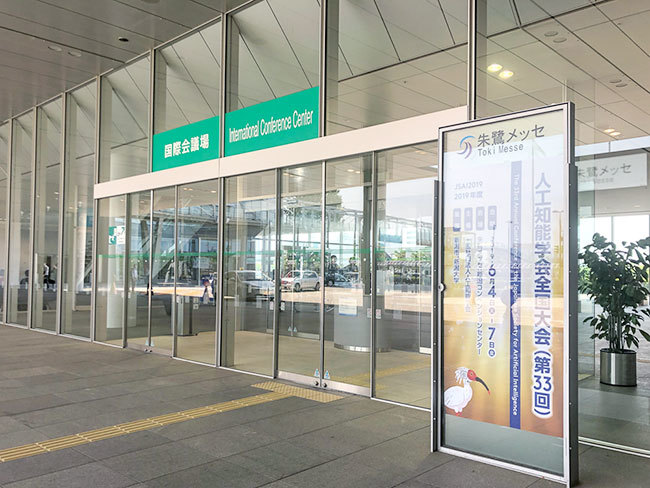
The 33rd Annual Conference of the Japanese Society for Artificial Intelligence (JSAI2019) was held in Niigata City from June 4 to 7, 2019. As a sponsor for the second time, Dentsu Inc. exhibited at a booth again this year, introducing the activities of its AI MIRAI project.
The Japanese Society for Artificial Intelligence is one of Japan's largest academic societies in the AI field. This year's attendance approached a record-high 3,000 participants, filling the venue with an electric atmosphere. Pre-registration reportedly closed early due to overwhelming demand.
With over 800 papers presented and a record 90 sponsors, the four days offered a tangible sense of the ongoing AI boom. Haruka Watanabe, participating in AI MIRAI for the first time, reports on Dentsu Inc.'s initiatives and the conference atmosphere.
Introducing Dentsu Inc.'s Approach to AI Utilization
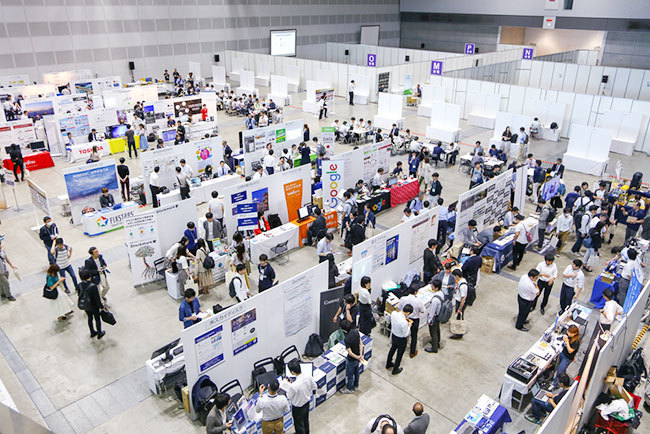
Following its participation in 2018, Dentsu Inc. returned as a Platinum Sponsor, exhibiting at a booth and presenting in an Industrial Session and Luncheon Seminar. This year also marked Dentsu Inc.'s first paper presentation (the Dentsu Group presented a total of four papers).
Working alongside members from Dentsu Digital Inc., Dentsu International Information Services, and Data Artist—all part of the Dentsu Group—we exchanged information, striving to enhance our group's presence and gather insights.
The booth featured an exhibit designed for everyone to enjoy: the "Second Business Card Maker." Based on your name (nicknames welcome) and hobbies/skills, AICO—Dentsu Inc.'s AI copywriter—generates eight new job titles, with instant business card printing available. The color on the back of the card is determined by facial expressions like "happiness" or "surprise," recognized by a camera.
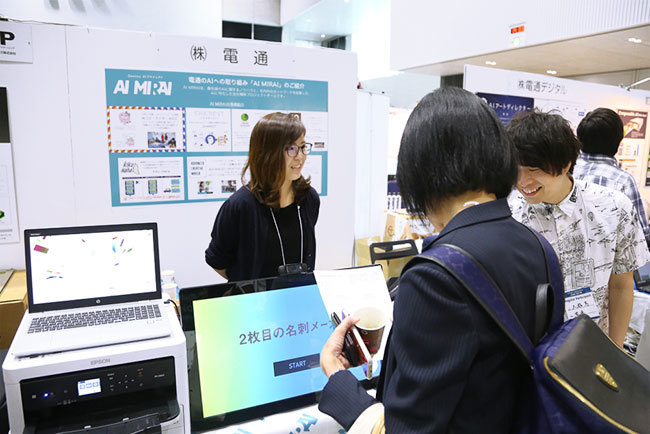
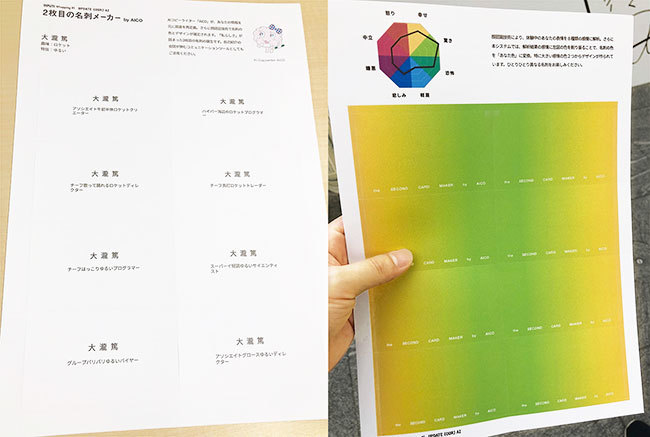
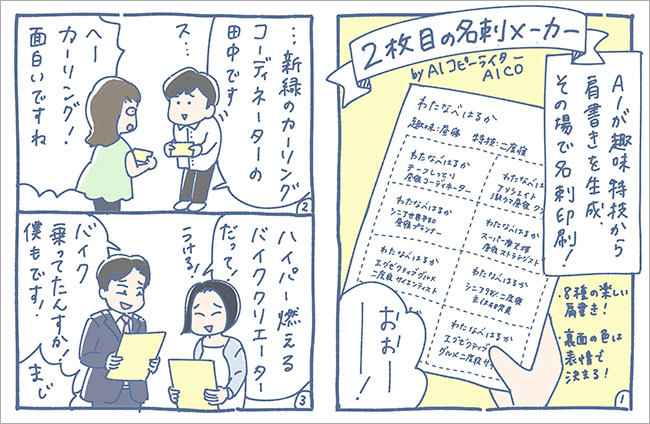
"Wow, you have this hobby?!" "This job title is hilarious!" – such reactions fostered communication among visitors at the booth. The exhibit offered a tangible experience of Dentsu Inc.'s distinctive approach to AI utilization.
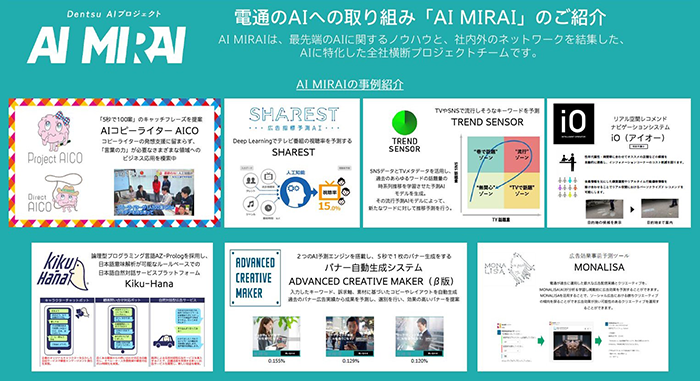
The Industrial Session focused on updates since last year, providing concrete details about Dentsu Inc.'s AI initiatives.
・AICO: An AI copywriter that generates advertising copy
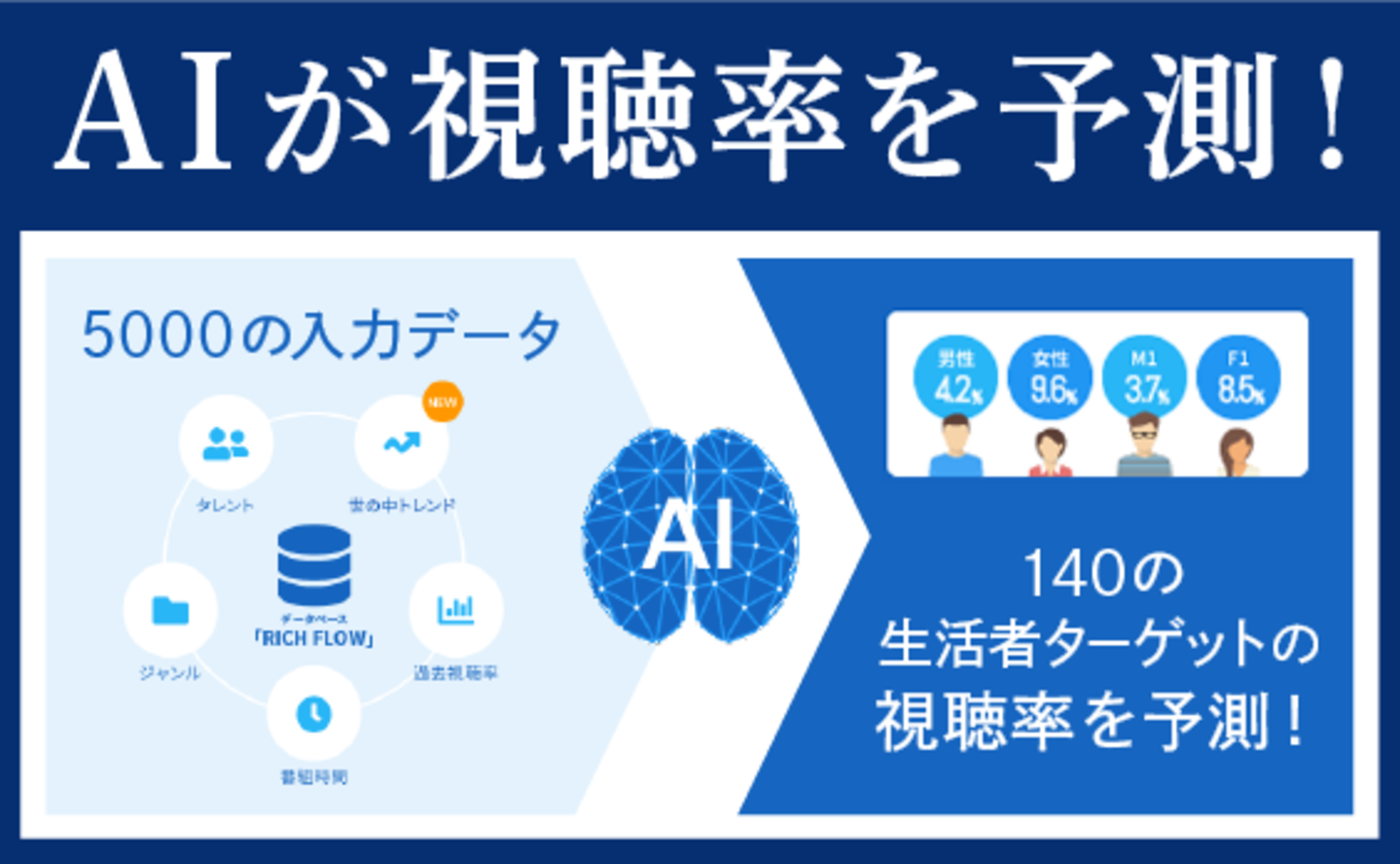
・SHAREST, an AI that predicts TV ratings
・TREND SENSOR, which predicts keywords likely to trend on TV and social media
・iO, a projection-based navigation system that guides users to destinations based on image recognition
・Kiku-Hana, a chatbot that automates and enhances corporate customer service
・ADVANCED CREATIVE MAKER: An automated banner generation & click-through rate prediction system
・MONALISA: Predicts the effectiveness of image and video web ads in advance
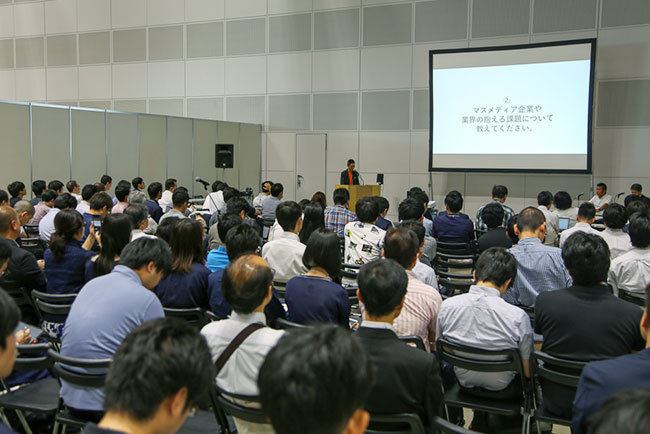
The luncheon seminar featured a talk session on the theme "The Future of Mass Media × AI" with Mr. Atsuto Ishida from TV Tokyo, Mr. Yasutaka Taniguchi from Nikkei Inc., and Mr. Takuya Kodama, Representative of Dentsu Inc. AI MIRAI.
TV Tokyo has been working on metadata conversion for over 50 years of broadcast content, while Nikkei Inc. is digitizing images of newspaper pages published over the past 100 years (using AI) and streamlining editorial proofreading work. The central topic was how to leverage the treasure trove of "non-structured data" held by mass media.
Over 100 participants attended this well-attended event, drawn by the unique perspective of "mass media" – an angle rarely seen in other research or events.
Additionally, Hiroyuki Fukuda of Dentsu Inc.'s Data & Technology Center presented a paper titled "Ad Copy Generation Using Variational Autoencoders with Keyword Conditions." He proposed a method to automatically generate ad copy that is more varied than before and better aligned with advertising objectives. Those interested are encouraged to read the paper.
Six Things I Learned as a Non-Engineer Attending
As a non-engineer attending the Japanese Society for Artificial Intelligence conference for the first time, the following six points stood out to me:
1. The Broadening Use of AI Across Industries
The AI Society covers every field of artificial intelligence. Sessions, where several papers from the same field are presented together, totaled 180 over four days. In addition to technology-focused sessions, there were numerous sessions organized by industry, such as "Agriculture," "Healthcare," and "Education," highlighting the expanding scope of AI application.
Even as a non-engineer, I could comprehensively learn about the latest research and technologies in topics that interested me. Simply glancing at the program allowed me to grasp the current trends in AI.
2. Notable Advancements in Business Applications
Compared to other specialized conferences, corporate participation and joint research between academia and industry were particularly noticeable. According to other attendees, corporate involvement has become even more active compared to last year.
3. Businesses promoting "AI democratization" are increasing
With a record number of sponsors, the corporate exhibition area was bustling. What stood out was the emergence of companies not just showcasing their own AI technologies for customer acquisition or R&D, but also those creating "platforms enabling general users to easily perform machine learning" and offering "courses to learn AI and machine learning." Amidst the call for "AI democratization," I sensed diversification and generalization of businesses in peripheral areas.
4. Discussions on AI reliability and ethics were also active
It was also notable to see numerous sessions and papers focused on AI reliability and ethics. As AI applications expand into fields touching human life and rights—such as healthcare, automotive, and politics—the development of rules based on "human-centered AI societal principles" is rapidly advancing globally. Here at the Japanese Society for Artificial Intelligence, I sensed heightened interest in the role of AI within society.
5. Efforts to Enhance International Presence
A new initiative this year was the introduction of an international session (where domestic papers were presented in English). This was aimed at enhancing the presence of Japanese AI research against the backdrop of major advances in the US and China. Eighty papers were presented, and the venue was bustling.
6. Role as a Platform for Industry-Academia Collaboration Among Researchers, Students, and Companies
Beyond the official networking event, various social gatherings of all sizes were held throughout Niigata City, creating opportunities for exchange beyond the boundaries of research and industry. One professor remarked, "Even within academia, cross-disciplinary exchange remains limited. It would be great to see more such opportunities." This comment was particularly memorable. The connections made in Niigata seem likely to foster increased collaborative research and development going forward.
In each case, it became clear that AI adoption is not merely riding a trend, but its substance and quality are gradually evolving.
Collaboration between academia and industry is essential for AI development
Personally, I was particularly intrigued by the field of creation × AI in this presentation. One session revealed ongoing research at every stage—from story creation to illustration—including AI-powered creative support systems, emotional identification of manga dialogue, four-panel manga analysis, and automation of tone application, all aimed at engineering an understanding of "the human process of making things."
Presentations from anime producers and manga artists provided field perspectives, which I found extremely fascinating as a manga and creative enthusiast.
Even at Dentsu Inc., which has focused on marketing communications like commercials that move people's hearts, there may be hints and opportunities for collaboration.
This time, Dentsu Inc. created various presentation opportunities, and subsequently received numerous inquiries, making it a fruitful conference participation. The national conference itself is increasingly leaning toward a more business-oriented aspect, becoming a venue for matching academia and industry, and differentiation from specialized academic conferences is progressing. We intend to continue monitoring it alongside specialized academic conferences.
Furthermore, the advancement of AI requires not only "algorithms" but also "large volumes of high-quality data." Alongside algorithm development, appropriate collaboration with private companies possessing real-world data will become increasingly crucial. Dentsu Inc. aims to engage in AI business, leveraging its ideas and driving force—sometimes as a data-holding player, and sometimes as an organizer connecting user companies with academic research.
AI MIRAI Official Website: https://aimirai.ai
Was this article helpful?
Share this article


Newsletter registration is here
We select and publish important news every day
For inquiries about this article
Back Numbers
Author

Haruka Watanabe
Dentsu Inc.
Creative & Knowledge Promotion Center
Producer